

You keep circling the exact same question at 2 a.m., night after night: fight for this, or finally let it go? Both options feel completely true on different days, which makes the decision far harder than either one alone. Reconciliation and release are opposite paths, but they start from the same honest inventory, and skipping that step is how people end up stuck in the wrong one for years. Here’s how to actually tell which one your situation calls for.
Why This Question Trips Up So Many People
Emotions and evidence often point in different directions. You might still feel deep love for someone while the actual pattern of the relationship shows nothing changing. Hope and honesty can pull against each other for months, sometimes years, without either one winning cleanly. Friends and family often make it worse, offering confident advice based on a fraction of what you actually know about the relationship.
Grief adds another layer. Even a relationship that clearly needs to end still triggers real loss, and that loss can masquerade as doubt. Feeling sad about letting go doesn’t automatically mean release is the wrong choice. Sadness is simply what loss feels like, whether or not the ending was the right call.
Signs You Need Reconciliation, Not Release
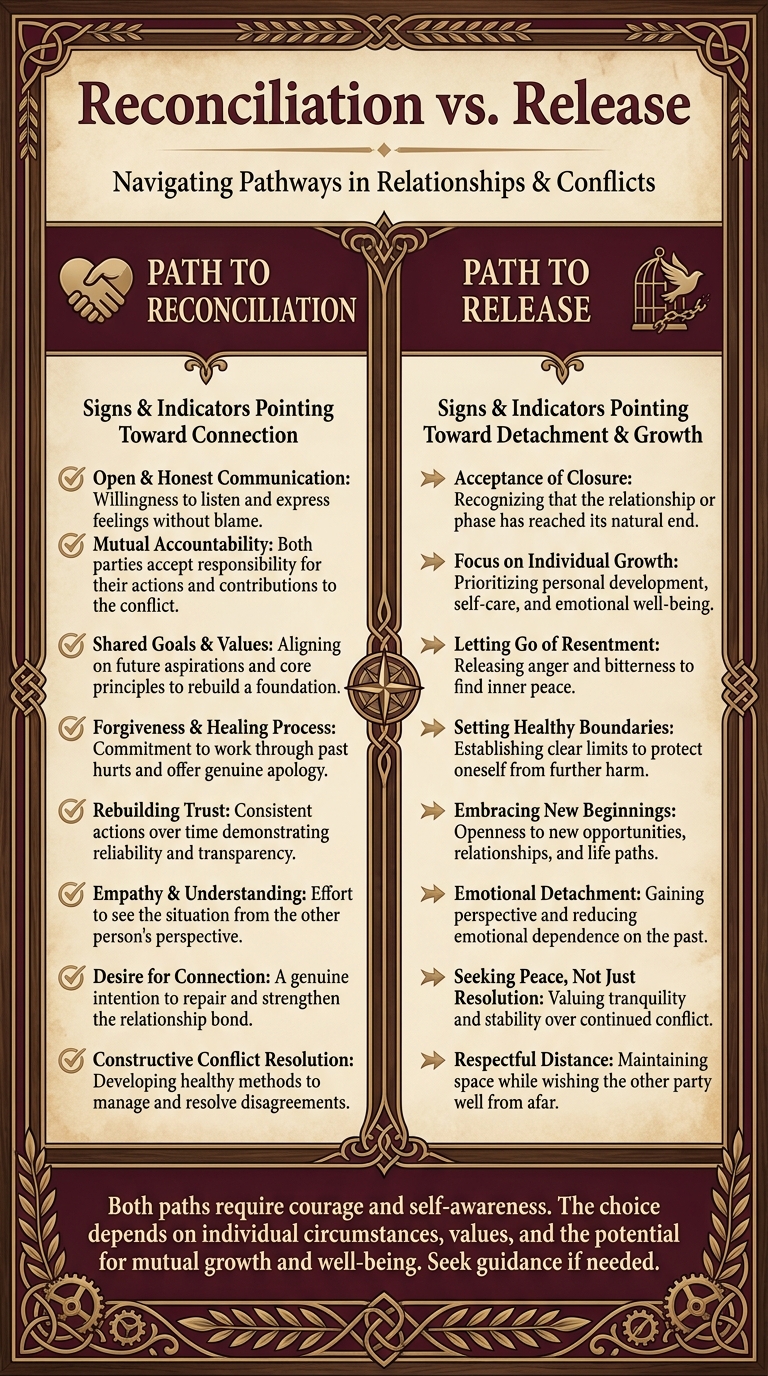
A few patterns point toward reconciliation. The core problem is solvable: communication, timing, or a misunderstanding rather than something fundamental. Both people still show real effort when given the chance, not just when cornered. Genuine affection remains underneath the current conflict, even if it’s buried.
Trust, while damaged, hasn’t been broken through repeated, deliberate betrayal. One or two honest conversations noticeably shift how the relationship feels. If most of these apply to your situation, reconciliation work has real ground to stand on. The more of them present, the stronger that ground tends to be.
Signs You Need Release, Not Reconciliation
Other patterns point the opposite direction. The core issue involves abuse, repeated dishonesty, or values that simply don’t align, no matter how much either person wants them to. Effort consistently comes from only one side. Trust has been broken again and again, past the point either of you can rebuild it.
Conversations about the relationship go in circles without ever producing real change. You feel smaller, not steadier, after time spent together. When most of these describe your situation, release tends to serve you better than continued effort toward reconciliation. Continuing to push in that case usually costs more than it gives back.

How to Actually Answer the Question for Yourself
Start with a plain, unsentimental list. Write down what’s actually solvable about the conflict and what genuinely isn’t, without softening either column. Ask whether the effort in this relationship has ever flowed in both directions, or only from you. Be specific with real examples rather than a general impression, since specifics are much harder to argue yourself out of later.
Notice how you feel in your body after time with this person, not just what you think you should feel. Steadier and calmer points one way. Anxious and smaller points the other. This isn’t a scientific test, but the pattern tends to be more honest than whatever story you’re telling yourself in the moment.
Ritual work supports whichever direction the honest answer points toward. A properly built reconciliation ritual strengthens something real that’s still there. On the other side, a properly built release ritual clears space for you to move forward instead of staying stuck between two answers.
Belief, Intention & The Power of Magic
Witchcraft, spells, and manifestation are deeply rooted in belief, intention, and spiritual practice. If these practices do not resonate with you, this may not be the path for you, and that’s perfectly okay. But if you believe in divine powers, trust your intentions, and feel drawn to the mysteries of the unseen, we invite you to continue exploring with Madame Celestine and discover the magic that speaks to your soul.
What Happens When You Choose the Wrong One
Pushing for reconciliation when release is actually needed tends to prolong pain that a clean ending would have resolved faster. You end up fighting for something that was never going to hold, wearing yourself down in the process. External research backs up the value of getting honest here. A clear-eyed assessment of the relationship’s real patterns consistently predicts whether it’s worth the continued effort.
Choosing release when reconciliation was actually possible carries its own cost. Walking away from something workable, out of fear or impatience, can mean losing a relationship that had real potential left. Neither mistake is permanent, but both cost time and energy you don’t get back, which is exactly why the honest inventory matters before you commit to either path.

Frequently Asked Questions
How do I know if I’m being honest with myself about which one I need?
Writing down the specific evidence, rather than just your feelings, usually reveals patterns you’ve been avoiding. If the list surprises you, that’s often a sign you’ve been reasoning from hope rather than reality.
Can a relationship need both reconciliation and release at different times?
Yes. Some relationships benefit from a period of release, like space or no contact, before an honest reconciliation attempt becomes possible.
What if the people around me disagree with my decision?
Outside opinions can offer perspective, but you’re the one living inside the relationship daily. Weigh their input, but trust the evidence you’ve gathered about your own situation.
Is it normal to feel relief and sadness about the same decision?
Very normal. Even the right choice, in either direction, usually comes with some grief attached, and that grief doesn’t mean you chose wrong.
Should I make this decision alone, or with help?
A practitioner or therapist can help you see patterns you’re too close to notice, but the final decision still has to come from you.
Not sure where to start? You don’t have to do this alone.
Madame Celestine offers guided spellwork for beginners — real support for your first working, not just another guide to read.
Related reading: She Hadn’t Spoken to Her Mother in Three Years — Here’s What Changed · Why Some Exes Come Back — And Some Never Do

About Madame Celestine
Madame Celestine has practiced and taught spellwork, divination, and seasonal ritual for over two decades, helping newcomers build a grounded, confident practice from their very first spell.