

The car breaks down, a payment bounces, and then your phone slips out of your hand and cracks. By the third mishap in a week, it’s hard not to wonder whether someone put a curse on you. A bad luck streak can feel personal and even supernatural. Yet much of what makes it feel that way happens inside our own minds. In this article, I’ll explain three mental habits that turn ordinary setbacks into a “curse,” and how to tell a normal rough patch from something deeper. Then I’ll share a simple ritual to close the chapter.
- When a Bad Luck Streak Feels Like a Jinx
- Your Mind Keeps a Louder Record of Bad Days
- Why Random Setbacks Arrive in Clumps
- The Monte Carlo Mistake: Chasing the End of a Bad Luck Streak
- How to Tell a Bad Luck Streak From Something Deeper
- A Simple Ritual to Close a Bad Luck Streak
- Frequently Asked Questions
- References
When a Bad Luck Streak Feels Like a Jinx
Here is a detail I love. The word “jinx” first appeared in 1911 as American baseball slang. It probably traces back to “jynx,” an older English word for a charm or spell. That word, in turn, came from the wryneck, a small bird once used in witchcraft and divination.[1]
So when you feel jinxed, you’re reaching for a word that has always carried a hint of magic. That feeling is natural. However, before I decide anyone cursed you, I always look at three very human habits first.

Your Mind Keeps a Louder Record of Bad Days
In 2001, a team led by psychologist Roy Baumeister reviewed a large body of research. They concluded that bad is stronger than good across a broad range of human experience. Bad feedback, bad emotions, and bad events have more impact than good ones. We also process bad information more thoroughly.[2]
In other words, your memory is not a fair judge. A week with three setbacks and ten small kindnesses will feel like a bad week, because the setbacks shout and the kindnesses whisper. So a bad luck streak often looks longer and darker in memory than it really was.
Why Random Setbacks Arrive in Clumps
The second habit is seeing patterns in chance. Psychologists call it the clustering illusion. It’s our tendency to treat the streaks that naturally appear in random events as if they must mean something.[3]
During World War II, for example, Londoners developed theories about why V-2 rockets kept striking certain neighborhoods. Yet in 1946, a statistical analysis by R. D. Clarke showed the strikes fit a random distribution.[3] Random events simply don’t spread out evenly. Instead, they bunch up, and three bad things in one week can be nothing more than chance landing in a clump.
The Monte Carlo Mistake: Chasing the End of a Bad Luck Streak
The third habit can cost real money. In 1913, a roulette wheel at the Monte Carlo Casino landed on black 26 times in a row. Gamblers lost millions of francs betting on red, because they were sure the streak had to break.[4] Psychologists call this the gambler’s fallacy, the belief that a run of one result makes the opposite more likely next time.
The lesson for a bad luck streak is simple. Don’t make a big, desperate move to “force” your luck to turn. Instead, make small, steady choices until the ground feels solid again.
How to Tell a Bad Luck Streak From Something Deeper
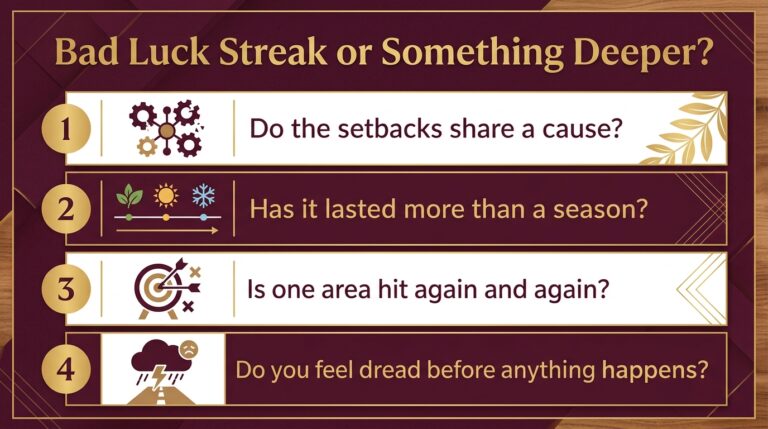
Sometimes a streak really is more than chance. Before you do any spiritual work, ask yourself four questions.
- Do the setbacks share a cause? If one habit or decision sits behind most of them, it’s a pattern you can change.
- Has it lasted more than a season? A few weeks is common, while many months deserves a closer look.
- Is one area hit again and again? Repeated trouble in money, love, or work alone often points to something specific.
- Do you feel dread before anything happens? Constant heaviness can be exhaustion, anxiety, or what practitioners call energy that needs clearing.
In Southern folk magic, people sometimes describe a lasting run of misfortune as being “crossed,” and they do “uncrossing” work to clear it. Even so, I always suggest checking the practical and emotional side first.
A Simple Ritual to Close a Bad Luck Streak
When you’re ready to draw a line under a rough patch, this ritual helps mark the end. Each step has a clear purpose.
1. Balance the record. Write down the bad things from this stretch. Then, beside them, write three good things from the same weeks. This gently corrects the mind’s habit of remembering only the bad.
2. Uncross the sticks. Next, tie two small twigs into an X with thread. Hold them and name the streak out loud. Then untie them and lay them side by side, parallel, so they no longer cross.
3. Light a white candle. Place the parallel twigs beside a white candle and let it burn for a while as you breathe slowly. White traditionally stands for a clean slate.

4. Take one small, safe step. Finally, remember Monte Carlo. Choose one modest action that moves you forward, such as a phone call, a repair, or an overdue task. Small wins rebuild confidence faster than big gambles.
Belief, Intention & The Power of Magic
Witchcraft, spells, and manifestation are deeply rooted in belief, intention, and spiritual practice. If these practices do not resonate with you, this may not be the path for you, and that’s perfectly okay. But if you believe in divine powers, trust your intentions, and feel drawn to the mysteries of the unseen, we invite you to continue exploring with Madame Celestine and discover the magic that speaks to your soul.
If your rough patch is mostly about work or success, you might also like my article on whether confidence, luck, or timing is really missing. It can help you pinpoint what to work on next.
Frequently Asked Questions
How long does a bad luck streak usually last?
There is no fixed length. Many rough patches pass within a few weeks, especially once you stop making hurried decisions to escape them.
Is a bad luck streak a sign of a curse?
Usually not. Our minds naturally remember bad events more strongly and see patterns in random clusters, so ordinary setbacks can feel like a curse.
What does it mean to be crossed?
In Southern folk magic, being “crossed” describes a lasting run of misfortune that practitioners believe needs spiritual clearing, often called uncrossing.
Should I take a big risk to break a bad luck streak?
It’s usually wiser not to. The gambler’s fallacy shows that a streak doesn’t make the opposite result more likely, so small, steady steps are safer.
Why does a white candle help?
In many traditions, white stands for purity and a fresh start. Lighting one gives the end of a rough patch a clear, calm moment.
References
- Jinx. Online Etymology Dictionary. https://www.etymonline.com/word/jinx
- Roy F. Baumeister, Ellen Bratslavsky, Catrin Finkenauer, Kathleen D. Vohs. Bad Is Stronger Than Good. Review of General Psychology, 2001 (University of Minnesota record). https://experts.umn.edu/en/publications/bad-is-stronger-than-good/
- Clustering illusion. Wikipedia. https://en.wikipedia.org/wiki/Clustering_illusion
- Gambler’s fallacy. Wikipedia. https://en.wikipedia.org/wiki/Gambler%27s_fallacy
Not sure where to start? You don’t have to do this alone.
Madame Celestine offers guided spellwork for beginners — real support for your first working, not just another guide to read.
Related reading: Luck Spell vs. Manifestation: What’s the Real Difference · He Kept Missing Every Opportunity — Until He Broke the Pattern

About Madame Celestine
Madame Celestine has practiced and taught spellwork, divination, and seasonal ritual for over two decades, helping newcomers build a grounded, confident practice from their very first spell.