
If you want to cast a love spell on someone, you’re asking one of the oldest questions in folk magic. Can you really put a spell on a person? And if you can, should you? Experienced practitioners ask a few questions before they light a single candle, and this guide walks through them. First comes what folklorists recorded about love work in the American South in the 1930s. After that, you’ll see why a red flannel bag and a twisted root still matter today. You’ll also find a simple candle, honey and photo method, step by step, along with the reasons behind each part. Finally, you’ll learn the mistakes that quietly undo most home love spells, and when it makes sense to ask for help.
- Can You Put a Spell on Someone? What Practitioners Actually Believe
- The First Question Every Witch Asks: Who Is This Spell Really For?
- Love Work Was a Trade: What Zora Neale Hurston Wrote Down in 1935
- Red Flannel and a Root: The Bag Behind Many Love Spells
- Rivers, Sweetness and Oshun: The Yoruba Thread in Love Magic
- Draw, Sweeten or Carry: The Three Ways to Cast a Love Spell
- How to Cast a Love Spell on Someone, Step by Step
- Herbs of Venus: How an Old Herbal Picked Love Plants
- A Spell to Attract Love When There’s No One in Mind
- Five Mistakes That Undo a Love Spell
- The First Month After You Cast a Love Spell
- Why So Many People Hand Love Work to a Practitioner
- Frequently Asked Questions
- References
Can You Put a Spell on Someone? What Practitioners Actually Believe
Practitioners say yes, but with a catch. In most folk traditions, a love spell works on the space between two people rather than on one person’s mind. It’s meant to open a door, warm a feeling or draw attention. So when someone asks whether they can cast a love spell on someone, practitioners usually answer with a question of their own: what exactly do you want to happen?
That answer shapes everything else. For example, a spell to draw new love into your life is very different from a spell aimed at one named person. Likewise, a spell to warm up a cooling relationship is different again. Each one uses different tools, and each one raises different questions.
No honest practitioner promises that a love spell will make a specific person feel a specific way. Instead, they describe what the work intends to do. That’s the frame for everything below.
The First Question Every Witch Asks: Who Is This Spell Really For?
Before casting a love spell on someone, most practitioners ask about consent. Is the other person already interested? Are they free to choose you? Or would the spell try to override a clear “no”?
Many modern witches answer with the Wiccan Rede: “An it harm none, do what ye will.” Doreen Valiente first recorded the line publicly in a 1964 speech. The word “rede” simply means advice, and most Wiccans read it as guidance to apply case by case, much like the Golden Rule.[1] Under that reading, a spell that forces another person’s feelings causes harm.
Not every tradition works from the Rede, though. Folk and diaspora practices have their own rules, and many have long offered love work for named people. Even so, a practical middle ground has formed. Many practitioners will cast a love spell for a specific person when the interest is already there, or when the aim is to open communication. Fewer will work against a clear refusal. If this question is on your mind, the site’s article on the ethics of a love binding spell covers the debate in more depth.
There’s a practical reason for this, too. A love spell that works with an existing spark has something to build on. By contrast, a spell aimed at someone who has firmly walked away is pushing against the whole situation.

Love Work Was a Trade: What Zora Neale Hurston Wrote Down in 1935
Some of the best records of how people cast a love spell come from American folklorists. In 1935, J. B. Lippincott published Zora Neale Hurston’s Mules and Men, with a preface by the anthropologist Franz Boas. Its second half covers hoodoo, and it reads like a catalogue of real requests.[2]
The chapter titles alone tell the story. There’s “Ritual to Get a Man” and “Routine to Keep a Husband True.” A later chapter adds “To Make Love Stronger,” “To Bring a Lover Back” and “To Rule the Man You Love.”[2] In other words, love work sat right alongside protection, legal trouble and uncrossing in the everyday practice Hurston recorded.
During the Jim Crow era, rootworkers offered Black clients help with love, money, employment and protection from the police.[3] Later, the folklorist Harry Middleton Hyatt gathered years of interviews from across the South into his five-volume Hoodoo, Conjuration, Witchcraft, Rootwork, published in 1970.[4] Together, these records show that love spells were a serious request, brought to a skilled worker, rather than a party trick.
Red Flannel and a Root: The Bag Behind Many Love Spells
One of the most important love tools in this tradition is small enough to fit in a pocket. It’s the mojo bag, also called a conjure bag, a toby or a “hand.” Most Southern-style bags use red flannel. Inside are roots, herbs, coins, stones or a written petition, chosen for the bag’s purpose.[5]
This practice has deep African roots. The word “mojo” likely comes from the Kikongo word mooyo, linked to the spirits within magical charms. The Bakongo people of the Congo River region made medicine bags of cloth or leather, and enslaved people carried the practice to America. In West Africa, people call similar bags juju or gris-gris.[5]
Love bags are a specific type, and some people wear them right against the skin. Practitioners also “feed” or “dress” a bag with a liquid, such as perfume or alcohol, to keep it working.[5] So a mojo bag is a charm the caster carries and tends over time.
The most famous root in these bags is High John the Conqueror. It’s said to come from Ipomoea jalapa, a relative of the morning glory and the sweet potato. The root takes its name from a folk hero thought to come from Congolese stories of a prince sold into slavery who was never broken in spirit. Practitioners use it for luck, strength and victory, and it’s common in love spells as well.[6] Hurston herself wrote about the figure in a 1943 article, describing a power left behind in a root.[6]
Rivers, Sweetness and Oshun: The Yoruba Thread in Love Magic
Across the Atlantic, love has its own patron. Oshun, also spelled Osun, is a Yoruba orisha from southwestern Nigeria. She’s tied to rivers, water, purity, fertility, love and sensuality, and she’s counted among the most powerful orishas.[7]
Her home is a real place. The Osun-Osogbo Sacred Grove, a forest of about 75 hectares in Osogbo, was added to the UNESCO World Heritage List in 2005. It holds around forty shrines and sculptures, and every July and August the town holds a twelve-day festival that renews its bond with the goddess.[8]
Sweetness also runs through modern love work, whatever the tradition. A honey jar is meant to “sweeten” a person or a situation toward you, and the site’s guide to honey jar spell mistakes explains how to tend one properly.
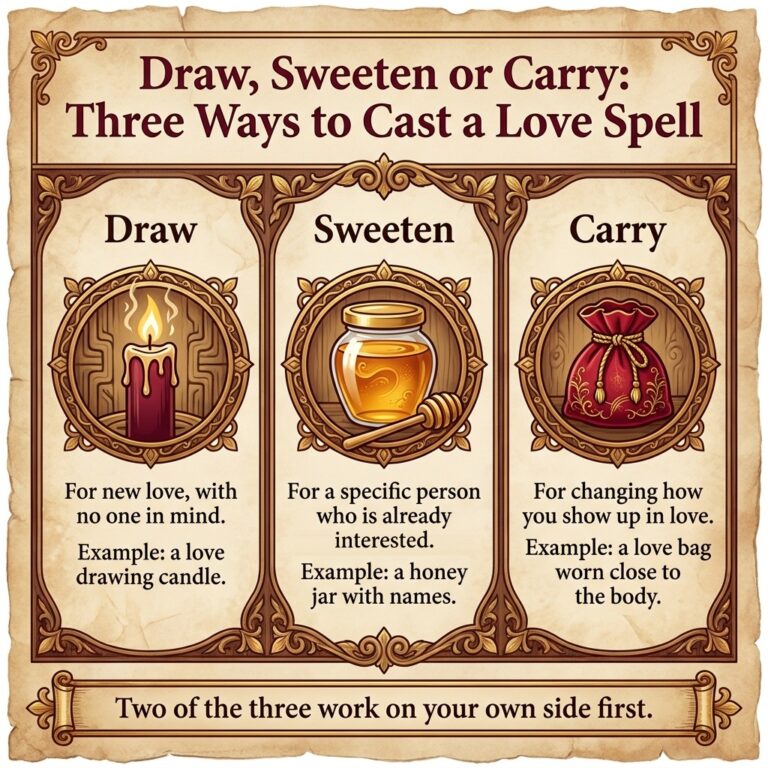
Draw, Sweeten or Carry: The Three Ways to Cast a Love Spell
Put the hoodoo records, the mojo bag and the Yoruba imagery side by side, and a clear pattern appears. Love work tends to make one of three moves.
The first move is to draw. These spells call love toward the caster without naming anyone, like the “Love Drawing” candles sold for rootwork.[3] They suit someone who wants new love but has no particular person in mind.
The second move is to sweeten. Here the spell names a specific person and aims to warm their feelings, usually with honey, sugar or a photo. This suits a situation where the interest already exists but feels stuck or shy.
The third move is to carry. A charm such as a love mojo bag stays on the caster’s body, and the caster feeds it over time.[5] This suits someone who wants to change how they show up in love, whether or not a specific person is involved.
Seen this way, the old records offer a useful insight. In two of the three moves, the main target of the spell is the caster, not the other person. Drawing spells change what you invite in, and carried charms change what you bring with you. Only sweetening points directly at someone else. So if you’re unsure which love spell to cast, the traditions suggest starting with the moves that work on your own side first.
How to Cast a Love Spell on Someone, Step by Step
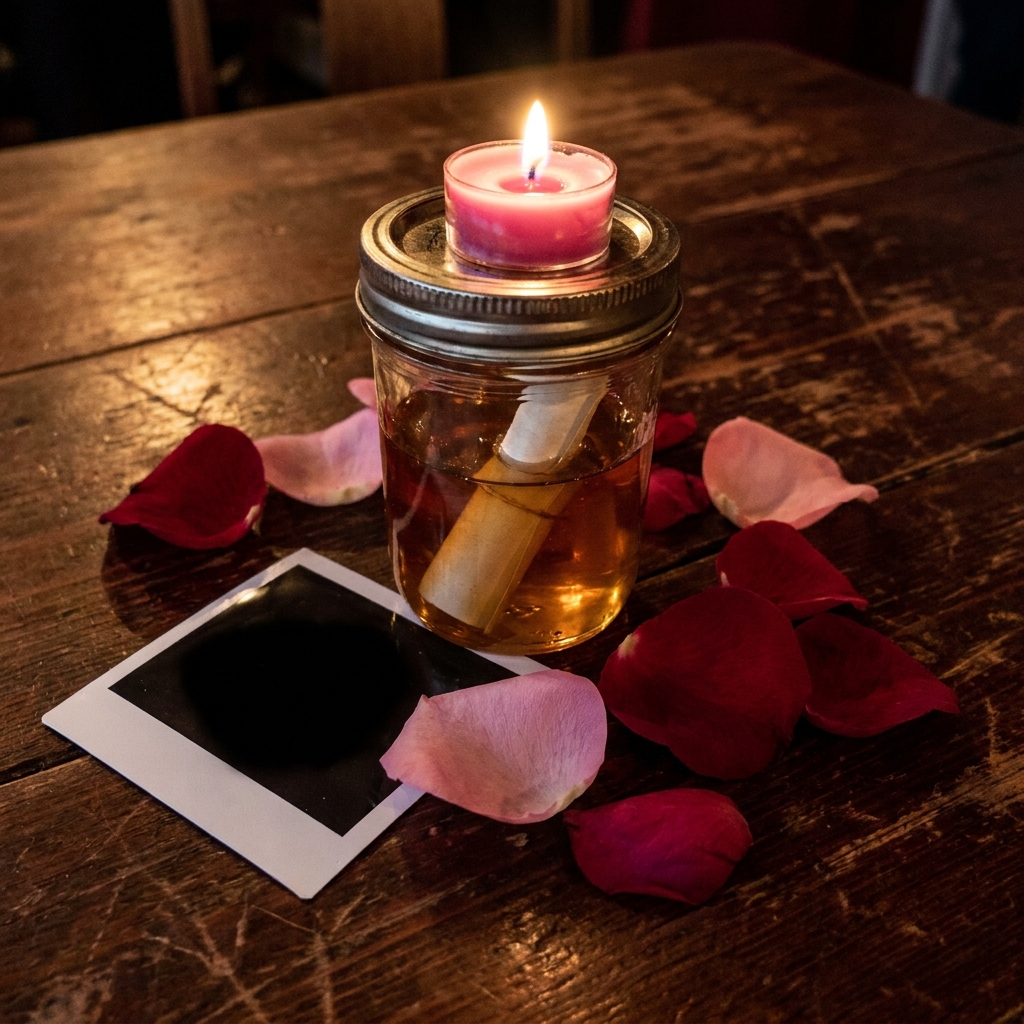
The method below is a sweetening spell. It’s the most common way people cast a love spell on someone they already know. It uses a candle, honey, a name and an optional photo.
1. Choose your timing
Many practitioners prefer a Friday, the day named for Venus in several European languages, during a waxing moon. A growing moon is thought to support drawing and building work. These choices aren’t essential, but they help the caster focus.
2. Write the petition
Write the other person’s full name on a small piece of paper. Then turn the paper and write your own name across it, so the two names cross. Below them, write one plain sentence about what you hope for, such as open and honest communication. Keep it about the bond, not about controlling a person.
3. Add the photo, if you have one
A love spell with a picture uses a photo the way older spells used a name or a lock of hair. It ties the work to a real person. Place the photo face up under the petition paper.
4. Sweeten the jar
Fold the paper toward you, which symbolizes drawing them closer. Then place it in a small jar of honey and say your intention aloud. Many people add rose petals or a pinch of cinnamon for warmth.
5. Light the candle
Set a small pink or red candle on the jar’s lid and let it burn down safely. Pink is usually chosen for tenderness and red for passion. While it burns, sit quietly and picture an easy, warm conversation between you.
6. Tend it, then let it be
Finally, keep the jar somewhere private. Practitioners often burn a new small candle on it once a week. Between those times, they leave the work alone and go about ordinary life, including real-world contact with the person.
Belief, Intention & The Power of Magic
Witchcraft, spells, and manifestation are deeply rooted in belief, intention, and spiritual practice. If these practices do not resonate with you, this may not be the path for you, and that’s perfectly okay. But if you believe in divine powers, trust your intentions, and feel drawn to the mysteries of the unseen, we invite you to continue exploring with Madame Celestine and discover the magic that speaks to your soul.
Herbs of Venus: How an Old Herbal Picked Love Plants
When people cast a love spell with herbs, they’re following a habit that goes back centuries. In 1653, the English herbalist Nicholas Culpeper finished The Complete Herbal, a guide that assigned each plant to a ruling planet.[9] Plants given to Venus, the planet of love, became natural choices for anyone who wanted to cast a love spell.
Some of his Venus plants are surprising. Ground-ivy is “an herb of Venus,” and alkanet sits “under the dominion of Venus.” Even the alder tree and common beans make the list.[9] Culpeper went further with French beans. He claimed they “incite to venery,” an old word for sexual desire.[9]
Modern practitioners rarely reach for beans, of course. Still, the logic survives. Rose, cinnamon and other warm, sweet plants fill today’s love jars and bags for the same reason Culpeper sorted plants by planet. Each herb is chosen for what it’s believed to carry. So before you cast a love spell, it helps to know why each ingredient is on the table, not just that it’s traditional.
A Spell to Attract Love When There’s No One in Mind
Not everyone who searches for how to cast a love spell has a name ready. If you simply want love to find you, a drawing spell is the traditional choice.
The simplest version needs only a pink candle and a few minutes. First, take a bath or wash with rose petals in the water, as a way of opening yourself. Next, light the candle and write down the qualities you hope a partner will bring, rather than a name. Then burn the list in the flame, or keep it under the candle until it burns out. Because no one is named, this spell avoids the consent question altogether. For that reason, many practitioners say it’s the first love spell anyone should cast.
Some people pair it with a carried charm. A small red bag with rose petals, a root and a coin, worn close to the body, follows the old mojo bag pattern of a prayer you take with you.[5]
Five Mistakes That Undo a Love Spell
Most people who cast a love spell and feel it failed run into the same few problems. Fortunately, each one is easy to avoid.
Casting from panic
People who cast a love spell in the middle of a fight or right after a breakup often pour fear into it rather than love. Practitioners usually suggest waiting a day or two, so the intention is clear.
Asking for control
A petition like “make them obsessed with me” pushes against the person, not toward the bond. As a result, many practitioners believe it backfires. Clear, gentle wording tends to hold better.
Checking for results every hour
Constant checking keeps the caster anxious and the work unsettled. Instead, most traditions ask for patience, often one full moon cycle of about 29 and a half days.
Ignoring the real world
Practitioners treat ordinary contact, such as a phone call or an honest conversation, as part of the work. A spell sitting in a drawer can’t stand in for it.
Stacking spells on top of each other
Casting a new spell every few days muddies the intention. One clear spell, tended well, is usually the better path. For signs that a spell is settling, see this guide on signs your love spell is working.

The First Month After You Cast a Love Spell
Once you cast a love spell, the hardest part is usually waiting. Practitioners describe the first month in fairly steady stages.
In the first few days, most traditions say to leave the work alone. The jar stays closed, the bag stays on, and the caster gets on with ordinary life. Over the next few weeks, people watch for small shifts. A message arrives sooner than expected, or a conversation feels easier. However, these are signs of belief and interpretation, not proof. Good weeks happen in every relationship, and it’s easy to credit a spell for one.
By the end of a moon cycle, practitioners usually take stock. If things feel warmer, they keep tending the spell. If nothing has moved, they look again at the first question. Was the interest really there? Was the wording about the bond, or about control? Sometimes the honest answer is that a different kind of work, or no spell at all, fits better.
Why So Many People Hand Love Work to a Practitioner
Hurston’s hoodoo chapters are organized around the workers she met, and the love rituals in them belong to those workers.[2] In other words, the people in her book brought their love troubles to someone who knew the roots, the words and the timing.
That habit still makes sense. When you care deeply about someone, it’s hard to judge the situation clearly. A practitioner brings two things that are hard to supply alone. The first is perspective. Someone outside the relationship can ask whether a drawing, sweetening or carried charm fits best, or whether the situation calls for reconciliation or communication work instead. The second is method. An experienced hand knows how to word the petition, build the work and tend it over time.
If that sounds like what you need, the love spells offered on this site start from your own situation. Each request begins with a conversation about what you hope for and why. No spell can promise how another person will feel. Still, a carefully made love spell gives your intention a clear shape and the steady care it needs.
Frequently Asked Questions
Can you put a spell on someone to love you?
Practitioners believe a love spell can open a door or warm existing feelings. However, no honest practitioner promises to make a specific person feel a specific way.
Is it wrong to cast a love spell on someone without them knowing?
It depends on your tradition. Many Wiccans see it as overriding free will, while some folk traditions have long done love work for named people. Many practitioners today will only work where the interest is already there.
What do you need to make a love spell?
A simple love spell needs a candle, a piece of paper with names on it, and something sweet such as honey. A photo, rose petals or cinnamon are common additions.
How long does a love spell take to work?
Most practitioners suggest waiting at least one full moon cycle, about a month, before judging the result. During that time they tend the spell and keep ordinary contact going.
What is the best love spell for beginners?
A drawing spell with a pink candle is the usual starting point. It doesn’t name anyone, so it avoids the consent question entirely.
References
- Wiccan Rede. Wikipedia. https://en.wikipedia.org/wiki/Wiccan_Rede
- Mules and Men, Zora Neale Hurston (1935; Perennial Library edition, 1990). Louisiana Anthology, Louisiana Tech University. https://www2.latech.edu/~bmagee/louisiana_anthology/303_download/texts/hurston–mules_and_men/Mules%20and%20men.pdf
- Hoodoo (spirituality). Wikipedia. https://en.wikipedia.org/wiki/Hoodoo_(spirituality)
- Halloween Hoodoo. University of Missouri Libraries, Special Collections. https://library.missouri.edu/news/special-collections/halloween-hoodoo
- Mojo (African-American culture). Wikipedia. https://en.wikipedia.org/wiki/Mojo_bag
- John the Conqueror. Wikipedia. https://en.wikipedia.org/wiki/John_the_Conqueror
- Oshun. Encyclopaedia Britannica. https://www.britannica.com/topic/Oshun
- Osun-Osogbo Sacred Grove. UNESCO World Heritage Centre. https://whc.unesco.org/en/list/1118/
- The Complete Herbal, Nicholas Culpeper (1653; Thomas Kelly edition, 1850). Project Gutenberg. https://www.gutenberg.org/ebooks/49513
Not sure where to start? You don’t have to do this alone.
Madame Celestine offers guided spellwork for beginners — real support for your first working, not just another guide to read.
Related reading: Love Binding Spell: What Happens After You Cast It (Read First) · Signs Your Love Spell Is Working: 7 Changes to Notice

About Valentine
Valentine is the pen name our editorial team uses for articles on West African spiritual traditions, protection and herbal lore. Articles under this byline are researched from published sources and reviewed by Madame Celestine before publishing.