

Candle flame meanings are one of the first things new witches want to learn. After all, every spell candle seems to behave differently: one burns tall and still, another jumps and crackles, and a third smokes black. So what, if anything, is it telling you? In this guide, you will learn the science of how a candle really burns, so you can rule out simple causes first. Then you will learn three traditional methods for reading candles, through the flame, the smoke and the wax.
- Why Read a Candle? A Short History of Fire Divination
- Know Your Flame First: The Science Behind Candle Flame Meanings
- Method 1: Candle Flame Meanings, From Tall to Flickering
- Method 2: Reading the Smoke
- Method 3: Reading the Wax
- How to Read Candle Flame Meanings in Your First Session
- Frequently Asked Questions
- References
Why Read a Candle? A Short History of Fire Divination
Reading fire is one of the oldest forms of divination. The English word for it, “pyromancy,” dates to the late 1300s. It comes from the Greek pyr, meaning fire, and manteia, meaning oracle or divination.[1]
Scientists have been fascinated by candles too. In 1848, Michael Faraday gave a famous series of lectures for young people at London’s Royal Institution.[2] He told his audience that a candle is one of the best doorways into the whole study of science.[2]
That shared fascination is a useful starting point. Good readers of candle flame meanings understand both sides: what the flame is doing physically, and what practitioners believe it means.
Know Your Flame First: The Science Behind Candle Flame Meanings
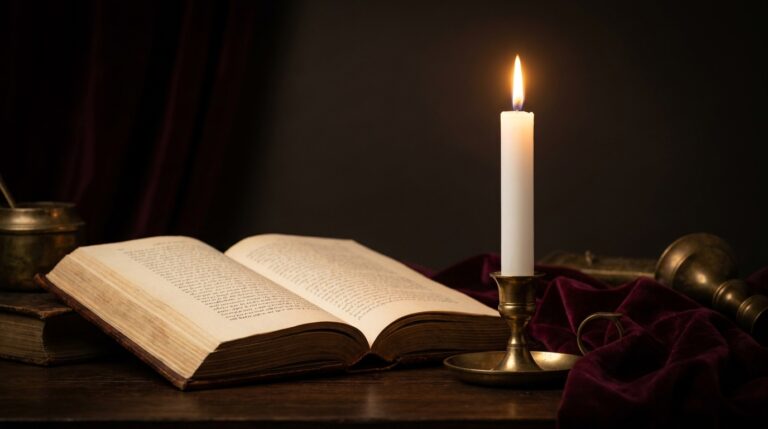
Before you read any sign, it helps to know how a candle works. When you light it, the flame melts the wax near the wick. Then the wick draws the liquid wax upward, much as a paper towel soaks up water. Finally, the heat turns that wax into a hot gas, and the gas is what actually burns.[3]
This matters for reading, because many “signs” have simple physical causes. For example, a flame flickers or flares when it gets too much or too little air or fuel. In that case, unburned soot escapes as smoke.[3] So a draft, a long wick or a cheap candle can all change the flame.
Even the flame’s shape comes from physics. On Earth, rising hot air pulls the flame into a teardrop and carries soot to the tip, which makes it yellow. In space, however, a candle flame becomes a small blue sphere.[4] For this reason, experienced readers always trim the wick and block drafts first. Only then do they look for meaning.
Method 1: Candle Flame Meanings, From Tall to Flickering
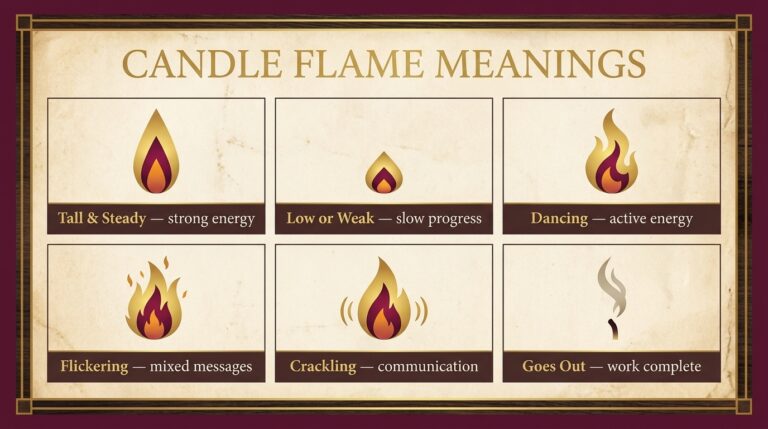
Reading the flame itself is the simplest method. Watch it for a few minutes after it settles. Here are the traditional candle flame meanings most practitioners use.
- Tall and steady: strong energy and a clear path. Many read this as a sign the working is going well.
- Low or weak: slow progress or resistance. Some readers see it as a cue to add more focus or patience.
- Dancing or jumping: active energy, sometimes read as spirits or strong emotion around the question.
- Flickering on and off: mixed messages or an unsettled situation.
- Crackling or popping: in folk practice, a sign of communication, or of obstacles being burned away.
- Going out on its own: often read as the work being complete, or as a need to pause and try again later.
Method 2: Reading the Smoke
Smoke reading is sometimes called capnomancy, from the Greek word for smoke. It works best with a candle placed where you can see the smoke clearly against a plain wall.
Traditionally, practitioners read thin white smoke as a positive sign, such as a blessing or a prayer being carried upward. By contrast, they often read heavy black smoke as resistance or negativity that the candle is burning through. Direction matters as well. Smoke drifting toward you often signals your wish coming closer, while smoke moving away suggests you may need to let something go.
Remember the science, though. Black smoke is also simply soot from a long wick or a draft. So trim the wick and try again before you draw a conclusion.
Method 3: Reading the Wax
The third method looks at what the candle leaves behind. Wax reading, called ceromancy, studies the drips, pools and shapes left once the candle has burned down. For example, a clean, even burn is usually read as a smooth outcome, while heavy dripping on one side may point to an imbalance.
This is a rich method in its own right. Our full guide to candle wax reading techniques and meanings covers the shapes in detail.

How to Read Candle Flame Meanings in Your First Session
- Choose a plain candle. A simple white candle is best, since it has no color meaning of its own.
- Prepare the space. Trim the wick to about a quarter inch, close windows and turn off fans. This removes the most common physical causes of odd flames.
- Ask one question. Keep it clear and open, such as “What do I need to know about this choice?”
- Light and wait. Let the flame settle for two or three minutes before you read anything.
- Observe all three signs. First watch the flame, then the smoke, and later the wax.
- Write it down. Finally, note what you saw and how you felt. Over time, your notes will show your own personal patterns.
Never leave a burning candle unattended, and keep it away from anything that could catch fire.
Belief, Intention & The Power of Magic
Witchcraft, spells, and manifestation are deeply rooted in belief, intention, and spiritual practice. If these practices do not resonate with you, this may not be the path for you, and that’s perfectly okay. But if you believe in divine powers, trust your intentions, and feel drawn to the mysteries of the unseen, we invite you to continue exploring with Madame Celestine and discover the magic that speaks to your soul.
Frequently Asked Questions
What are the meanings of a tall candle flame?
In most traditions, a tall, steady flame is read as strong energy and a positive sign for your intention. Check that the wick is not too long, though, since that can also make a flame tall.
What are the most common candle flame meanings?
The main ones are tall and steady for strength, low for slow progress, dancing for active energy, flickering for mixed messages, and popping for communication.
What does black smoke from a candle mean?
Spiritually, many read it as the candle burning away negativity. Physically, it usually comes from soot, so trim the wick and check for drafts first.
What does it mean if my candle goes out by itself?
Many practitioners see it as the work being finished, or as a sign to pause and repeat the ritual later.
What color candle is best for candle reading?
White is the usual choice for beginners, because it does not add a color meaning of its own to the reading.
References
- Pyromancy. Online Etymology Dictionary. https://www.etymonline.com/word/pyromancy
- The Chemical History of a Candle: Engineer Guy launches new book and YouTube series on Faraday lectures. Department of Chemical and Biomolecular Engineering, University of Illinois. https://chbe.illinois.edu/news/stories/chemical-history-candle-engineer-guy-launches-new-book-and-youtube-series-faraday-lectures
- Candle Science. National Candle Association. https://candles.org/candle-science/
- Candle Flame – 1g vs Microgravity. NASA. https://www.nasa.gov/image-article/candle-flame-1g-vs-microgravity/
Not sure where to start? You don’t have to do this alone.
Madame Celestine offers guided spellwork for beginners — real support for your first working, not just another guide to read.
Related reading: Why Herbs Matter in Traditional Spell Work · Understanding Candle Wax Reading: Technique & Meanings in Divination: Symbolism, Tradition & Personal Practice

About Madame Celestine
Madame Celestine has practiced and taught spellwork, divination, and seasonal ritual for over two decades, helping newcomers build a grounded, confident practice from their very first spell.