

You’ve decided you want to try spellwork, but every time you sit down to actually do it, doubt shows up first: What if I say it wrong? What if nothing happens? What if I’m not “ready”? That hesitation is the single biggest thing keeping beginners from ever lighting the candle — not lack of talent, not missing tools, just the fear of doing it wrong. This guide walks through how to cast your first spells with a structure simple enough to actually follow, even while unsure.
Start Smaller Than You Think You Should
Most beginners stall out before they ever light a candle because they picture spellwork as something dramatic — elaborate altars, rare herbs, a script that has to be word-perfect. It isn’t. A spell is simply a focused act of intention, and the simplest ones tend to work best when you’re still building confidence. Pick one clear, modest goal: a calmer commute, better sleep, more patience with a difficult coworker. Save the ambitious love or money spells for later, once you have a feel for how your own practice moves.
Doubt itself isn’t a disqualifier. Most practitioners never feel fully certain; they act anyway and pay attention to what happens. Treat your early spells as experiments, not tests you can fail.
Timing, Tools, and What Actually Matters
You don’t need a full altar setup to begin. A candle, a lighter, and a quiet ten minutes are enough. If you want to add timing — a waxing moon for growth, a waning moon for release, a specific day of the week ruled by the energy you’re working with — treat it as a helpful layer, not a requirement. Correspondences (colors, herbs, planetary days) amplify intention; they don’t replace it.
Write down what you’re asking for in a single plain sentence before you begin. This does more for a shaky first attempt than any tool on the market — it forces the vague hope in your chest into something specific enough to actually work toward.
A Simple Structure to Follow
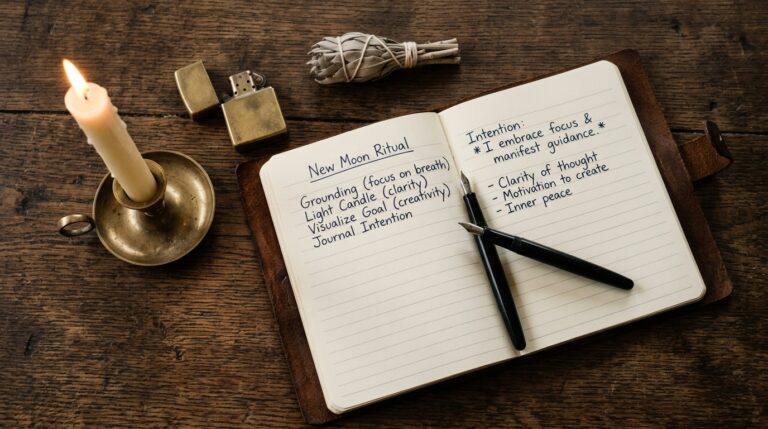
Ground and center for a minute or two — a few slow breaths is fine. State your intention aloud or in your head, in the present or future tense, as if it’s already unfolding. Light the candle (or do whatever small physical action anchors the spell). Sit with the feeling of the outcome for a moment. Then close deliberately: blow out the candle, put your tools away, and let it go. That last step matters more than beginners expect — obsessively checking whether it “worked” undercuts the release the spell depends on.

What to Do When It Doesn’t Feel Like Enough
If a spell falls flat, it’s rarely because you did it wrong in some ritualistic sense. More often the intention was too vague, the timing fought against exhausted energy, or the goal needed practical action alongside the magical one — a job spell still needs a résumé sent out. Keep a small journal of what you tried and what shifted afterward, even loosely. Patterns will show up faster than you expect, and that record becomes the actual foundation of confident practice — not certainty handed to you in advance, but evidence you build for yourself.
It also helps to separate “unsure of the outcome” from “unsure I’m allowed to do this.” The second kind of doubt is worth examining directly — it’s often inherited from outside sources that framed magic as forbidden or dangerous rather than as a normal human practice with a long history. You don’t need permission from anyone to explore this, and hesitation rooted in that old messaging tends to fade with repetition, not with more research.

Your Next Step
Reading about spellwork only gets you so far — at some point the next move is doing one, deliberately, with a bit of guidance so the structure above doesn’t feel like guesswork. If you’d rather have that first spell worked with you than figure it out entirely alone, Madame Celestine’s spell services are built for exactly that starting point.
Not sure where to start? You don’t have to do this alone.
Madame Celestine offers guided spellwork for beginners — real support for your first working, not just another guide to read.
Related reading: The Witch’s Runes: 13 Symbols for Divination · Wiccan & Pagan Holiday Calendar

About Madame Celestine
Madame Celestine has practiced and taught spellwork, divination, and seasonal ritual for over two decades, helping newcomers build a grounded, confident practice from their very first spell.