
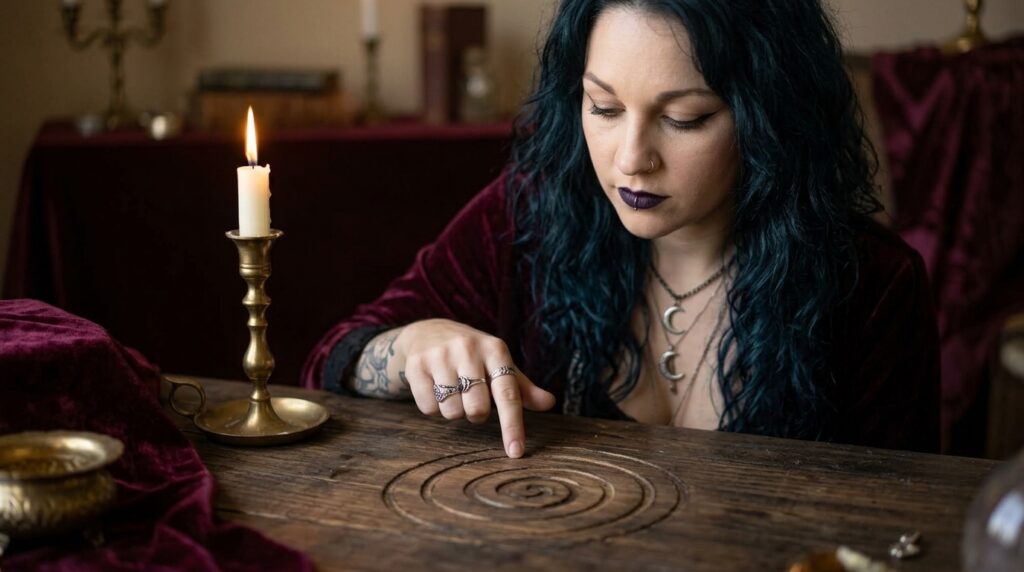
You’ve probably drawn a spiral without thinking about it. Doodled in a margin, traced absentmindedly in sand. That impulse isn’t random. The spiral is one of the oldest symbols humans have carved, painted, and worn. It appears on nearly every continent, long before writing existed. It shows up wherever people have tried to picture growth, cycles, and the pull between life and death. Here’s what it actually means, where it comes from, and how to bring it into your own practice.
What the Spiral Represents
At its simplest, a spiral shows movement that returns to itself while never quite repeating. That’s why it became such a natural symbol for cycles. Think of the seasons, the moon’s phases, a life moving through birth, growth, decline, and renewal. A circle suggests something closed and complete. A spiral suggests process instead. You’re never back exactly where you started. You’ve moved inward or outward while circling the same center. That distinction is part of why the symbol carries so much weight in goddess-centered traditions specifically. There, cyclical, embodied time matters more than a straight line from beginning to end.
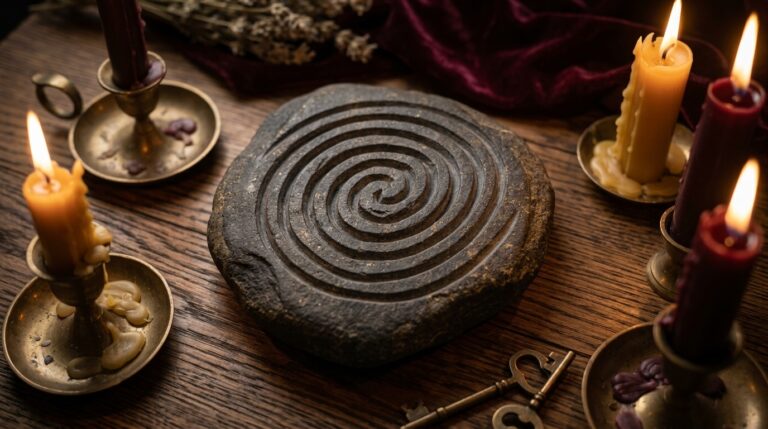
Part of why the spiral feels so instinctively right is that nature keeps drawing it too. A nautilus shell grows in a logarithmic spiral, adding chambers in the same proportion as it expands. A fern frond unfurls that way. Water spirals down a drain. Entire galaxies, including our own, spiral through space on a scale too large to picture directly. When ancient people carved a spiral into stone, they weren’t inventing an abstract design. They were sketching a pattern they already saw everywhere around them.
The Spiral Across Ancient Cultures
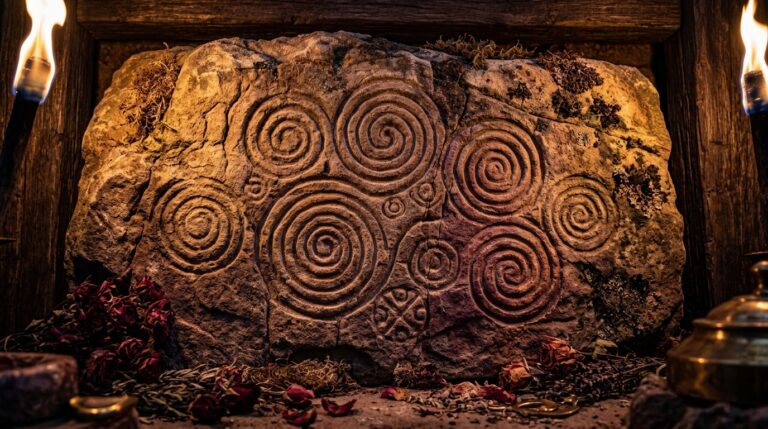
The most famous carved spiral in the Western world sits inside Newgrange, a passage tomb in Ireland built roughly 5,000 years ago. Its triple spiral is often called “Celtic.” According to Newgrange’s own archaeological record, though, the carving actually predates Celtic culture in Ireland by around 2,500 years. Its original meaning was never written down. Many researchers connect it to the sun and the turning seasons. Others tie it to the passage between life and death the tomb itself represents. Local tradition holds that the winter solstice sunrise once illuminated the carved stone directly. Archaeologists studying the site later investigated that claim in detail.
Minoan Crete carved double spirals into seals and pottery thousands of years before that, often paired with goddess imagery. In Maori tradition, the koru spiral represents new life unfurling. It’s modeled directly on a young fern frond opening toward the light. Spirals also appear in Native American petroglyphs across the American Southwest. You’ll find them in Neolithic pottery from China and in Aboriginal Australian rock art too. No single culture invented the symbol. It arrived independently, again and again, because the shape maps something close to universal in how humans experience time.
The Spiral as a Goddess Symbol
Within modern goddess spirituality, the spiral often stands in for the maiden-mother-crone cycle. More broadly, it represents the feminine as a process rather than a fixed state. It resists the idea that a woman, or any cyclical force, moves in one direction only. Growth doesn’t mean leaving the past behind entirely. It means carrying it inward while continuing to expand. Some practitioners connect the spiral specifically to the womb and to birth. They read the shape as the first path anything living travels on its way into the world. Others use it to mark grief and mourning instead. The same inward turn that describes birth also describes a return to the earth at the end of life. That’s part of why the spiral has become such a popular tattoo choice in recent years. A single small spiral can honor a loss, mark a personal transformation, or simply serve as a quiet reminder that you’re always somewhere in a cycle, never permanently stuck.
Ways to Work with the Spiral in Practice
You don’t need elaborate tools to bring the spiral into your practice. Drawing one slowly, by hand, while holding a question or intention, is a simple meditative act on its own. Walking a labyrinth, if you have access to one, is a physical version of the same idea. You move inward toward a center, pause, then walk back out changed by what you found there. A spiral dance, where a group moves in a slow inward and outward spiral together, is a common closing ritual at seasonal gatherings. Wearing spiral jewelry, or placing a small spiral carving on your altar, keeps the symbol present as a quieter, ongoing reminder. Some practitioners also carve or paint a small spiral near a doorway as a protective marker. The shape’s constant motion is thought to unsettle stagnant or unwelcome energy before it can settle in. Our protection spells collection has more on that kind of doorway and threshold work.
A Simple Spiral Ritual
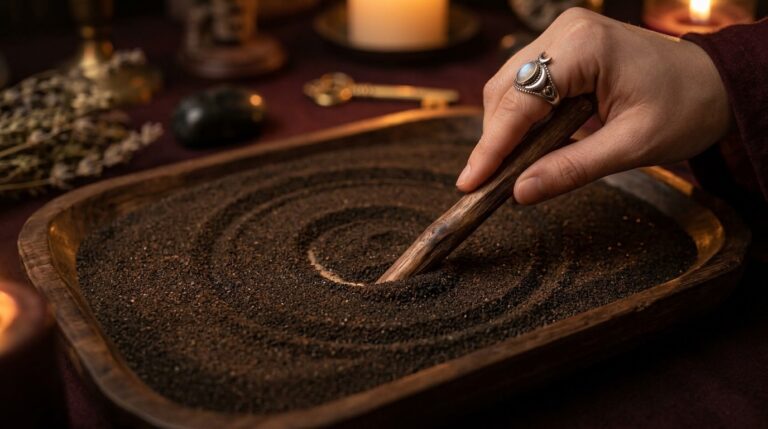
Find a quiet space and a sheet of paper. Start at the center and draw a spiral outward, slowly, without rushing the line. As you draw, name something you’re moving away from at the center. Then name something you’re growing toward at the outer edge. Sit with the finished drawing for a moment. Then put it somewhere you’ll see it, on your altar or a wall you pass daily. Revisit it in a month and notice what’s shifted since you drew it. Some practitioners keep a running series of these drawings, one per moon cycle. Over a year, the stack becomes a visual record of where your life actually went, rather than where you expected it to go. The spiral doesn’t promise a straight path forward, and that’s exactly the point. For more grounding rituals to build into your regular practice, browse our full spells library.
Not sure where to start? You don’t have to do this alone.
Madame Celestine offers guided spellwork for beginners — real support for your first working, not just another guide to read.
Related reading: Exploring 11 Goddesses of Darkness: Sacred Names for Spirits of the Dark: Symbolism, Tradition & Personal Practice · Working with How to Talk to Spirits: Mediumship and Psychic Connection: Ritual Context, Meaning & Practice

About Madame Celestine
Madame Celestine has practiced and taught spellwork, divination, and seasonal ritual for over two decades, helping newcomers build a grounded, confident practice from their very first spell.