

You want to deepen a commitment, maybe to a partner, a path, or a version of yourself you’re building. At the same time, you’re wary of vanishing into it. That tension is common. It’s worth taking seriously before you design a dedication ritual around it.
What a Satanic Dedication Ritual Actually Commits You To
A dedication ritual formalizes intention. It’s a declared commitment, spoken and witnessed by yourself, to a relationship, practice, or set of values. It isn’t a binding contract that overrides your future choices.
Some practitioners use candles, cords, or written vows to mark the moment. Others prefer something quieter, like a single spoken statement at dusk. Neither approach is more valid than the other. What matters is that the ritual reflects a choice you actually made, not one you felt pressured into.
If your dedication centers on a relationship, our commitment ritual services page outlines the general approach practitioners take. This happens well before any words get spoken aloud. The ritual marks a moment. It doesn’t remove your ability to reassess later, and it shouldn’t be treated as though it does.

Why Boundaries Matter Just as Much as Devotion
Devotion and self-erasure are not the same thing. They can start to feel similar, though, once boundaries disappear from the picture. A dedication built without limits tends to demand more of you over time, not less.
This holds true outside ritual practice too. Psychology Today’s guide to healthy boundaries in close relationships frames boundaries as a way of teaching others how to treat you. It isn’t about cutting connection off. The same principle applies to a commitment you make to a path, a practice, or another person.
Building a Dedication Ritual That Protects Your Autonomy
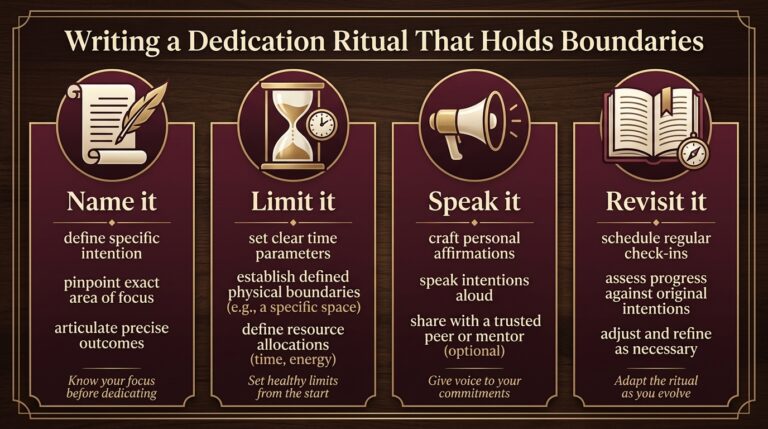
Write your commitment in specific terms rather than sweeping ones. “I dedicate myself to growing this bond with honesty” holds up better over time than an open-ended vow.
Name what you’re not committing to as clearly as what you are. This isn’t cynicism. It’s the difference between devotion and quietly disappearing into someone else’s expectations. Say the limits out loud during the ritual itself, not just in your own head.

Signs a Commitment Path Has Crossed Into Losing Yourself
Watch for shrinking opinions, interests, or friendships that used to matter to you. Watch, too, for guilt whenever you consider your own needs apart from the commitment.
A healthy dedication leaves room for you to still recognize yourself a year later. If it doesn’t, that’s information worth acting on. Don’t ignore it out of fear of breaking the vow you made.
Revisiting and Adjusting Your Commitment Over Time
Dedication rituals aren’t meant to be permanent and unexamined. Revisit yours periodically, ideally at a seasonal marker. Ask whether the terms still fit the life you’re actually living.
Adjusting a commitment isn’t a failure of the original ritual. It’s a sign you’re staying honest with yourself as circumstances change around you. Some practitioners repeat the ritual each year with updated terms, treating it as a living agreement rather than a one-time event.
Not sure where to start? You don’t have to do this alone.
Madame Celestine offers guided spellwork for beginners — real support for your first working, not just another guide to read.
Related reading: What Is an Infernal Offering? Understanding Its Place in Devotional Practice · Love, Obsession, or Closure? Finding the Right Question Before Seeking Ritual Work

About Madame Celestine
Madame Celestine has practiced and taught spellwork, divination, and seasonal ritual for over two decades, helping newcomers build a grounded, confident practice from their very first spell.