

Romantic uncertainty can make ordinary questions feel enormous. You may wonder what someone feels, whether a connection has a future, or how to find peace when answers remain unclear. In occult settings, some people encounter the idea of Satanic evocation while searching for meaning or a sense of direction. Understanding the term carefully can help separate symbolism and personal reflection from claims about controlling another person.
What Satanic Evocation Means in Occult Practice
Evocation generally refers to a ritual practice intended to call or address a spiritual presence. Its meaning varies across occult traditions, and people may approach it literally, symbolically, psychologically, or as part of a personal spiritual framework. The word alone does not tell you what a practitioner believes or what a ritual is meant to accomplish.
Satanism itself is not one uniform tradition. Some forms are theistic, while others are atheistic or non-theistic and use Satan as a symbol of individualism, questioning, or resistance to authority. The American Psychological Association’s dictionary entry on Satanism provides a reference point for the term, but it does not describe every contemporary practice or individual interpretation.
For that reason, it is useful to ask what a particular source means by “evocation” instead of assuming every ritual has the same purpose, symbolism, or expected result.

Why Romantic Uncertainty Can Make Ritual Feel Appealing
Uncertainty can leave you replaying conversations, reading into brief messages, and searching for signs. A ritual may seem appealing because it creates a deliberate pause in that cycle. It can provide structure, a private space to name emotions, and a way to reflect on what matters to you.
Those personal effects are different from proof that a ritual can reveal another person’s private feelings or change their decisions. When exploring spiritual material, keep a distinction between what a practice means to you and what can be established about another person or the relationship.
Consider what you are hoping to gain. Is it reassurance, courage to communicate, acceptance of an unclear situation, or help deciding what boundary you need? Naming the need can make the experience more grounded.
Evocation, Intention, and the Limits of Influence
Intention is often central to ritual language. Someone might use a written statement, meditation, or symbolic action to focus attention on a personal goal. In a relationship context, a constructive intention might concern self-understanding, emotional steadiness, or the willingness to speak honestly.
It is important not to treat another person as an object to be directed. Their feelings, consent, and choices remain their own. No spiritual practice should be presented as a guaranteed way to override those choices, compel affection, or secure a particular romantic outcome.
If a source promises certainty or total control, approach that claim critically. Ask whether it is describing a belief, offering metaphor, making a commercial promise, or providing evidence. These are different kinds of statements and should not be confused.

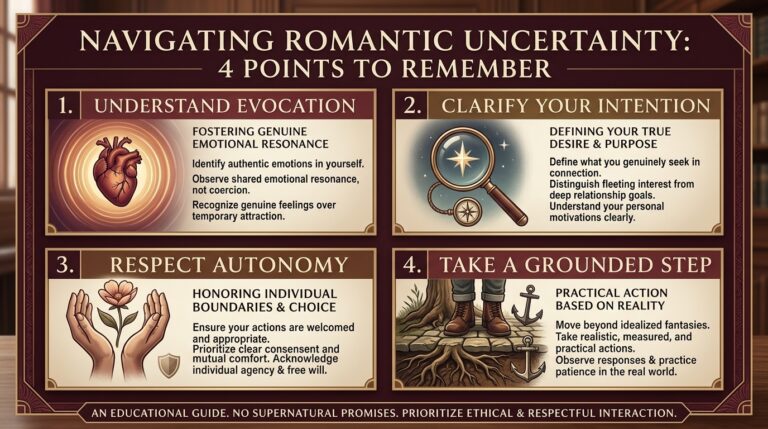
Questions to Ask Before Exploring a Spiritual Working
Before engaging with a ritual described as evocation, pause and consider a few questions:
- What do I actually want? Try to describe the need beneath the immediate romantic question.
- What do I believe this practice represents? Be clear about whether you view it as spiritual, symbolic, meditative, or something else.
- Does the approach respect everyone’s autonomy? Avoid framing another person’s consent or emotions as something to take away.
- What practical step could support me? Consider an honest conversation, a boundary, time away from repeated checking, or support from someone you trust.
These questions do not require you to adopt or reject a particular belief. They help you remain thoughtful about your expectations and the effect the practice may have on your choices.
Finding Clarity Without Surrendering Your Agency
You may not be able to resolve romantic uncertainty immediately. You can, however, decide how you respond to it. Write down what you know, what you are assuming, and what you still need to ask. If it feels appropriate and safe, communicate directly rather than relying only on hints or interpretations.
Make room for the possibility that the answer may not be the one you hoped for. That possibility can hurt, but acknowledging it can also help you protect your time, dignity, and emotional well-being. Choose actions that reflect your values instead of actions driven by urgency or fear.
If you want to explore spiritual traditions, read across sources and take time to understand their different meanings. You can also use a simple reflective practice without making promises about supernatural results. For further general exploration, see our spells and ritual practice guide.
Ultimately, the most useful outcome is not certainty at any cost. It is greater clarity about your own intentions, respect for the other person’s freedom, and a grounded next step you can choose for yourself.
Not sure where to start? You don’t have to do this alone.
Madame Celestine offers guided spellwork for beginners — real support for your first working, not just another guide to read.
Related reading: Goetic Rituals and Relationship Uncertainty: What Beginners Should Know · The Infernal Pact Explained: Meaning, Symbolism, and Questions to Ask First

About Madame Celestine
Madame Celestine has practiced and taught spellwork, divination, and seasonal ritual for over two decades, helping newcomers build a grounded, confident practice from their very first spell.