
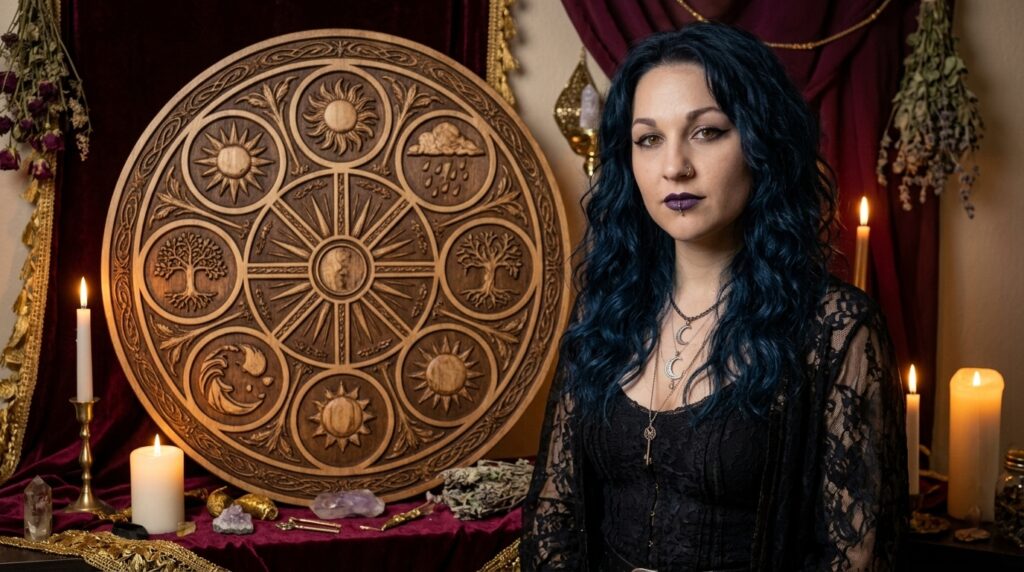
You want to actually follow the Wheel of the Year instead of scrambling to Google “when is the next sabbat” every few weeks. Between solstices that shift by a day or two, cross-quarter festivals with three different spellings, and half the internet listing Southern Hemisphere dates without saying so, it’s easy to lose track. Here’s every 2026 date in one place, what each sabbat actually celebrates, and how to build a printable page you can pin above your altar so you never have to search again.
What Is the Wheel of the Year? Tracing the Eight Sacred Points
The Wheel of the Year is the annual cycle of eight sabbats observed in Wicca and modern Paganism, alternating between four solar festivals — the solstices and equinoxes — and four cross-quarter “fire festivals” that fall roughly between them. The framework as practiced today is a 20th-century synthesis, built by Wiccan founders in the 1950s and 60s who drew on older Celtic, Germanic, and Anglo-Saxon seasonal customs rather than reviving a single ancient calendar wholesale. That doesn’t make it less meaningful; it means the Wheel is a living tradition, still shaped by the people who keep it. Each turn marks a shift in light, harvest, or season, giving practitioners a rhythm to plan rituals, reflection, and gratitude around.
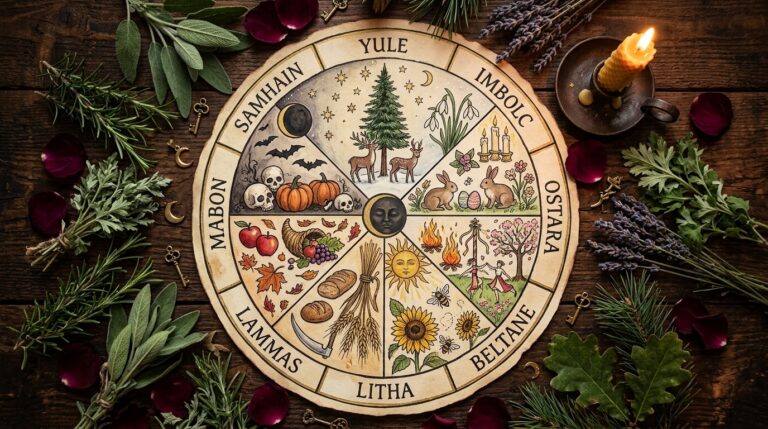
The 8 Sabbats and Their 2026 Dates
Solstice and equinox dates shift slightly each year because the calendar year doesn’t divide evenly into the solar year, so it’s worth checking against an ephemeris rather than memorizing a fixed date. Here’s the Northern Hemisphere lineup for 2026:
Imbolc — February 1–2. Ostara (Spring Equinox) — March 20. Beltane — April 30–May 1. Litha (Summer Solstice) — June 21. Lughnasadh (Lammas) — August 1. Mabon (Autumn Equinox) — September 22–23. Samhain — October 31. Yule (Winter Solstice) — December 21.
If you’re in the Southern Hemisphere, the wheel runs six months offset — Samhain lands near your spring, Beltane near your autumn — so swap each sabbat with the one directly opposite it on the wheel rather than using the Northern dates as written.
What Each Sabbat Celebrates: Themes, Symbols & Simple Practices
Imbolc marks the first stirrings of spring under the snow, and it’s traditionally tied to Brigid, hearth fires, and small acts of purification like sweeping out old energy. Ostara celebrates balance as day and night reach equal length, making it a natural time for planting intentions alongside seeds. Beltane is a fire and fertility festival, historically marked with bonfires, maypoles, and honoring the land’s peak vitality. Litha, the longest day, calls for outdoor ritual and sun-honoring work at the height of summer’s strength. Lughnasadh is the first harvest, centered on bread, grain, and gratitude for early abundance. Mabon is the second harvest and a time for balance again, this time tipping toward rest. Samhain, the best known sabbat, honors ancestors and thins the veil between worlds. Yule marks the return of the light at the year’s longest night, often kept with candles, evergreens, and quiet reflection. A simple practice for any sabbat is to light one candle, name what the season is asking you to release or welcome, and let it burn down while you sit with that intention.

Belief, Intention & The Power of Magic
Witchcraft, spells, and manifestation are deeply rooted in belief, intention, and spiritual practice. If these practices do not resonate with you, this may not be the path for you, and that’s perfectly okay. But if you believe in divine powers, trust your intentions, and feel drawn to the mysteries of the unseen, we invite you to continue exploring with Madame Celestine and discover the magic that speaks to your soul.
Building Your Own Printable Wheel of the Year Page
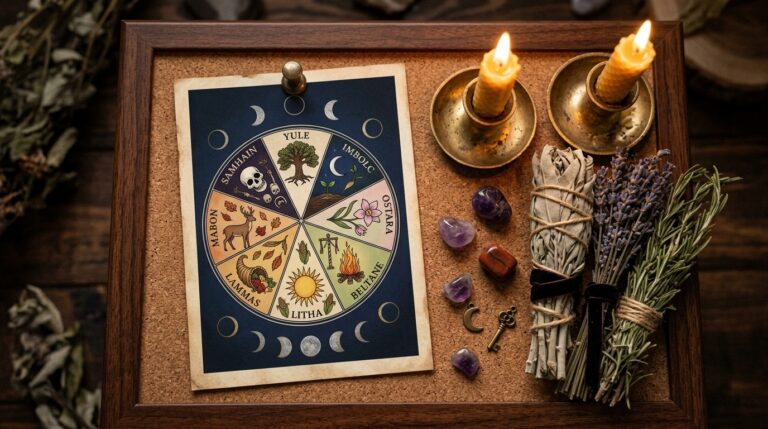
A printable Wheel of the Year page works best when it does three things at once: shows the circle itself, lists this year’s confirmed dates, and leaves room for your own notes. Start with a plain circle divided into eight even sections, one per sabbat, and label each with its name and date. Around the outside edge, add a thin ring for correspondences — a color, herb, or stone for each sabbat — so the page doubles as a quick-reference altar card. Leave a blank line under each section for a one-word intention you’ll fill in closer to the date, rather than pre-writing it months in advance. Print it on cardstock if you plan to keep it up all year, and pin it somewhere you’ll actually see it — a kitchen corkboard works better for consistency than a spellbook that stays closed most days. If you’d rather sketch it by hand, that’s traditional too; hand-drawn wheels are common precisely because redrawing one each year is itself a small ritual.
For a broader look at how one specific sabbat plays out in practice, this guide to Beltane bonfire rituals walks through fire-festival traditions in more depth.
Common Mistakes When Tracking the Wheel of the Year
The most frequent error is copying a fixed date from an old post without checking the current year, which throws off the solstice and equinox sabbats by a day or two. Another is applying Northern Hemisphere dates while living south of the equator, which puts your Samhain in spring instead of autumn. Some practitioners also treat all eight sabbats as equally elaborate, then burn out by March; it’s fine to mark the minor ones with a single candle and save bigger ritual work for the sabbats that mean the most to you. According to the World History Encyclopedia’s overview of the Wheel of the Year, the modern eight-sabbat structure itself is a 20th-century synthesis rather than an unbroken ancient calendar, which is worth remembering if a tradition ever feels too rigid to adapt to your own life.
Frequently Asked Questions
Do I have to celebrate all eight sabbats?
No. Many practitioners focus on the sabbats that feel most meaningful to their own path, such as Samhain and Yule, and mark the others with a smaller gesture like lighting a candle.
Why do solstice and equinox dates change every year?
The solar year doesn’t divide evenly into 365-day calendar years, so the exact moment of each solstice and equinox shifts by about six hours annually, occasionally crossing into a different calendar date.
What’s the difference between Yule and Christmas?
Yule is a solstice-based Pagan festival marking the return of the light, celebrated on the winter solstice itself, while Christmas is a fixed-date Christian holiday on December 25 that later absorbed some Yule symbolism like evergreens and candles.
How do Southern Hemisphere sabbat dates work?
Southern Hemisphere practitioners typically shift the wheel six months, so Samhain is celebrated near the Northern Hemisphere’s Beltane date and vice versa, keeping each sabbat aligned with its actual season.
Can I celebrate a sabbat on a different day than its exact date?
Yes. Many practitioners celebrate on the nearest weekend for practical reasons, since the meaning comes from intention and timing within the season, not from hitting the astronomical moment precisely.
What’s a good first sabbat for someone new to this practice?
Samhain and Yule tend to be the most approachable starting points, since their themes — honoring the past and welcoming returning light — are intuitive even without deep study of the full wheel.
Not sure where to start? You don’t have to do this alone.
Madame Celestine offers guided spellwork for beginners — real support for your first working, not just another guide to read.
Related reading: Working with Full Moon Correspondences: The Essence of Lunar Energy: Ritual Context, Meaning & Practice · A Moon Water Recipe for Every Phase: Boost Your Magick Powers: Ingredients, Preparation & Ritual Use

About Madame Celestine
Madame Celestine has practiced and taught spellwork, divination, and seasonal ritual for over two decades, helping newcomers build a grounded, confident practice from their very first spell.