
The relationship is struggling and you’re stuck deciding what to do about it. A friend mentions a ritual consultation, another suggests couples counseling, and nobody explains how the two are actually different or which one fits what you’re dealing with. Booking the wrong kind of support wastes money and time you don’t have to spare, so it’s worth understanding what each one is actually built to do before you pick up the phone.
What a Satanic Ritual Consultation Actually Offers
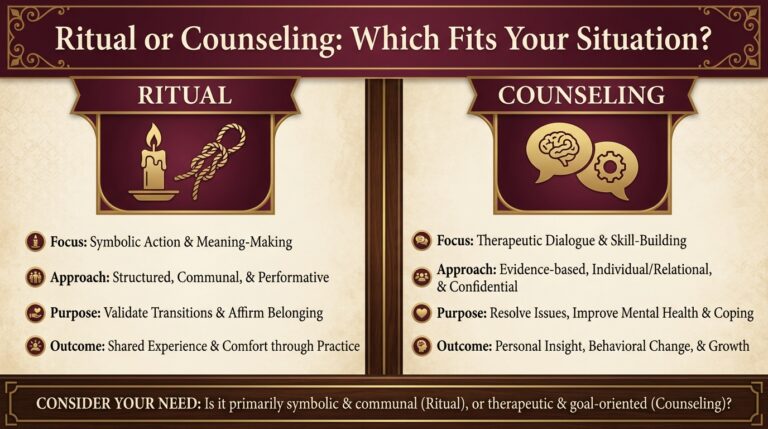
A Satanic ritual consultation is a symbolic and intention-focused practice. It’s built around clarifying what you want, setting deliberate intention, and working through personal or spiritual material — often for one person, even when the relationship involves two. A practitioner might help you process grief, resentment, or hope through ritual, but they are not mediating a conversation between you and your partner, and they aren’t trained to diagnose or treat relationship dynamics clinically.
Ritual work is most useful when what you need is internal clarity: understanding your own intentions, processing an emotion you haven’t been able to name, or marking a decision you’ve already made. It isn’t designed to change another person’s behavior or resolve a structural conflict between two people.
What Relationship Counseling Actually Offers
Relationship or couples counseling is a clinical, evidence-based process, usually involving both partners in the room with a licensed therapist. The therapist’s job is to observe communication patterns, teach conflict-resolution tools, and help both people understand what’s actually breaking down between them — not just what each person feels individually.
According to Cleveland Clinic, marriage counseling has an improvement rate of roughly 70 to 80 percent and works by rebuilding communication, honesty, and trust so partners can navigate conflict as a team instead of adversaries. That structured, dual-perspective process is something ritual work simply isn’t designed to replicate.
How to Tell Which Kind of Support Your Situation Calls For
Start by naming what’s actually happening. If the core issue is a recurring argument, a communication breakdown, or a decision both partners need to make together, that points toward counseling — it requires both people and a structured process. If the core issue is your own grief, an intention you want to set, or a decision you’ve already made and need to process internally, ritual work may be the better fit.
A simple gut check: does resolving this require the other person to change, understand, or participate? If yes, counseling is built for that. If the work is entirely about your own clarity, closure, or intention, ritual consultation fits better. Some situations genuinely call for both, addressed one at a time rather than blended together. For a closer look at a related distinction, our piece on reconciliation or release walks through how to tell which of those two paths actually matches your situation.
Belief, Intention & The Power of Magic
Witchcraft, spells, and manifestation are deeply rooted in belief, intention, and spiritual practice. If these practices do not resonate with you, this may not be the path for you, and that’s perfectly okay. But if you believe in divine powers, trust your intentions, and feel drawn to the mysteries of the unseen, we invite you to continue exploring with Madame Celestine and discover the magic that speaks to your soul.
Can Ritual and Counseling Work Together?
They can, as long as you’re clear about what each is doing. Some people use ritual work to process the emotional weight of a relationship before or between counseling sessions — it gives you a private space to sit with feelings you might not be ready to bring into a room with your partner yet. Others use ritual afterward, to mark a decision the counseling process helped them reach.
What doesn’t work is treating either one as a substitute for the other. Ritual isn’t a shortcut around the harder, slower work of couples counseling, and counseling isn’t a replacement for the personal, spiritual processing ritual work offers. Used for what they’re each actually built for, they can support different parts of the same difficult season.

Red Flags in Either Approach
In ritual work, be cautious of any practitioner who claims a ritual can force another person’s feelings, guarantee a specific outcome, or replace an honest conversation entirely. In counseling, be cautious of a therapist who consistently takes one partner’s side, dismisses concerns without exploring them, or doesn’t leave you feeling steadier after sessions over time.
Whichever path you choose, you should leave feeling more grounded and clearer about your own choices — not more confused, more dependent on the practitioner, or more certain that someone else can fix the relationship for you.
Frequently Asked Questions
Can a Satanic ritual replace couples counseling?
No. Ritual work supports personal intention and processing, while counseling addresses the structural, two-person dynamics a ritual isn’t built to change.
Do I need my partner’s participation for a ritual consultation?
No. Most ritual consultations are designed around the individual seeking them, even when the situation involves a relationship.
How do I know if my relationship issue needs a therapist instead of ritual work?
If resolving it requires your partner to understand, change, or participate directly, that points toward counseling rather than ritual work.
Is it normal to use both ritual and counseling at the same time?
Yes, as long as each is used for what it’s actually suited to — ritual for personal processing, counseling for structured, joint work.
What should I ask before booking a ritual consultation?
Ask what outcome the practitioner realistically expects, whether they claim to influence another person’s will, and how they define what the session includes.
Not sure where to start? You don’t have to do this alone.
Madame Celestine offers guided spellwork for beginners — real support for your first working, not just another guide to read.
Related reading: The Adversary Archetype: Exploring Rejection, Resilience, and Self-Determination · Can Shadow Work Help You Process a Breakup? A Satanic Practice Perspective

About Madame Celestine
Madame Celestine has practiced and taught spellwork, divination, and seasonal ritual for over two decades, helping newcomers build a grounded, confident practice from their very first spell.