

A breakup doesn’t just end a relationship. It exposes everything you were avoiding while you were in it. The resentment you swallowed. The neediness you’re embarrassed by. The anger you never let yourself feel. Most people try to move on by pushing those parts back down. Satanic shadow work takes the opposite approach. It asks you to sit with the parts of yourself the split brought to the surface, instead of shoving them back into the dark.
What “Shadow Work” Actually Means in a Satanic Framework
In LaVeyan and modern Satanic practice, the “shadow” isn’t a demon to exorcise. It’s the collection of traits you’ve disowned because they felt too ugly, too needy, or too inconvenient to admit. Satanism treats the self as the highest authority. Instead of praying jealousy or bitterness away, the practice asks you to name it, examine it, and decide what to do with it on your own terms. After a breakup, that shadow gets loud. It’s the version of you that begged. The version that lied to keep the peace. The version that stayed too long.

The goal isn’t self-flagellation. It’s ownership. A Satanic approach to shadow work treats every uncomfortable trait as information, not evidence of failure. Where some spiritual traditions ask you to forgive quickly and move on, this one asks you to slow down first. You can’t release a feeling you refuse to look at directly. A rushed forgiveness usually just delays the reckoning instead of skipping it.
A Simple Ritual Structure for Post-Breakup Shadow Work
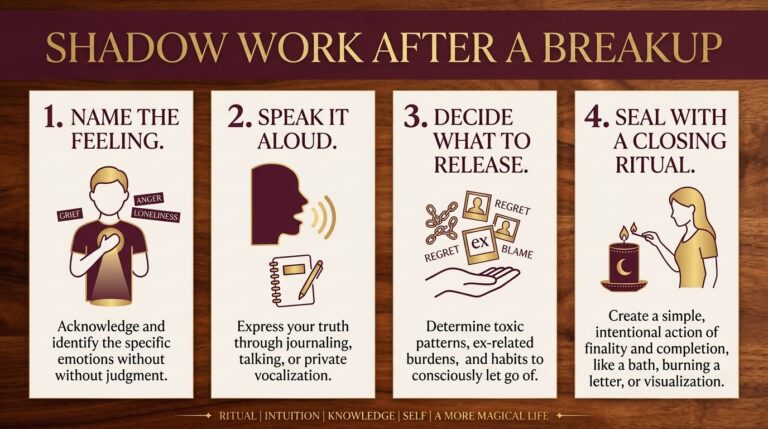
You don’t need an elaborate altar to start. A candle, a mirror, and forty-five minutes of uninterrupted time are enough. Light the candle after dark and sit facing the mirror. Ask yourself one direct question: what did this relationship reveal about me that I didn’t want to see? Write the answer without editing it. Read it back out loud to the mirror. Speaking it to your own reflection, rather than just a journal, is what separates shadow work from ordinary venting. It forces acknowledgment instead of avoidance.
Repeat this over consecutive nights if one session doesn’t surface much. Grief rarely hands over its full inventory on the first try. Some nights you’ll write a single sentence and feel done. Other nights the page fills fast. That unevenness is normal — shadow work moves at your own pace, not a fixed schedule.
Keep the pages you write. Many practitioners burn them at the end as a deliberate closing act. Reading them back a few weeks first, before burning, often reveals a pattern you missed the first time.
What Usually Surfaces — and Why It’s Not a Bad Sign
People expect shadow work to reveal noble insights. More often it reveals pettiness: the urge to check their new partner’s profile, satisfaction at their bad luck, anger that outlasts the relationship by months. None of that means you’re a worse person than you thought. It means the relationship gave those traits a place to live. Now they’re unhoused and looking for somewhere to go.

Naming the trait out loud — “I am angry, and I want them to hurt too” — takes away its power to run the show quietly in the background. What you don’t name tends to leak into your next relationship instead. It shows up as unexplained jealousy, guardedness, or testing a new partner for the same betrayal the old one committed.
Building Closure Without Needing the Other Person’s Participation
Shadow work suits post-breakup healing better than waiting on an apology, mostly because it doesn’t require the other person at all. Our guide to sigil magic for heartbreak pairs well with this practice. Shadow work names what’s unresolved inside you. A closure sigil gives that resolution a physical end point. Together they replace the conversation you may never get with one you have entirely on your own terms.
Knowing When to Pause the Practice
Shadow work should surface material you can sit with, not material that overwhelms you. It’s a practice meant to build self-awareness gradually, not to force a crisis. If a session leaves you spiraling for days instead of settling, that’s a signal to slow down. Carl Jung, who originated the shadow concept in psychology, framed the work as gradual integration, not confrontation for its own sake. Cleveland Clinic’s overview of shadow work makes the same point: the goal is self-awareness, not re-traumatization. If breakup grief feels unmanageable on your own, a licensed therapist can help you do this work.
Frequently Asked Questions
Is Satanic shadow work the same as Jungian shadow work?
They share the same core idea: integrating disowned traits instead of suppressing them. Satanic practice frames it as self-ownership and ritual rather than clinical therapy.
How long does shadow work take to help after a breakup?
Most people notice the loudest feelings quiet down after several sessions over a few weeks. Grief timelines still vary by relationship and person.
Do I need an altar or special tools to start?
No. A candle, a mirror, and privacy are enough to begin; more elaborate ritual tools are optional additions, not requirements.
Can shadow work replace therapy after a difficult breakup?
No. It’s a self-reflection practice, not a substitute for professional mental health support, especially if grief feels unmanageable.
What if I don’t like what I discover about myself?
That discomfort is normal and expected. The practice is about acknowledging traits honestly, not judging yourself for having them.
Not sure where to start? You don’t have to do this alone.
Madame Celestine offers guided spellwork for beginners — real support for your first working, not just another guide to read.
Related reading: Satanic Conjuration in Occult Literature: What the Term Means and What It Doesn’t · The Infernal Altar and a Broken Heart: A Beginner’s Guide to Ritual Preparation

About Madame Celestine
Madame Celestine has practiced and taught spellwork, divination, and seasonal ritual for over two decades, helping newcomers build a grounded, confident practice from their very first spell.