

You have seen the word in a secondhand grimoire, in a forum thread, or in the fine print of a ritual consultation listing. It stopped you cold: conjuration. It sounds like something out of a horror film, and that is the problem. Most people meet this term stripped of its history. So they either dismiss it as nonsense or fear it as something dangerous. Neither reaction matches what the word has actually meant to writers and practitioners for centuries. Here is what conjuration really means in occult literature, how it differs from terms it gets lumped in with, and where the popular image of it parts ways with the written tradition.
- What “Conjuration” Actually Means in the Texts
- Conjuration vs. Evocation vs. Invocation: Untangling the Terms
- Where the Word Comes From: The Written Grimoire Tradition
- Popular Culture’s Version vs. the Literary Reality
- How Modern Satanic Practice Reframes the Term
- If You’re Curious About Ritual Work, Start Here
- Frequently Asked Questions
What “Conjuration” Actually Means in the Texts
In classical grimoire literature, conjuration is a formal address. It is not a magic word that forces something to appear out of thin air. The Latin root, conjurare, means “to swear together” or “to bind by oath.” A conjuration is structured language. It opens by invoking authority, names the entity or force being addressed, and states the operator’s intent, usually inside a prepared ritual space. It functions closer to a legal summons than a spell in the cartoon sense. Texts that use the term, from medieval Solomonic manuals to later Golden Dawn material, treat it as one stage within a longer ceremony, not the whole event.
That legal framing is not incidental. Many grimoire authors wrote for readers who already understood formal oaths and courtroom language, and they borrowed that structure on purpose. A conjuration typically states who is speaking, by what authority, and what is being requested, in that order. Learning this structure matters more than memorizing any single translated phrase. It explains why so many surviving conjurations across different grimoires read the same way, even when the wording varies.

Conjuration vs. Evocation vs. Invocation: Untangling the Terms
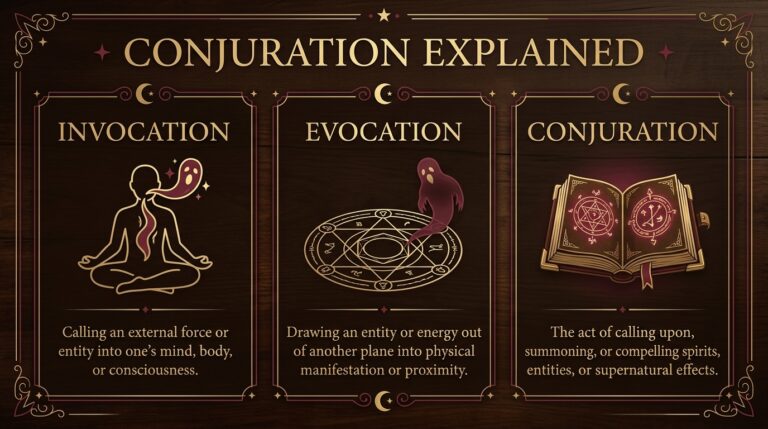
These three words get used interchangeably online, and that is where most confusion starts. Invocation traditionally means calling a force or archetype inward, to embody it within yourself. Evocation means calling something to manifest outside yourself, often into a bounded space like a circle described in the source text. Conjuration overlaps with both, but it emphasizes the formal, oath-bound language used to open or close that exchange. A single ceremony might use all three. An invocation sets the practitioner’s internal state. A conjuration formally addresses the entity. An evocation defines where that presence is meant to occur. Writers are not always consistent about these boundaries, which is part of why the terms blur together in casual use.
Translation adds another layer of confusion. Many of these terms entered English through Latin and later French editions of older manuscripts. Translators did not always agree on which Latin verb mapped to which English word. A phrase rendered as “conjuration” in one edition might appear as “evocation” in another printing of the same source. When modern commentary treats these words as fixed categories, it helps to remember that those boundary lines were drawn well after the original texts were written, often by nineteenth-century scholars trying to systematize older material for a new audience.
Where the Word Comes From: The Written Grimoire Tradition
Conjuration language survives largely because it was written down. Medieval and early modern grimoires such as The Key of Solomon, along with later compilations catalogued by occult scholars, preserved specific phrasings, diagrams, and timing instructions. Practitioners were expected to copy these precisely. These texts were controversial in their own era, too. The Church branded much of this material as forbidden. That is part of why it circulated in secret and picked up a reputation for danger that outlived the actual content. For the fuller history of how these manuals developed, and which ones are considered foundational, Encyclopedia.com’s overview of the grimoire tradition traces that lineage from Francis Barrett through the Golden Dawn’s published editions.
Related terminology from this same family of texts shows up throughout modern infernal practice discussions. If you have also run across a phrase like an enn or a devotional chant and wondered what it means structurally, our piece on what a demonic enn actually is covers similar ground from a different angle.

Popular Culture’s Version vs. the Literary Reality
Film and television treat conjuration as an instant event. Chant the right words, and something crosses over immediately and dramatically. That framing sells tickets, but it is not what the source texts describe. The written tradition treats conjuration as preparation-heavy and largely psychological in effect: weeks of study, precise timing, a controlled setting, and a great deal of internal focus. There is no documented case of a conjuration compelling an outcome against someone else’s will. Any practitioner or shop that implies otherwise is selling a story, not a ritual. Being skeptical of dramatic claims is not disrespect for the tradition. It is the same discernment any serious student of occult literature should bring to the material.
This gap between depiction and documentation matters practically, too. Someone who approaches a consultation expecting a cinematic event will almost certainly be disappointed. That can leave the false impression that the practitioner “did it wrong.” A more accurate expectation, set by reading the actual source material rather than a screenplay, tends to produce a far more grounded experience. It also protects you from anyone using theatrical claims to justify a higher price tag or an unusually invasive request.
How Modern Satanic Practice Reframes the Term
Contemporary Satanic and left-hand path frameworks, including LaVeyan-influenced approaches, generally treat conjuration language as psychodrama. It becomes a structured tool for confronting fear, naming an internal obstacle, and rehearsing the self-possessed state the practitioner wants to carry afterward. The entity or force named in the ritual is engaged as a symbol worth taking seriously, not necessarily as an external agent with independent will. This reframing does not erase the historical weight of the terminology. It repositions the practitioner as the one doing the work, which is a meaningfully different posture than waiting for something outside yourself to act on your behalf.
That shift also changes what counts as success. A ritual built around conjuration language, understood this way, succeeds when the practitioner leaves with more clarity, resolve, or self-possession than they started with. It does not succeed because an external event occurred on command. That is a harder story to market with dramatic imagery. It is also a more honest description of what people who take this seriously actually report experiencing.
If You’re Curious About Ritual Work, Start Here
Reading about conjuration and performing a ritual built around it are two different commitments. If the topic genuinely interests you, start with primary and secondary sources rather than short-form social content. Get clear on what outcome you actually want. Treat any paid ritual consultation as a conversation, one where you can ask direct questions before committing. A practitioner worth working with can explain their process in plain language, without leaning on mystique to dodge your questions.
It also helps to separate curiosity from urgency. Maybe you are drawn to this material because you are processing something difficult: a breakup, a career setback, a sense of powerlessness. That context matters, and a good consultation makes room for it rather than rushing straight to ritual mechanics. Terminology like conjuration sounds intense because it was written to carry weight. Treating that weight with care, rather than dismissing it or getting swept up by it, is what separates informed interest from getting talked into something you don’t fully understand.
Frequently Asked Questions
Is conjuration the same thing as summoning a demon?
Not in the way film and television portray it. In the written tradition, conjuration is formal ritual language used to address a named force within a prepared ceremony. It is not an instant, involuntary summoning.
What is the difference between conjuration and evocation?
Evocation traditionally means calling a presence to manifest in a defined external space. Conjuration refers more specifically to the oath-bound, formal language used to open that address. The two terms overlap and are often used together in the same ceremony.
Do I need a grimoire to understand this terminology?
No. You can learn the history and vocabulary from reputable reference sources without owning or working from a grimoire yourself. Understanding the language is a separate step from practicing with it.
Is Satanic conjuration dangerous?
The historical and literary record does not support claims that conjuration language compels outcomes against anyone’s will. Most contemporary practitioners describe it as internal, symbolic work rather than something with external force.
Where should I start if I want to learn more?
Begin with reputable historical overviews of the grimoire tradition. Then look at how practitioners in your specific tradition of interest describe their own approach, since interpretations vary widely between lineages.
Can I write my own conjuration instead of using a traditional one?
Many modern practitioners do exactly that. The historical texts function more as a template than a fixed script. Understanding the structure, naming the force, stating your intent, closing with clarity, matters more than reciting a specific author’s exact wording.
Not sure where to start? You don’t have to do this alone.
Madame Celestine offers guided spellwork for beginners — real support for your first working, not just another guide to read.
Related reading: The Infernal Altar and a Broken Heart: A Beginner’s Guide to Ritual Preparation · Satanic Dedication Rituals: Exploring Commitment Without Losing Your Boundaries

About Madame Celestine
Madame Celestine has practiced and taught spellwork, divination, and seasonal ritual for over two decades, helping newcomers build a grounded, confident practice from their very first spell.