

You’ve opened a grimoire or ritual text and found a list of titles — King, Duke, President, Marquis — attached to names you don’t recognize. It reads like a royal court roster, not a book of magic. Is this hierarchy something you’re supposed to understand before you work with it, or just decorative flourish left over from an old manuscript? It’s worth knowing where it came from before deciding how much weight to give it.
What “Infernal Hierarchy” Actually Refers To
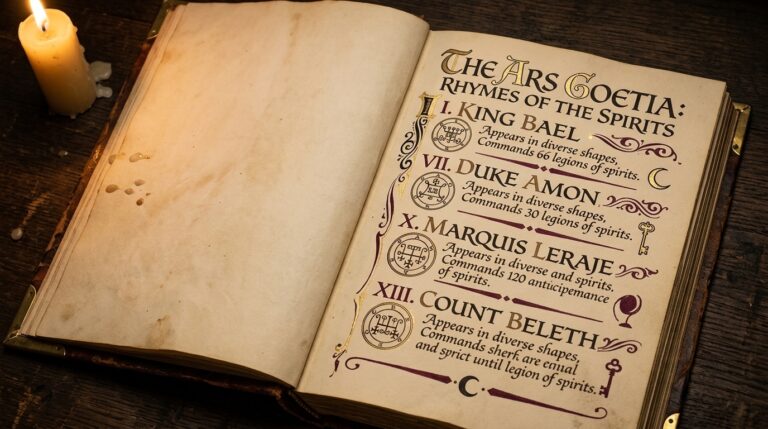
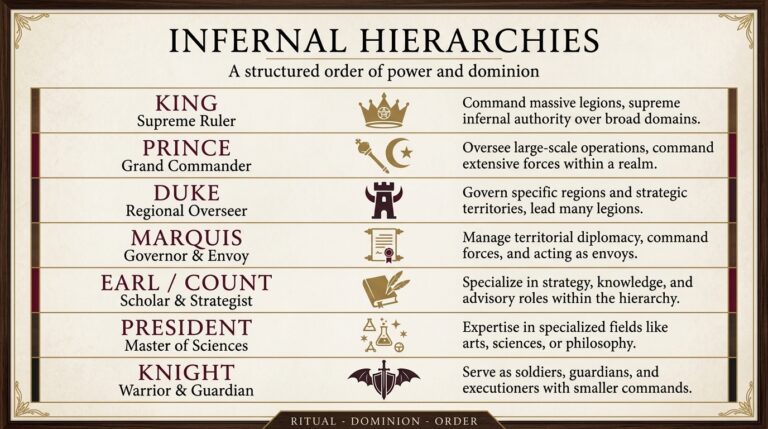
Infernal hierarchy refers to the ranked structure of spirits found in grimoires, most famously the Ars Goetia section of the Lemegeton, or Lesser Key of Solomon. Entities are assigned titles like King, Duke, Prince, President, Marquis, Earl, and Knight, each with a described rank, number of legions commanded, and specific areas of influence.
This isn’t unique to any single text. Multiple historical grimoires organized their spirit entries this way, treating the infernal realm as a mirrored, inverted court structure rather than an undifferentiated mass of demons.
Where This Ranking System Comes From
The titles borrowed directly from medieval and early modern European nobility and court structure — the same vocabulary used for actual kings, dukes, and earls of the period. Grimoire authors mapped that familiar social order onto the spirit world, giving each entity a rank that made its relative standing legible to readers already fluent in feudal hierarchy.
According to Encyclopedia.com, grimoires like the Lemegeton catalog spirit entities and provide instructions for invoking them, part of a broader tradition of detailed ritual and spell manuals compiled across centuries. The hierarchy wasn’t necessarily theological doctrine; it was an organizing tool borrowed from the culture that produced it.
Why Rank Matters (or Doesn’t) in Modern Practice
For most modern Satanic and Luciferian practitioners, infernal hierarchy functions symbolically rather than as literal cosmology. Treat it as a framework for organizing intention: a “King” designation might signal an entity associated with broad, authoritative influence, while a “Knight” might suggest something more focused or tactical. This gives practitioners a structured vocabulary for matching a working’s scope to the symbolism they’re drawing on.
If you’re using a grimoire’s hierarchy in your own practice, start by reading the described domain and rank together, rather than picking a name at random. The rank is context for the description, not a separate rule to follow on its own.
It also helps to remember that these texts were compiled by different authors across different periods, sometimes contradicting each other on details. Treating the hierarchy as a living, interpretive tradition rather than a single fixed authority tends to produce a more grounded practice than trying to reconcile every discrepancy between sources.
Belief, Intention & The Power of Magic
Witchcraft, spells, and manifestation are deeply rooted in belief, intention, and spiritual practice. If these practices do not resonate with you, this may not be the path for you, and that’s perfectly okay. But if you believe in divine powers, trust your intentions, and feel drawn to the mysteries of the unseen, we invite you to continue exploring with Madame Celestine and discover the magic that speaks to your soul.
Figures Traditionally Associated With Prosperity and Ambition
Within traditional infernal hierarchies, certain entries are specifically associated with knowledge, eloquence, favor, or worldly influence — themes that map naturally onto prosperity and career-focused practice. Practitioners drawing on this symbolism for ambition-related work often look specifically at entries described as governing favor, persuasion, or command over others, rather than assuming any high-ranking title automatically applies to money matters.
If you’re newer to working with named entities from a hierarchy like this, our piece on Goetic rituals for beginners covers foundational context worth reading first.
Common Misreadings of Infernal Hierarchy
A frequent mistake is treating the hierarchy as a literal chain of command you need to navigate correctly, like a bureaucracy with consequences for skipping levels. It’s better understood as a descriptive framework than a rulebook with penalties. Another common misreading is assuming higher rank always means “more powerful for my purposes” — a King-ranked entry with a broad domain isn’t necessarily more useful for a specific, narrow intention than a more focused lower-ranked one.
Reading the actual description of an entity’s domain matters more than fixating on its title alone. A third common misreading treats the hierarchy as fixed and universal across all traditions, when in practice different lineages and individual practitioners interpret, adapt, or set aside parts of it entirely based on their own study and experience.
Frequently Asked Questions
Is infernal hierarchy the same across all grimoires?
No. Different grimoires assign different ranks and sometimes different names to similar entities, so it’s worth treating each text as its own internally consistent system.
Do I need to understand the whole hierarchy before working with a single entity?
No. Understanding the specific entry you’re drawing on matters more than memorizing the entire structure.
Where did the King, Duke, and Earl titles originate?
They’re borrowed from medieval and early modern European nobility, mapped onto spirit entries by the authors who compiled these grimoires.
Does a higher-ranked title mean a stronger ritual outcome?
Not necessarily. Rank describes traditional standing within the text, not a guarantee of effectiveness for your specific intention.
Is it disrespectful to question or reinterpret this hierarchy?
Most modern practitioners treat these texts as historical frameworks to engage with thoughtfully, not fixed doctrine beyond question.
Not sure where to start? You don’t have to do this alone.
Madame Celestine offers guided spellwork for beginners — real support for your first working, not just another guide to read.
Related reading: Luciferian Self-Mastery for Career Frustration: An Occult Perspective · The Grimoire of Prosperity: What to Know Before Commissioning Occult Work

About Madame Celestine
Madame Celestine has practiced and taught spellwork, divination, and seasonal ritual for over two decades, helping newcomers build a grounded, confident practice from their very first spell.