

You’re good at your job, but the frustration keeps building anyway — passed over, ignored, stuck watching decisions get made without you in the room. Generic career advice tells you to “stay patient” or “network more,” but that doesn’t touch the real issue: you feel powerless in a situation where your effort clearly isn’t the thing determining the outcome. Luciferian self-mastery starts from a different premise entirely: power you build yourself, rather than power you wait to be given.
What Luciferian Self-Mastery Actually Means
Self-mastery, in Luciferian thought, centers on self-created knowledge and agency rather than waiting for permission, validation, or rescue from an external authority. Applied to career frustration, it reframes the question from “when will someone finally recognize me” to “what am I actually building, regardless of whether they do.”
This isn’t about pretending the frustration doesn’t matter, or pretending your workplace’s dysfunction is fine. It’s about locating your power somewhere that doesn’t depend entirely on someone else’s decision to grant it.
Why Career Frustration Often Signals a Deeper Power Imbalance
Career frustration rarely comes from nowhere. It usually tracks closely with a lack of genuine control — over your workload, over how decisions get made, over whether your contributions actually shape outcomes. Mayo Clinic identifies lack of control and unclear expectations as leading causes of job burnout, alongside workplace conflict and poor work-life balance.
Naming this clearly matters, because it shifts the frustration from a vague, diffuse feeling into something specific enough to actually work with. Powerlessness responds to reclaimed agency; vague dissatisfaction doesn’t respond to much of anything.

A Self-Mastery Ritual for Reclaiming Agency at Work
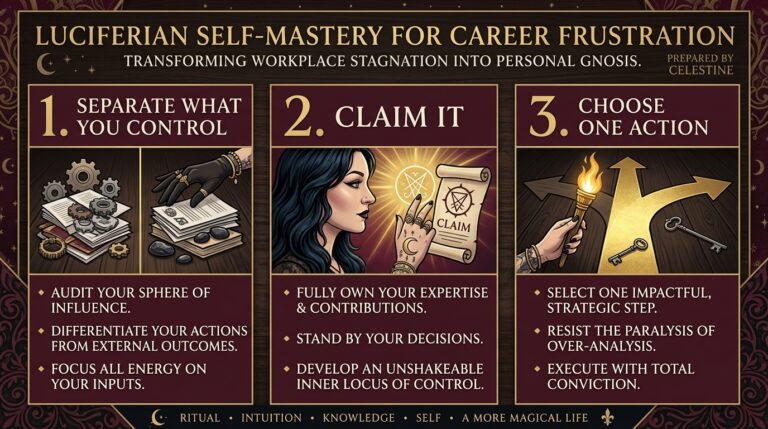
Light a black candle to mark a deliberate pause from the frustration cycle. Write down, specifically, what part of your work situation you don’t currently control — a decision, a promotion timeline, someone else’s opinion of you. Read it aloud, then set it aside physically, even moving it to another part of the room.
Now write down what you do control: your skill development, how you spend your energy, which opportunities you pursue outside this one path. State this list aloud as a claim, not a hope: “This is mine regardless of what happens with the rest.” Close by naming one specific action within your actual control that you’ll take this week.
Belief, Intention & The Power of Magic
Witchcraft, spells, and manifestation are deeply rooted in belief, intention, and spiritual practice. If these practices do not resonate with you, this may not be the path for you, and that’s perfectly okay. But if you believe in divine powers, trust your intentions, and feel drawn to the mysteries of the unseen, we invite you to continue exploring with Madame Celestine and discover the magic that speaks to your soul.
Turning Ritual Clarity Into Real Workplace Change
The point of separating what you control from what you don’t isn’t comfort — it’s direction. Once you know which lever is actually yours to pull, you can act on it directly: building a skill that makes you harder to overlook, having the direct conversation you’ve been avoiding, or quietly building options outside your current role. Our piece on why talent alone isn’t enough goes further into what actually moves the needle when ability alone isn’t producing results.
Reclaiming agency doesn’t guarantee the promotion or the recognition. It guarantees you stop waiting for someone else’s decision to determine your sense of your own worth.

When Self-Mastery Becomes an Excuse to Avoid the Real Problem
This framework can quietly curdle into avoidance if you’re not careful. If “focusing on what I control” becomes a permanent reason never to have the hard conversation, apply for the internal transfer, or acknowledge that a workplace is genuinely unfair, the self-mastery language has become a way to avoid uncomfortable but necessary action rather than a way to take it.
Self-mastery should make you more capable of acting, not more comfortable doing nothing. If months pass with the same frustration and no movement, it’s worth revisiting whether the ritual’s insight actually got translated into anything real. A useful test is whether you can point to something concrete that changed because of the clarity you gained — a conversation you had, an application you sent, a boundary you set. If the answer is nothing, the ritual became a comfort instead of a catalyst, and that’s worth naming honestly.
Frequently Asked Questions
Is this ritual meant to change how my employer treats me?
No. It’s designed to clarify and strengthen your own sense of agency, not to influence someone else’s decisions directly.
How is this different from just journaling about work frustration?
The structure — separating what you control from what you don’t, then naming one concrete action — pushes the reflection toward direction rather than open-ended venting.
What if I genuinely don’t control very much in my current job?
That’s useful information in itself. If your list of what you control is very short, it may point toward a larger decision about whether this role fits you.
Can I repeat this ritual regularly?
Yes, especially during periods of high frustration. Some people find a monthly check-in useful for staying honest about what’s actually shifted.
Does this replace talking to a manager or HR about workplace issues?
No. It’s a reflective tool, not a substitute for direct workplace conversations or, where relevant, formal channels.
Not sure where to start? You don’t have to do this alone.
Madame Celestine offers guided spellwork for beginners — real support for your first working, not just another guide to read.
Related reading: The Grimoire of Prosperity: What to Know Before Commissioning Occult Work · Infernal Consecration: What It Means to Prepare an Object for Ritual Use

About Madame Celestine
Madame Celestine has practiced and taught spellwork, divination, and seasonal ritual for over two decades, helping newcomers build a grounded, confident practice from their very first spell.