
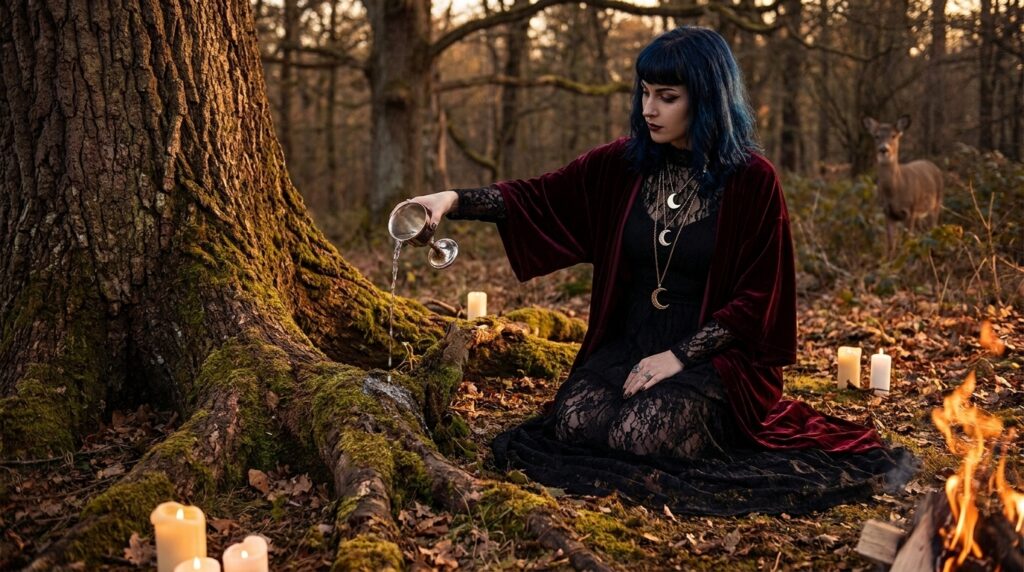
Forest goddesses show up in almost every culture that ever lived near trees, yet most lists stop at Artemis. So who else watched over the woods, the wild animals and the hunters who entered them? In this guide, you will meet eleven goddesses from Greece and Rome to Finland and India. You will learn one surprising detail about each, what her symbols mean, and how to honor forest goddesses in a simple ritual of your own.
- Mistresses of the Hunt: Artemis, Diana and Feronia
- Boar, Deer and Mountain: Celtic Forest Goddesses
- Skis, Bows and Sacred Trees: Norse and Baltic Goddesses
- Sky-Blue Robes: The Finnish Forest Goddesses
- Aranyani: India’s Vanishing Lady of the Forest
- How to Honor Forest Goddesses: A Simple Ritual
- Frequently Asked Questions
- References
Mistresses of the Hunt: Artemis, Diana and Feronia
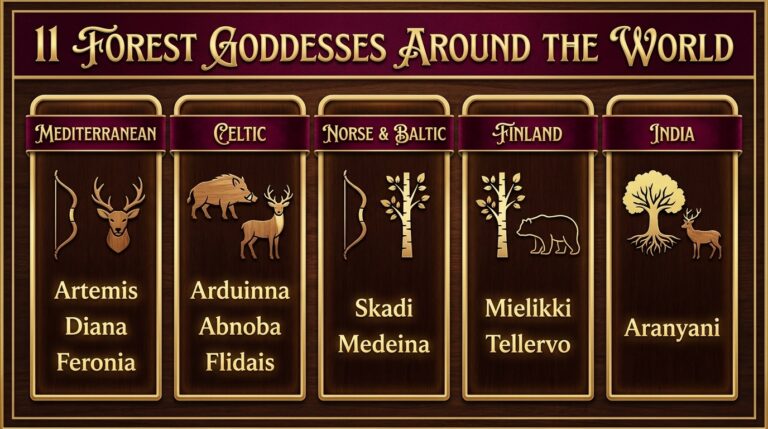
1. Artemis (Greece). Artemis ruled the wild places beyond the city walls. Homer calls her the “mistress of wild beasts,” which is a telling title. She hunted animals, yet she also protected them, especially the young.
2. Diana (Rome). Rome’s Diana took on much of Artemis’s role, but her most famous shrine was uniquely Italian. It sat in a wooded grove beside Lake Nemi, south-east of Rome. Romans called the lake the “Mirror of Diana” because it reflected the moon.[1] Her priest there, the “King of the Wood,” had to be a runaway slave who had killed the priest before him.[1] That strange rule later inspired James Frazer’s famous 1890 study, The Golden Bough.[1]
3. Feronia (Italy). Feronia is less known but just as rooted in the wild. She was honored in sacred groves and linked with fertility, wildlife and fresh growth. For this reason, she is a good choice for anyone who wants a quieter, less warlike forest goddess.

Boar, Deer and Mountain: Celtic Forest Goddesses
4. Arduinna (Gaul). Arduinna gave her name to the Ardennes, the dense forest that stretches across Belgium, Luxembourg and France. She is often linked with the wild boar. A small bronze of a huntress riding a boar is sometimes identified as her, although scholars are not certain.
5. Abnoba (Germany). Abnoba was the goddess of the Black Forest, and her name was also given to its mountains. In fact, the Roman historian Tacitus wrote that the Danube itself rises from Mount Abnoba.[2] So one of Europe’s greatest rivers was said to flow from a goddess’s mountain.
6. Flidais (Ireland). In Irish tradition, Flidais is a goddess of wild creatures, above all the deer. Her herds were said to be the deer of the forest, which she tended as a farmer tends cattle. As a result, she stands for the idea that the wild has its own keeper.
Skis, Bows and Sacred Trees: Norse and Baltic Goddesses
7. Skadi (Norse). Skadi is the winter huntress of the North. According to the Prose Edda, she often travels on skis with her bow and shoots wild beasts. She is even called the “ski-goddess.”[3] When she married the sea god Njord, they could not agree on a home. So they tried nine nights in her mountains and three by his sea, until she finally returned to the mountains for good.[3]
8. Medeina (Lithuania). Medeina is the Baltic goddess of forests and the hunt. Her name is usually linked to medis, the Lithuanian word for “tree.” Like Artemis, she is often pictured as a protector of animals as much as a huntress.
Sky-Blue Robes: The Finnish Forest Goddesses
9. Mielikki (Finland). In Finnish folk belief, Mielikki is the mistress of the forest and the wife of Tapio, the great woodland god.[4] One old account describes her dressed in sky blue.[4] Hunters also believed her mood mattered. When she favored them, she was Mielikki, meaning “the gracious.” When she did not, they called her Kuurikki, “the deaf one.”[4]
10. Tellervo (Finland). Tellervo is the daughter of Tapio and Mielikki, a young maiden of the forest. In the Finnish epic the Kalevala, a housewife sending her cattle into the woods calls on Tellervo to keep them safe. So she is a gentle choice for protecting pets, livestock and gardens.

Aranyani: India’s Vanishing Lady of the Forest
11. Aranyani (India). One of the oldest forest hymns in the world is addressed to Aranyani, in the Rig Veda. The poet calls her the goddess of the wild who seems to vanish from sight. She is heard in the chirp of crickets, which sounds like tinkling bells.[5]
The hymn also offers a lovely promise. It says the goddess never kills unless a murderous enemy comes near. Finally, it praises her as the sweet-scented mother of all wild things, who does not farm yet always has food to share.[5] In short, she is the forest as a generous host.
How to Honor Forest Goddesses: A Simple Ritual
You do not need a deep forest for this. A park, a single tree or even a houseplant will do. What matters is respect for the living world.
- Choose one goddess. Pick the forest goddess whose story speaks to you most, rather than calling on all eleven at once.
- Bring a natural offering. Choose something that will not harm wildlife, such as fresh water, a little honey or a few seeds.
- Go to your tree. Stand or sit quietly and listen for one minute. Like Aranyani’s crickets, the small sounds are part of the ritual.
- Speak her name. Say her name, then share what you are asking for, such as protection, courage or calm.
- Leave the offering and give back. Pour the water at the roots. Then, if you can, pick up a little litter before you go.
If you would like to bring more plants into your practice, our simple guide to plant magick for green witches is a natural next step.
Belief, Intention & The Power of Magic
Witchcraft, spells, and manifestation are deeply rooted in belief, intention, and spiritual practice. If these practices do not resonate with you, this may not be the path for you, and that’s perfectly okay. But if you believe in divine powers, trust your intentions, and feel drawn to the mysteries of the unseen, we invite you to continue exploring with Madame Celestine and discover the magic that speaks to your soul.
Frequently Asked Questions
Who is the most famous of the forest goddesses?
Artemis, and her Roman form Diana, are the best known. However, many other cultures had their own, from Finland’s Mielikki to India’s Aranyani.
Which forest goddess protects animals?
Several do. Artemis, Flidais and Medeina are all linked with guarding wild creatures, not only hunting them.
Can I work with forest goddesses if I live in a city?
Yes. A park, a single tree or a houseplant can serve as your connection to the green world.
What offerings do forest goddesses like?
Practitioners usually choose simple, natural gifts such as fresh water, honey or seeds. Avoid anything that could harm wildlife or leave litter.
Are forest goddesses still worshipped today?
Many modern pagans and witches honor them. Some follow reconstructed traditions, while others work with them as inspiring figures.
References
- Rex Nemorensis: The King of the Wood. Encyclopaedia Romana, University of Chicago. https://penelope.uchicago.edu/encyclopaedia_romana/miscellanea/nemi/rex.html
- Tacitus. Tacitus on Germany. Project Gutenberg. https://www.gutenberg.org/files/2995/2995-h/2995-h.htm
- Snorri Sturluson. Gylfaginning (The Fooling of Gylfe), from the Prose Edda, translated by Rasmus B. Anderson (1880). World Mythology, Volume 1: Gods and Creation, Maricopa Open Digital Press. https://open.maricopa.edu/worldmythologyvolume1godsandcreation/chapter/gylfaginning-the-fooling-of-gylfe-from-the-prose-edda-by-snorri-sturluson/
- Kristine Larsen. Ladies of the Forest: Melian and Mielikki. Journal of Tolkien Research, Volume 9, Issue 1, Valparaiso University, 2020. https://scholar.valpo.edu/cgi/viewcontent.cgi?article=1164&context=journaloftolkienresearch
- Rig Veda, Book 10, Hymn 146: Aranyani. Internet Sacred Text Archive. https://sacred-texts.com/hin/rigveda/rv10146.htm
Not sure where to start? You don’t have to do this alone.
Madame Celestine offers guided spellwork for beginners — real support for your first working, not just another guide to read.
Related reading: Working with Scrying for Beginners: PDF Guide & Wiccan Scrying Spell: Preparation, Timing & Ritual Practice · Divine Feminine: The Spiritual Meaning of Goddess Energy: Symbolism, Interpretation & Ritual Practice

About Madame Celestine
Madame Celestine has practiced and taught spellwork, divination, and seasonal ritual for over two decades, helping newcomers build a grounded, confident practice from their very first spell.