
Scrying for beginners can feel mysterious: you stare into a bowl of water or a dark mirror, and you are somehow meant to see something. So what are you actually looking for, and where did this practice come from? In this guide, you will learn what the word “scry” really means and how a queen’s advisor used an Aztec mirror to do it. You will also learn what science says happens to your eyes as you gaze, and how to try a simple Wiccan scrying spell of your own.
- What Is Scrying? A 500-Year-Old Word for Seeing
- An Aztec Mirror in Queen Elizabeth’s Court
- Mirrors, Candles and Future Husbands: Halloween Scrying
- Choosing Your First Tool: Scrying for Beginners Made Simple
- What Happens to Your Eyes When You Scry
- A Simple Wiccan Scrying Spell for Beginners
- Frequently Asked Questions
- References
What Is Scrying? A 500-Year-Old Word for Seeing
Scrying means gazing into a reflective or shifting surface to receive images, symbols or insight. The English word first appeared in the 1520s. It is a shortened form of “descry,” an older verb meaning to see, discern or spot something hidden.[1] So at its root, scrying is simply the art of seeing what is not obvious.
Almost any surface can work. People have used water, black mirrors, crystal balls, candle flames and even polished stones. When it comes to scrying for beginners, the tool matters less than the state of mind you bring to it.
Scrying is also one of many ways people have tried to read what lies ahead. If you are curious how it compares with tarot, runes and other methods, our overview of traditional and modern divination methods is a good place to start.
An Aztec Mirror in Queen Elizabeth’s Court
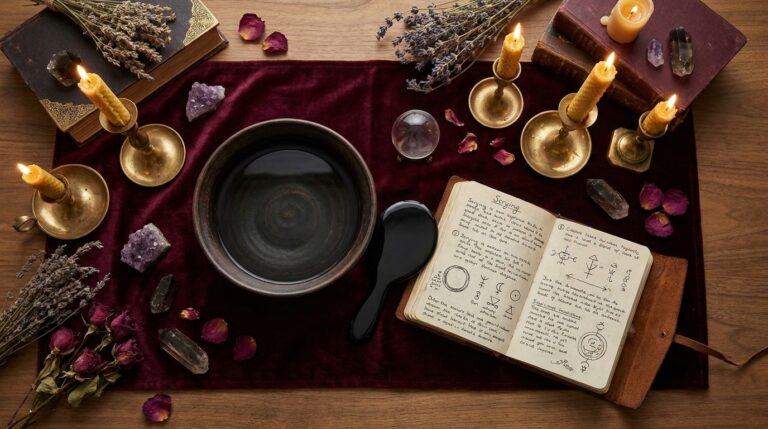
The most famous scrying tool in the Western world is a polished disc of black volcanic glass. It belonged to John Dee, the scientific advisor and astrologer to Queen Elizabeth I.[2] In the 1580s, Dee worked with mediums, most famously Edward Kelley, who gazed into mirrors or crystals to hold what Dee called conversations with angels.[2]
Here is the surprising part. In 2021, researchers tested the mirror’s chemistry and traced the obsidian to Pachuca in central Mexico. That confirmed it was a genuine Aztec object, carried to Europe soon after the Spanish conquest.[2] Today it sits in the British Museum.[2]
So the black mirror many witches use now has roots on two continents. The Aztecs linked obsidian mirrors with their own sacred traditions. Then Dee brought the same kind of object into the heart of Tudor England.
Mirrors, Candles and Future Husbands: Halloween Scrying
Scrying was not only for court magicians. Around 1900, one of the most popular Halloween customs was a kind of mirror scrying called catoptromancy. A young woman would gaze into a mirror, hoping to glimpse the face of her future husband.[3]
Candlelight was central to the ritual. In fact, one postcard from the period even includes a prayer to the “bright flame.”[3] That detail still matters in scrying for beginners, because soft, flickering light is one of the best settings to work in.

Choosing Your First Tool: Scrying for Beginners Made Simple
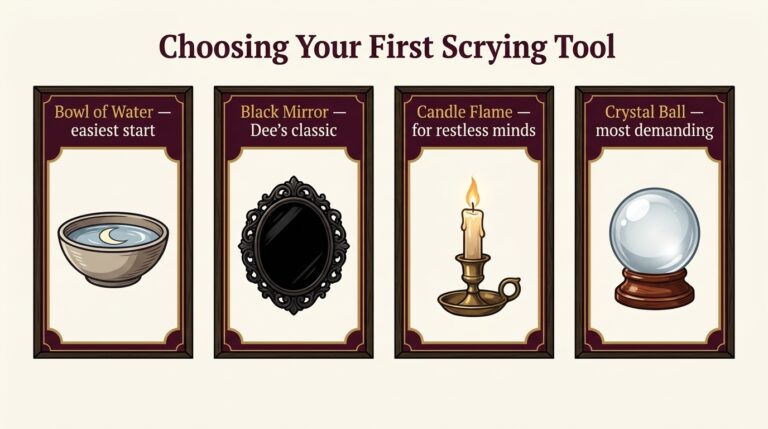
Scrying for beginners does not require anything costly. In fact, most beginners already own a good scrying tool. Here are the four most common choices, from easiest to most demanding.
- A bowl of water: the simplest option. Use a dark bowl, or add a drop of ink, so the surface turns mirror-like.
- A black mirror: the modern echo of Dee’s obsidian. You can make one by painting the back of a picture-frame glass black.
- A candle flame: good for people who find stillness hard, since the flame’s movement holds your focus.
- A crystal ball: the classic image, but often the hardest for beginners, because its clear depth can feel busy.
Whichever you choose, keep it only for scrying if you can. Many practitioners believe a tool gains strength each time you use it with the same purpose.
What Happens to Your Eyes When You Scry
If you gaze long enough, the scene in front of you will start to shift. There is a known reason for part of this. When you stare at something that does not change, your brain’s cells slowly stop responding to it. Then parts of the view seem to fade or vanish, until a blink brings them back.[4]
Mirrors add something even stranger. In a 2010 study, 50 people gazed at their own faces in a mirror in dim light. Within about a minute, most began to see their face change. Some saw the faces of parents, old women, animals or even monsters.[4]
Scientists see this as a trick of perception. Practitioners, meanwhile, often see it as the doorway itself: the moment the everyday view loosens and symbols can come through. Either way, this is one of the most useful facts in scrying for beginners, because it helps you stay calm when the images start.
A Simple Wiccan Scrying Spell for Beginners
This ritual follows common Wiccan practice, with scrying for beginners in mind. Many witches scry on the night of the full moon, when they hold their monthly moon ritual. You will need your scrying tool, one or two candles, a notebook and about 30 quiet minutes.
- Prepare the space. Dim the lights and place the candles so their flames do not reflect directly in your tool. A reflected flame is distracting.
- Cast a circle. Walk around your space clockwise, or simply picture a ring of light around you. In Wicca, this marks sacred space and keeps unwanted energy out.
- Ground yourself. Sit comfortably and take ten slow breaths. Then ask one clear, open question, such as “What do I need to know about my new job?”
- Soften your gaze. Look into the tool without straining, as if looking through it. Blink normally and let your eyes relax.
- Notice, do not force. Shapes, colors, words or feelings may drift in. Let them come and go without judging them.
- Record and close. After 10 to 15 minutes, write down everything you noticed. Finally, thank any guides you called on, open the circle and snuff the candles.
Belief, Intention & The Power of Magic
Witchcraft, spells, and manifestation are deeply rooted in belief, intention, and spiritual practice. If these practices do not resonate with you, this may not be the path for you, and that’s perfectly okay. But if you believe in divine powers, trust your intentions, and feel drawn to the mysteries of the unseen, we invite you to continue exploring with Madame Celestine and discover the magic that speaks to your soul.
Frequently Asked Questions
What is the easiest scrying method for beginners?
A dark bowl of water in candlelight is usually the easiest. It costs nothing, and its surface is calm enough to hold your focus.
How long should a beginner scry?
Start with 10 to 15 minutes. Longer sessions can tire your eyes, and short, regular practice tends to work better than one long attempt.
What if beginners see nothing when scrying?
That is very common at first. Many practitioners receive feelings, words or memories rather than clear pictures, so record whatever comes and keep practicing.
Is scrying for beginners safe?
For most people, yes. Take breaks, blink normally, and stop if you feel uneasy or dizzy.
Do I need to be Wiccan to scry?
No. Scrying is far older than Wicca and appears in many cultures, so anyone can practice it within their own beliefs.
References
- Scry. Online Etymology Dictionary. https://www.etymonline.com/word/scry
- Stuart Campbell, Elizabeth Healey, Yaroslav Kuzmin and Michael D. Glascock. The mirror, the magus and more: reflections on John Dee’s obsidian mirror. Antiquity, Volume 95, Issue 384, December 2021. Cambridge University Press. https://www.cambridge.org/core/journals/antiquity/article/mirror-the-magus-and-more-reflections-on-john-dees-obsidian-mirror/38D4BFEA2CB9766973791029C2EE1289
- Karen Renner. Monster or matrimony? The evolution of a Halloween trick. The NAU Review, Northern Arizona University, October 28, 2021. https://in.nau.edu/news/renner-halloween/
- Susana Martinez-Conde and Stephen L. Macknik. Illusory Scenes Fade into and out of View. Scientific American, July 2013. https://www.scientificamerican.com/article/illusory-scenes-fade-in-out-view/
Not sure where to start? You don’t have to do this alone.
Madame Celestine offers guided spellwork for beginners — real support for your first working, not just another guide to read.
Related reading: Divine Feminine: The Spiritual Meaning of Goddess Energy: Symbolism, Interpretation & Ritual Practice · Celtic Pentacle: Spiritual Meaning, Symbolism & Power: Symbolism, Interpretation & Ritual Practice

About Madame Celestine
Madame Celestine has practiced and taught spellwork, divination, and seasonal ritual for over two decades, helping newcomers build a grounded, confident practice from their very first spell.