

Can a goal-setting ritual actually help you move toward prosperity, or is it just candle smoke and wishful thinking? It is a fair question, and clients ask me some version of it every week. In this article, I will explain what “Satanic” means in this kind of practice. I will also share what psychology research says about goals and ritual, and how I build a grounded ritual around a real goal. By the end, you should know what a ritual can offer you and where its role stops.
What “Satanic” Really Means in a Goal-Setting Ritual
First, let’s clear up the word itself. “Satan” comes from a Hebrew word meaning an adversary, or one who opposes and obstructs.[1] In early biblical usage, it was a role rather than a personal name. So the symbol began as a figure who stands in the way.
Modern Satanic practice often flips that idea around. Anton LaVey founded the Church of Satan in San Francisco on April 30, 1966, the old festival night of Walpurgisnacht.[2] His church did not worship Satan as a literal being. Instead, it treated rituals as psychodramas meant to strengthen the ego and encourage self-assertion.[2]
That framing matters for prosperity work. In my practice, the Adversary is a symbol of the part of you that refuses to stay small. So a Satanic goal-setting ritual is not a plea to an outside power. Rather, it is a focused act where you claim a goal as your own.

Why Vague Wishes Stall and Specific Goals Move
Even the word “prosper” holds a clue. It traces back to an Old Latin phrase often read as “according to hope” or “according to expectation.”[3] In other words, prosperity was measured against something you hoped for. However, a hope has to be named before it can be measured.
Psychology backs this up. After 35 years of research, Edwin Locke and Gary Latham reported that specific, difficult goals led to better performance than simply telling people to do their best.[4] A “do your best” goal has no clear finish line, so almost any effort feels acceptable. They also found that people need feedback on their progress, because goals plus feedback work better than goals alone.[4]
This is why I never begin a ritual with “I want more money.” Instead, I ask for a number, a date, and a first action. For example, “Raise my freelance rate to $60 an hour by March” gives the ritual a clear target.
Why a Ritual Steadies You Before a Big Goal
So why add ritual at all, if a written goal already helps? The answer lies in how ritual affects your nerves. Researchers Francesca Gino and Michael Norton found that rituals done before high-pressure tasks, such as singing in public, reduced anxiety and raised confidence.[5] Their studies also found that rituals seemed to help even people who did not believe in them.[5]
Athletes know this well. Michael Jordan famously wore his old North Carolina shorts under his Bulls uniform for every game.[5] Of course, the shorts did not score points. Still, the repeated act gave him a sense of steadiness before pressure.
A Satanic goal-setting ritual works on the same human level. The black candle, the spoken words, and the sealed paper all mark a line between “thinking about it” and “committing to it.” As a result, many practitioners say they feel calmer and more decisive afterward.
How I Build a Goal-Setting Ritual, Step by Step
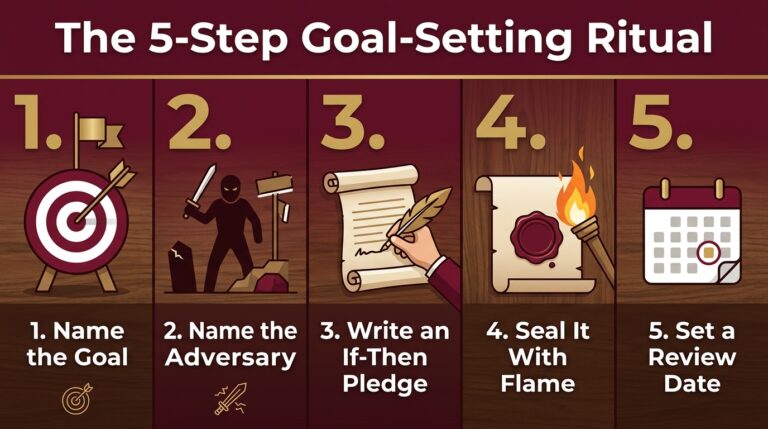
Here is the simple structure I teach. Each step has a purpose, so please don’t skip one because it feels plain.
1. Name the goal. Write one specific goal on paper, with a number and a deadline. This follows the goal research above, since a clear target is easier to pursue.
2. Name the adversary. Next, write the main obstacle underneath. It might be fear of asking, a messy budget, or a habit of waiting. Here the old meaning of Satan returns, because you are naming what stands in your way.
3. Write an if-then pledge. Then add one line in this form: “If this happens, then I will do that.” Psychologists call this an implementation intention. A review of 94 studies found these if-then plans had a medium-to-large effect on reaching goals.[6]
4. Seal it with flame. Light a black candle, which in my practice stands for the unknown and for self-rule. After that, read your goal, obstacle, and pledge aloud. Fold the paper and drip wax on it to seal your word.
5. Set a review date. Finally, mark a date on your calendar to check your progress. This is your feedback step, and it turns the ritual into a cycle instead of a single wish.
Belief, Intention & The Power of Magic
Witchcraft, spells, and manifestation are deeply rooted in belief, intention, and spiritual practice. If these practices do not resonate with you, this may not be the path for you, and that’s perfectly okay. But if you believe in divine powers, trust your intentions, and feel drawn to the mysteries of the unseen, we invite you to continue exploring with Madame Celestine and discover the magic that speaks to your soul.
Where the Goal-Setting Ritual Ends and the Real Work Begins
Now for the honest part. A ritual cannot send the email, pitch the client, or pay down the debt for you. What practitioners believe it can do is sharpen intention and steady your nerve. After that, the results depend on what you actually do.

That is why the review date matters so much. When it arrives, unfold the paper and compare your goal to where you stand. If you moved forward, note what helped. If you stalled, look again at the obstacle you named, because it may need a new if-then pledge.
I also remind clients that ambition and devotion can live side by side. If you want to explore that link further, read my piece on where infernal devotion meets personal ambition. Either way, treat the ritual as a starting gun, not the finish line.
Frequently Asked Questions
Do I have to believe in Satan to do a goal-setting ritual?
No. Many modern Satanists treat Satan as a symbol of self-rule rather than a being to worship. The ritual centers on your own goal, focus, and commitment.
Can a ritual guarantee that I will prosper?
No ritual can promise a result. Practitioners use ritual to clarify intention and build confidence, while the outcome still depends on your actions and circumstances.
What should I write down during the ritual?
Write one specific goal with a number and a deadline. Then add the main obstacle and one if-then pledge for handling it.
How often should I repeat a goal-setting ritual?
Many practitioners repeat their goal-setting ritual at each review date, often monthly. That rhythm lets you adjust the goal and pledge based on real progress.
Is a black candle required for this ritual?
A black candle is traditional in my practice, but it is not a strict rule. What matters most is that the act feels deliberate and meaningful to you.
References
- Satan (n.). Online Etymology Dictionary. https://www.etymonline.com/word/Satan
- Church of Satan. Encyclopaedia Britannica. https://www.britannica.com/topic/Church-of-Satan
- Prosper (v.). Online Etymology Dictionary. https://www.etymonline.com/word/prosper
- Building a Practically Useful Theory of Goal Setting and Task Motivation: A 35-Year Odyssey. Edwin A. Locke and Gary P. Latham, American Psychologist, 2002. Stanford Medicine (hosted PDF). https://med.stanford.edu/content/dam/sm/s-spire/documents/PD.locke-and-latham-retrospective_Paper.pdf
- Why Rituals Work. Francesca Gino and Michael I. Norton, May 14, 2013. Scientific American. https://www.scientificamerican.com/article/why-rituals-work/
- Implementation Intentions. National Cancer Institute, Division of Cancer Control and Population Sciences. https://cancercontrol.cancer.gov/brp/research/constructs/implementation-intentions
Not sure where to start? You don’t have to do this alone.
Madame Celestine offers guided spellwork for beginners — real support for your first working, not just another guide to read.
Related reading: Custom Infernal Prosperity Work vs. a General Ritual Guide: What’s Different? · Satanic Ritual Pricing: What Questions Should You Ask Before Paying?

About Madame Celestine
Madame Celestine has practiced and taught spellwork, divination, and seasonal ritual for over two decades, helping newcomers build a grounded, confident practice from their very first spell.