

You’ve written the goal down a dozen times — “grow the business,” “get promoted,” “finally make real money” — and it still feels like wishing more than working. Infernal devotion offers something different from a vague hope: a practice built around naming exactly what you want, committing to it fully, and backing that commitment with consistent, disciplined action. Here’s how devotion and ambition actually work together.
What Infernal Devotion Actually Means in Practice
Infernal devotion is a sustained, deliberate relationship with the infernal current — not a single ritual, but an ongoing practice of alignment between what you value, what you ask for, and how you act. It shows up as regular ritual work, but also as the discipline you bring to daily choices that either move you toward your ambition or quietly work against it.
Devotion in this sense isn’t about servitude. It’s about consistency: showing up for your practice and your goals with the same seriousness, rather than treating either as something you get to when you feel inspired.
Why Personal Ambition Benefits From a Devotional Structure
Ambition without structure tends to drift. You want the promotion, but the wanting alone doesn’t clarify what specifically needs to happen this month to get there. Devotional practice forces that clarity by requiring you to return to your intention regularly, refine it, and measure your actual progress against it instead of just your enthusiasm.
This mirrors something well-documented outside of ritual practice entirely. A retrospective review of decades of goal-setting research by psychologists Edwin Locke and Gary Latham found that specific, difficult goals consistently led to higher performance than simply urging people to “do their best.” Vague directives leave too much room for people to define success loosely; a clearly defined objective removes that ambiguity. The same logic applies directly to devotional ambition work: a ritual built around “I want more money” gives you far less to act on than one built around “I will secure X new clients by the equinox.”
Treat your devotional practice as the mechanism that keeps translating a broad ambition into that kind of specific, workable target, session after session, rather than letting the goal stay comfortably abstract.

Building a Devotional Practice Around a Specific Ambition
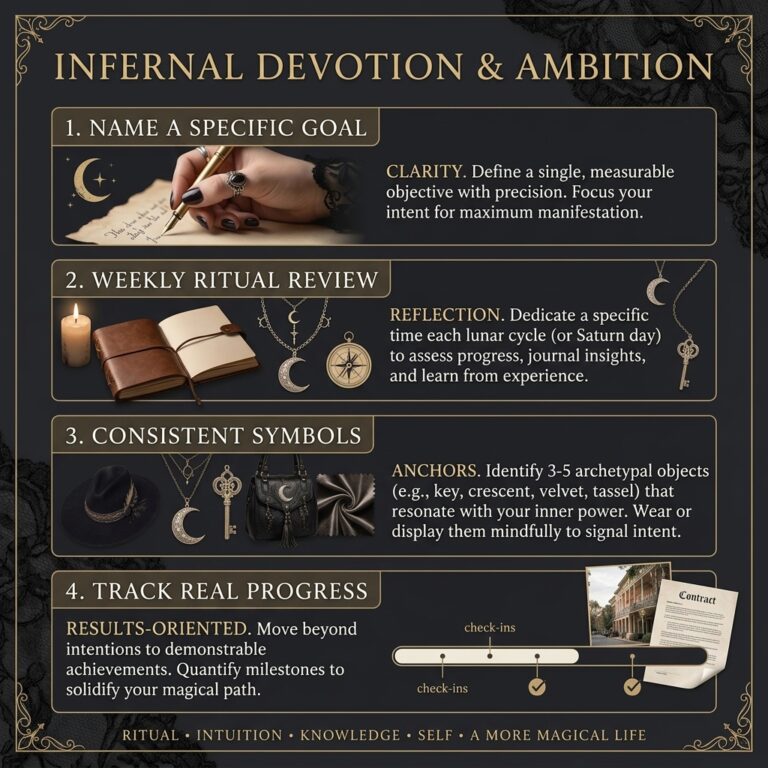
Start by writing your ambition as a specific, measurable statement rather than a general wish. “Financial success” becomes “consistent monthly income of a defined amount by a defined date.” This single step does more for your practice’s effectiveness than almost anything else you’ll do.
Establish a recurring rhythm — weekly is common — where you return to an altar or working space, restate the intention, and review what you actually did toward it since the last session. This review step matters as much as the ritual itself: it’s where devotion and ambition visibly connect, rather than existing as two separate parts of your life.
Keep the ritual actions themselves consistent too. Using the same core symbols, the same basic structure, session after session, builds a kind of practiced fluency that a constantly changing approach doesn’t. Save experimentation for refining the goal’s specifics, not for reinventing your entire practice every week.
Belief, Intention & The Power of Magic
Witchcraft, spells, and manifestation are deeply rooted in belief, intention, and spiritual practice. If these practices do not resonate with you, this may not be the path for you, and that’s perfectly okay. But if you believe in divine powers, trust your intentions, and feel drawn to the mysteries of the unseen, we invite you to continue exploring with Madame Celestine and discover the magic that speaks to your soul.
Devotion Is Not a Substitute for Doing the Work
A devotional practice sharpens your focus and discipline; it doesn’t replace the actual effort your ambition requires. If your goal is a promotion, devotion supports the confidence and consistency to ask for it, prepare for it, and follow through — it doesn’t hand you the title on its own. Practitioners who treat ritual as a substitute for action tend to see their devotion stall out, because nothing in the outside world is responding to reinforce it.
The strongest devotional ambition work treats ritual and effort as two halves of the same commitment, not competing options. If you’re newer to working with named infernal figures in a relationship context and want to see how devotional consistency plays out after a setback, our piece on infernal devotion after betrayal walks through the same core discipline applied to rebuilding self-respect.

Signs Your Devotional Practice Is Actually Working
Look for increasing clarity about what you actually want, not just more ritual activity. If your intention statements are getting sharper and more specific over successive sessions, the practice is doing its job. Look also for a growing willingness to take the concrete actions your ambition requires — the harder conversation, the extra application, the follow-up you’d otherwise avoid.
A devotional practice that isn’t working tends to feel repetitive without producing either clarity or motion — the same vague wish, restated, with nothing changing in your actual behavior between sessions. If that’s what you’re noticing, revisit how specific your stated goal actually is before assuming the practice itself has failed.
Frequently Asked Questions
How is infernal devotion different from a single ambition ritual?
A single ritual is one working toward a goal. Devotion is an ongoing, recurring practice that keeps refining and supporting that same goal over time.
How often should I return to a devotional ambition practice?
Weekly is common and sustainable for most practitioners, though the right rhythm depends on how demanding your specific goal is.
Can devotional practice replace practical effort toward my goal?
No. Devotion supports focus and follow-through, but the concrete actions your ambition requires still have to happen in the world.
Does my intention need to be extremely specific?
Yes, as specifically as you can manage. Vague intentions are consistently harder to act on or measure progress against than clearly defined ones.
What if my ambition changes partway through a devotional practice?
Update your stated intention at your next session. A devotional practice should track your actual goal, not lock you into an outdated one.
Not sure where to start? You don’t have to do this alone.
Madame Celestine offers guided spellwork for beginners — real support for your first working, not just another guide to read.
Related reading: Satanic Ritual Correspondences: Symbols, Timing, and Preparation Explained · Ceremonial Satanic Magic and Ambition: Questions to Ask Before a Consultation

About Madame Celestine
Madame Celestine has practiced and taught spellwork, divination, and seasonal ritual for over two decades, helping newcomers build a grounded, confident practice from their very first spell.