
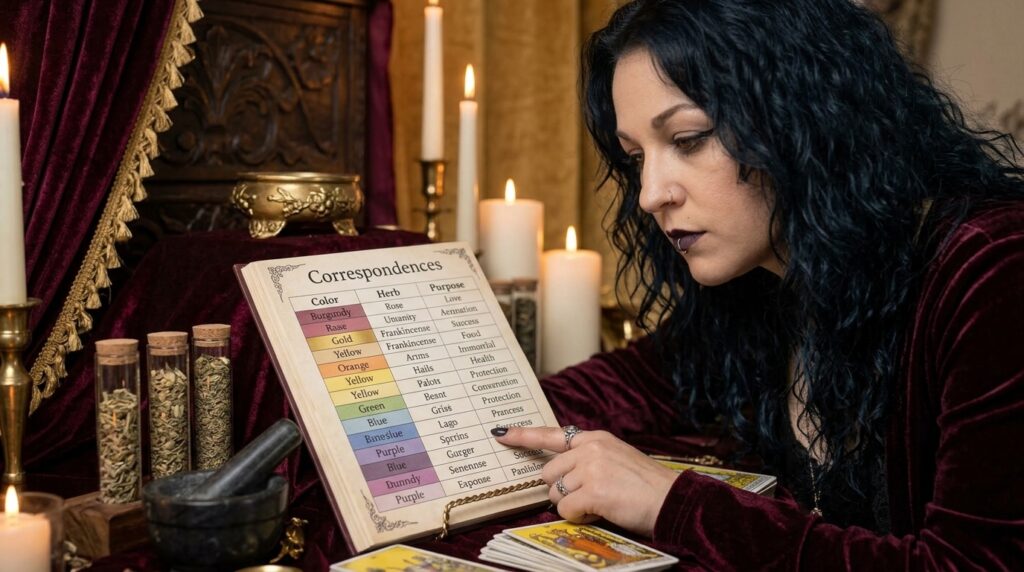
You’re reading a ritual guide and hit a wall of specifics: burn a red candle, work on a Tuesday, use cinnamon and not sage. Is all of this actually load-bearing, or is half of it decorative tradition you can skip without consequence? Understanding what correspondences are and where they came from makes it much easier to tell which details matter for your specific working.
What “Correspondences” Actually Means in Ritual Practice
A correspondence is a symbolic association: a color, herb, planet, day, or object linked to a particular quality or intention through tradition. Red corresponds to passion and courage; cinnamon to prosperity and speed; Tuesday to Mars, and therefore to action and conflict. None of these links are arbitrary in the sense of being random — they’re inherited from centuries of astrological, herbal, and symbolic tradition layered together.
Using correspondences means choosing elements that symbolically reinforce your intention, so the ritual’s components echo and support the goal rather than working against or unrelated to it.
Where Timing Correspondences Come From
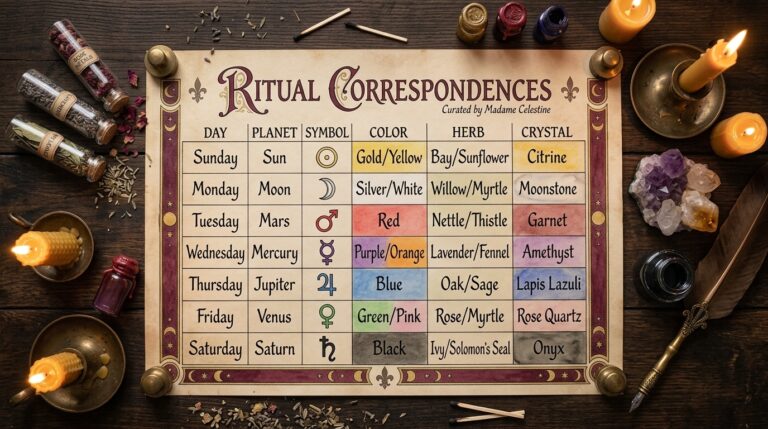
Day-of-the-week correspondences trace back to ancient astronomy. Britannica notes that the Babylonians named the days of the week after the five known planetary bodies plus the sun and moon, a system the Romans later adopted and that still underlies the modern week. Tuesday’s association with Mars (and therefore action, conflict, and drive) comes directly from this ancient planetary naming system, as do the other six days’ traditional associations.
Knowing this history helps explain why timing correspondences show up so consistently across different ritual traditions — they’re drawing on the same underlying astronomical framework, not competing systems that happen to agree by coincidence.
How to Choose Correspondences for Your Own Ritual
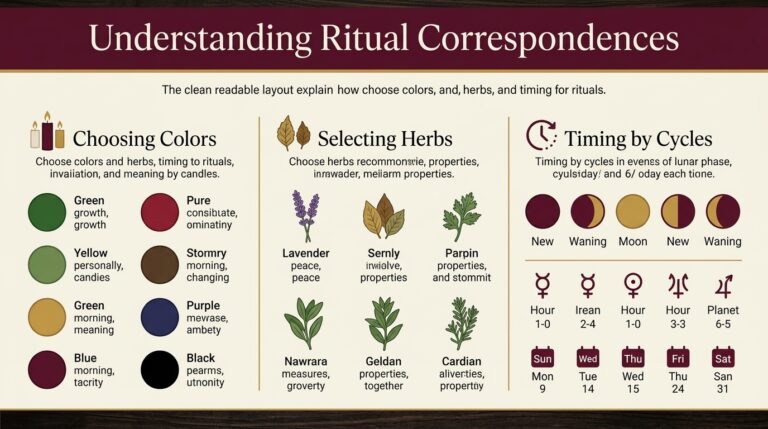
Start with your intention, not the correspondence list. Name specifically what you want the working to support, then look for colors, herbs, and timing that symbolically reinforce that specific goal, rather than picking elements first and reverse-engineering a purpose.
If your intention involves prosperity, gold or green candles, cinnamon or basil, and a Thursday (traditionally associated with Jupiter and expansion) work well together. If a strict match on timing isn’t practical, prioritize the elements you have more control over, like color and herbs, over the specific day, rather than delaying the entire working indefinitely.
It also helps to keep a short personal reference list of the correspondences you use most often, rather than relooking up the same associations every time. Over time, many practitioners find that a handful of colors, herbs, and days cover the majority of their actual practice, even if a full traditional table includes dozens of options they rarely reach for.
Belief, Intention & The Power of Magic
Witchcraft, spells, and manifestation are deeply rooted in belief, intention, and spiritual practice. If these practices do not resonate with you, this may not be the path for you, and that’s perfectly okay. But if you believe in divine powers, trust your intentions, and feel drawn to the mysteries of the unseen, we invite you to continue exploring with Madame Celestine and discover the magic that speaks to your soul.
Preparing Your Space and Materials Before a Working
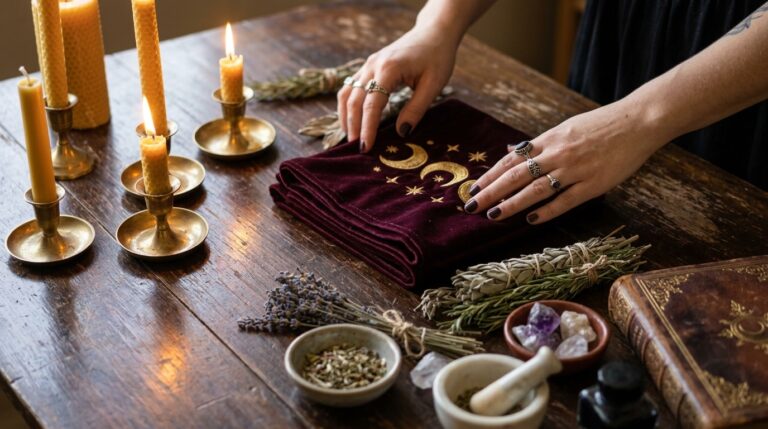
Clean your workspace physically before laying out any correspondences — clutter and dust are practical distractions as much as symbolic ones. Gather every material you plan to use before you begin, so the ritual isn’t interrupted partway through by a missing item. For a deeper look at working with one specific type of timing correspondence, see our piece on full moon correspondences.
Give yourself a few quiet minutes before starting to settle your attention. Rushed preparation tends to produce a rushed, distracted working, regardless of how correct the correspondences are. If you’re new to this, it can help to write out a short checklist beforehand — candle, herbs, timing, intention statement — so preparation becomes a quick habit rather than something you have to reconstruct from memory every time.
Do You Need Every Correspondence to Get It “Right”?
No. Correspondences are a support system for intention, not a checklist where a missing item invalidates the entire working. If you don’t have the traditionally correct herb or can’t perform the ritual on its associated day, a well-focused intention with whatever’s available typically matters more than perfect adherence to every traditional detail.
Treat correspondences as tools that strengthen a working, not as a rigid formula that determines whether it counts. Intention is what actually carries a ritual; correspondences simply give that intention a clearer, more focused shape to move through.
Frequently Asked Questions
What happens if I use the “wrong” color candle?
Nothing catastrophic. A mismatched color isn’t ideal, but a clear, focused intention matters more than perfect correspondence matching.
Do I have to perform a ritual on its traditionally associated day?
No. Timing correspondences are a helpful reinforcement, not a strict requirement. Adjust for what’s realistic in your schedule.
Where can I find a full list of correspondences?
Many grimoires and modern practitioner references include correspondence tables for colors, herbs, planets, and days, though lists vary somewhat between traditions.
Can I create my own correspondences instead of using traditional ones?
Yes. Many practitioners develop personal correspondences over time based on what genuinely resonates with their own practice.
Is timing more important than materials, or the reverse?
Neither consistently outweighs the other. Prioritize whichever elements you have realistic control over for a given working.
Not sure where to start? You don’t have to do this alone.
Madame Celestine offers guided spellwork for beginners — real support for your first working, not just another guide to read.
Related reading: Ceremonial Satanic Magic and Ambition: Questions to Ask Before a Consultation · Infernal Hierarchies Explained: Why Demonic Ranks Appear in Ritual Books

About Madame Celestine
Madame Celestine has practiced and taught spellwork, divination, and seasonal ritual for over two decades, helping newcomers build a grounded, confident practice from their very first spell.