

If you are thinking about a satanic career ritual, the hardest part is often not the ritual itself. Instead, it is working out what you are really being offered, and what is only implied. Many offers use big words like “power,” “promotion” or “success” without saying where the work begins and ends. So this guide gives you ten plain questions about scope and claims. Along the way, you will learn where career pacts first show up in folklore, why old grimoires spoke of “dignities and places,” and how modern Satanism frames ritual in a very different way. By the end, you should be able to read any offer calmly and ask for the details that matter.
- Why “Career” Once Meant a Racecourse, and Why Scope Matters
- From Theophilus to Faust: The Oldest Career Pacts in Folklore
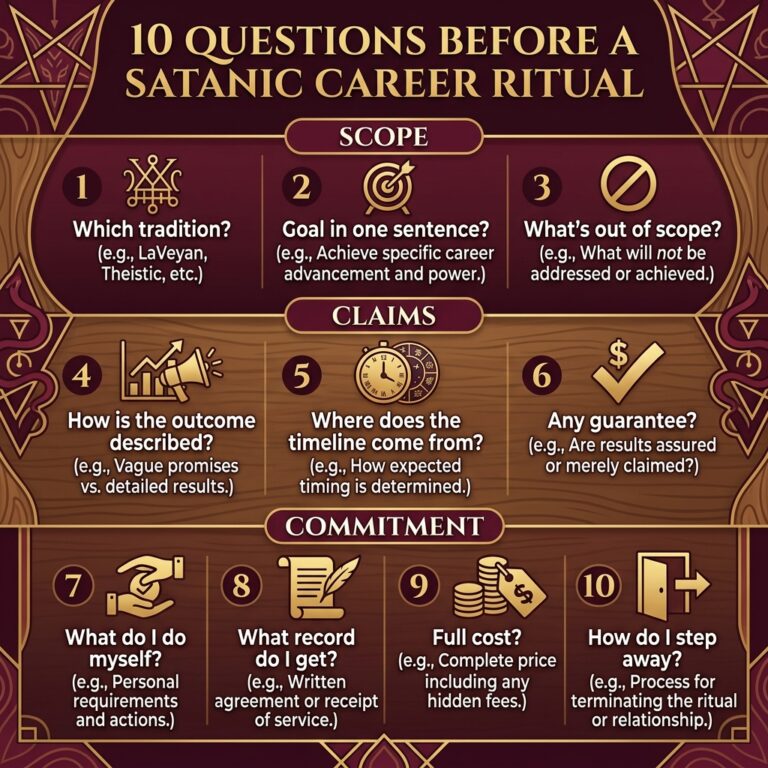
- Scope Questions 1–3: What a Satanic Career Ritual Covers
- Claims Questions 4–6: How a Satanic Career Ritual Is Described
- Commitment Questions 7–10: Your Part in the Career Ritual
- Red Flags and Green Flags in Satanic Career Ritual Claims
- Frequently Asked Questions
- References
Why “Career” Once Meant a Racecourse, and Why Scope Matters
The word “career” has a surprisingly physical history. In the 1530s it meant a running at full speed, and it came from the French carrière, a road or racecourse[1]. It only took on the sense of a person’s working life in 1803[1]. That older picture is still useful. After all, a racecourse has a start line, a finish line and fixed edges. A good career working should have the same.
That is why scope comes first when you weigh a satanic career ritual. Scope simply means the boundaries of a piece of work: what it aims at, what it leaves alone, and what it does not claim to touch. For example, “help me feel steady and focused before my promotion review” is a clear scope. By contrast, “unlock unlimited success” has no edges at all. When a working has no edges, you cannot judge it, and you cannot tell when it is finished.

Claims are the second half of the picture. A claim is any statement about what the ritual will do. Practitioners in every tradition describe their work in terms of intention, symbolism and focus. However, a claim that sounds like a guaranteed result is a different thing entirely. The questions below help you tell the two apart.
From Theophilus to Faust: The Oldest Career Pacts in Folklore
Deals with dark powers over work and status are far older than modern Satanism. One of the oldest is the legend of Theophilus of Adana, a sixth-century archdeacon in what is now Turkey[2]. According to the story, a new bishop stripped him of his post because of unfounded rumors. Theophilus then sought out a necromancer, and through him he made a pact with the Devil[2]. In return, he gained the bishop’s seat he had once turned down. Later, he repented, and the legend ends with the Virgin Mary promising to plead for him. In other words, one of the first famous devil’s pacts was really a workplace dispute.
The Theophilus story also shaped later tales, and it is seen as an inspiration for the Faust legend[2]. The first known printed Faust book appeared in 1587 as a small chapbook, the Historia von D. Johann Fausten[3]. In the legend, Faust calls on the Devil for powers that let him enjoy all the knowledge and pleasures of the world[3]. Notably, both stories are warnings about vague bargains. The terms sound generous, but the true cost hides in the fine print.
Grimoires, the old handbooks of ritual magic, took a more practical tone. The Lesser Key of Solomon, whose first part is the Ars Goetia, was compiled in the mid-17th century from older material[4]. It lists spirits and the specific things each is said to offer. For instance, Orobas and Orias are both described as giving “dignities and places,” along with the favour of friends and foes[5]. Bune, meanwhile, is said to give riches and make a person wise and eloquent[5]. So even these old texts were narrow. That habit of precision is worth bringing to any satanic career ritual today.
Scope Questions 1–3: What a Satanic Career Ritual Covers
The first three questions set the edges of a satanic career ritual. Ask them before anything else, because every later answer depends on them.
1. Which tradition is this working rooted in? “Satanic” covers very different ideas. The Church of Satan, founded by Anton LaVey on April 30, 1966, treats Satan as a symbol of self-assertion and rebellion against unjust authority, not as a real being[6]. Theistic and Goetic practitioners, by contrast, work with spirits they regard as real. Neither view is right for you by default. Still, the answer shapes everything else, so ask for it plainly.
2. Can we write the goal in one sentence? A clear goal might be “prepare me for the interview on the 14th” or “mark the start of my job search.” Then both of you know the target. If you are not sure whether your aim is about money or about your role, this guide on choosing between a prosperity working and a career working can help you sort it out first.
3. What is outside the scope? This is the question most people forget. A careful practitioner will tell you what the working will not attempt. For example, it may not target a named coworker, override someone else’s choices, or replace the practical steps of applying and preparing. Also, notice how comfortable they are with this question. Clear limits usually signal an honest approach.
Claims Questions 4–6: How a Satanic Career Ritual Is Described
Next, look closely at the language. Claims live in small words, so these three questions slow the conversation down.
4. How do you describe the intended outcome? LaVey defined magic as changing events in line with one’s will where normal methods would fail[7]. Yet he also said that some rituals in The Satanic Bible are simply applied psychology[7]. That is a useful model of honest framing. So listen for words like “intend,” “focus,” “support” or “symbolize.” Then compare them with words like “will,” “guarantee” or “force.”
5. What timeline do you describe, and why? Some traditions link a satanic career ritual to a moon phase or a set number of days. That is a reason about timing, and it makes sense on its own terms. A promise that you will be promoted “within 30 days,” however, is a claim about another person’s decision. Ask where the timeline comes from.
6. Do you offer any guarantee? In practice, no one can guarantee what a hiring manager, a board or a market will do. So a practitioner who says this plainly is being straight with you. By contrast, a guarantee paired with pressure to decide quickly deserves a pause.
Commitment Questions 7–10: Your Part in the Career Ritual
7. What will I be asked to do myself? Many versions of a satanic career ritual ask the client to take part. You might light a candle on set days, write your goal each morning, or keep a short journal. First, ask how much time this takes. Then ask why each step is there, because a good answer explains the meaning, not just the task.
8. What record will I receive? A short written summary is a sign of care. It might list the date, the goal, the tradition, any spirit or symbol involved, and what you agreed to do. As a result, you have something to review later instead of relying on memory.
9. What is the full cost, and what is included? Ask for one total figure. Also ask whether follow-up questions, extra sessions or materials cost more. Surprise add-ons are a common source of regret.
10. How do I step away if I change my mind? You should be able to stop without fear. If anyone suggests that leaving will curse you or ruin your job, treat that as your reason to leave. Healthy practice respects your choice. Indeed, the stories of Theophilus and Faust show exactly why open terms matter.
Belief, Intention & The Power of Magic
Witchcraft, spells, and manifestation are deeply rooted in belief, intention, and spiritual practice. If these practices do not resonate with you, this may not be the path for you, and that’s perfectly okay. But if you believe in divine powers, trust your intentions, and feel drawn to the mysteries of the unseen, we invite you to continue exploring with Madame Celestine and discover the magic that speaks to your soul.
Red Flags and Green Flags in Satanic Career Ritual Claims
Once you have answers from each satanic career ritual offer, compare them side by side. Green flags tend to look calm and specific. For example, the practitioner names their tradition, writes the goal down, lists what is out of scope, and gives one clear price. They also describe outcomes as intentions and explain the meaning behind each step.

Red flags, on the other hand, tend to be loud and vague. Watch for guaranteed promotions, fixed deadlines for other people’s decisions, and claims that only one secret rite can save your career. Also be wary of pressure built on fear, such as warnings that you are blocked or cursed and must act today. Finally, notice if the price keeps growing after you say yes.
One common mistake is to judge an offer by how dramatic it sounds. In fact, the old grimoires were quite dry. They named a spirit, a rank and a single gift, such as “dignities and places”[5]. So drama is not a sign of depth. Precision is.
Another mistake is to forget the practical side of a career goal. A satanic career ritual can give you a focused moment of intention, and many practitioners believe it does more than that. Even so, your CV, your preparation and your conversations still carry real weight. For that reason, the ritual works best alongside them, not instead of them.
Frequently Asked Questions
What is a satanic career ritual?
It is a ritual working aimed at a work goal, such as a job search, a promotion review or a new venture, framed within a Satanic or infernal tradition. Depending on the practitioner, it may be symbolic and psychological, or it may involve spirits they regard as real.
Can a satanic career ritual guarantee a promotion?
No honest practitioner can guarantee another person’s decision. Most describe the work as an intention or focus that supports your own efforts.
Is Satan treated as a real being in these rituals?
It depends on the tradition. The Church of Satan treats Satan as a symbol, while theistic practitioners regard infernal spirits as real, so ask which view your practitioner holds.
How specific should my career goal be?
It should be specific enough to fit in one sentence, with a clear finish line. For example, “feel prepared for my interview next week” is far easier to scope than “unlimited success.”
What should I do if a practitioner pressures me to decide quickly?
Pause and step back. Calm, patient answers and clear pricing are better signs than urgency or warnings about curses.
References
- Career (n.). Online Etymology Dictionary. https://www.etymonline.com/word/career
- Theophilus of Adana. Wikipedia. https://en.wikipedia.org/wiki/Theophilus_of_Adana
- Faust. Wikipedia. https://en.wikipedia.org/wiki/Faust
- The Lesser Key of Solomon. Wikipedia. https://en.wikipedia.org/wiki/The_Lesser_Key_of_Solomon
- Lemegeton, Part 1: Goetia. Edited by Joseph H. Peterson. Esoteric Archives. https://www.esotericarchives.com/solomon/goetia.htm
- Church of Satan. Encyclopaedia Britannica. https://www.britannica.com/topic/Church-of-Satan
- The Satanic Bible. Wikipedia. https://en.wikipedia.org/wiki/The_Satanic_Bible
Not sure where to start? You don’t have to do this alone.
Madame Celestine offers guided spellwork for beginners — real support for your first working, not just another guide to read.
Related reading: The Black Flame in Luciferian Thought: Knowledge, Ambition, and Self-Discovery · Can Ritual Support Goal-Setting? A Grounded Look at Satanic Prosperity Practice

About Wong Fat Kin
Wong Fat Kin is the pen name our editorial team uses for articles on Taoist ritual, talismans (符), house cleansing, Feng Shui and divination. Articles under this byline are researched from published sources and reviewed by Madame Celestine before publishing.