
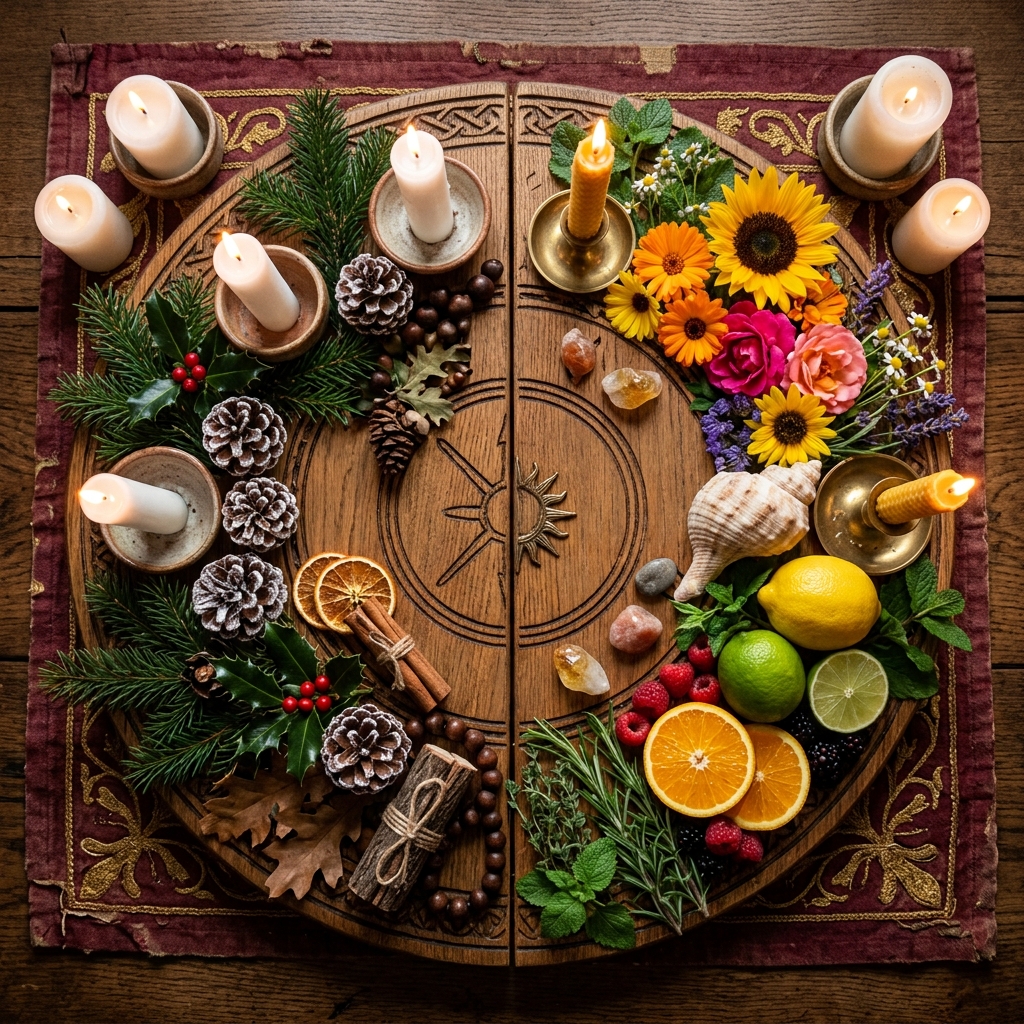
Southern hemisphere sabbats raise a question that every new witch below the equator eventually asks: why is my Yule in June? If you live in Sydney, Cape Town or Buenos Aires, the Wheel of the Year you read about online doesn’t match the weather outside your door. In this guide, I’ll explain where the wheel came from, why the seasons flip, and how witches in the south adapt the old symbols. I’ll also give you the 2026 dates for Samhain and Yule in both hemispheres, so you can plan ahead.
- A Wheel Built for Northern Skies
- Tilt, Not Tradition: Why Southern Hemisphere Sabbats Flip
- The Six-Month Swap: Every Sabbat in Both Hemispheres
- When Is Yule 2026, and When Is Samhain 2026?
- How to Adapt Sabbat Symbols Down Under
- What a New Orleans Winter Teaches About Southern Hemisphere Sabbats
- Common Mistakes When Flipping the Wheel
- Frequently Asked Questions
- References
I have practiced seasonal ritual in New Orleans for over two decades. As you’ll see, even a northern city like mine taught me that the wheel was always meant to bend to the land you stand on.
A Wheel Built for Northern Skies
First, it helps to know that the Wheel of the Year is younger than most people think. Its festivals draw on old sources, but the eight-part cycle is modern. According to one well-known account, Gerald Gardner and Ross Nichols joined the four solar festivals and the four points between them into a single calendar. By the mid-1960s, the phrase “Wheel of the Year” was already in use for this eight-part cycle[1].
Even some of the names are recent. The Wiccan writer Aidan Kelly named Litha, Ostara and Mabon in 1974[1]. In fact, there’s no evidence that the ancient Celts followed one grand story across the whole year. That idea spread later, partly through the writings of Robert Graves[1].
However, the older festivals still carry their northern roots in their names. Samhain comes from Irish and means “summer’s end.” It marked the turn from summer to winter in the Celtic year, when people believed the boundary between the living and the dead grew thin[2]. Yule, meanwhile, was a midwinter solstice festival of the Germanic peoples. In several northern European languages, the word now simply means Christmas[3].
So every symbol on the wheel grew out of one particular sky and climate. The evergreen bough, the bonfire against the dark and the first spring lambs all belong to northern latitudes. As a result, those symbols start to feel strange once you cross the equator. That is where Southern Hemisphere sabbats begin.

Tilt, Not Tradition: Why Southern Hemisphere Sabbats Flip
The reason for the flip is astronomy, not opinion. Earth’s axis leans to one side, and it keeps pointing the same way as the planet circles the Sun[4]. So for part of the year, the North Pole tips toward the Sun and the north enjoys summer. At the same time, the South Pole tips away, and the south has winter[4]. Six months later, the positions swap.
This means a solstice happens at the same moment everywhere on Earth, but it means opposite things. The December solstice brings the longest night of the year to New Orleans. On that same day, Melbourne enjoys its longest day.
Because the sabbats follow the light, most southern witches move each festival by six months. Pagans in the Southern Hemisphere often shift the dates this way to match their own seasons[1]. Therefore, Yule lands in June and Samhain lands at the end of April. The festival keeps its meaning. Only the page on the calendar changes.
The Six-Month Swap: Every Sabbat in Both Hemispheres
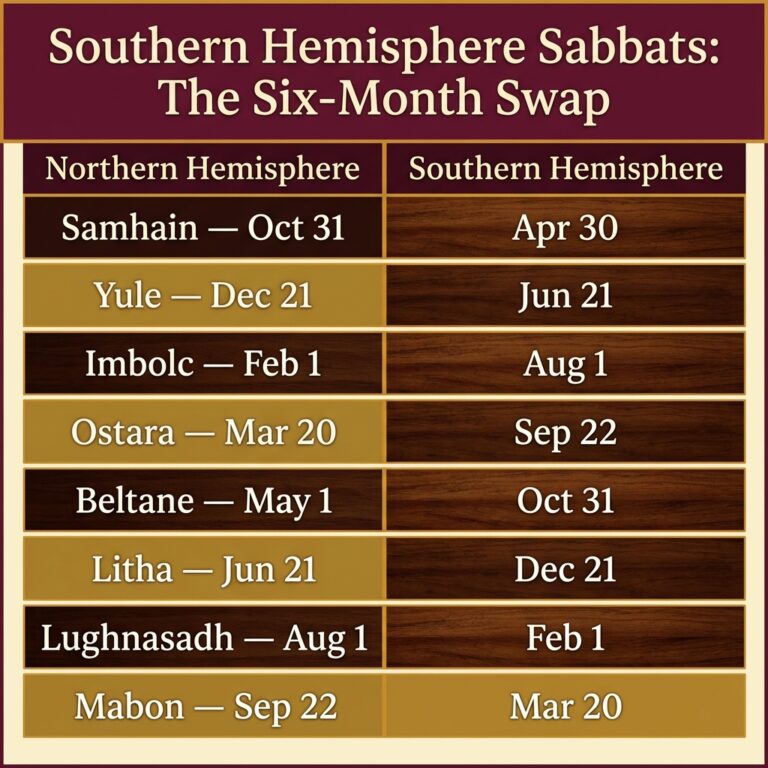
Here is how Southern Hemisphere sabbats line up against the northern wheel. The solar festivals can shift by a day from year to year, while the four fire festivals are fixed by custom. For a closer look at what each festival celebrates, see my guide to the Wheel of the Year and its sabbat dates.
| Sabbat | Northern Hemisphere | Southern Hemisphere |
|---|---|---|
| Samhain | October 31 | April 30 |
| Yule (winter solstice) | around December 21 | around June 21 |
| Imbolc | February 1 | August 1 |
| Ostara (spring equinox) | around March 20 | around September 22 |
| Beltane | May 1 | October 31 |
| Litha (summer solstice) | around June 21 | around December 21 |
| Lughnasadh | August 1 | February 1 |
| Mabon (autumn equinox) | around September 22 | around March 20 |
Notice one striking pair. When northern witches honor their dead at Samhain, southern witches are lighting Beltane fires for fertility and new life. Both groups celebrate on the same night, at opposite ends of the wheel.
When Is Yule 2026, and When Is Samhain 2026?
These are the dates people search for most. The exact solstice times below come from the U.S. Naval Observatory[5].
Yule 2026 Date in the Northern Hemisphere
The December solstice arrives on Monday, December 21, 2026, at 20:50 Universal Time[5]. Here in New Orleans, that is 2:50 in the afternoon. For northern witches, that moment is Yule.
Yule 2026 Date for Southern Hemisphere Sabbats
Southern Yule has already passed this year. The June solstice came on June 21, 2026, at 08:24 Universal Time[5]. In Sydney, that was 6:24 in the evening. Meanwhile, the December solstice becomes Litha in the south. Because of the time difference, it falls on the morning of December 22 across Australia.
When Is Samhain 2026?
Traditionally, Samhain is kept on November 1 and the evening before[2]. So northern Samhain runs from Saturday night, October 31, 2026, into November 1. In the south, Samhain comes on April 30 into May 1 instead, so the next one arrives in 2027.
How to Adapt Sabbat Symbols Down Under
Flipping the dates is the easy part. The real work of Southern Hemisphere sabbats is translating the symbols. Here is how I suggest you approach it, step by step.
First, name what the festival is really about. Strip each sabbat down to its core idea. Yule is the return of the light. Samhain is the close of the harvest and a time to remember the dead. Once you know the idea, you can choose symbols that carry it well.
Next, look outside your own door. Swap imported plants for local ones that bloom or fruit in that season. For example, many Australian witches use golden wattle for Imbolc, because it flowers in late winter. A holly wreath means little where holly doesn’t grow.
Then, honor what the land already celebrates. In Aotearoa New Zealand, the rising of Matariki, the Pleiades star cluster, signals the Māori New Year in the winter sky[6]. Since 2022, a public holiday has marked it each June or July[6]. Matariki isn’t a Wiccan sabbat, and it belongs to Māori tradition. Still, it reminds us that the southern sky has its own midwinter stories, and they deserve respect rather than borrowing.
Finally, make peace with Christmas. In the south, Christmas lands close to Litha, the longest day of the year. Some witches light a simple solstice candle at the beach in December and save their Yule log for June. Others hold a midwinter feast in June, much like the “Christmas in July” dinners many Australians already enjoy.
Belief, Intention & The Power of Magic
Witchcraft, spells, and manifestation are deeply rooted in belief, intention, and spiritual practice. If these practices do not resonate with you, this may not be the path for you, and that’s perfectly okay. But if you believe in divine powers, trust your intentions, and feel drawn to the mysteries of the unseen, we invite you to continue exploring with Madame Celestine and discover the magic that speaks to your soul.
What a New Orleans Winter Teaches About Southern Hemisphere Sabbats
Even in the north, the wheel never fit everyone neatly. Here in New Orleans, Yule rarely brings snow. Our Decembers are mild and damp, and camellias bloom while English books insist the earth is asleep. Samhain often arrives while the evenings are still warm enough for short sleeves.
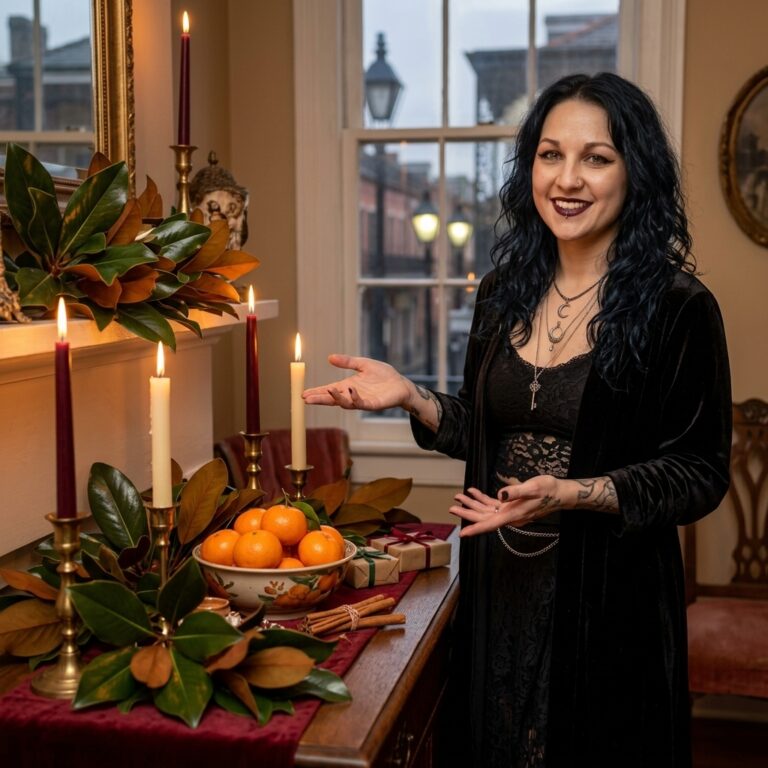
So I learned early to read the wheel as a set of ideas, not a weather report. For example, a New Orleans Yule altar might hold glossy magnolia leaves and bright satsumas, because that is what the city offers in December. The symbol changes, yet the meaning holds. Evergreen leaves still speak of life that endures, and golden fruit still stands in for the returning sun.
Anyone keeping Southern Hemisphere sabbats faces the same question, only more sharply. In both cases, the answer is to honor the turning of the light where you actually stand. The old festivals came from people who watched their own fields and skies closely. When you watch yours, you follow their example more faithfully than any imported calendar could.
Common Mistakes When Flipping the Wheel
Following northern social media. Most online content is written for the north. As a result, beginners keeping Southern Hemisphere sabbats can end up celebrating Samhain in spring without noticing. Keep your own local calendar, and check it before each festival.
Forgetting the direction of the sun. In the north, the sun arcs across the southern sky and seems to move clockwise. That is why many northern witches cast circles “deosil,” or sunwise, which means clockwise. South of the equator, the sun arcs across the northern sky and appears to move anticlockwise. So some southern witches reverse their circle direction too, while others keep the northern habit. Either way, choose on purpose.
Treating the tropics like the temperate south. Near the equator, the year often turns on wet and dry seasons rather than hot and cold. A witch in Darwin may find that neither calendar fits well. In that case, build your festivals around the rains, the harvests and the light instead.
Flipping the meaning along with the date. The whole point of moving a sabbat is to keep its meaning intact. In Southern Hemisphere sabbats, Yule in June is still about the returning light. It simply arrives when that light truly returns for you.
Frequently Asked Questions
When is Yule 2026?
In the Northern Hemisphere, Yule falls on the winter solstice, December 21, 2026. In the Southern Hemisphere, Yule fell on June 21, 2026, and the December solstice is celebrated as Litha instead.
When is Samhain 2026?
Northern Samhain runs from the evening of October 31 into November 1, 2026. Southern Samhain is celebrated from April 30 into May 1.
Do all witches follow Southern Hemisphere sabbats?
No. Most southern witches shift the dates by six months to match their seasons, but some keep the northern calendar to stay in step with global traditions. It is a personal choice, so pick the approach that feels meaningful to you.
What is the Yule 2026 date in Australia?
Australian Yule fell on the June solstice, June 21, 2026. The December solstice arrives on the morning of December 22, 2026, across Australia, where witches celebrate it as Litha.
Should circles be cast anticlockwise south of the equator?
Some southern witches cast anticlockwise because the sun appears to move that way in their sky. Others keep casting clockwise out of habit or lineage. Both approaches are common.
Why are Southern Hemisphere sabbats six months apart from northern ones?
Earth’s tilted axis gives the two hemispheres opposite seasons. Moving each sabbat by six months keeps it in line with the light and weather it was meant to honor.
References
- Wheel of the Year. Wikipedia. https://en.wikipedia.org/wiki/Wheel_of_the_Year
- Samhain. Encyclopaedia Britannica. https://www.britannica.com/topic/Samhain
- Yule. Encyclopaedia Britannica. https://www.britannica.com/topic/Yule-festival
- What Causes the Seasons? NASA Space Place. https://spaceplace.nasa.gov/seasons/en/
- Earth’s Seasons – Equinoxes, Solstices, Perihelion, and Aphelion (2026). U.S. Naval Observatory, Astronomical Applications Department. https://aa.usno.navy.mil/calculated/seasons?year=2026&tz=0.00&tz_sign=-1&tz_label=false&dst=false
- Matariki – Te Tau Hou Māori. Te Ara – the Encyclopedia of New Zealand. https://teara.govt.nz/en/matariki-maori-new-year
Not sure where to start? You don’t have to do this alone.
Madame Celestine offers guided spellwork for beginners — real support for your first working, not just another guide to read.
Related reading: Exploring What Does It Mean To Be Born On A Full Moon?: Symbolism, Tradition & Personal Practice · Moon Magick: Working With The Moon Cycles: Ritual Ideas, Meaning & Practical Guidance
About Madame Celestine
Madame Celestine has practiced and taught spellwork, divination, and seasonal ritual for over two decades, helping newcomers build a grounded, confident practice from their very first spell.