
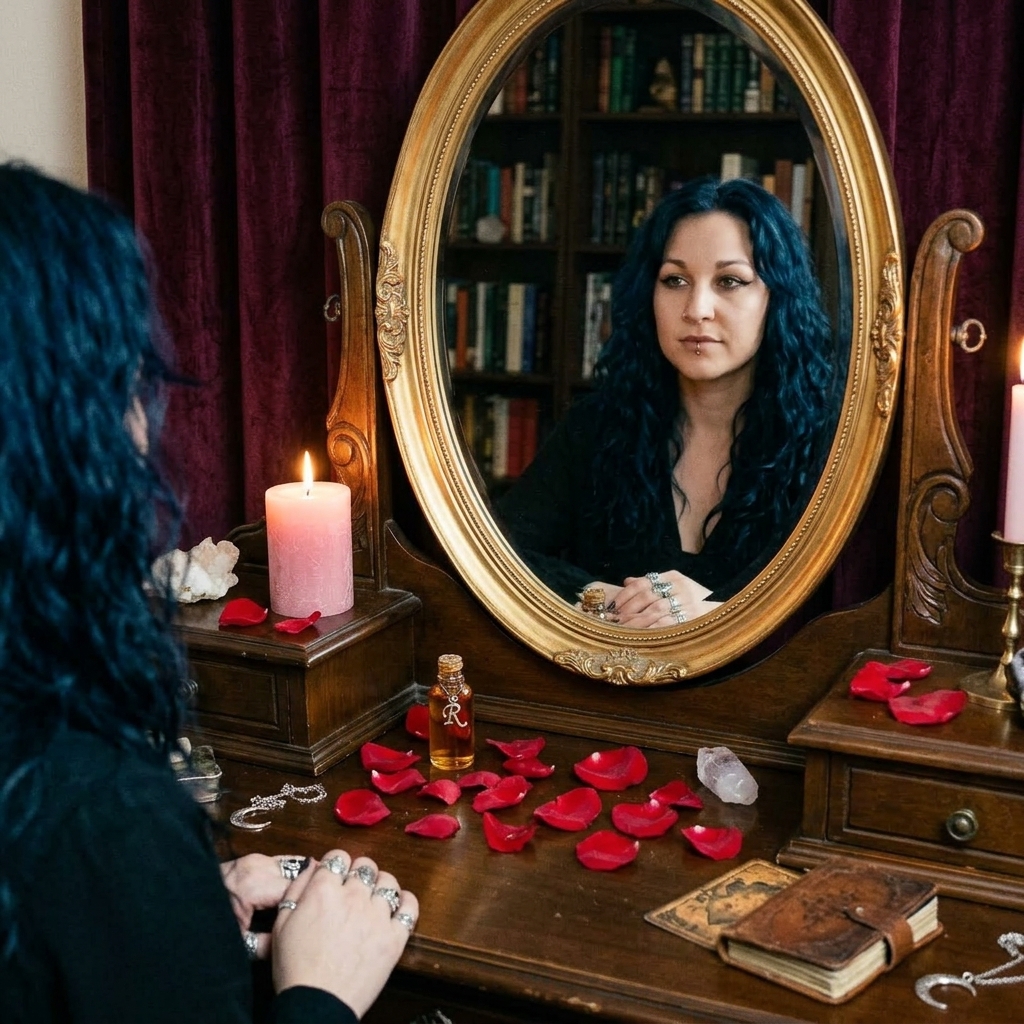
A glamour spell is one of the first things many people search for when they get curious about magic, and it’s also one of the most misunderstood. Maybe you’ve seen the word on a candle label or in a spellbook. So what is a glamour spell, really? Does it change your face, or something quieter? In this guide, I’ll explain where the word comes from and why it once meant “grammar.” You’ll also see how beauty magic worked in the ancient world. Finally, I’ll walk you through a simple ritual you can do at your own mirror.
- What Is Glamour Magic? A Spell for How You’re Seen
- From “Grammar” to Glamour: The Word Was Always a Spell
- Aphrodite’s Girdle and Egyptian Kohl: Beauty Magic in the Ancient World
- Glamour Spells vs. Beauty Spells vs. Attraction Spells
- How to Cast a Simple Glamour Spell at Your Mirror
- Why Friday, Roses, and Mirrors? The Old Logic Behind Each Tool
- Common Glamour Spell Mistakes to Avoid
- Everyday Glamour Magick: Charms, Makeup, and a Glamour Magic Book
- Frequently Asked Questions
- References
What Is Glamour Magic? A Spell for How You’re Seen
Glamour magic is spellwork aimed at perception. In other words, it works on how other people see you and how you see yourself. It doesn’t claim to change your bone structure. Instead, practitioners use it to draw attention to qualities that are already there, such as warmth, poise, or charm.
That’s why a glamour spell sits between two other kinds of work. On one side are beauty spells, which focus on your own looks and self-image. On the other side is an attractive spell, which focuses on drawing a certain response from others. Glamour magic borrows from both. For example, one person might cast it before a job interview. Someone else might cast it before a first date, or simply on a morning when they feel invisible.
You’ll see the word spelled two ways. “Glamour” is the British and older form, while “glamor” is the American one. So a glamor spell and a glamour spell are the same practice. Likewise, glamour magick, glamor magick, and glamor magic all point to the same craft. The extra “k” in “magick” is simply a spelling some witches use to set ritual magic apart from stage tricks.
From “Grammar” to Glamour: The Word Was Always a Spell
Here is a detail most people don’t know. The word “glamour” began as a Scottish form of “grammar.” In the Middle Ages, “grammar” meant more than sentence rules. It also meant learning in general, and that included occult learning. Because few people could read, book knowledge itself seemed a little magical. As a result, the Scots term “gramarye” came to mean magic or enchantment. By 1715, “glamer” was in print, and people spoke of casting the glamour on someone.[1]
Then Sir Walter Scott, the Scottish novelist and poet, made the word popular in English. After that, its meaning slowly shifted. By 1840, glamour could mean “magical beauty” or alluring charm. Later, by 1939, it had become tied to Hollywood, fashion, and celebrity.[1]
So when we cast a glamour spell today, we are using the word in its oldest sense. A movie star’s “glamour” and a witch’s glamour were once the same idea. Both were about enchanting the eye. In fact, I find that history useful to remember. It reminds me that glamour witchcraft is about perception and presence, not about becoming someone else.
Aphrodite’s Girdle and Egyptian Kohl: Beauty Magic in the Ancient World
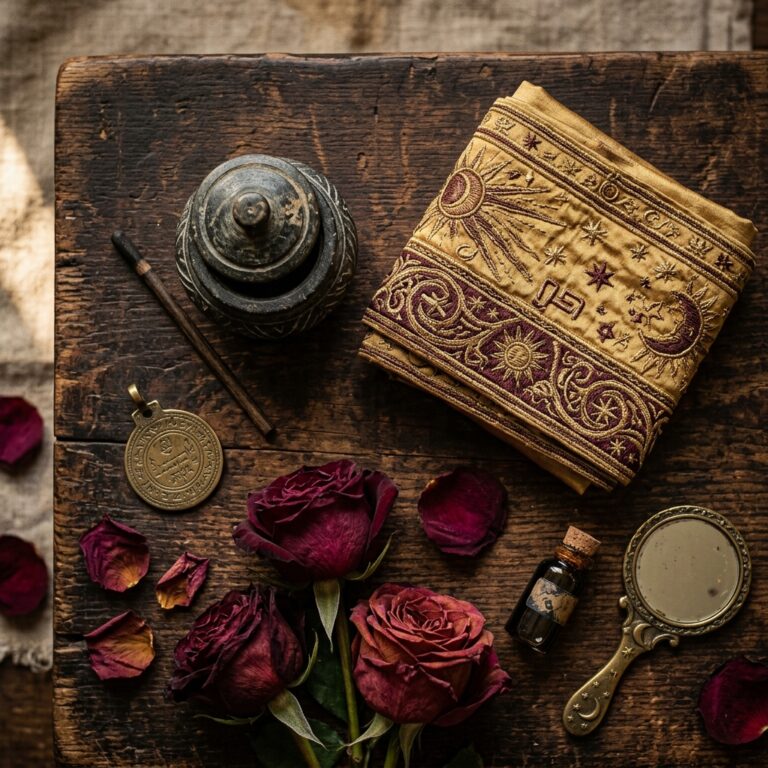
Long before the word existed, people practiced beauty magic. One of the oldest examples comes from Homer’s Iliad. In Book 14, the goddess Hera wants to win the attention of Zeus. So she asks Aphrodite to lend her love and desire. Aphrodite then hands Hera an embroidered band from her own breast. According to the poem, love, desire, and a “beguilement that steals the wits even of the wise” were worked into it.[2]
That band is essentially a glamour charm. It isn’t a potion or a curse. Rather, it’s an object you wear that changes how others respond to you. Aphrodite herself was the Greek goddess of love and beauty, and the Romans identified her with Venus.[3] That link still shapes beauty spells today, as you’ll see below.
Ancient Egypt offers another example. There, both men and women wore eye makeup such as kohl. It shielded the eyes from the glare of the desert sun. However, people also believed it offered protection against evil influences.[4] In other words, lining the eyes was both a beauty ritual and a protective one. Many modern witches still treat makeup this way. For them, putting it on with intention turns a daily habit into a small act of glamour magic.
Glamour Spells vs. Beauty Spells vs. Attraction Spells
These three terms overlap, so it helps to separate them before you start. First, spells for beauty turn inward. They focus on self-image, skin, or the feeling of being at home in your body. Next, an attraction spell turns outward. It aims to draw interest, often romantic, toward you. Finally, glamour spells work on the space in between. They shape the impression you leave, so people notice what you want them to notice.
Knowing the difference matters because it changes what you ask for. For instance, “make me beautiful” is vague and hard to hold in mind. By contrast, “let people see my confidence when I walk into the room” is clear. A clear intention is easier to focus on, and focus is the heart of any spell glamour practitioners use. Also, choosing glamour over an attraction spell keeps the work about you. It asks nothing of another person’s free will, which many witches consider a more ethical choice.
How to Cast a Simple Glamour Spell at Your Mirror
This is a gentle, beginner-friendly glamour spell. You only need a mirror, a pink or red candle, a little rose water, and a carrier oil. Plan on about twenty minutes, and choose a quiet time when no one will interrupt you.
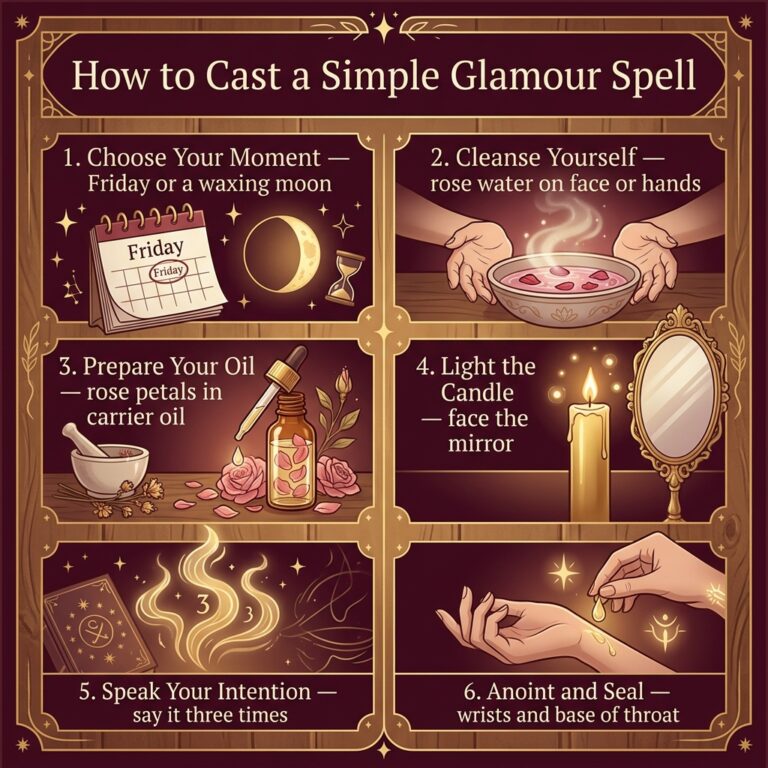
1. Choose your moment. Many witches cast on a Friday, the day named for Venus, or during a waxing moon. The waxing moon is the phase when the moon grows toward full, so it is linked with increase.
2. Cleanse yourself. Wash your face or hands with rose water. This marks the shift from ordinary time into ritual time. It also clears away the day, so you start fresh.
3. Prepare your oil. Add a few dried rose petals to a small bottle of carrier oil, such as jojoba. If you’d like a deeper version, my guide to making your own spell oils explains infusion step by step.
4. Light the candle and face the mirror. Place the candle so its light falls on your face. Then look at yourself calmly for a full minute. Notice what you like, not what you want to fix.
5. Speak your intention. Say out loud how you wish to be seen. For example: “Let others see the warmth and strength I already carry.” Keep it short, and say it three times.
6. Anoint and seal. Finally, touch a drop of oil to your wrists and the base of your throat. Then let the candle burn down safely, or snuff it out and relight it on the next Friday.
Belief, Intention & The Power of Magic
Witchcraft, spells, and manifestation are deeply rooted in belief, intention, and spiritual practice. If these practices do not resonate with you, this may not be the path for you, and that’s perfectly okay. But if you believe in divine powers, trust your intentions, and feel drawn to the mysteries of the unseen, we invite you to continue exploring with Madame Celestine and discover the magic that speaks to your soul.
Why Friday, Roses, and Mirrors? The Old Logic Behind Each Tool
Every piece of the ritual above has a reason behind it. Take Friday first. The English name honors the Germanic goddess Frigg. Yet the day itself is a translation of the Latin dies Veneris, “the day of Venus.” That Latin phrase, in turn, came from the Greek name meaning Aphrodite’s day.[5] So when witches cast a glamour spell on a Friday, they tie into a naming tradition that runs back through three languages to the goddess of beauty.
Roses carry a similar link. In most modern correspondence tables, rose belongs to Venus. That’s why rose water, rose petals, and rose oil appear in so many beauty spells. Likewise, pink and red candles stand for affection and warmth. Copper, the metal many traditions assign to Venus, often turns up in glamour jewelry for the same reason.
Mirrors matter too. A mirror is where you meet your own image, so it’s the natural place to work on how you’re seen. Some practitioners also treat mirrors as doorways, which is why they cover them during certain rituals. In glamour magic, though, the mirror is simply a focusing tool. It holds your attention on yourself while you speak your intention.
Common Glamour Spell Mistakes to Avoid
The first mistake is expecting a new face. As I said above, glamour magic works on perception, not physical features. If you cast expecting your reflection to change overnight, you’ll likely feel let down. Instead, watch for subtler shifts, such as how you carry yourself or how a conversation flows.
The second mistake is casting from dislike. When you stand at the mirror listing flaws, your focus goes to those flaws. As a result, the spell ends up feeding the very feelings you hoped to leave behind. So begin with something you genuinely like about yourself, even if it’s small.
A third mistake is aiming the spell at one specific person. At that point, you’re no longer casting a glamour. You’re casting a spell to influence someone else, which raises questions of consent. Keep the glamour about you, and let others respond freely.
Finally, don’t skip safety. Test any oil on a small patch of skin first. Also, never leave a candle burning unattended.
Everyday Glamour Magick: Charms, Makeup, and a Glamour Magic Book
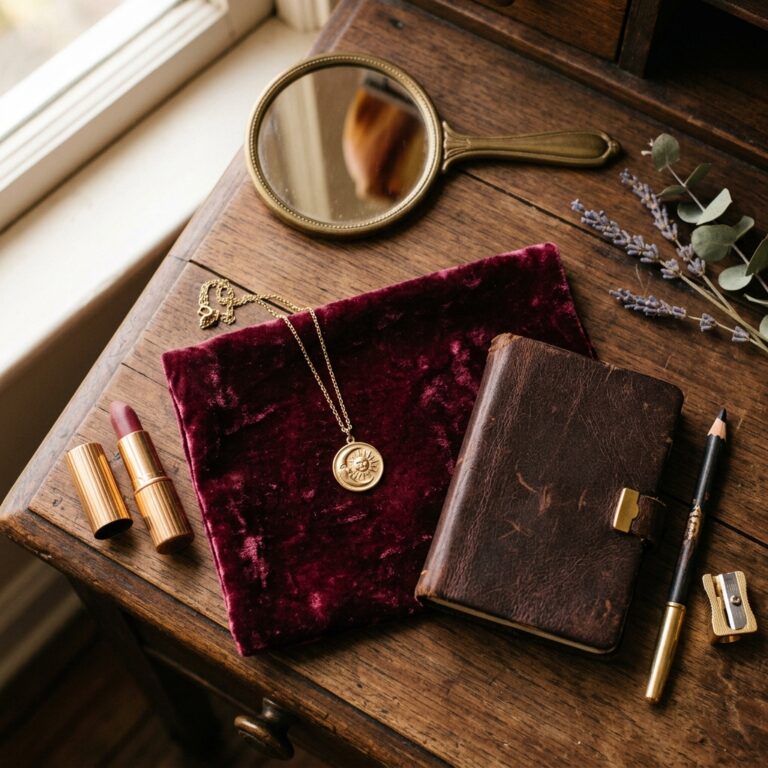
Not every glamour needs a candle. In fact, many practitioners weave glamour magick spells into ordinary routines. For example, you can charge a ring or pendant under a waxing moon. Then you wear it whenever you want that feeling back. This follows the same idea as Aphrodite’s band, since the charm carries the glamour for you.
Makeup offers another path. As the Egyptians did with kohl, you can treat each step as a small ritual. Speak a word of intention as you line your eyes or apply lipstick. Similarly, some witches trace a tiny symbol in the air over their face before stepping outside.
If you want to go further, keep a glamour magic book. This is a small notebook where you record each working, the date, the moon phase, and what you noticed afterward. Over time, it shows you which timing and tools feel strongest for you. It also turns scattered experiments into a real practice of your own.
Frequently Asked Questions
What is a glamour spell in simple terms?
A glamour spell is a ritual meant to shape how you are perceived. Practitioners use it to bring out qualities like confidence, warmth, or charm, rather than to change physical features.
Is a glamor spell different from a glamour spell?
No, they are the same practice. “Glamour” is the older British spelling, and “glamor” is the American spelling.
What is glamour magic mainly used for?
People often use glamour magic before interviews, dates, performances, or any moment when they want to feel seen. Many also use it simply to feel more at ease in their own skin.
Is this ritual safe for beginners?
Simple beauty spells with candles, rose water, and oil are well suited to beginners. Just patch-test any oil on your skin first, and never leave a flame unattended.
Which day of the week works best?
Many witches choose Friday, the day traditionally linked with Venus. Others prefer the waxing moon, which is associated with growth and increase.
Can a glamour spell make someone fall in love with me?
A glamour spell is about how you present yourself, not about controlling another person. If your goal is a specific relationship, that is a different kind of work with its own ethical questions.
References
- Glamour – Etymology, Origin & Meaning. Online Etymology Dictionary. https://www.etymonline.com/word/glamour
- Homer, Iliad Book 14 (trans. A. T. Murray). Theoi Classical Texts Library. https://www.theoi.com/Text/HomerIliad14.html
- Aphrodite | Mythology, Worship, & Art. Encyclopaedia Britannica. https://www.britannica.com/topic/Aphrodite-Greek-mythology
- Riley Black, Makeup in Ancient Egypt, June 30, 2021. Natural History Museum of Utah. https://nhmu.utah.edu/articles/makeup-ancient-egypt
- Friday – Etymology, Origin & Meaning of the Name. Online Etymology Dictionary. https://www.etymonline.com/word/Friday
Not sure where to start? You don’t have to do this alone.
Madame Celestine offers guided spellwork for beginners — real support for your first working, not just another guide to read.
Related reading: The Desire Ritual for When You Feel Invisible to Your Partner · Passion Spell or Communication Problem? What to Fix First

About Madame Celestine
Madame Celestine has practiced and taught spellwork, divination, and seasonal ritual for over two decades, helping newcomers build a grounded, confident practice from their very first spell.