
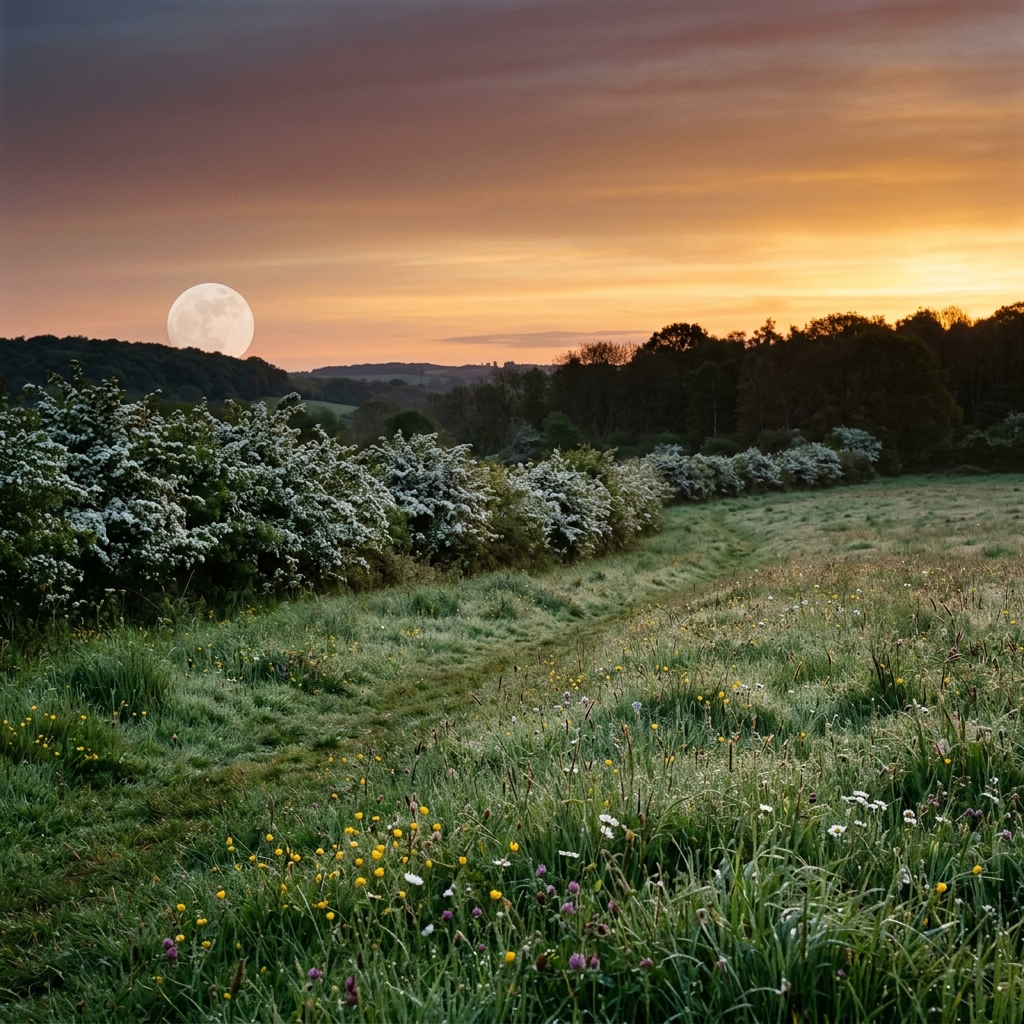
Flower Moon luck is a modern name for a very old question: how do you carry good fortune from spring into the rest of the year? Today, most people meet the idea through moon calendars. However, the customs behind it are much older. They come from the May Day traditions of Britain and Ireland, where the first morning of May was treated as a hinge in the year. In this guide, you’ll learn why people washed in dew at dawn and why they refused to lend out fire. You’ll also see why hawthorn blossom stayed outside the house. Finally, you’ll find a simple ritual built from those customs.
- The Flower Moon Meets May Day: Two Calendars, One Season
- Luck You Kept, Not Luck You Chased: The Old May Eve Rules
- Washing in May Dew: From Arthur’s Seat to Pepys’s Wife
- Bringing in the May, and Why Hawthorn Stayed Outside
- A Flower Moon Luck Ritual Drawn From Old May Customs
- May Day or Full Moon? Choosing Your Timing
- Common Mistakes With May Luck Customs
- Frequently Asked Questions
- References
The Flower Moon Meets May Day: Two Calendars, One Season
The Flower Moon is the full moon of May. It takes its name from the flowers that bloom that month, and it is also called the Milk Moon and the Corn Planting Moon.[1] These names reached most readers through North American almanacs, so they are not the names used in old Britain or Ireland.
May Day, by contrast, is a fixed date. It falls on May 1 and celebrates the return of spring. Scholars think its first purpose was to ensure fertility for crops, livestock, and people.[2] So the two calendars measure the season differently. One follows the moon, while the other follows the sun and the farming year.
That difference matters for anyone working with Flower Moon luck today. The customs in this article belong to May Day and May Eve, the night before. Pairing them with the Flower Moon is a modern choice, not an ancient rule. Still, the pairing makes sense. Both mark the same turning point, when the land is at its most fertile and the year’s fortune seemed to hang in the balance.
Luck You Kept, Not Luck You Chased: The Old May Eve Rules
Modern luck spells usually try to draw fortune in. Old May customs, however, worried far more about luck slipping out. In Ireland, people believed that luck could be stolen on May Eve and May Day. For that reason, a household would not give away water or fire during those days, since doing so might hand over the luck of the house.[3]
The same fear shaped farm life. Someone with ill intent might skim water from a neighbour’s well, or gather dew from a neighbour’s field, on May morning. As a result, that household was thought to lose its produce for the year.[3] Some families even made a special “May Eve churn” of butter. They salted it and kept it all year, because its power was believed to protect the milk and cream.[3]
This is the most useful lesson in Flower Moon luck. Good fortune was treated as something a household already had, and the task was to guard it. Fire played a central role in this protective thinking, too. For instance, Beltane fires were lit at the start of May across the Gaelic world. You can read more about them in this guide to Beltane fires and sacred flame traditions.
Washing in May Dew: From Arthur’s Seat to Pepys’s Wife
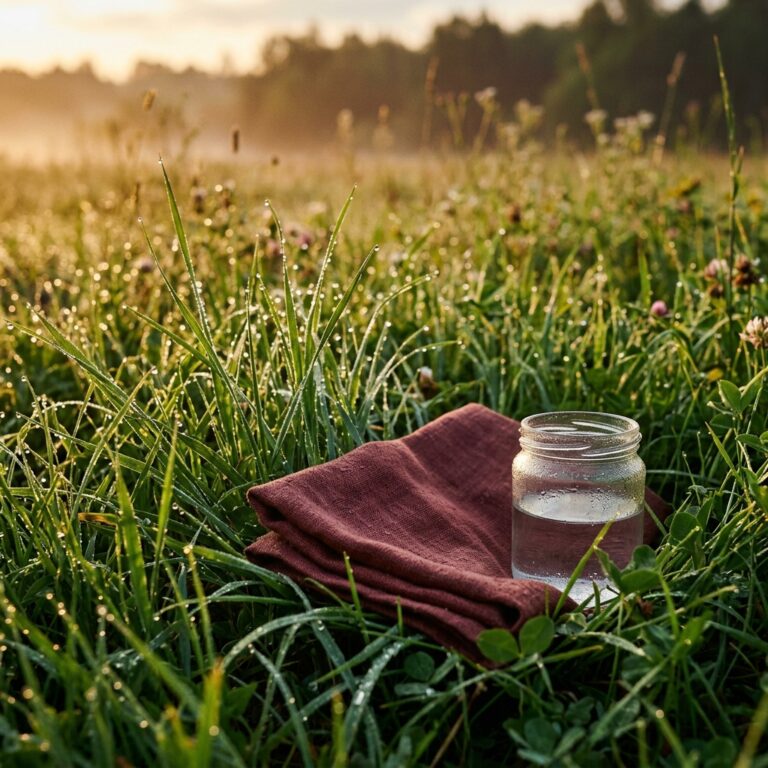
Of all the May customs, dew washing lasted longest. In Edinburgh, people climbed Arthur’s Seat, Calton Hill, and Blackford Hill before sunrise every May 1. Most were young women. They washed their faces in the dew, which was believed to bring vitality, beauty, and good fortune for the year ahead.[4] The custom survived well into the twentieth century, though crowds had shrunk to a few hundred by 1987.[4]
England had the same belief. On 28 May 1667, the diarist Samuel Pepys wrote that his wife had gone to gather May dew the next morning. A friend had told her it was the best thing in the world to wash her face with.[5] In other words, a fashionable London household trusted a country custom.
Ireland shared it too. There, May morning dew and water drawn from the well on May Day were thought to be good for the complexion. They were also believed to offer protection and cures.[3] So the dew was never only a beauty treatment. Rather, it carried the whole season’s promise of health and luck. That’s why dew still sits at the heart of Flower Moon luck today.
Bringing in the May, and Why Hawthorn Stayed Outside
Another custom was “bringing in the May.” People gathered flowers and green branches on May morning to decorate homes and public spaces.[2] In Ireland, flowers were laid on doorsteps and windowsills. They were believed to bring luck to the house and protect it from unseen forces.[3]
Yet one May flower came with a warning. Hawthorn is so closely tied to the month that it is simply called “May” or the May tree. It is described as the ancestor of the maypole and the source of May Day garlands.[6] Even so, folklore says you should never bring its blossom into the house. Part of the reason is bad luck. The other part is the scent, which reminded people in medieval times of the Great Plague.[6]
That tension is worth noticing. Hawthorn could decorate a maypole or a doorway, since those were outdoor, shared spaces. Inside the home, however, it crossed a line. For Flower Moon luck, the rule is simple. Use hawthorn outdoors and choose gentler blooms, such as primroses or marigolds, for the threshold.
A Flower Moon Luck Ritual Drawn From Old May Customs
This Flower Moon luck ritual combines the customs above into one short practice. You can do it on May Eve and May morning, or on the night of the Flower Moon and the dawn after. Either way, you’ll need a clean glass jar, a cloth, and a few yellow or white flowers.
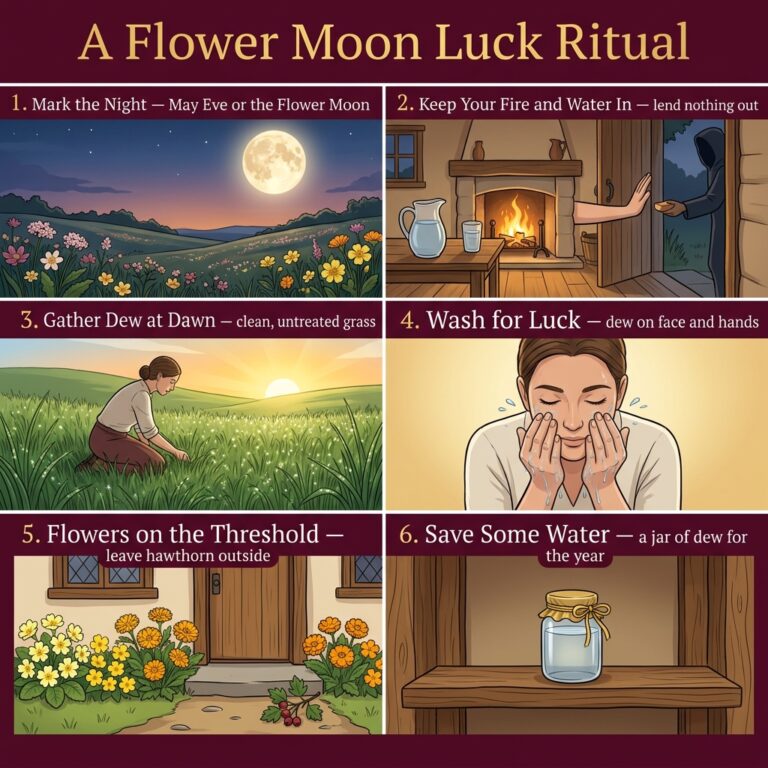
1. Mark the night. Choose May Eve or the evening of the Flower Moon. Then tidy your doorstep, because the threshold is where luck enters and leaves.
2. Keep your fire and water in. That evening, don’t lend out a candle, a lighter, or water. This follows the old belief that giving them away gives away the luck of the house.
3. Gather dew at dawn. Before sunrise, press the cloth into clean, untreated grass. Next, wring it into the jar. Choose grass you know hasn’t been sprayed.
4. Wash for luck. Touch the dew to your face and hands. As you do, name the kind of fortune you want to keep this year, such as health, steady work, or a peaceful home.
5. Lay flowers on the threshold. Place your flowers on the doorstep or a windowsill. Leave the hawthorn outside, as tradition advises.
6. Save some water. Finally, seal a little dew in the jar and keep it somewhere dark. Many practitioners touch a drop to the doorframe whenever luck feels thin.
Belief, Intention & The Power of Magic
Witchcraft, spells, and manifestation are deeply rooted in belief, intention, and spiritual practice. If these practices do not resonate with you, this may not be the path for you, and that’s perfectly okay. But if you believe in divine powers, trust your intentions, and feel drawn to the mysteries of the unseen, we invite you to continue exploring with Madame Celestine and discover the magic that speaks to your soul.
May Day or Full Moon? Choosing Your Timing

Some years, the Flower Moon falls close to May 1. In other years, it lands weeks later. So which date should you use for Flower Moon luck? The honest answer is that both have a logic.
May Eve and May morning carry the weight of history. These are the dates on which the old customs actually took place. If you want to work inside that tradition, choose them. The full moon, on the other hand, fits a lunar practice. Many modern witches time luck and abundance work to the full moon, since it marks a peak of light and completion.
A third option is to split the ritual. For example, you can keep your fire and water in on May Eve and gather dew on May morning. Then, at the Flower Moon, you can refresh the threshold flowers and bless the saved jar. This approach honours the historical dates while still following the moon.
If you live in the Southern Hemisphere, the picture changes. There, May falls in autumn, so the flowering season is months away. Many Southern Hemisphere practitioners move these customs to November instead, when their own spring flowers bloom.
Common Mistakes With May Luck Customs
The first mistake is gathering dew anywhere. Lawns and roadside verges are often treated with chemicals. Because the dew goes on your face, choose a wild meadow or your own untreated garden instead.
The second mistake is treating the customs as a way to take from others. The old stories about skimming a neighbour’s well describe something feared, not something to copy. So gather only from your own land or from public spaces where it harms no one.
A third mistake is bringing hawthorn indoors because it looks lovely in a vase. Tradition is clear on this point, and the scent is strong enough to make the rule practical as well.
Finally, don’t expect instant results. Flower Moon luck customs were about the year as a whole. Their aim was to protect and steady a household’s fortune over months, not to deliver a windfall overnight.
Frequently Asked Questions
What is Flower Moon luck?
Flower Moon luck is a modern name for luck-keeping customs timed to May. It pairs the May full moon with older May Day traditions from Britain and Ireland, such as dew washing and guarding the home’s fire and water.
Why was May dew thought to be lucky?
May dew was believed to bring beauty, health, and good fortune for the coming year. People often gathered it before sunrise on May 1.
Can I bring hawthorn blossom into my house?
Folklore says no. Hawthorn blossom was considered unlucky indoors, so it was traditionally kept outside on maypoles, garlands, and doorways.
Do I have to use the exact date of the Flower Moon?
No. The historical customs belonged to May Eve and May Day, so either those dates or the full moon can work. Many practitioners use both.
Why not give away fire or water on May Day?
In Irish tradition, giving away fire or water on May Eve or May Day was thought to give away the household’s luck for the year.
References
- Full Moon Names. timeanddate.com. https://www.timeanddate.com/astronomy/moon/full-moon-names.html
- May Day | Spring Festival, Europe, Maypole, & Celebration. Encyclopaedia Britannica. https://www.britannica.com/topic/May-Day-European-seasonal-holiday
- Traditions and customs May Day / Bealtaine. National Museum of Ireland. https://www.museum.ie/en-ie/collections-research/folklife-collections/folklife-collections-list-(1)/religion-and-calendar-customs/may-day
- David McLean, When Scots would wash their faces in the May dew for luck, May 1, 2018 (updated May 1, 2024). The Scotsman. https://www.scotsman.com/arts-and-culture/when-scots-would-wash-their-faces-in-the-may-dew-for-luck-586256
- Samuel Pepys, Tuesday 28 May 1667. The Diary of Samuel Pepys. https://www.pepysdiary.com/diary/1667/05/28/
- Fritha West, Why is hawthorn known as the May Tree?, April 11, 2022. Nature’s Calendar, Woodland Trust. https://naturescalendar.woodlandtrust.org.uk/blog/2022/why-is-hawthorn-known-as-the-may-tree/
Not sure where to start? You don’t have to do this alone.
Madame Celestine offers guided spellwork for beginners — real support for your first working, not just another guide to read.
Related reading: Stuck at Work? Your Energy Might Be the Problem · The Promotion Ritual HR Will Never Tell You About

About Edmund Hale
Edmund Hale is the pen name our editorial team uses for articles on grimoires, Qabalah, ceremonial magic and British folklore. Articles under this byline are researched from published sources and reviewed by Madame Celestine before publishing.