

If you have met the Qliphoth in an occult book, you may wonder how an old Jewish idea about “shells” became tied to the shadow self. The answer is a long and surprising journey. It runs from medieval Spain to a mystic in Safed, and from there to modern depth psychology. In this guide, you will learn what the word means and where the idea began. You will also see why many practitioners now use it for shadow work, and how to explore it with care.
- Shells and Husks: What the Word Qliphoth Means
- The Other Side: Where the Qliphoth First Took Shape
- Shattered Vessels: Luria’s Story of How Shells Formed
- How the Qliphoth Became a Map of the Shadow Self
- A Five-Step Qliphoth and Shadow Self Reflection
- The Qliphoth and the Shadow Self in Daily Life: Four Signs
- Four Common Misreadings of the Qliphoth
- Why the Qliphoth Still Speak to the Shadow Self Today
- Frequently Asked Questions
- References
Shells and Husks: What the Word Qliphoth Means
The word comes from Hebrew. In Jewish mystical writing it is usually spelled qelipot or kelipot, and it means “husks” or “shells”[1]. The singular form is qelipah. Western occult books, however, tend to use the spelling “Qliphoth.”
The image is simple but powerful. Think of a nut inside its shell, or grain inside its husk. The valuable part sits within, while the outer layer hides it and keeps it out of reach. So the Qliphoth are not described as evil beings in the first place. Instead, they are pictured as coverings that trap something good inside.
This detail changes how you read everything that follows. A shell is not the opposite of the fruit. Rather, it is what stands between you and the fruit. That is why the idea later fits so well with inner work.

The Other Side: Where the Qliphoth First Took Shape
The roots of the idea lie in the Zohar, a collection of mystical texts written in 13th-century Spain. One of its key themes is the Sitra Ahra, which means “the Other Side”[2]. In Kabbalah, a Jewish mystical tradition, this term names the realm of impure forces. It stands in contrast to the side of holiness[3].
However, the Zohar does not draw a clean, simple line between the two. One scholar argues that its texts show holy and demonic structures rising, collapsing and forming again together. In this reading, each side is bound up with the other[2]. In other words, the darkness is not a distant enemy. It grows in the same soil as the light.
This is the first reason the Qliphoth appeal to people doing shadow work. The old texts already suggest that you cannot fully understand the bright side of anything without facing its hidden twin.
Shattered Vessels: Luria’s Story of How Shells Formed
The idea took its most famous form in the 16th century. Isaac Luria, often called Ha-ari (“the Lion”), lived from 1534 to 1572 and taught in Safed. He founded the school of Kabbalah that still bears his name[4].
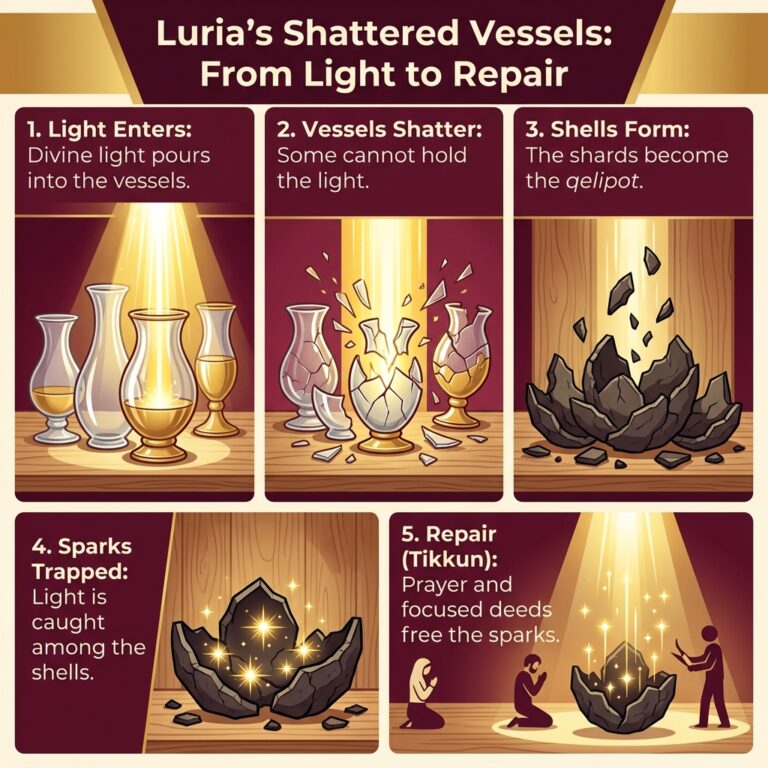
Luria told a striking creation story. First, divine light poured into a set of vessels. Then some of those vessels could not hold the light, and they shattered. Their broken shards became the husks, or qelipot. Meanwhile, sparks of light that failed to rise back to their source stayed trapped among those shells[1]. Another teacher adds that the leftover fragments gave life to the realms of impurity[5].
Next comes the most hopeful part. Luria taught tikkun, which means repair. Through prayer and focused action, people help to “raise up the fallen sparks” and restore what was broken[1]. So in this story, the shells are not the end. Instead, they hold light that is waiting to be freed.
How did Luria’s followers actually do this repair? Much of what we know comes from Hayyim Vital, who wrote down versions of Luria’s teachings. Those writings list three main tools: daily prayer, the other commandments, and special meditative exercises called yihudim[1]. Each act also needed kavvanot, which are carefully focused intentions. In other words, the same deed could either stay ordinary or become an act of repair. The difference lay in the attention behind it.
How the Qliphoth Became a Map of the Shadow Self
Much later, Western occultists borrowed the Qliphoth and gave them a new role. In many modern systems, they appear as a dark mirror of the Tree of Life, a kind of reverse map. Some Left-Hand Path and Satanic practitioners use this map for self-exploration rather than worship.
The Tree of Life itself is a diagram of ten spheres, called sefirot, that Kabbalists use to show how divine qualities flow into the world. In the reverse map, each bright sphere has a shadowed counterpart. So for these practitioners, the Qliphoth become a way to explore the shadow self, one hidden layer at a time.
Here, the psychologist Carl Jung offers a useful lens. Jung described the shadow as the traits and impulses we do not identify with, or cannot comfortably accept as part of ourselves. He also noted that we often meet the shadow indirectly, by seeing in others the qualities we will not admit in ourselves[6].
Put these ideas side by side, and the link becomes clear. The shell is the hard layer of denial, anger or shame. The spark is the energy or need locked inside it. Therefore, working with the Qliphoth and the shadow self means cracking the husk to recover what it hides. This is a modern reading, not traditional Jewish teaching, and it helps to hold both views with respect.
A Five-Step Qliphoth and Shadow Self Reflection
You do not need a complex ritual to begin. This simple journaling practice follows the shell-and-spark pattern, and it takes about twenty minutes.
1. Notice a strong reaction. First, recall a moment when someone irritated you more than the situation deserved. Strong reactions often point to shadow material, because they show where projection is at work.
2. Name the shell. Next, write down the trait you disliked in that person. Then ask whether a small version of it lives in you, too. This is the husk you are learning to see.
3. Look for the spark. After that, ask what need sits inside the trait. For example, “arrogance” may hide a healthy wish to be seen. This is the trapped light in Luria’s story.
4. Make one small repair. Then choose one small action that honors the spark in a healthy way. This reflects the idea of tikkun, where repair happens through deeds, not only thoughts.
5. Close and ground. Finally, close your journal, drink some water and step outside for a few minutes. Shadow work can stir up feelings, so a clear ending helps you return to daily life.
Belief, Intention & The Power of Magic
Witchcraft, spells, and manifestation are deeply rooted in belief, intention, and spiritual practice. If these practices do not resonate with you, this may not be the path for you, and that’s perfectly okay. But if you believe in divine powers, trust your intentions, and feel drawn to the mysteries of the unseen, we invite you to continue exploring with Madame Celestine and discover the magic that speaks to your soul.
The Qliphoth and the Shadow Self in Daily Life: Four Signs
You do not need a grimoire to notice the shells in your own life. Instead, they tend to show up in ordinary moments. Here are four common signs that shadow material is close to the surface.
You overreact to a small thing. A minor comment stings for days. That extra charge often points to a disowned trait, which is exactly where the shell sits.
The same pattern keeps repeating. You meet a new boss, partner or friend, and the old conflict returns. In Luria’s image, the same spark is still trapped, so the same shell keeps forming around it.
You feel sharp envy. Envy can feel ugly, but it often hides a real wish. For example, envy of a confident friend may reveal your own buried wish to speak up.
Your inner critic sounds very harsh. Sometimes the shadow faces inward. A cruel inner voice can be a husk around a part of you that simply wants care.
None of these signs means something is wrong with you. Rather, they are invitations to look more closely at the Qliphoth and the shadow self in your own story.
Four Common Misreadings of the Qliphoth
Because the Qliphoth sound dark and mysterious, they attract a lot of confusion. Here are four mistakes worth avoiding.
Treating them as a literal map of hell. In the Jewish sources, the shells describe a broken cosmos that can be repaired. They are not a tour guide to a fiery underworld.
Forgetting where the idea came from. The Qliphoth began in a living Jewish tradition, long before anyone linked them to the shadow self. So it is respectful to learn that origin, even if your own practice takes a different path.
Seeing shadow work as glorifying the dark. The goal is not to become your worst traits. Instead, it is to understand them so they stop running your life from behind the scenes.
Using it in place of real support. Reflection can be deeply helpful. Still, if old pain feels overwhelming, a trained therapist is the right companion for that part of the journey.

Why the Qliphoth Still Speak to the Shadow Self Today
At first glance, a medieval idea about broken vessels seems far from modern life. Yet its central message feels very current. The parts of yourself you hide are not simply bad. Instead, they may hold energy you have lost access to.
That is also why the theme appears in other shadow-work writing, such as this look at shadow work after a breakup from a Satanic practice perspective. In every version, the same promise returns. Each shell you understand may release a spark.
So the Qliphoth invite patience rather than fear. You crack one husk at a time, and each small repair adds a little more light to your life.
Frequently Asked Questions
What does Qliphoth mean?
Qliphoth is a Western spelling of the Hebrew qelipot, meaning “shells” or “husks.” In Kabbalah, the word describes coverings that trap holy sparks of light.
Are the Qliphoth the same as demons?
Not exactly. Jewish sources link them to the realm of impurity, but they are first pictured as shells around hidden light rather than as individual beings.
How are the Qliphoth connected to the shadow self?
Modern practitioners compare the shell to the parts of ourselves we deny and the spark to the energy hidden inside them. This is a modern psychological reading, not the original Jewish teaching.
Is working with the Qliphoth dangerous?
Reflective shadow work is usually gentle, but it can stir up strong feelings. Keep sessions short, ground yourself afterwards and seek a therapist if old pain feels overwhelming.
Do I need to study Kabbalah to explore this idea?
No, but learning the basic Jewish background helps you understand the symbols and use them respectfully. A good introduction to Lurianic Kabbalah is a strong place to start.
References
- Tikkun in Lurianic Kabbalah. Lawrence Fine. My Jewish Learning. https://www.myjewishlearning.com/article/tikkun-in-lurianic-kabbalah/
- “Improper Twins”: The Ambivalent “Other Side” in the Zohar and Kabbalistic Tradition. N. A. Berman, doctoral thesis, 2014. UCL Discovery, University College London. https://discovery-pp.ucl.ac.uk/id/eprint/1435419
- Sitra Achra. Sefaria. https://www.sefaria.org/topics/sitra-achra
- Isaac ben Solomon Luria. Encyclopaedia Britannica. https://www.britannica.com/biography/Isaac-ben-Solomon-Luria
- Shattered Vessels: Introduction to the Ari’s Concept of Shevirat haKeilim. Moshe Miller. Chabad.org. https://www.chabad.org/kabbalah/article_cdo/aid/380568/jewish/Shattered-Vessels.htm
- Shadow Work Meaning in Jungian Psychology Explained. Meridian University. https://meridianuniversity.edu/content/shadow-work-meaning-in-jungian-psychology-explained
Not sure where to start? You don’t have to do this alone.
Madame Celestine offers guided spellwork for beginners — real support for your first working, not just another guide to read.

About Edmund Hale
Edmund Hale is the pen name our editorial team uses for articles on grimoires, Qabalah, ceremonial magic and British folklore. Articles under this byline are researched from published sources and reviewed by Madame Celestine before publishing.