
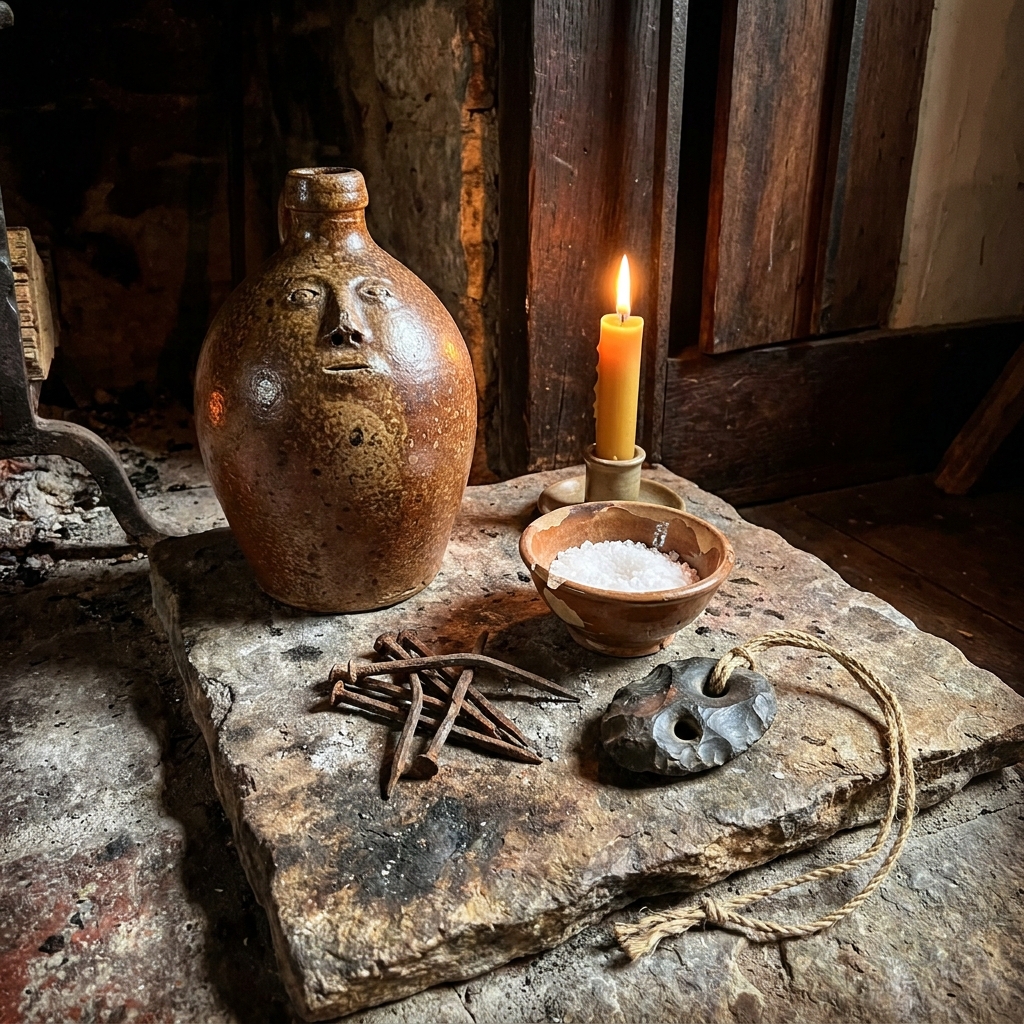
If you’ve searched for how to break a curse, something has probably gone wrong for a while. Maybe it’s a run of bad luck, a heavy feeling at home, or a sense that someone wishes you harm. People have asked this exact question for centuries, and English villagers once paid good money for the answer. This guide follows their methods. First, you’ll see what a curse meant to the people who feared one. Then you’ll find six traditional steps for breaking a curse yourself, drawn from old folk practice. Finally, you’ll learn what the archaeological record shows about witch bottles, hag stones and marks on doorways, and when it makes sense to call in a practitioner.
- The People England Paid to Break a Curse
- The Bottle Under the Hearth: A 1671 Recipe for Breaking a Curse
- Cursed or Just Unlucky? What to Do First
- How to Break a Curse in 6 Steps
- Hag Stones and Daisy Wheels: The Curse Breakers Hidden in Old Houses
- Salt, Iron and Watching Eyes: Why Curse Breaking Looks the Same Everywhere
- Should You Send a Curse Back? The Old Answer and the New One
- Five Mistakes That Keep a Curse Hanging Around
- Breaking a Spell vs. Breaking a Curse: Is There a Difference?
- Signs a Curse Has Lifted
- How to Break a Family Curse or a Bad Luck Curse
- When a Curse Won’t Lift: Why People Still Call a Practitioner
- Frequently Asked Questions
- References
The People England Paid to Break a Curse
For several hundred years, ordinary people in Britain who felt bewitched didn’t go to a priest first. Instead, they went to the local cunning man or cunning woman. These were village healers and charm-makers who worked from the late medieval period into the early twentieth century.[1]
Breaking curses was the heart of their trade. The historian Owen Davies called them the only healers to offer a full set of anti-witch measures. Their methods mixed written charms, rituals, prayers and herbal medicines. Sometimes they also confronted the suspected witch directly, or through the courts.[1]
They were also far from rare. Davies estimated that several thousand may have been working in England at any one time until the mid-nineteenth century. In fact, he argued that the whole profession faded once belief in harmful witchcraft faded, because curse breaking was its core service.[1] So when you ask how to break a curse, you’re asking the question that kept an entire class of folk practitioners in business.

The Bottle Under the Hearth: A 1671 Recipe for Breaking a Curse
The best-documented curse breaker in English history is a bottle. In 1671, Joseph Blagrave of Reading published Astrological Practice of Physick. Among herbal remedies, it covers illnesses thought to come from sorcery or witchcraft, and ways to expel evil spirits.[2]
His method was blunt. The patient’s urine went into a bottle with three nails, pins or needles and a little white salt. Then the household kept the bottle warm. Blagrave claimed the bottle, left long enough, “will endanger the witch’s life.”[3] In other words, the bottle was meant to turn the curse back on its sender.
That wasn’t just a theory on paper. In 2004, workers in Greenwich, London, found a sealed witch bottle from this period. Retired chemist Alan Massey and a team of scientists then examined it with X-rays, a CT scan and chemical tests. Inside were 12 iron nails, one driven through a leather heart, along with 8 brass pins, hair, fingernail clippings and urine.[4] People believed the bottle would absorb the spell and torment the witch who cast it.[4]
Later bottles changed purpose. By the eighteenth century, people made many of them for general protection rather than to strike back at one person. One Cornish document of the period made a bold promise. With such a bottle, it said, “no enemy will have power over you.”[3] That shift, from revenge to protection, is exactly the direction most modern curse breaking has taken.
Cursed or Just Unlucky? What to Do First
Before anyone lights a candle, it helps to ask an honest question. Is this a curse, or is it a hard season? Plenty of misfortune has ordinary causes, such as stress, illness, money pressure or a run of genuinely bad timing. For example, the site’s guide to a bad luck streak with a hidden cause walks through that sorting process.
Practitioners usually look for a pattern rather than a single bad day. People describe a few common signs. Trouble starts suddenly after a conflict. The home feels heavy no matter how often it’s cleaned. Or small accidents keep repeating with no clear link. However, none of these proves a curse. They’re simply the reasons people start asking how to break a curse in the first place.
Above all, health comes first. If you’re dealing with physical or mental symptoms, see a doctor. The cunning folk themselves combined charms with herbal medicine, so even they paired magic with physical remedies.[1]
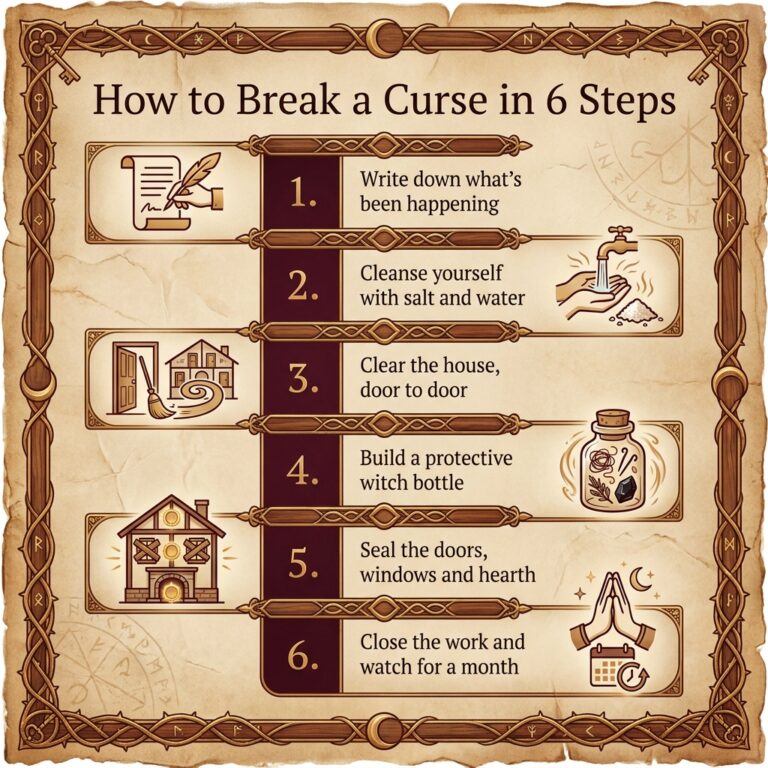
How to Break a Curse in 6 Steps
The steps below follow the order many traditional practitioners use. First you clear yourself, then your home, then you seal and protect. Each step comes with the reason behind it, so you know what it’s meant to do.
1. Write down what’s been happening
Start with a short, honest list. Note when the trouble began, what changed around that time and what keeps repeating. A clear list tells you whether you’re dealing with a pattern at all, and it gives you something to compare against later.
2. Cleanse yourself with salt and water
Salt appears in Blagrave’s 1671 bottle recipe for a reason.[3] Across folk magic, it’s treated as something that absorbs and purifies. So a common first act is a bath or wash with a handful of salt in the water, followed by a rinse in clean running water. The idea is that whatever clings to you is drawn out and washed away.
3. Clear the house, door to door
Next comes the home. Practitioners open the windows, sweep from the back of the house toward the front door, and carry smoke or salt water through each room. Then they sweep the dirt out over the threshold. For a fuller version, see this guide to cleansing yourself and your home.
4. Build a protective witch bottle
The historical bottle is the centerpiece of English curse breaking. Modern practitioners usually make a gentler version. They fill a glass jar with iron nails, pins, salt, rosemary and vinegar. Then they seal it and bury it near the house or hide it near the hearth. Practitioners believe the sharp metal catches and pins down harm. Unlike Blagrave’s recipe, though, the modern bottle aims to block and absorb, not to hurt anyone.
5. Seal the doors, windows and hearth
Old English households protected their houses at the openings, because that’s where people believed harm got in.[5] So practitioners finish a curse breaking by marking these points. Some hang a holed stone by the door, some draw a protective symbol, and some lay a line of salt along the sill.
6. Close the work and watch for a month
Finally, the practitioner states aloud that the curse is broken and the work is closed. Then comes patience. Most traditions suggest waiting one full moon cycle, about 29 and a half days, before judging the result. Meanwhile, keep your list from step one and add to it. If the pattern fades, most practitioners consider the work done.
Belief, Intention & The Power of Magic
Witchcraft, spells, and manifestation are deeply rooted in belief, intention, and spiritual practice. If these practices do not resonate with you, this may not be the path for you, and that’s perfectly okay. But if you believe in divine powers, trust your intentions, and feel drawn to the mysteries of the unseen, we invite you to continue exploring with Madame Celestine and discover the magic that speaks to your soul.
Hag Stones and Daisy Wheels: The Curse Breakers Hidden in Old Houses
After breaking a curse, people faced an old question: how to keep it from coming back. The answer is still visible on English buildings today.
Historic England calls them witches’ marks, or apotropaic marks, from a Greek word for turning away harm. They’re symbols scratched into stone or wood in churches, houses, barns and even caves. Most sit near doorways, windows and fireplaces. They were common from about the sixteenth to the early nineteenth century.[5]
The most common is the daisy wheel, or hexafoil, a six-petaled flower drawn with a compass. Historic England notes that its meaning is still debated. Ritual protection is the most widely accepted theory, but some see it as a sun symbol or simply geometry practice.[5]
Holed stones did the same job. The Pitt Rivers Museum in Oxford holds a naturally perforated “hag stone” taken from a carter’s cottage door at Rushmore, near Salisbury, around 1880. Museum records say it was there “to keep away witches.” People also hung such stones over stable doors and horses’ stalls. They linked them to protection from “hag-riding,” the nightmares blamed on witches.[6] If you want a related doorway charm, the site also has a guide on hanging witch bells.

Salt, Iron and Watching Eyes: Why Curse Breaking Looks the Same Everywhere
England isn’t the only place with a long tradition of breaking curses. Take the evil eye, a harmful glance usually blamed on envy. Fear of it appears in ancient Greece and Rome and in Jewish, Islamic, Buddhist and Hindu traditions. People there have answered it with amulets, sacred texts, ritual drawings and protective foods. In Turkey, for instance, blue eye beads called nazar are sold as protection.[7]
Put these traditions next to the English evidence, and three jobs keep showing up. Some objects absorb harm, like salt and the contents of a witch bottle. Others block it at the door, like hag stones, daisy wheels and eye amulets. A smaller group sends it back, like Blagrave’s urine bottle, which aimed to endanger the witch.[3]
Read this way, the old record gives a practical guide. If the problem feels like something clinging to you, the traditions point to absorbing tools such as salt and washing. If it feels like something getting in, they point to blocking tools at doors and windows. The third job, returning harm, is the one most modern practitioners now leave out. As a result, a modern curse breaking usually combines absorbing and blocking and stops there.
Should You Send a Curse Back? The Old Answer and the New One
Two of the most searched questions are how to reverse a curse and how to find out who cursed you. The old cunning folk would have understood both. Some of their counter-magic, such as pin-pierced animal hearts and rag dolls of the witch, was meant to harm the person blamed.[1] They also used scrying with a mirror, a crystal or a bowl of water to reveal a culprit’s face, though mostly in cases of stolen goods.[1]
That history has a dark side, however. In a village, naming a witch could ruin a neighbor’s life. With the evil eye, for example, Britannica notes that accusations fell most often on strangers, childless women and old women.[7] So most modern practitioners now avoid both naming and returning. Instead, they focus on breaking the curse’s hold on you and protecting your home.
There’s also a practical reason. Revenge work keeps your attention fixed on the person you fear. By contrast, cleansing and protection turn your attention back to your own life, which is usually where the change needs to happen.
Five Mistakes That Keep a Curse Hanging Around
Many people who try to break a curse on their own run into the same problems. Most of them are easy to avoid once you know them.
Skipping the honest list
Without a written record, every bad day starts to look like proof. As a result, people often repeat cleansings for weeks without knowing whether anything changed. The list from step one is the only fair way to judge.
Cleansing the person but not the house
Folk tradition treats the home and the body as linked. So a salt bath alone often feels incomplete. Practitioners usually clear both, in the same week, and then protect the doors.
Rushing the result
Checking for change every morning keeps fear running. Instead, most traditions ask for one full moon cycle of patience. That gap also gives ordinary problems time to show themselves for what they are.
Aiming the work at a person
Trying to punish a suspected witch tends to keep the conflict alive. It also keeps your attention on them rather than on your own life. That’s the main reason modern practitioners dropped the revenge side of the old witch bottle.
Never closing the work
Finally, many home rituals simply trail off. Traditions that break curses usually end with a clear statement that the work is done, followed by a sealing act such as burying the bottle. Without that close, people often feel the curse is still hanging around.
Breaking a Spell vs. Breaking a Curse: Is There a Difference?
People often search for how to break a spell put on them and how to break a curse as if they were the same thing. In folk practice, they overlap heavily, but the words carry different weight.
A curse usually means a wish for harm, such as illness, bad luck or a broken household. A spell is broader. Someone might believe a love spell, a binding or a “stay away” working was cast on them without any wish to hurt. So the first question practitioners ask is what the working seems to do. If it seems to harm, they treat it as a curse and follow the full six steps. If it seems to pull, hold or push you, they focus on cleansing and on cutting the tie.
Either way, the tools stay much the same. Salt, water, a cleared house and protected doors appear in nearly every method for removing spells and curses. That’s also why learning how to break a curse covers most unwanted spells as well. The difference lies mostly in the closing words, which name what you’re releasing.
Signs a Curse Has Lifted
Practitioners describe the end of a curse in quiet terms. The home feels lighter. Sleep improves. Small accidents and missed chances become less frequent, or at least stop feeling connected. However, these are signs of belief and interpretation, not proof. That’s why the written list matters so much. If your notes from week four look calmer than your notes from week one, most practitioners would say the curse breaking has done its job.
How to Break a Family Curse or a Bad Luck Curse
Some people feel the trouble didn’t start with them. A family curse is the belief that misfortune runs down a bloodline, often traced to an old quarrel or a broken promise. A bad luck curse, by contrast, is usually felt as one long streak in one person’s life.
The traditional approach to both is the same six steps, applied more widely. For a family curse, practitioners often add an ancestor element, such as lighting a candle for the family line and stating that the pattern ends now. For a bad luck curse, they put extra weight on step one. Writing the streak down often shows which parts feel magical and which have ordinary fixes.
When a Curse Won’t Lift: Why People Still Call a Practitioner
Learning how to break a curse yourself is a real option, and the steps above are the traditional place to start. Still, there’s a reason the cunning folk stayed busy for centuries. When you’re the one who feels cursed, it’s hard to see the situation clearly. Fear makes every bad day look like evidence.
A practitioner brings two things that are hard to supply alone. The first is distance. Someone outside the situation can help sort a true pattern from a rough patch, and suggest whether cleansing, protection or banishing work fits best. The second is method. An experienced hand knows how to build the work, how to close it properly and what to do if it needs a second round.
If you’d like that kind of help, the banishing spells offered on this site focus on removing unwanted influences and negativity. Each request starts with a free conversation about what’s been happening. That way, the ritual fits your situation. No spell can promise a specific outcome. A carefully made banishing, though, gives your intention to break the curse a clear form and a proper close.
Frequently Asked Questions
Can you break a curse yourself?
Yes. Most people used traditional methods at home, with salt, water, a witch bottle and protection at doors and windows. People usually seek a practitioner when the problem keeps returning or feels too close to judge clearly.
How long does it take to break a curse?
Many practitioners suggest waiting one full moon cycle, about a month, before judging the result. Some practitioners repeat the work over several cycles if the pattern doesn’t fade.
What should you do if someone put a curse on you?
First, rule out ordinary causes and look after your health. Then follow the traditional order: cleanse yourself, cleanse your home, and protect the doors and windows.
Is it safe to reverse a curse back to the sender?
Old English witch bottles aimed to harm the suspected witch. Most modern practitioners, however, avoid returning harm. They focus on breaking the curse’s hold and protecting the home instead.
How do you break a family curse?
Practitioners use the same cleansing and protection steps, often adding a candle for the family line and a spoken statement that the pattern ends with you.
References
- Cunning folk in Britain. Wikipedia. https://en.wikipedia.org/wiki/Cunning_folk_in_Britain
- Blagraves Astrological Practice of Physick (1671), catalogue record ESTC R13219. Max Planck Institute for the History of Science. https://reademed.mpiwg-berlin.mpg.de/book/r13219
- Witch Bottle (Bellarmine Jar with boxed contents), object 14. Museum of Witchcraft and Magic, Boscastle. https://museumofwitchcraftandmagic.co.uk/object/witch-bottle-bellarmine-jar/
- Online Halloween feature on the Greenwich witch bottle. Archaeology Magazine, Archaeological Institute of America. https://www.archaeology.org/online/features/halloween/opening_witch_bottle/
- What Are Witches’ Marks? Historic England. https://historicengland.org.uk/whats-new/features/discovering-witches-marks/what-are-witches-marks/
- Dorset hag stone (1884.56.3). The Other Within: England, Pitt Rivers Museum, University of Oxford. https://england.prm.ox.ac.uk/englishness-Dorset-hag-stone.html
- Evil eye. Encyclopaedia Britannica. https://www.britannica.com/topic/evil-eye
Not sure where to start? You don’t have to do this alone.
Madame Celestine offers guided spellwork for beginners — real support for your first working, not just another guide to read.
Related reading: Spiritual Cleansing: How to Cleanse Yourself and Your Home · Protection Candle Colors: Which Candle to Burn for Protection

About Edmund Hale
Edmund Hale is the pen name our editorial team uses for articles on grimoires, Qabalah, ceremonial magic and British folklore. Articles under this byline are researched from published sources and reviewed by Madame Celestine before publishing.