
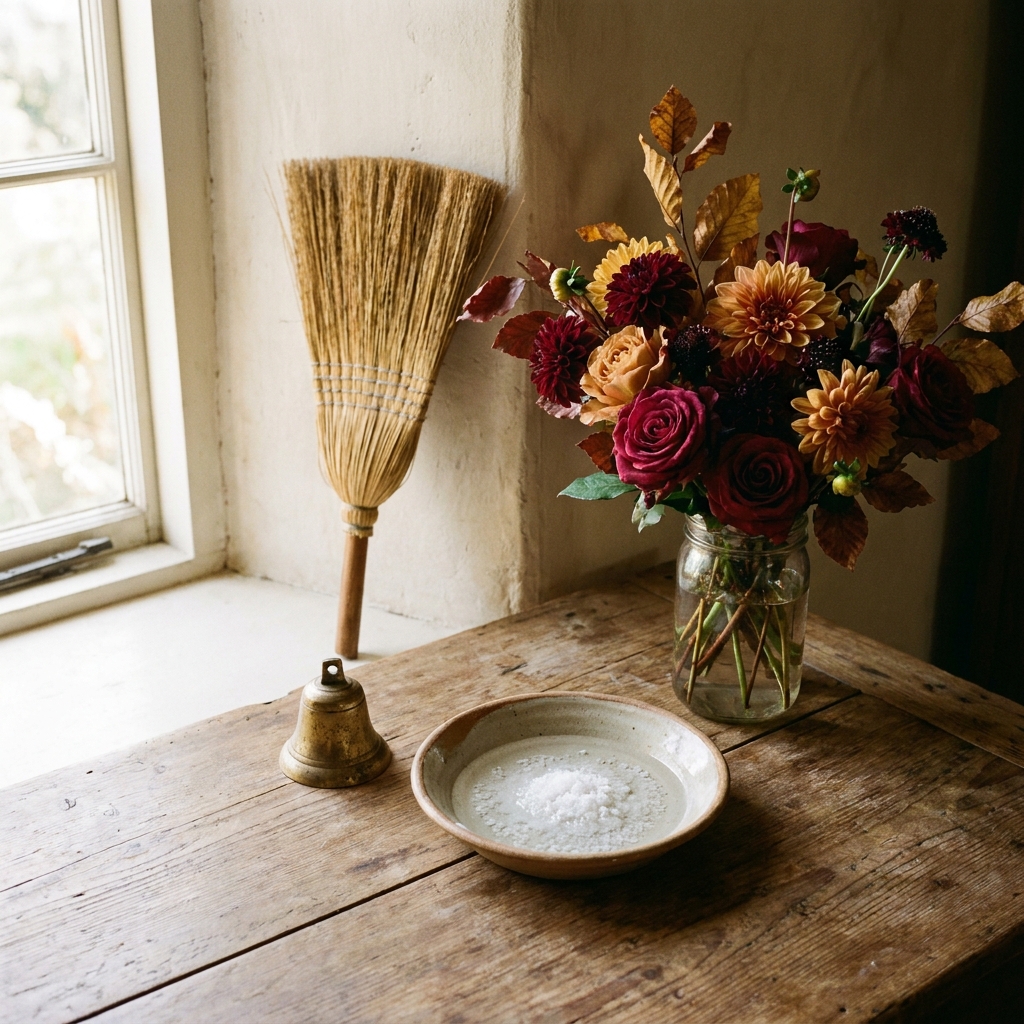
Spiritual cleansing usually starts with a feeling you can’t quite name. Maybe the house feels heavy after a long month. Or you come home and carry the whole day into every room with you. So you want to clear the air, but every guide you find seems to need a shelf of special tools. This spiritual cleansing guide keeps it simple. First, you’ll learn an easy cleansing for yourself, then a room-by-room cleansing ritual for your home. Along the way, you’ll see why bells, salt water and brick dust turn up in traditions that never met each other.
- What Spiritual Cleansing Really Means
- How to Do a Spiritual Cleanse on Yourself
- How to Spiritually Cleanse Your Home in Five Steps
- New Orleans Ways of Cleansing a House
- One Pattern Behind Every Spiritual Cleansing
- How to Cleanse Your House Without Smoke or Sage
- Spiritual Cleansing for a Shared Home, One Room or One Object
- How Often Should You Do a Spiritual Cleansing?
- What to Do After You Cleanse Your Home
- Frequently Asked Questions
- References
What Spiritual Cleansing Really Means
Spiritual cleansing is the practice of clearing a person or a place so it feels lighter and ready for something new. In practice, it mixes two kinds of work. One part is ordinary cleaning. The other part is intention, which simply means deciding what you want the space to hold next.
People have paired those two jobs for a very long time. For example, Iranian families still do khāne-takānī, or “shaking down the house,” before Nowruz, the Persian New Year that falls around the spring equinox. They wash clothes, blankets and textiles, and the ritual is meant to keep bad luck out of the coming year [1]. Similarly, Jewish households clear all leavened bread from the home before Passover. And before Lunar New Year, Chinese families sweep out the old year’s dust, then avoid sweeping after the celebrations so the new luck isn’t swept out the door [1].
None of these is “witchcraft” in the modern sense. Yet in each one, the housework is the first half of the spiritual cleansing.
Cleansing, Blessing and Banishing Are Different Jobs
It helps to name what you’re doing before you start. Cleansing clears out what has built up. Blessing invites something in, such as peace, rest or kindness. Banishing, by contrast, is a firmer act aimed at pushing a specific thing away. This guide covers the first two, because those are what most people mean by spiritual cleansing at home.
How to Do a Spiritual Cleanse on Yourself
I always tell people to start spiritual cleansing with themselves. After all, you’re the one walking the day’s weight from room to room. My own self-cleanse has three steps, and none of them needs anything you don’t already own.
Step 1: Wash With Intention
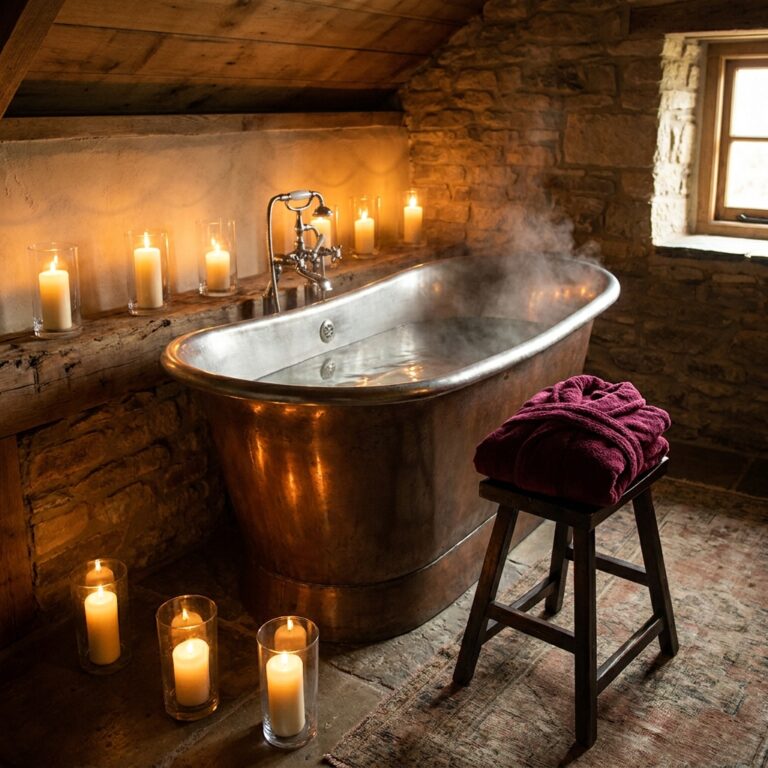
Take a warm bath or shower. As the water runs, imagine the day’s worries flowing away with it, down the drain and out of your life. That picture is what turns an ordinary shower into a cleanse.
Washing with water is one of the oldest forms of spiritual cleansing. In Shinto, for instance, priests prepare entō, which is rock salt dissolved in water. They use it to purify people and places before worship. During a purification rite, the priest dips a sprig of the sacred sakaki tree into the salt water and shakes it to the left, right and left again [2]. In fact, a Shinto text from the early ninth century already records salt-water purification [2]. You don’t need a sakaki branch, of course. But a pinch of salt in your bath is a small nod to a very old idea.
Step 2: Breathe and Release
Next, take three slow breaths. On the last one, say out loud: “I release what weighs upon me. I welcome peace.”
Why say it aloud? Because spoken words turn a private wish into a decision. You hear yourself commit to it. Also, the slow breathing calms the body, so the words land on a settled mind instead of a racing one.
Step 3: Wear Something Fresh
Finally, put on clean, comfortable clothes. This marks a new beginning in the plainest way possible. After all, pulling the day’s clothes back on undoes the point of the wash.
Other Ways People Cleanse Themselves
Other traditions approach spiritual cleansing of the body very differently. In a limpia, a Mexican cleansing, a curandera (folk healer) prays while rubbing an egg over the person’s body. Then she brushes them with leaves. One account in the University of Southern California’s folklore archive describes a curandera using leaves from a tree called el paraíso. The man who received it said the cleansing was meant to drive off bad energy after a long stretch of bad luck, and that its effect lasted a couple of months [3]. So the limpia, unlike a bath, treats the cleanse as something done for you by another person.
How to Spiritually Cleanse Your Home in Five Steps
Once you feel clear yourself, turn to the house. Here is the spiritual cleansing ritual I teach, step by step. It works in a studio apartment or a family home, and you can finish it in an afternoon.
Step 1: Clear the Clutter, Starting Where You Avoid
Sweep, tidy and take out the rubbish. Begin with the places you avoid. That might be the closet you never open, the drawer of old papers, or the corner where things pile up. Those spots tend to hold the heaviest feeling, so clearing them first changes the whole house.
Also, don’t rush past this step to get to the “real” ritual. As the Nowruz and Passover customs show, the cleaning is the ritual. If you want to see where else people go wrong, read about common cleansing ritual mistakes.
Step 2: Welcome Fresh Air
Then open a window, as long as the weather and the air quality allow it. Fresh air is the simplest way to show that the old has somewhere to go. If you can, open windows on opposite sides of the house for a few minutes, so the air actually moves through.
Step 3: Use Sound in Every Room
Next, ring a bell, clap gently, or play uplifting music as you walk through each room. Clapping is quick and free. A bell, on the other hand, gives a clean, ringing note that seems to hang in the air.
Sound has a long history as a way to clear the air of unseen trouble. In medieval Europe, for example, people rang church bells loudly to frighten away the spirits they believed caused storms. Many bells were even inscribed Fulgura frango, roughly “I break up the lightning” [4]. You’ll find more of that lore in the history of witch bells.
Step 4: Speak Your Intention
When you reach the last room, stand still and say: “May this home hold peace, kindness, and rest.” You can say it once at the center of the house, or once in every room. Either way, keep the words simple and mean them.
Step 5: Finish With Care
Lastly, give the house something to hold. Arrange fresh flowers, or create a quiet corner for reflection with a chair, a candle and nothing else. This step matters because an empty, cleared space feels unfinished. So you fill it, on purpose, with the feeling you asked for.
Belief, Intention & The Power of Magic
Witchcraft, spells, and manifestation are deeply rooted in belief, intention, and spiritual practice. If these practices do not resonate with you, this may not be the path for you, and that’s perfectly okay. But if you believe in divine powers, trust your intentions, and feel drawn to the mysteries of the unseen, we invite you to continue exploring with Madame Celestine and discover the magic that speaks to your soul.
New Orleans Ways of Cleansing a House
New Orleans has its own vocabulary for this work, cher, and much of it lives at the front door. Two old customs stand out.
Red Brick Dust at the Threshold
Red brick dust is just what it sounds like: red brick ground into a fine powder. Traditionally, people sprinkle it along the edges of a house or across its entrances to guard against danger, both spiritual and physical. Researchers at the University of Louisiana at Lafayette’s Ernest J. Gaines Center note that the custom is especially tied to New Orleans. They also point to folklorist Harry Middleton Hyatt, who recorded it in his huge collection Hoodoo, Conjuration, Witchcraft, Rootwork [5].
Florida Water, a Cologne That Became a Cleanser
Florida Water began as an ordinary toilet water. A New York firm founded by Robert J. Murray in 1808 made and sold it. Yet its own advertising soon pitched it “like Holy Water for cleansing, good luck and protection” [6]. As a result, a drugstore cologne slid into spiritual use. The same product is still made today.
That crossover from shop shelf to altar is a big part of the city’s story. Author Carolyn Morrow Long traces it in her book Spiritual Merchants: Religion, Magic and Commerce. She follows the trade in spiritual products from New Orleans to New York, through herb shops, candle shops and “hoodoo drugstores” [7]. In other words, many washes and colognes used for cleansing a house reached people through ordinary shops.
One Pattern Behind Every Spiritual Cleansing
Put these spiritual cleansing traditions side by side and a shared shape appears. The table below lines them up by how each one clears and what it does next. (The New Orleans row pairs two separate customs, so read it as my grouping.)

| Tradition | How it clears | What comes after |
|---|---|---|
| Nowruz (Iran) | Washing clothes and blankets | The New Year welcomed in |
| Lunar New Year (China) | Sweeping out the old year’s dust | No sweeping, so luck stays |
| Shinto (Japan) | Salt water shaken from a sakaki sprig | Worship and offerings |
| Limpia (Mexico) | An egg and leaves passed over the body | Good luck invited back |
| New Orleans hoodoo | Florida Water, sold for cleansing | Brick dust across the entrances |
The Four Movements: Clean, Clear, Mark, Fill
Read across the rows and four movements keep recurring. First, people clean in the plain, physical sense. Next, they clear, with smoke, sound, salt water or an egg. Then many mark a boundary, often the doorway. Finally, they fill the space with what they want, whether that’s luck, worship or a new year.
As I read it, most traditions don’t treat a cleanse as finished once something is removed. Instead, they follow the clearing with a sign of what belongs there now. That’s why the home ritual above ends with flowers and spoken words. So if your own spiritual cleansing ever feels flat, check which of the four movements you skipped. Usually, it’s the last one.
Where Traditions Disagree: Silence or Speech
Not every tradition agrees on words, though. The Survey of Scottish Witchcraft, a University of Edinburgh database of trial records, includes the 1650 case of a woman named Catharin Skair. According to witnesses, she drew water from a well, said nothing on the way, and forbade anyone to follow her. Then she cast the water over her rigg, a ridge of farmland [8]. Her charm relied on silence. By contrast, the home ritual in this guide relies on speaking aloud. Both choices point at the same thing, though. They make the act feel set apart from ordinary chores.
How to Cleanse Your House Without Smoke or Sage
This is one of the most common questions people ask about how to cleanse a house. Often, they rent and have a touchy smoke alarm. Or a child or pet has sensitive lungs, or smoke simply bothers them. The good news is that smoke is only one spiritual cleansing tool. In fact, none of the five steps above needs it.

Here are smoke-free ways to clear a room:
- Sound: bells, clapping, a singing bowl or music.
- Air: open windows and let the room breathe.
- Water: a light mist of salt water or Florida Water.
- Sweeping: a broom moved toward the front door.
There’s also a good reason to go easy on white sage specifically. The conservation group United Plant Savers warns that white sage is “very easy to be overharvested.” It has no federal or state protection in the US, so the group advises buying cultivated sources rather than wild-picked bundles [9]. For a fuller comparison, see this guide to choosing smoke, salt or water.
Spiritual Cleansing for a Shared Home, One Room or One Object
Not everyone controls a whole house. You might share an apartment, live with family, or only want to clear a bedroom or a desk. Happily, the same steps shrink to fit.
Cleansing a Single Room
Treat the room as the whole house. Tidy it, starting with the corner you avoid. Then open its window, clap or ring a bell, and speak your intention at the door. Finally, leave one thing in it that you love, even if that’s just a clean pillowcase.
Cleansing When Others Live With You
In a shared home, keep to your own rooms unless everyone agrees. Pushing a ritual onto housemates rarely brings the peace you’re asking for. Instead, offer to do the shared spaces together, or choose a quiet hour when the house is empty. Music and fresh air are easy to share, too, since nobody minds a tidy kitchen with the window open.
Cleansing an Object
People often ask whether a mirror, a secondhand chair or a piece of jewelry can be cleansed too. If you’d like to try, the same pattern applies. First, clean it physically. Then pass it through sound, fresh air or a light mist of salt water, and finish by stating what it’s for now. Because an object has no “room,” the last step matters even more. You’re telling it, and yourself, that its old story is over.
How Often Should You Do a Spiritual Cleansing?
There’s no fixed rule. Still, three rhythms work well for most people. First, do the three-step self-cleanse whenever a day leaves you drained. Second, give the house a full spiritual cleansing at the turn of a season or a new year, as so many traditions do. Third, cleanse after a big change, such as moving in, a breakup or a houseguest who overstayed their welcome.
Harder seasons need a gentler hand, however. After a death, a long illness or a family conflict, it usually helps to wait a little and shape the ritual to what happened. Here’s how to approach cleansing a home after a death.
What to Do After You Cleanse Your Home
Once the ritual is done, the quiet work begins. Keep the quiet corner you made. Change the flowers before they wilt. And open a window now and then, even on ordinary days.
Remember, spiritual cleansing rituals offer symbolic renewal. They mark a fresh start, and they help you notice your home again. Everyday care is the foundation of a peaceful house, from clean dishes to kind words. So treat the ritual as the ribbon on top of that care.
Frequently Asked Questions
What do you say during a spiritual cleansing?
Keep it short and honest. For yourself, try “I release what weighs upon me. I welcome peace.” For the home, try “May this home hold peace, kindness, and rest.”
Can you do a spiritual cleanse in the shower?
Yes. A shower works just as well as a bath. What matters is that you picture the day’s worries flowing away with the water.
Do I need special tools for a spiritual cleansing?
No. A broom, an open window, your hands for clapping and your own voice are enough. Bells, salt and flowers are optional extras.
How long does it take to cleanse a house?
For most homes, an afternoon is plenty. The decluttering usually takes longest, and the spoken intention takes only a moment.
Is spiritual cleansing tied to one religion?
No. Cleansing customs appear in many faiths and folk traditions, from Nowruz to Shinto to Mexican limpias. You can shape the words to fit your own beliefs.
References
- Spring cleaning has ancient origins. Here’s why we still do it. Lola Méndez, National Geographic, March 19, 2024. https://www.nationalgeographic.com/history/article/history-of-spring-cleaning
- Entō. Encyclopedia of Shinto, Kokugakuin University. https://d-museum.kokugakuin.ac.jp/eos/detail/?id=9651
- Una Limpia. USC Digital Folklore Archives, University of Southern California. https://folklore.usc.edu/una-limpia/
- Frightening off thunder demons. Brendan McWilliams, The Irish Times, March 19, 1998. https://www.irishtimes.com/news/frightening-off-thunder-demons-1.139202
- Faith, Folklore, and Fun: Spirituality, Folk Magic, and Folk Practices in Black America. Francisco Rodriguez, Ernest J. Gaines Center, University of Louisiana at Lafayette, August 28, 2023. https://louisiana.edu/ernestgaines/blog/faith-folklore-and-fun-spirituality-folk-magic-and-folk-practices-black-america-francisco-rodriguez
- Lanman & Kemp’s Florida Water bottle (1856). Zachary Taylor, Southampton History Museum, April 26, 2020. https://www.southamptonhistory.org/post/deep-dive-exploring-the-exhibits-12
- Spiritual Merchants: Religion, Magic and Commerce. Carolyn Morrow Long, University of Tennessee Press, 2001. https://utpress.org/?p=837
- Catharin Skair (case C/EGD/1856). The Survey of Scottish Witchcraft, University of Edinburgh. https://witches.hca.ed.ac.uk/case/C/EGD/1856
- White Sage – Salvia apiana. United Plant Savers. https://unitedplantsavers.org/white-sage-salvia-apiana/
Not sure where to start? You don’t have to do this alone.
Madame Celestine offers guided spellwork for beginners — real support for your first working, not just another guide to read.
Related reading: Protection Candle Colors: Which Candle to Burn for Protection · House Cleansing After a Hard Season: Clearing Grief, Illness or Conflict

About Madame Celestine
Madame Celestine has practiced and taught spellwork, divination, and seasonal ritual for over two decades, helping newcomers build a grounded, confident practice from their very first spell.