
A commitment spell and a love spell sound alike, so people often ask which one they actually need. The short answer is that they solve different problems. A love spell is meant to open a door. A commitment spell is meant to keep a good door from swinging shut. In this article, you’ll learn how practitioners tell the two apart. You’ll also see why the ancient Greeks drew the same line, where our symbols of commitment come from, and how to choose the right working for your relationship today.
- Commitment Spell vs Love Spell: The Difference in One Line
- The Ancient Greeks Already Split Love Magic in Two
- What a Love Spell Is Built to Do
- What a Commitment Spell Is Built to Do
- Rings, Knots and Holiness: Where Commitment Symbols Come From
- Choosing and Working a Commitment Spell, Step by Step
- Common Commitment Spell Mistakes and the Question of Free Will
- Frequently Asked Questions
- References
Commitment Spell vs Love Spell: The Difference in One Line
Here is the simplest way to put it. A love spell works on feeling, while a commitment spell works on staying. The first is about attraction, spark and openness. The second is about loyalty, steadiness and a shared future.
That difference changes almost everything else. It changes who the spell is for, which tools practitioners reach for, and even which phase of the moon they prefer. So before you light a single candle, it helps to name which of those two problems you’re really facing.
For example, someone who is single and wants to meet a partner has a love question. On the other hand, someone who has dated the same person for three years and feels the relationship drifting has a commitment question. Many people use the words loosely, but the intention underneath is quite different.
The two also run on different clocks. A love spell is usually a single push at the start of something. A commitment spell, by contrast, is often repeated. Some couples renew theirs on an anniversary, at each full moon, or after a hard season they came through together. That rhythm fits its purpose, because commitment isn’t one decision. It’s a choice people keep making.
The Ancient Greeks Already Split Love Magic in Two
This split isn’t a modern invention. In his study Ancient Greek Love Magic, the classicist Christopher Faraone describes two broad families of spells.[1]
The first family aimed to stir up eros, meaning intense passion. These included the agōgē or “leading” charms. They were meant to drive the target from her home toward the hopeful lover, and men used them almost exclusively. The second family aimed at philia, meaning affection. Women usually practiced this kind, often to regain or strengthen the affection of a partner who had drifted.[1]
In other words, the Greeks had their own version of love spells and commitment spells. The first was about pulling someone in. The second was about keeping a bond warm. Modern practice has kept the structure but mostly dropped the coercion. Today, most practitioners treat forceful “leading” magic as something to avoid, not imitate.
What a Love Spell Is Built to Do
A love spell aims to open things up. It may aim to draw a new partner, to make you more noticeable, or to rekindle warmth. Many practitioners also start with self-love work first, because they believe it’s hard to attract what you can’t receive.
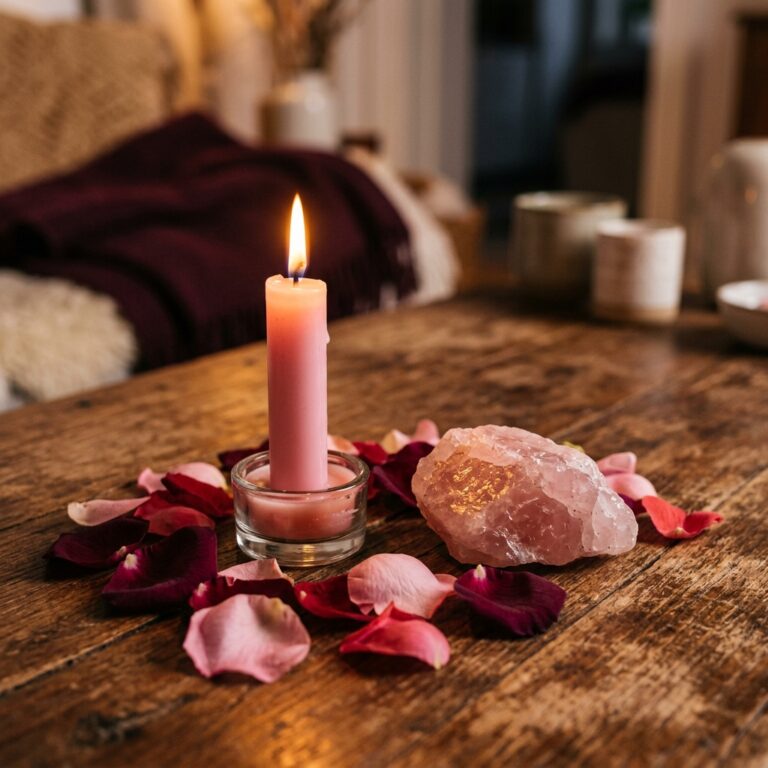
The tools reflect that goal. You’ll often see pink or red candles, rose petals, rose quartz and sweet scents. Timing usually follows the waxing moon, because people link a growing moon with growing things. The mood of the work is hopeful and outward-facing.
Still, a love spell has clear limits. It can support your openness and confidence. However, it can’t choose a partner for you or override someone else’s feelings. For a fuller picture, see this guide to what a love spell can do and what it never will.
It also helps to separate attraction from sweetening. Attraction work tries to draw someone new into your life. Sweetening work, which often uses honey or sugar, tries to make an existing connection kinder and warmer. Sweetening actually sits closer to commitment work, so it can be a gentle bridge between the two.
What a Commitment Spell Is Built to Do
A commitment spell starts from a different place. It assumes the love already exists. Its job is to steady the bond, deepen trust and encourage both people to choose each other again. That’s why practitioners generally advise against casting one on a relationship that hasn’t really begun.
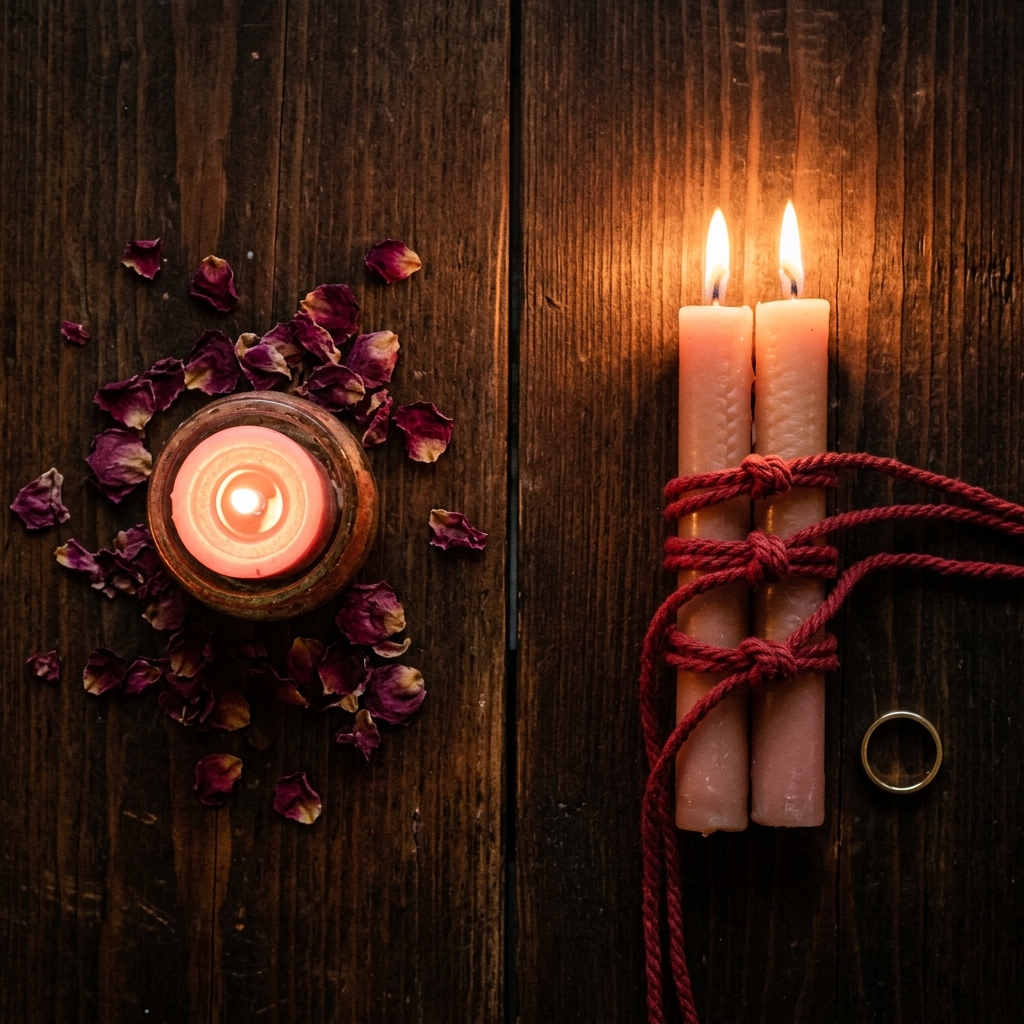
The tools look different too. Commitment spells often use cords and knots, two candles tied together, honey or a pair of rings. Instead of the waxing moon, many practitioners prefer the full moon. At that point the lunar cycle is complete, or “whole.” Some also choose Friday, the day traditionally linked to Venus.
The mood is quieter as well. A love spell reaches outward. A commitment spell turns inward, toward the two people already in the room. So its intention sounds less like “bring me someone” and more like “let what we have hold steady.”

Rings, Knots and Holiness: Where Commitment Symbols Come From
Many tools in commitment spells borrow from older symbols of marriage. Rings are the clearest example. The Victoria and Albert Museum holds a gold ring from around 1400. Inside, a French inscription reads “with all my heart.” Its red and blue stones were meant to stand for the lovers as a pair. It even hides a small secret compartment beneath the setting.[2]
Rings like this, known as posy rings, often carried short verses or mottos. They weren’t only romantic, though. The London Museum notes that posy rings also expressed religious faith or political loyalty.[3] In short, a ring was a promise worn on the body.
Language tells a similar story. The Jewish wedding ritual is called kiddushin, a Hebrew word that means “holiness.” During the ceremony, partners exchange rings and declare that each is holy to the other. The idea is that the two are set apart for one another.[4] That notion of being “set apart” sits very close to what a commitment spell hopes to express.
Knots carry the same message. Modern handfasting ceremonies, for instance, wrap a cord around the couple’s joined hands. That is also why cords appear so often in commitment spells. A knot is easy to understand at a glance, because it joins two ends that were separate.
Choosing and Working a Commitment Spell, Step by Step
First, ask four honest questions. Is there already a relationship? Do both of you want it to continue? Is the problem distance or doubt, rather than a total lack of interest? Have you talked about it openly? If you answer yes to all four, a commitment spell fits. If not, a love spell or simple self-reflection is the better starting point.
Next, gather simple tools. Many practitioners use two small candles, one for each person, and a length of red or white cord. Some add a drop of honey or a sprig of rosemary, which folk tradition links to remembrance and faithfulness.
Then set the candles side by side and loosely tie the cord around both. As you tie three knots, speak one clear intention for each. For example, you might say “trust,” “honesty” and “a shared future.” After that, let the candles burn safely under watch. Then keep the knotted cord somewhere private.
Finally, follow the ritual with a real conversation. Practitioners see the spell as support for the relationship, not a replacement for talking.
Belief, Intention & The Power of Magic
Witchcraft, spells, and manifestation are deeply rooted in belief, intention, and spiritual practice. If these practices do not resonate with you, this may not be the path for you, and that’s perfectly okay. But if you believe in divine powers, trust your intentions, and feel drawn to the mysteries of the unseen, we invite you to continue exploring with Madame Celestine and discover the magic that speaks to your soul.
Common Commitment Spell Mistakes and the Question of Free Will
The biggest mistake is using a commitment spell to hold someone who wants to leave. That repeats the old coercive “leading” magic in softer clothing. Most ethical practitioners believe it also backfires, because a bond held against someone’s will rarely feels like love.
Another mistake is casting too early. A commitment spell after two dates asks the relationship to carry weight it hasn’t earned yet. Instead, a love spell or simple patience fits that stage much better.
People also tend to mix both goals in one working. They ask for new passion and lasting loyalty in the same breath. As a result, the intention gets blurry. It’s usually clearer to handle attraction first and commitment later.
Finally, some people treat the spell as the whole plan. Yet people build commitment through daily choices, such as keeping promises, showing up and talking through hard things. The ritual can mark that intention, but it can’t do the choosing for you.
Frequently Asked Questions
What is a commitment spell?
A commitment spell is a ritual meant to strengthen an existing relationship by focusing on loyalty, trust and a shared future. It is not designed to create attraction where none exists.
Can a love spell turn into a commitment spell?
Not directly, because they serve different stages. Many practitioners work a love spell early on, then a commitment spell once both partners clearly want to build something lasting.
When is the best time to cast a commitment spell?
Many practitioners choose the full moon because it symbolizes completion and wholeness. Friday is also popular because of its traditional link to Venus.
Do commitment spells work on someone who wants to leave?
Most ethical practitioners advise against using them that way. They see commitment spells as support for two willing people, not a way to hold someone against their will.
Which tools are used in commitment spells?
Common tools include two candles tied together, red or white cord knotted three times, honey, rosemary and rings. Each one symbolizes binding, sweetness or faithfulness.
References
- Review of Christopher A. Faraone, Ancient Greek Love Magic. Edward Kadletz, Bryn Mawr Classical Review 2000.02.19. https://bmcr.brynmawr.edu/2000/2000.02.19/
- Ring, c. 1400. Victoria and Albert Museum, Explore the Collections. https://collections.vam.ac.uk/item/O377723/ring-unknown/
- Posy ring. London Museum, Collections. https://www.londonmuseum.org.uk/collections/v/object-61945/posy-ring/
- What’s the Hebrew word for the wedding ceremony? Reform Judaism (ReformJudaism.org). https://reformjudaism.org/learning/answers-jewish-questions/whats-hebrew-word-wedding-ceremony
Not sure where to start? You don’t have to do this alone.
Madame Celestine offers guided spellwork for beginners — real support for your first working, not just another guide to read.
Related reading: Glamour Spell: Beauty and Attraction Magic Explained · The Desire Ritual for When You Feel Invisible to Your Partner

About Yitzchak Meir
Yitzchak Meir is the pen name our editorial team uses for articles on Kabbalah and Jewish mystical traditions. Articles under this byline are researched from published sources and reviewed by Madame Celestine before publishing.