
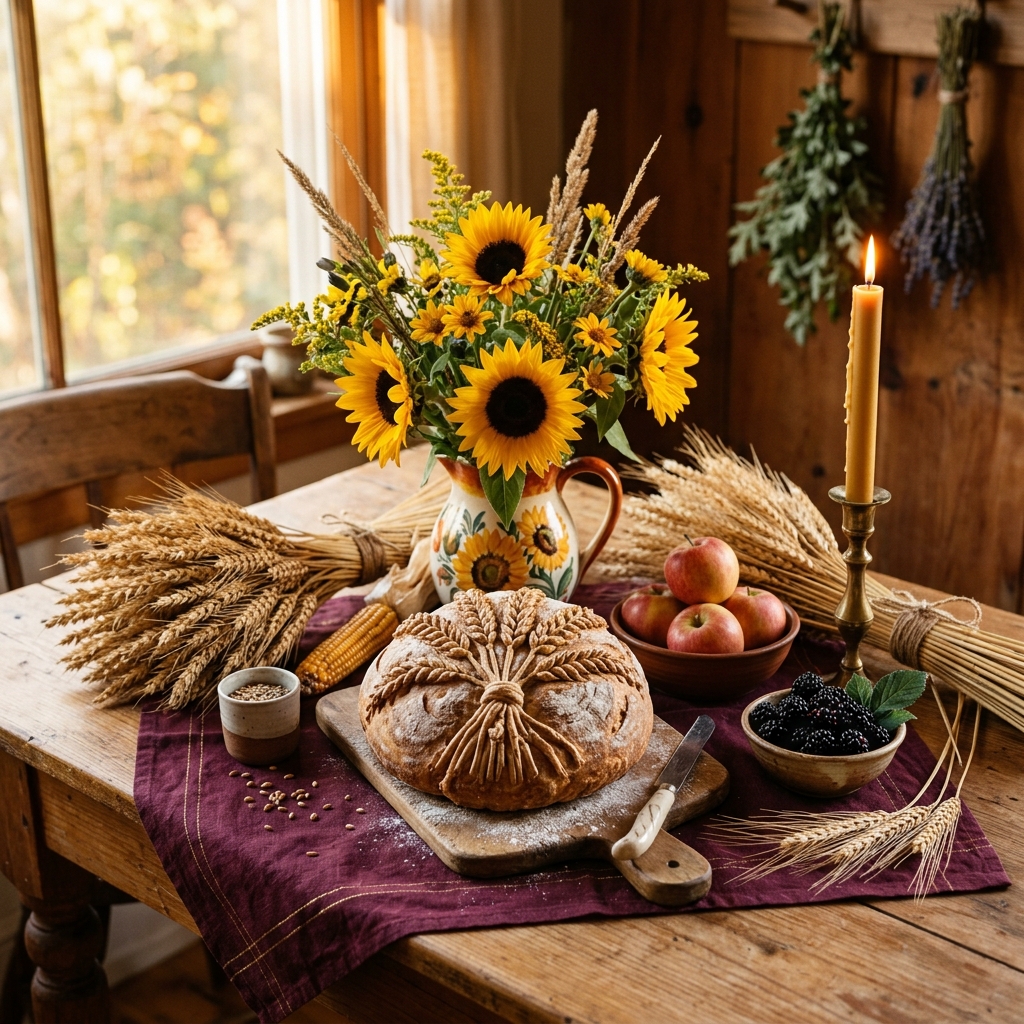
A Lammas celebration marks the moment summer turns toward harvest, but many people are unsure what the day really involves. Is it Lammas or Lughnasadh? Is it Christian, Celtic or Wiccan? The honest answer is all three, and the story behind each name is surprisingly rich. In this guide, you will learn where Lammas and Lughnasadh come from, how they connect, and how to celebrate the first harvest at home with a simple ritual and blessing.
- What Is Lammas? The “Loaf Mass” Behind the Festival
- Lughnasadh: Lugh, Tailtiu and the First Harvest Games
- When Is Lammas? Dates and the Meaning of Lammastide
- One Day, Two Names: What Lammas and Lughnasadh Share
- Lammas Celebration Symbols and Colors
- Your Lammas Celebration: A Simple Ritual and Blessing
- Lammas Celebration Ideas for Every Home
- Frequently Asked Questions
- References
What Is Lammas? The “Loaf Mass” Behind the Festival
Lammas is the traditional name for 1 August, one of the old Quarter Days of the British Isles. Its name comes from an Anglo-Saxon word meaning “loaf-mass.”[1] In the early English church, it was a harvest festival. People brought loaves made from the new grain, and the church consecrated them.[1]
That detail explains the whole mood of the day. The first wheat of the year was not saved for later. Instead, it went straight into bread, and that bread was offered back in thanks. So Lammas is a festival of first fruits, not of the full harvest. Today, a Lammas celebration usually keeps that same focus on bread and thanks.
The day also left its mark on English literature. In Romeo and Juliet, Juliet’s nurse asks how long it is “to Lammastide.” She then says Juliet will turn fourteen on Lammas Eve.[2] Shakespeare’s audience clearly knew the date well, because the season around it had its own name.
Lughnasadh: Lugh, Tailtiu and the First Harvest Games
Lughnasadh is the Gaelic name for the same season. It honors Lugh, a skilled hero god of Irish myth. However, the festival’s origin story is really about his foster mother, Tailtiu.
According to Irish tradition, Tailtiu chose her burial place at Teltown in County Meath. She asked for the trees there to be cleared to make room for her funeral games.[3] When she died on the first of August, Lugh honored her with the first Tailteann games.[3] Records show those games still running as late as 1168.[3]
Notice what this myth celebrates. It is not a battle or a conquest. Instead, it honors a woman who cleared land so that people could farm it. That makes Lughnasadh a fitting festival for the first grain. Even today, Lughnasa (Lúnasa) remains the Gaelic name for the month of August.[3] So a Lammas celebration that includes games or time outdoors draws on this Irish side of the story.
When Is Lammas? Dates and the Meaning of Lammastide
In the Northern Hemisphere, most people hold Lammas on 1 August, and many begin on the evening of 31 July. So, for example, Lammas 2025 fell on a Friday, while in 2027 it falls on a Sunday. Some modern pagans prefer the astronomical midpoint between the summer solstice and the autumn equinox, which usually lands a few days later.
The word Lammastide simply means the season around Lammas. In other words, it covers the late summer weeks when the first grain comes in. That is why Juliet’s nurse could ask how long it was to Lammastide, as if it were a stretch of time rather than a single day.
In the Southern Hemisphere, the seasons are reversed. As a result, many southern pagans hold their Lammas celebration around 1 February instead, when their own grain harvest begins.
One Day, Two Names: What Lammas and Lughnasadh Share
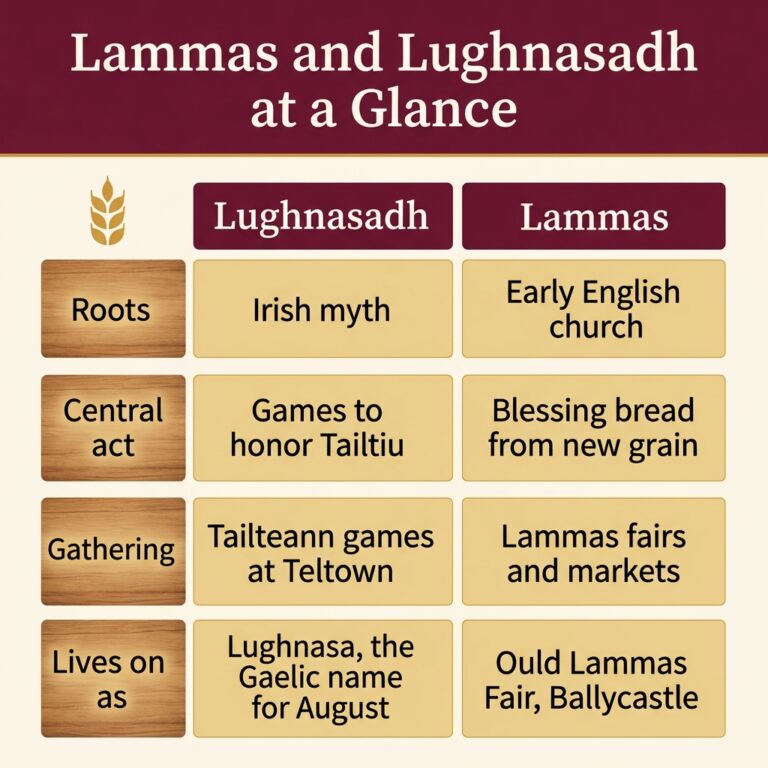
Put side by side, the Christian and Celtic stories look very different. One centers on a blessed loaf in church. The other centers on a goddess, a hero and a set of funeral games. Yet the two share more than a date.
| Lughnasadh | Lammas | |
|---|---|---|
| Roots | Irish myth | Early English church |
| Central act | Games to honor Tailtiu | Blessing bread from new grain |
| Gathering | Tailteann games at Teltown | Lammas fairs and markets |
| Lives on as | Lughnasa, the Gaelic name for August | Ould Lammas Fair, Ballycastle |
The Lammas fair tradition is still alive. In Ballycastle, Northern Ireland, the Ould Lammas Fair dates back over 400 years. It still features horse trading and local treats like dulse, a dried seaweed, and yellowman, a honeycomb toffee.[4]
Read together, the pattern is clear. Both traditions turn the first grain into a reason to gather. Lughnasadh gathered people for games, while Lammas gathered them for church, then for fairs and trade. So the heart of the first harvest was never private. It was about sharing early abundance with a community.
For a modern practitioner, this is the most useful lesson. A Lammas celebration works best when something is shared, whether it is a loaf, a meal or simply your time.
Lammas Celebration Symbols and Colors
Modern Lammas symbols grow straight out of this history. Here are the ones you will see most often.
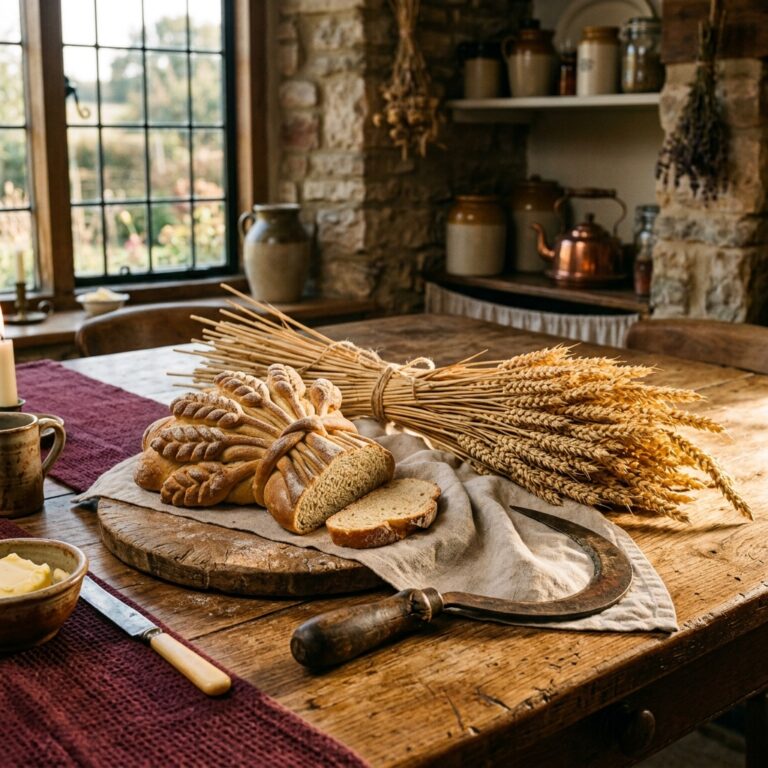
Bread. A fresh loaf is the central symbol, because Lammas literally means “loaf-mass.” Many people bake a loaf shaped like a wheat sheaf.
Wheat and grain. Sheaves of wheat, barley or oats stand for the first cut of the harvest.
The corn dolly. In many harvest traditions, people made a harvest doll from the last sheaf of grain. They then kept it until spring planting.[5] Many modern pagans weave a small corn dolly at Lammas and keep it on the altar through winter.
The sickle. This curved blade recalls the work of cutting grain by hand.
Sunflowers and late-summer fruit. Sunflowers, apples and berries add color and show the land at its fullest.
The most common colors for Lammas follow the fields. Gold and yellow echo ripe wheat, while orange and bronze suggest the late-summer sun. Also, green and brown represent the earth that still has more to give.
You do not need every symbol for a meaningful Lammas celebration. In fact, one loaf, a few stalks of wheat and a single gold candle are enough to carry the whole idea of the day.
Your Lammas Celebration: A Simple Ritual and Blessing
This Lammas ritual follows the old pattern of bread, thanks and sharing. It suits beginners and experienced practitioners alike.
1. Bake or buy a loaf. If you can, bake bread on the day. Kneading gives you quiet time to think about what you have grown this year. A good bakery loaf works just as well.
2. Set up your Lammas altar. Use a gold or yellow cloth. Then add your bread, a few stalks of wheat, a candle and seasonal fruit or flowers.
3. Light the candle and name your first fruits. Think of three things that have started to pay off this year. They might be a new skill, a habit or a relationship.
4. Speak a Lammas blessing. Hold the loaf and say something simple, such as: “First grain, first bread, I give thanks for all that is growing. May I share what I have, and may there be enough for all.”
5. Break and share the bread. Offer the first piece outdoors, perhaps to the birds or the earth. Then share the rest with the people around you.
6. Close the ritual. Put out the candle safely. Afterwards, keep a stalk of wheat on your altar as a reminder of what you named.
Belief, Intention & The Power of Magic
Witchcraft, spells, and manifestation are deeply rooted in belief, intention, and spiritual practice. If these practices do not resonate with you, this may not be the path for you, and that’s perfectly okay. But if you believe in divine powers, trust your intentions, and feel drawn to the mysteries of the unseen, we invite you to continue exploring with Madame Celestine and discover the magic that speaks to your soul.
Lammas Celebration Ideas for Every Home
You can adapt the first harvest to almost any life. Here are a few variations, each drawn from the traditions above.
For families. Hold a small backyard games day in honor of Tailtiu. Races, ball games or a picnic all echo the spirit of the Tailteann games.
For solitary practitioners. Take a walk past a field, a farm or even a garden. Then write a short list of the “first fruits” in your own life.
For busy days. Simply share bread with someone. That single act carries most of the meaning of the day.
For community. Visit a local fair or farmers’ market, just as people once went to Lammas fairs.
A few mistakes are also worth avoiding. First, don’t waste food in the name of an offering. A small crumb outdoors is enough. Second, don’t treat Lammas as the end of the harvest. It is the beginning, and the fuller harvest festival comes at the autumn equinox. For more on that second harvest, see these Mabon traditions from around the world.
Frequently Asked Questions
What is Lammas?
Lammas is a first harvest festival held on 1 August. Its name means “loaf-mass,” from the old English custom of blessing bread made from the new grain.
Is Lammas the same as Lughnasadh?
They share the same date and theme, but they come from different roots. Lammas is an English church festival, while Lughnasadh is the Gaelic festival linked to the god Lugh.
Is Lammas a Wiccan holiday?
Yes. In modern Wicca, Lammas or Lughnasadh is one of the eight sabbats on the Wheel of the Year, marking the first harvest.
What happens at a Lammas celebration?
Most people bake or share bread, set up a harvest altar and give thanks for early successes. Many also hold games, picnics or community meals.
Can a Lammas celebration include Lughnasadh traditions?
Yes. Many modern pagans combine both, pairing the Lammas loaf with games, outdoor meals or a toast to Lugh and Tailtiu.
What are the colors for Lammas?
Gold, yellow, orange, bronze, green and brown are the most common choices. They reflect ripe grain, the late-summer sun and the fertile earth.
References
- Lammas. Encyclopaedia Britannica. https://www.britannica.com/topic/Lammas
- Romeo and Juliet, Act 1, Scene 3. William Shakespeare. Folger Shakespeare Library. https://www.folger.edu/explore/shakespeares-works/romeo-and-juliet/read/1/3/
- Teltown; the Táilteann Games. Discover Boyne Valley, Meath. https://www.discoverboynevalley.ie/boyne-valley-drive/heritage-sites/teltown-tailteann-games
- Ballycastle’s Ould Lammas Fair makes spectacular return. Causeway Coast and Glens Borough Council, 31 August 2022. https://causewaycoastandglens.gov.uk/news/ballycastles-ould-lammas-fair-makes-spectacular-return
- Harvest festival. Encyclopaedia Britannica. https://www.britannica.com/topic/harvest-festival
Not sure where to start? You don’t have to do this alone.
Madame Celestine offers guided spellwork for beginners — real support for your first working, not just another guide to read.
Related reading: Witch Bells: Origins, Protection and How to Hang Them · Spell Jar for Protection, Love or Happiness: How to Make One

About Wren Ashby
Wren Ashby is the pen name our editorial team uses for articles on sigils, Tarot and modern traditional witchcraft. Articles under this byline are researched from published sources and reviewed by Madame Celestine before publishing.