

Learning how to make a spell jar is one of the easiest ways into practical magic, but most guides skip the part that makes it work: why a sealed jar at all? People usually want a clear recipe for protection, love or happiness. This guide gives you that. It also traces the jar back to the witch bottles buried under old English homes, explains what the seal actually does, and helps you choose ingredients that fit your intention instead of copying a list.
- Why a Jar? The Logic Behind the Spell Jar
- Before You Make a Spell Jar: Four Centuries of Witch Bottles
- The Secret in the Seal: Why Honey, Salt and Glass Work Together
- How to Make a Spell Jar in Seven Steps
- How to Make a Spell Jar for Protection: Ingredients and Build
- Love and Happiness Jars: Sweetness and Light
- Mistakes People Make With a Spell Jar, and How to Retire One
- Frequently Asked Questions
- References
Why a Jar? The Logic Behind the Spell Jar
Before you learn how to make a spell jar, it helps to know why the jar matters. A spell jar is a sealed container filled with materials chosen for one intention. You gather ingredients, focus on your goal, close the lid and keep the jar somewhere meaningful. Then the jar holds that intention in one place, like a small battery you can see.
The container matters more than people think. A loose sachet of herbs dries out, scatters and gets lost. A jar, however, keeps everything together and visible. So each time you see it, you remember what you asked for. That daily reminder is a big part of why practitioners find jar spells so steady.
Also notice the core idea of containment. Whatever you put inside is held, kept and protected from the outside world. As you’ll see, that idea runs through four centuries of sealed charms.
Before You Make a Spell Jar: Four Centuries of Witch Bottles
The spell jar’s best-known ancestor is the witch bottle, and every guide on how to make a spell jar owes something to it. Across Europe, from the early modern era into the early 20th century, people who believed they were bewitched filled bottles with their own fingernails, hair or urine. They often added bent pins and cloth hearts. Some buried the bottles, some boiled them and some left them in the chimney.[1]
The goal was aggressive. The bottle was meant to attack the witch’s bladder, force them to reveal themselves or stop their attacks. Secrecy mattered too, because talking about the bottle supposedly broke the spell.[1] Researchers have identified about 250 witch bottles in England, but fewer than a dozen in the United States.[1]
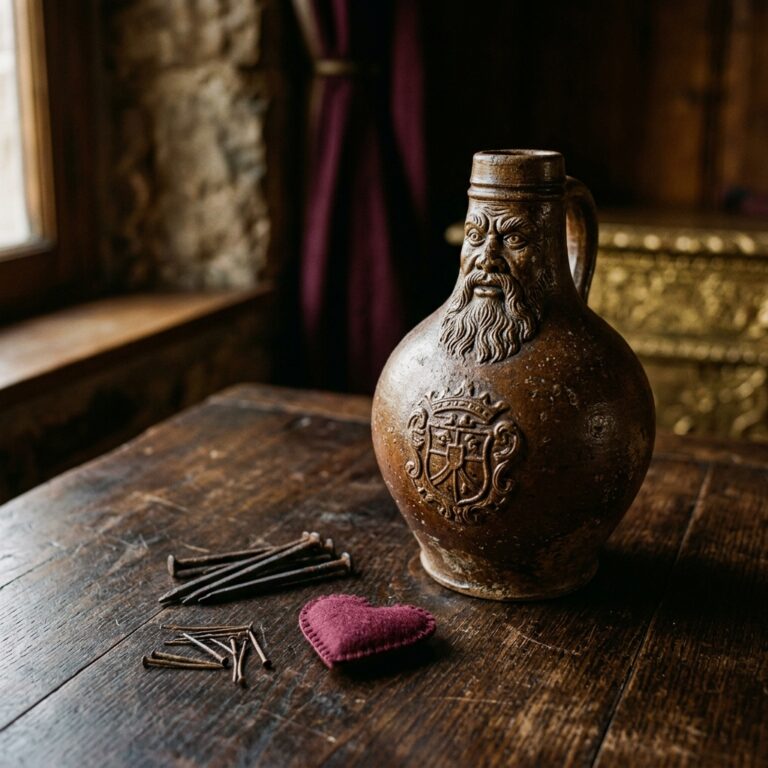
You can see one in the London Museum. It’s a stoneware jug made in Frechen, Germany, around 1670, with a bearded face on its neck. Inside were a heart-shaped piece of felt pierced with pins and eleven nails, a charm to prevent witchcraft.[2]
Some bottles were believed to trap the witch herself. Oxford’s Pitt Rivers Museum holds a silvered glass bottle from Hove, Sussex, collected in 1915. The woman who owned it warned that opening it would release a witch and bring “a peck o’ trouble.”[3]
The Secret in the Seal: Why Honey, Salt and Glass Work Together
Here’s the part most guides miss. The fillers people reach for in jars tend to be things that don’t spoil. Honey is the best example. It’s very low in moisture, so few microbes survive in it. Its pH also sits between about 3 and 4.5, and bees add an enzyme that produces hydrogen peroxide.[4]
As a result, archaeologists have found pots of honey in Egyptian tombs that remain unspoiled after thousands of years. There’s one catch, though. Left open in a humid place, honey will spoil. The seal matters.[4] Salt works on a similar principle, because people have preserved food in salt for as long as anyone remembers.
Put those facts beside the witch bottles, and a pattern appears. A spell jar joins two kinds of keeping. The filler preserves, and the seal protects the filler. So the jar isn’t just a pretty container for herbs. It’s a small model of the thing you want to last, whether that’s safety, affection or a good mood.
That’s my own reading, not an established rule of witchcraft. Still, it gives you a practical test when you choose ingredients. Ask whether the base of your jar is something that keeps. Keep that question in mind as you learn how to make a spell jar of your own.
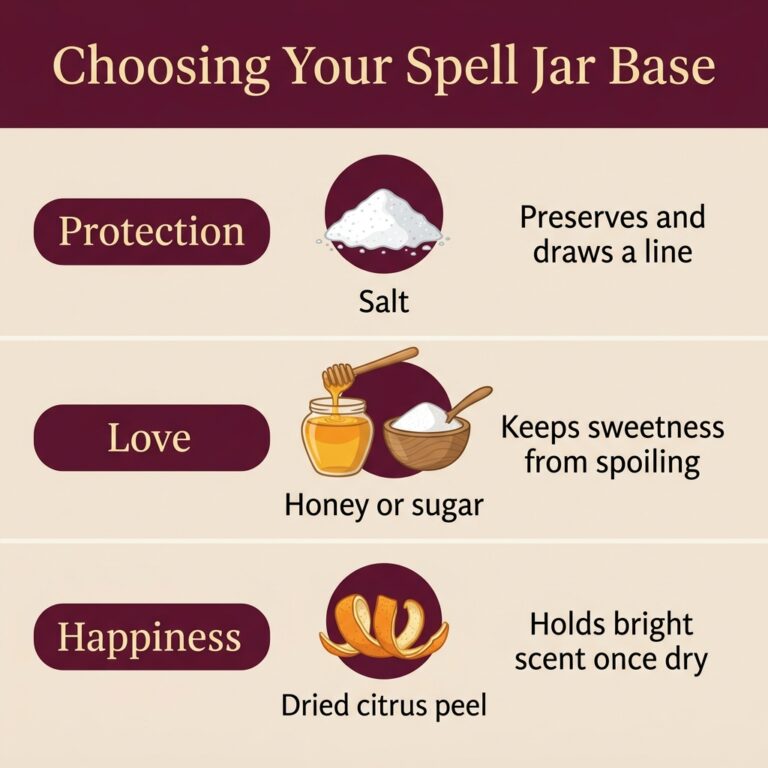
| Intention | Base that keeps | Why it fits |
|---|---|---|
| Protection | Salt | Preserves and draws a line |
| Love | Honey or sugar | Keeps sweetness from spoiling |
| Happiness | Dried citrus peel | Holds bright scent once dry |
How to Make a Spell Jar in Seven Steps
You don’t need rare supplies. A clean glass jar with a tight lid, a few kitchen ingredients and a quiet half hour are enough. Here’s how to make a spell jar for any intention.
First, write your intention in one short sentence, such as “My home is safe” or “I welcome kindness.” Keep it in the present tense. Next, clean and dry the jar well, because moisture spoils herbs and undoes the keeping idea.
Then add your base layer, such as salt, honey or dried peel, from the table above. After that, add two or three supporting herbs or items chosen for the same intention. Fewer, well-chosen ingredients work better than a crowded jar you can’t explain.
Now fold your written intention and place it inside. Some practitioners draw a sigil instead, a symbol designed from the letters of the intention. Either way, the paper gives the jar its “why.”
Next, close the lid tightly. Many people seal the rim with drips of candle wax in a color that suits the goal. Finally, place the jar where it makes sense, such as near the front door for protection or by the bed for love. Then touch it or glance at it now and then to keep the intention alive.
Belief, Intention & The Power of Magic
Witchcraft, spells, and manifestation are deeply rooted in belief, intention, and spiritual practice. If these practices do not resonate with you, this may not be the path for you, and that’s perfectly okay. But if you believe in divine powers, trust your intentions, and feel drawn to the mysteries of the unseen, we invite you to continue exploring with Madame Celestine and discover the magic that speaks to your soul.
How to Make a Spell Jar for Protection: Ingredients and Build
The protection jar spell is the closest modern cousin of the witch bottle. However, most practitioners today use it to guard a home rather than to attack anyone.
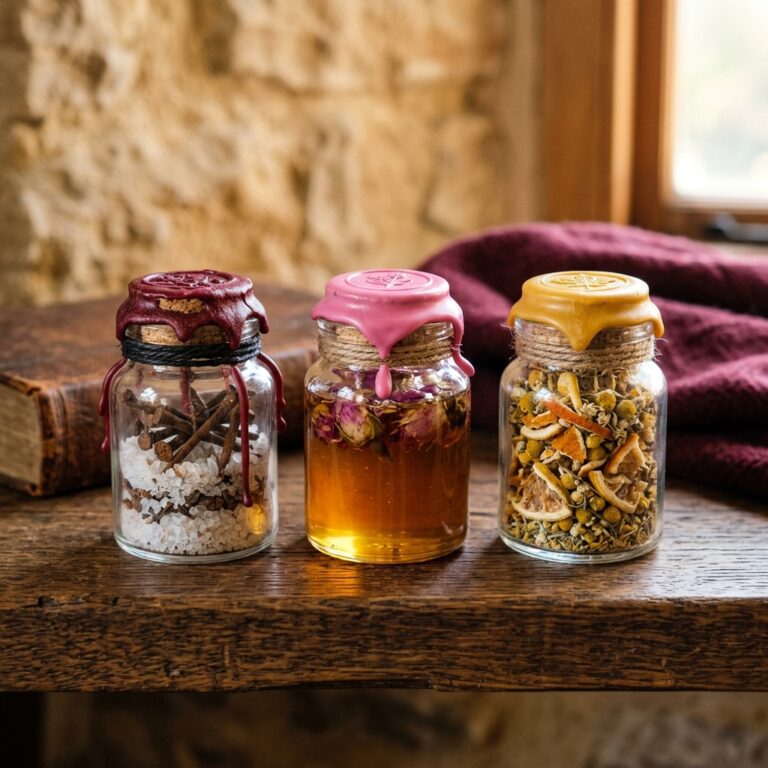
Common protection spell jar ingredients include salt as the base, a few iron nails or pins, and protective herbs such as rosemary or bay. Some people add a red thread wound around the jar. The sharp items echo the pins and nails found in old bottles, while the salt does the keeping.
Here’s how to make a protection spell jar. Layer the salt first, then the nails and herbs, then your folded intention. Seal it with black or red wax and keep it near your main entrance. For a deeper look at which plants suit the job and where they come from, see this guide to herbs for protection.
Love and Happiness Jars: Sweetness and Light
The same method for how to make a spell jar applies here, only with a softer base. A love jar builds on the honey principle. Use honey or sugar as the base, then add rose petals, a cinnamon stick or a few dried apple slices. Because the goal is warmth rather than a wall, keep sharp objects out. A pink or red wax seal suits it well.
Also be clear about what the jar is for. A love jar works best as an intention to welcome or deepen love in your own life. It’s not meant to override another person’s free choice, and practitioners who try that often end up frustrated.
A happiness jar is the brightest of the three. Start with dried orange or lemon peel, then add dried chamomile, a little lavender or a sunflower petal. Seal it with yellow wax and keep it where morning light reaches it. So each time you see it, it lifts the room a little.
Mistakes People Make With a Spell Jar, and How to Retire One
Knowing how to make a spell jar also means knowing how to end one well. The most common mistake is adding fresh, wet ingredients to a sealed jar. They rot, and the jar turns into the opposite of what you wanted. So dry everything first.
Another mistake is leaving a candle burning unattended while you seal the lid. Wax drips are pretty, but always work on a heatproof surface and put the flame out when you’re done.
Finally, retire jars thoughtfully when their work is done. Many practitioners open the jar, bury or compost the plant matter, and wash and reuse or recycle the glass. Dispose of nails and pins safely rather than leaving them in soil where people or animals walk.
Frequently Asked Questions
How do you make a spell jar for beginners?
Choose one intention, write it down, and add a base like salt, honey or dried citrus peel. Then add two or three matching herbs, place the paper inside and seal the lid.
What are the best protection jar ingredients?
Salt, iron nails or pins, and protective herbs such as rosemary or bay are the most common. Many people also wrap the jar in red thread.
How long does a spell jar last?
Most practitioners keep a jar until its goal feels met or the ingredients start to break down. For ongoing intentions like home protection, many refresh the jar about once a year.
Where should I put a spell jar for protection?
Near the main entrance of your home is the most common spot. Some people also keep one by a window or in a car.
What do I do with an old spell jar?
Open it, bury or compost the plant material, and wash and reuse or recycle the glass. Dispose of any nails or pins safely.
References
- Thomas Waters. Six Ways That People of the Past Used Magic to Protect Their Homes, From Witch Bottles to Mystical Symbols. Smithsonian Magazine, September 15, 2026. https://www.smithsonianmag.com/history/six-ways-that-people-of-the-past-used-magic-to-protect-their-homes-from-witch-bottles-to-mystical-symbols-180989493/
- Jug, Bartmann jug, witch bottle. London Museum. https://www.londonmuseum.org.uk/collections/v/object-927829/jug-bartmann-jug-witch-bottle/
- Agu-‘nsi figure, Witch in a Bottle, and Rowan Loops. Pitt Rivers Museum, University of Oxford. https://www.prm.ox.ac.uk/agu-nsi-bottle-rowan-loops
- Natasha Geiling. The Science Behind Honey’s Eternal Shelf Life. Smithsonian Magazine, August 22, 2013. https://www.smithsonianmag.com/science-nature/the-science-behind-honeys-eternal-shelf-life-1218690/
Not sure where to start? You don’t have to do this alone.
Madame Celestine offers guided spellwork for beginners — real support for your first working, not just another guide to read.
Related reading: Knot Magic Mistakes: Why Your Knot Spell Isn’t Holding · Easy Spells for Beginner Witches: Where to Start Your Practice

About Wren Ashby
Wren Ashby is the pen name our editorial team uses for articles on sigils, Tarot and modern traditional witchcraft. Articles under this byline are researched from published sources and reviewed by Madame Celestine before publishing.