
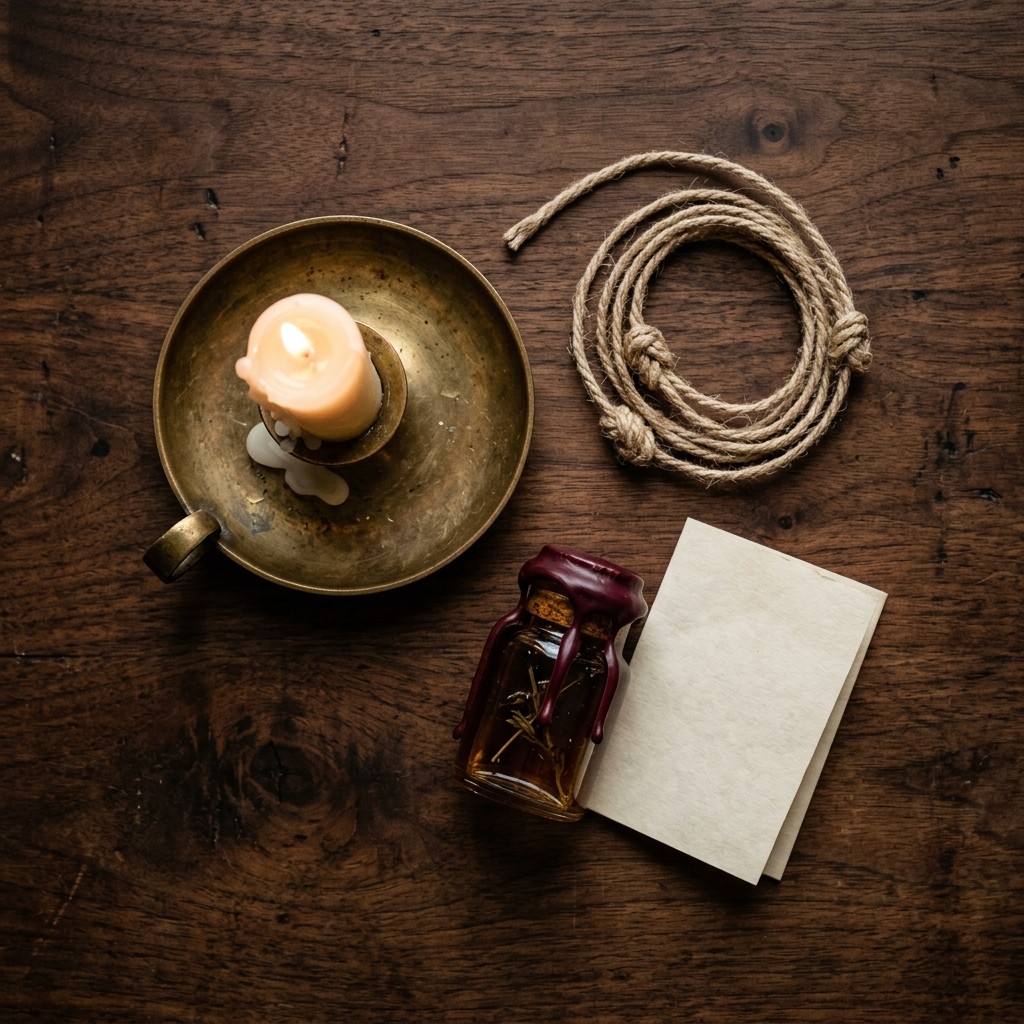
Easy spells for beginners are the best way into witchcraft, because they teach you the basics without a shelf full of tools. However, a quick search turns up hundreds of different spells, and it is hard to know where to start. So this guide keeps things simple. First, it covers four easy spells you can do tonight with a candle, a cord, a jar and a slip of paper. Then it shows where each one comes from, and how to pick the right one for what you want.
- Start Small: What Makes Easy Spells for Beginners Different
- Burn: A Simple Candle Spell for Your First Night
- Tie: The Knot Spell Sailors Once Bought From Witches
- Seal: The Jar Spell With Centuries Behind It
- Write: The Paper Spell Romans Threw Into a Sacred Spring
- Burn, Tie, Seal or Write: Choosing Between Different Spells
- Common Mistakes With Easy Spells for Beginners
- Frequently Asked Questions
- References
Start Small: What Makes Easy Spells for Beginners Different
An easy spell is not a weaker spell. Instead, it is a spell with one clear goal, one or two tools, and steps you can remember without a book open. That matters because your focus is the real engine of any spell. When you juggle ten ingredients, most of your attention goes to the recipe rather than the intention.
So before you begin, pick one modest goal. For example, you might want calmer mornings, more patience at work, or a fresh start after a hard month. Then choose a quiet time when you won’t be interrupted. Finally, decide how you will close the spell, because an ending tells your mind the work is done.
Where to Practice Easy Spells for Beginners
You don’t need a formal altar yet. Instead, a clear tabletop, a windowsill or even a tray on your bed will do. First, tidy the space, since clutter pulls at your attention. Then take three slow breaths before you start. Many witches also open a window for a moment, because fresh air marks the space as ready. That small routine turns any corner into a working space, and it keeps easy spells for beginners feeling calm rather than rushed.
Burn: A Simple Candle Spell for Your First Night
A candle spell is the classic first spell, and for good reason. It needs one candle, a safe dish and a few quiet minutes. Here is a simple version:
- First, choose a small candle. A white one suits almost any goal, and a small size means it can burn down in one sitting.
- Then carve one word into the wax, such as “calm” or “courage,” using a pin or a toothpick.
- Next, hold the candle and say your intention aloud in one short sentence, as if it is already true.
- After that, light it and sit with it for a few minutes while you picture the goal clearly.
- Finally, let it burn down safely, or snuff it and relight it on the following nights until it is gone.
Why Candles Top Most Lists of Easy Spells for Beginners
A flame changes what it touches, so many witches see burning as a way to send a wish outward. It also gives your eyes a single point to rest on, which makes focus easier. Color can add a layer of meaning too. For example, many modern witches use green for growth, pink for kindness, blue for calm and white for a fresh start. However, a plain white candle works for all easy spells for beginners, so don’t wait to buy a rainbow. Still, safety comes first. Always use a fireproof dish, keep the candle away from curtains, and never leave a flame alone.
Belief, Intention & The Power of Magic
Witchcraft, spells, and manifestation are deeply rooted in belief, intention, and spiritual practice. If these practices do not resonate with you, this may not be the path for you, and that’s perfectly okay. But if you believe in divine powers, trust your intentions, and feel drawn to the mysteries of the unseen, we invite you to continue exploring with Madame Celestine and discover the magic that speaks to your soul.
Tie: The Knot Spell Sailors Once Bought From Witches
Knot magic is one of the oldest simple spells in Britain. On the north coasts of Devon and Cornwall, sailors once bought knotted ropes from local witches, and Boscastle was especially known for this “selling the wind.” Each rope held three knots. Then, when a sailor needed a certain wind at sea, he untied one knot at a time.[1]
The idea behind it is worth noticing. A knot holds something in place until you choose to let it go. So a knot spell suits goals you want to keep, build or save for later. It is also one of the quietest easy spells for beginners, since it needs no flame and no special tools.
How to Tie Your Own Knot Spell
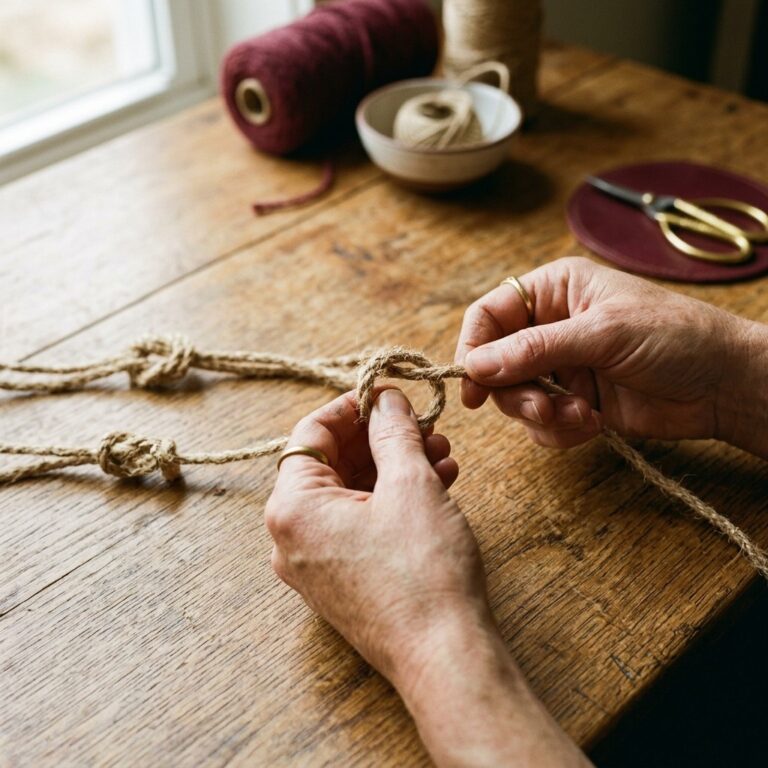
To try it, take a length of cord or thread. Then tie three knots along it, and say one line of your intention with each knot. Afterward, keep the cord somewhere safe. If you later want to release the spell, simply untie the knots one by one.
You may also read scary tales about cords in old folklore. For example, the Pitt Rivers Museum holds a feathered “witches’ ladder” found in a Somerset attic around 1878. Its label says it was used to steal milk and cause deaths. However, the museum’s own researcher notes that this label embellishes the original account.[2] In other words, cord magic has often sounded darker in the retelling than it was.
Seal: The Jar Spell With Centuries Behind It
Jar spells look modern, but they have deep roots. In 17th-century England, people filled glass and stoneware “witch bottles” with pins and nails, and sometimes thorns or nail clippings. Then they hid them in hearths or under floors, as protection against witchcraft.[3] Because a sealed container holds its contents in one place, a jar spell suits goals about keeping something safe or contained.
A Calm Jar You Can Make in Ten Minutes
First, find a small jar with a lid. Then add a spoonful of salt for clearing, a pinch of dried lavender for calm, and a slip of paper with your goal written on it. Next, close the lid and drip a little candle wax over it to seal the spell. Finally, keep the jar on your bedside table or desk, and hold it for a moment whenever you need to settle.

If you like, you can also shake the jar gently each morning. That small action keeps the spell part of your day, rather than something you made once and forgot.
Write: The Paper Spell Romans Threw Into a Sacred Spring
Writing is perhaps the simplest spell of all. It also has one of the best-preserved histories. At the Roman Baths in England, archaeologists found curse tablets written by about 130 people on small sheets of lead or pewter. The writers rolled them up and threw them into the spring where the goddess Sulis Minerva was believed to live.[4] Most asked her to right a wrong, often over the loss of modest everyday items.[4] In fact, these tablets are now on the UNESCO Memory of the World UK register.[4]
How to Write a Beginner’s Paper Spell
The lesson is that naming something clearly has always been part of magic. So take a slip of paper and write one sentence about what you want. Be exact, just as the Bath writers named what they had lost. Then fold the paper toward you to draw the wish in. Afterward, keep it under a candle, bury it in a pot of soil, or tear it up if you are letting something go. Some witches also turn the words into a sigil, which is a symbol built from the letters of a wish.
A basic sigil is easy to make. First, write your wish as one short sentence. Then cross out the repeated letters, and blend the letters that remain into a single shape. Finally, draw that shape on your paper or candle. Because the design no longer reads as words, many witches find it lets them release the wish instead of worrying at it.
Burn, Tie, Seal or Write: Choosing Between Different Spells
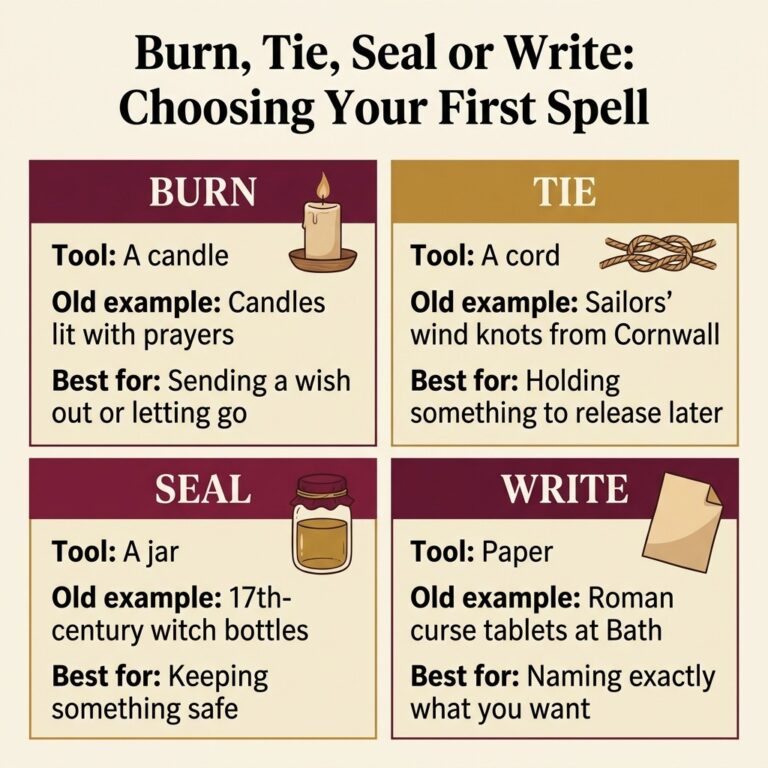
Put side by side, these four easy spells share a pattern. Each one rests on a single action, and each action suits a different kind of goal. This is an analysis rather than a fixed rule, but it can save you a lot of guesswork:
- Burn when you want to send a wish out or let something go, because a flame transforms what it touches.
- Tie when you want to hold something and release it later, just as sailors stored wind in knots.
- Seal when you want to keep something safe or contained, as the old witch bottles did.
- Write when you need to name exactly what you want, as the Roman writers at Bath did.
When people search for easy spells for beginners, they often ask which spell is the strongest. However, the more useful question is which action matches your goal. For example, a fresh start after a breakup fits Burn, while saving money fits Tie. Also, you can combine them once you feel confident. A written goal inside a sealed jar, for instance, uses both Write and Seal.
Common Mistakes With Easy Spells for Beginners
The first mistake is aiming at too many goals at once. Instead, give each spell one job, because a scattered intention is hard to hold. The second mistake is expecting instant, dramatic results. Spells are about focus and intention, so notice small shifts rather than waiting for a sign in the sky.
Another common mistake is copying a long, complex ritual before you have tried a short one. Similarly, many beginners spend money on tools they don’t need yet. A candle, a cord, a jar and some paper will carry you a long way. Also, don’t skip the ending. Snuff the candle, put away the cord, or say “it is done,” so the spell has a clear close. Finally, keep a short record of each spell. Note the date, what you did and how you felt, and then check back after a week. Over time, those notes show you which easy spells for beginners suit you best, and they turn guesswork into real learning. For more on building confidence, read how to cast spells when you’re new and unsure.
Frequently Asked Questions
What are the best easy spells for beginners?
A candle spell, a three-knot cord spell, a small jar spell and a written paper spell are all good first choices. Each needs only one or two tools and a few minutes.
Are there free magic spells that work?
Every spell in this guide costs little or nothing, since it uses a candle, cord, jar or paper. No spell can guarantee a result, however, because spells work through focus and intention rather than certainty.
Which simple witchcraft spells for beginners need no tools?
A written paper spell needs only paper and a pen. You can also tie a knot spell with any thread or string you already have.
How often should beginners cast easy spells?
Start with one spell and give it a week or two before adding another. That way, you can notice what changes and learn from it.
Which easy witchcraft spells for beginners are safest?
Knot, jar and paper spells involve no flame, so they are the safest to start with. If you use a candle, always keep it in a fireproof dish and never leave it unattended.
References
- 219 – Knotted rope. Museum of Witchcraft and Magic. https://museumofwitchcraftandmagic.co.uk/object/knotted-rope/
- Witches’ Ladder: the hidden history. Chris Wingfield. Pitt Rivers Museum, University of Oxford. https://england.prm.ox.ac.uk/englishness-witchs-ladder.html
- ‘Witch bottles’ concealed and revealed. MOLA (Museum of London Archaeology). https://www.mola.org.uk/discoveries/research-projects/witch-bottles-concealed-and-revealed
- Roman curse tablets. The Roman Baths. https://www.romanbaths.co.uk/roman-curse-tablets
Not sure where to start? You don’t have to do this alone.
Madame Celestine offers guided spellwork for beginners — real support for your first working, not just another guide to read.
Related reading: Fertility Spells and Rituals: What Tradition Offers Hopeful Parents · Why Manifestation Isn’t Working Yet: Common Blocks

About Wren Ashby
Wren Ashby is the pen name our editorial team uses for articles on sigils, Tarot and modern traditional witchcraft. Articles under this byline are researched from published sources and reviewed by Madame Celestine before publishing.