
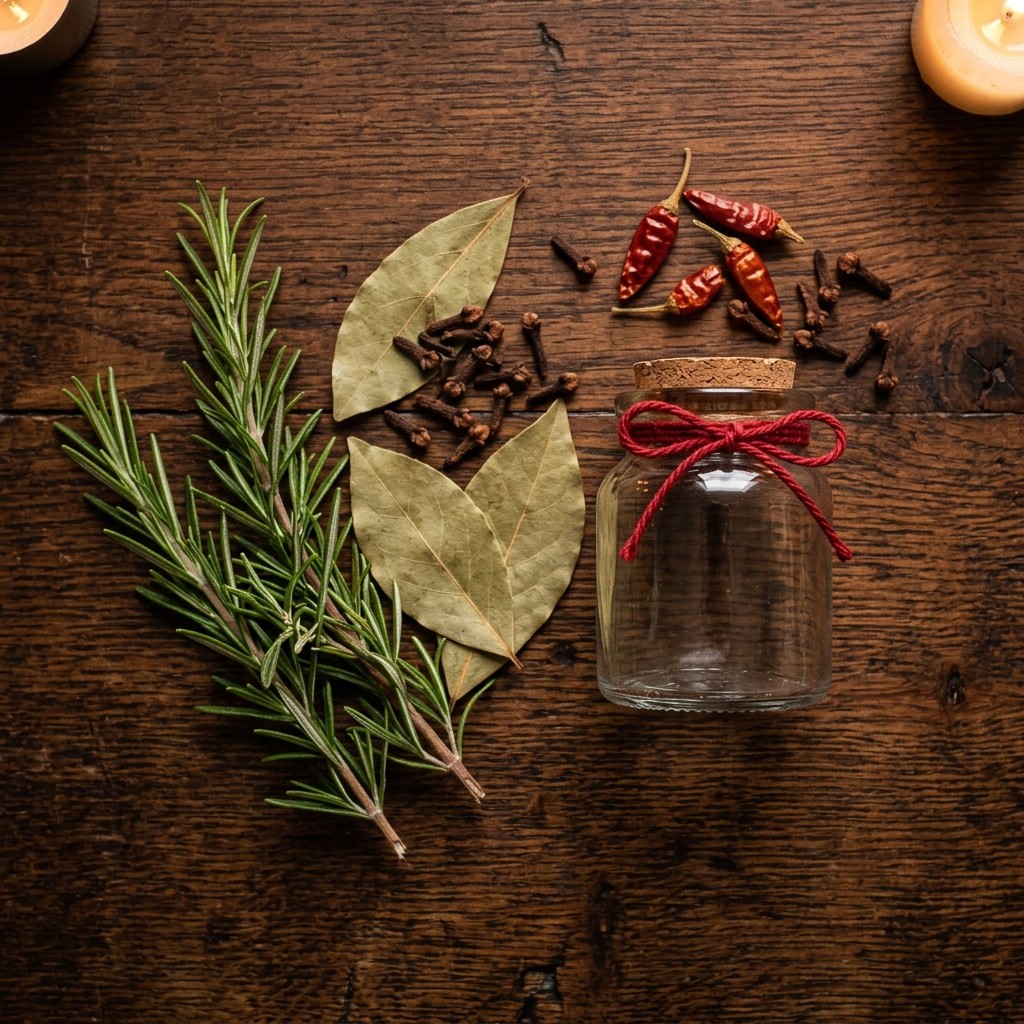
Protection herbs are some of the first plants a new witch learns to use, and for good reason. They are cheap and easy to find, and many already sit in your kitchen. But which ones did people actually rely on, and why those plants rather than others? First, this guide looks at the herbs of protection used in British and Italian folk magic. Then it draws out the pattern they share. Finally, it shows how to turn that pattern into a protection jar and a simple spice charm.
- Rowan and Red Thread: The Tree That Guarded Doorways
- St John’s Wort: The Protection Herb That Chased Devils
- Rue and the Cimaruta: Italy’s Silver Protection Herb
- Red, Sharp or Strong: What the Best Herbs for Protection From Evil Share
- Protection Herbs in a Jar: From Witch Bottle to Modern Spell
- A Protection Charm With Only Kitchen Spices
- Herbs for Protection and Cleansing: Using Them Well
- Frequently Asked Questions
- References
Rowan and Red Thread: The Tree That Guarded Doorways
In Scotland, the rowan tree was the classic guard against witchcraft and enchantment. People believed a rowan protected the house it grew beside, so families took care never to damage one.[1] They also carried pieces of it, and they tied sprigs near cows to keep their milk safe.[1]
If you look closely at a rowan berry, you will see why it seemed special. Each one has a tiny five-pointed star opposite its stalk, and the pentagram is an old protective sign.[1] The berries are also bright red. That color mattered, as an old rhyme shows: “Rowan tree and red thread / make the witches tine their speed.” Here, tine means “lose.”[1]
Rowan Crosses, Loops and Other Doorway Charms
So rowan and red thread often worked together. For example, on the Isle of Man, people made small crosses from rowan twigs and hung them over the lintel each May Eve.[1] Meanwhile, in North Yorkshire, loops of rowan were fixed to railings and gates. The Pitt Rivers Museum in Oxford holds three of them, which were collected in the 1890s. They guarded against witches, but also against ghosts, fairies and the evil eye.[2]

Now notice where these charms went. They sat on gates, lintels and railings, because those are the places where the outside world meets the home. That idea of guarding the threshold, often called warding, runs through almost every tradition in this guide. Rowan is a tree rather than a kitchen plant. Still, it shows the pattern that many protection herbs follow. For a fuller picture, see what warding means in occult practice.
St John’s Wort: The Protection Herb That Chased Devils
If you want herbs to hang for protection, St John’s wort has one of the longest records. In fact, few protection herbs in European folklore had such a clear job. Its yellow flowers open around the summer solstice, close to the feast of St John the Baptist on June 24.[3] An older name for the plant, fuga daemonum, means “devil chaser.” So people used it as an amulet at midsummer to ward off witches and bad luck.[3]
The plant also has a striking trick. When you crush the flower buds, they release a red liquid, and steeping the blossoms turns oil blood red.[3] Many people linked that color to the blood of St John.[4] Because of this, they gathered branches and hung them over doorways, tucked them under pillows, or wore them around the neck.[4]
The lesson for modern practice is therefore simple. A protection herb was often picked at a meaningful time and then placed at a point of entry. So if you grow St John’s wort, you can cut it near Midsummer and hang a bundle above the front door. However, don’t take it as a tea without talking to a doctor, because it interacts with many common medicines.
Rue and the Cimaruta: Italy’s Silver Protection Herb
In Italy, one herb became so trusted that people turned it into jewelry. Its name, cimaruta, comes from the Italian for “sprig of rue.” It is a silver charm shaped like a branch of the herb. Each tip ends in a small symbol, and together they were meant to ward off the evil eye.[5] The Science Museum in London holds an example that was made in Italy in the 18th or early 19th century.[5]
So why rue? It has a sharp, bitter smell that is hard to forget. In other words, it is the kind of plant that seems to push things away. That is also why rue appears in many modern lists of spiritual herbs for protection.
Rue was familiar in England too. In Shakespeare’s Hamlet, for instance, Ophelia hands out flowers and calls rue the “herb of grace o’ Sundays.” As a result, the plant carried a sense of blessing as well as defense. That double meaning helps explain why it moved so easily from the garden into charms.

Handling Rue and Other Strong Protection Herbs Safely
Still, handle fresh rue with care. Its sap can irritate the skin, especially in sunlight, so wear gloves when you cut it. Also, keep it away from children and pets. Instead of fresh rue, a silver charm or a dried sprig in a sealed jar gives you the symbol without the sting.
Red, Sharp or Strong: What the Best Herbs for Protection From Evil Share
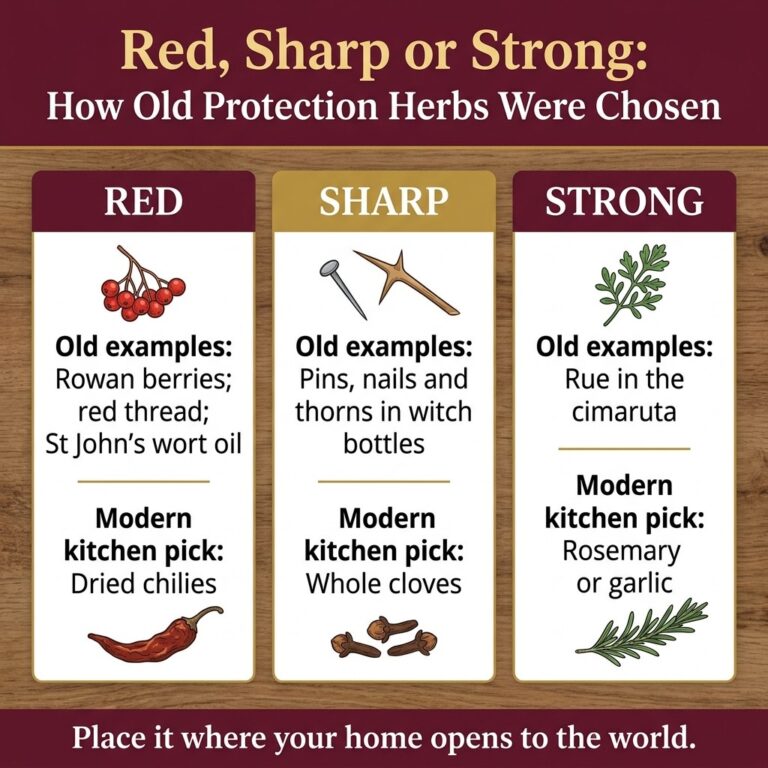
Put side by side, these traditions share a clear pattern. Almost every protective plant or object is red, sharp or strong-smelling. This grouping is an analysis rather than a rule from any single tradition, but it holds up well:
- Red: Rowan berries, red thread and St John’s wort oil are all red, so dried chilies make a good modern kitchen pick.
- Sharp: The pins, nails and thorns in old witch bottles are sharp,[6] so whole cloves are the kitchen match.
- Strong: Rue in the cimaruta has a strong smell, while rosemary or garlic can fill that role today.
There is also a second pattern. Nearly all of these charms went to a threshold, such as a lintel, a gate, a doorway, a hearth or the floor beneath it.[6] Put together, the two patterns give you a practical test. First, choose a herb for protection that is red, sharp or strong. Then, place it where your home opens to the world.
This test also frees you from long shopping lists, since you don’t need rare roots to follow the old logic. Instead, a chili, a clove or a sprig of rosemary can carry the same meaning, because each one matches a trait the old charms relied on. In short, the best protection herbs are the ones that fit the pattern and that you can actually get.
Protection Herbs in a Jar: From Witch Bottle to Modern Spell
The modern protection jar has a real ancestor. In 17th-century England, people filled glass and stoneware “witch bottles” with pins and nails, and sometimes urine, nail clippings and thorns. Then they hid them in hearths or under floors, as protection against witchcraft.[6] Today’s version keeps the idea but uses cleaner protection spell ingredients.
Choosing Protection Herbs and Tools for the Jar
- First, choose a small glass jar with a lid, because a jar holds the working in one place, just as the old bottles did.
- Then add something sharp, such as a few pins, small nails or rose thorns. Sharp items are meant to catch or turn away harm, so they carry the witch-bottle idea.
- Next, add your protection herbs. Rosemary, bay leaf and a pinch of dried rue or St John’s wort all fit, as long as at least one is red, sharp or strong.
- After that, add salt, since many modern witches use salt to cleanse. As a result, the jar both clears and guards.
- Also tie red thread around the neck, because it echoes the rowan rhyme and marks the jar as a guard.
- Then seal it with wax from a black or red candle. If you like, you can also draw a sigil, which is a symbol made from the letters of a wish, on top.
- Finally, place it at a threshold. For example, bury it near the front door, or keep it on a shelf beside the entrance.
Caring for Your Jar Over Time
A common mistake is to make the jar and then forget it. Instead, check on it now and then. If it cracks or spills, many practitioners take that as a sign it has done its work, so they bury the contents and make a new one.
Belief, Intention & The Power of Magic
Witchcraft, spells, and manifestation are deeply rooted in belief, intention, and spiritual practice. If these practices do not resonate with you, this may not be the path for you, and that’s perfectly okay. But if you believe in divine powers, trust your intentions, and feel drawn to the mysteries of the unseen, we invite you to continue exploring with Madame Celestine and discover the magic that speaks to your soul.
A Protection Charm With Only Kitchen Spices
Not everyone has rowan or rue nearby. Luckily, a protection charm with only spices works on the same logic. For example, whole cloves are a good choice, and their name even comes from an old word for “nail.” Meanwhile, dried chilies bring the red, while black pepper and garlic bring a strong bite.
To make one, first place a spoonful of each spice on a small square of red cloth. Then gather the corners, tie them with red thread, and state what you want protected. Finally, hang the pouch inside your front door or keep it in a coat pocket. Because it costs almost nothing, it is an easy first spell for anyone new to protection herbs witchcraft.
Bay leaves also make a good extra. For instance, many modern witches write a single word, such as a family name, on a dried bay leaf and slip it into the pouch. The leaf then works as a small written request alongside the spices. However, if a spice pouch gets damp or starts to smell stale, replace it, since fresh protection herbs and spices keep the charm feeling cared for.
Herbs for Protection and Cleansing: Using Them Well
Protection and cleansing often work as a pair. First, you clear a space, and then you guard it. So many witches wash or smoke-cleanse a room with rosemary or bay before they place a protection jar. The cleansing step removes what is already there, while the protection herbs keep new trouble out.
Also, keep safety in mind. Some herbs for protection spells are fine to cook with, but others are not. For example, don’t eat rue, and check with a doctor before drinking any herbal tea, especially St John’s wort. In addition, burn dried herbs only in a fireproof dish with a window open, and never leave smoke or candles unattended.
Finally, store your protection herbs well. Keep them in sealed jars away from light and damp, and label each one. Most dried herbs lose their scent within a year or so, so refresh your supply each spring. Because a strong smell is part of what made these plants protective, a faded herb is worth replacing.
Frequently Asked Questions
What are the best protection herbs for beginners?
Rosemary, bay leaf, garlic and cloves are easy to find and safe to handle. They also match the red, sharp or strong pattern that older protective charms share.
Which protection herbs are best to hang?
St John’s wort was traditionally hung over doorways, and rowan crosses tied with red thread were hung over the lintel. Bundles of rosemary or bay work well if those are hard to find.
Which protection herbs go in a protection jar?
Most jars hold something sharp, such as pins or thorns, plus protection herbs, salt and a red thread tied around the neck. The jar is sealed with wax and kept near an entrance.
Can I make a protection charm with only spices?
Yes. Whole cloves, dried chilies, black pepper and garlic tied in red cloth make a simple spice-only charm to hang inside your front door.
Is rue safe to use in spells?
Dried rue in a sealed jar is fine, but fresh rue sap can irritate skin, especially in sunlight. Wear gloves, keep it away from children and pets, and never eat it.
References
- Rowan mythology and folklore. Trees for Life. https://treesforlife.org.uk/into-the-forest/trees-plants-animals/trees/rowan/rowan-mythology-and-folklore/
- A Loop of Rowan Tree: amulets against witchcraft. Sandra Modh. Pitt Rivers Museum, University of Oxford. https://england.prm.ox.ac.uk/englishness-loop-of-rowan-tree.html
- St. John’s wort (Hypericum perforatum). 23 June 2009. The Medieval Garden Enclosed, The Metropolitan Museum of Art. https://blog.metmuseum.org/cloistersgardens/2009/06/23/midsomer-magick/hypericum-perforatum/
- St John’s Wort. Rachel Job and Judi McGinley, 17 August 2017. Museum of the Order of St John. https://museumstjohn.org.uk/st-johns-wort/
- Amulet or cimaruta in the form of a rue branch. Science Museum Group Collection. https://collection.sciencemuseumgroup.org.uk/objects/co106415/amulet-or-cimaruta-in-the-form-of-a-rue-branch
- ‘Witch bottles’ concealed and revealed. MOLA (Museum of London Archaeology). https://www.mola.org.uk/discoveries/research-projects/witch-bottles-concealed-and-revealed
Not sure where to start? You don’t have to do this alone.
Madame Celestine offers guided spellwork for beginners — real support for your first working, not just another guide to read.
Related reading: The Energy You Bring Home Without Realizing It · Smoke, Salt, or Water: Which Cleansing Method Fits Your Situation

About Wren Ashby
Wren Ashby is the pen name our editorial team uses for articles on sigils, Tarot and modern traditional witchcraft. Articles under this byline are researched from published sources and reviewed by Madame Celestine before publishing.