

Have you ever walked through your front door in a fine mood and snapped at someone within ten minutes? Often, that’s the energy you bring home from the day, and most of us never notice we’re carrying it. In this article, I’ll explain where that weight comes from and what researchers have found about it. I’ll also cover why so many cultures clean up at the threshold, and how to do a simple five-minute ritual before you step inside.
- The Energy You Bring Home Starts Before You Reach the Door
- What Researchers Found When They Followed Workers Home
- Why the Doorway Matters: Threshold Traditions Around the World
- A Five-Minute Ritual to Clear the Energy You Bring Home
- When the Energy You Bring Home Won’t Lift
- Frequently Asked Questions
- References
The Energy You Bring Home Starts Before You Reach the Door
Think about an ordinary day. You sit through a tense meeting, stand in a crowded train, and listen to a friend’s worries at lunch. Maybe you visit someone in the hospital, too. None of it feels like much at the time. Yet by evening, you’re carrying pieces of all of it.
Practitioners describe this as picking up other people’s energy. You might notice it as irritation with no clear cause, a sudden need to be alone, or a room that feels heavier after you arrive. So the problem often isn’t your home at all. Instead, it’s what came through the door with you.

What Researchers Found When They Followed Workers Home
The energy you bring home isn’t only a spiritual idea. In 1989, UCLA psychologist Rena Repetti studied air traffic controllers and how they behaved with their spouses after work. After high-workload days, the controllers were more socially withdrawn at home, and they expressed less anger.[1]
Here is the part I find most interesting. This pattern appeared on evenings when their spouses were supportive. Repetti suggested that pulling back for a while may help a stressed person return to a calm baseline. In other words, the quiet time many of us crave after a hard day may be a healthy reset, not a rejection of the people we love.
Why the Doorway Matters: Threshold Traditions Around the World
The word “liminal” comes from the Latin limen, meaning threshold or sill.[2] Across many cultures, that line between outside and inside is exactly where people clear themselves.
In Jewish tradition, for example, people wash their hands after leaving a cemetery, often three times on each hand. One explanation is that hands reach furthest into the outside world, so people cleanse them first. Many also let their hands air-dry. Then they set the cup down rather than passing it, so they don’t hand their grief to the next person.[3]
Similarly, in Shinto practice, people commonly sprinkle salt over themselves after attending a funeral. Some households also sprinkle water at the gate of the home each morning and evening.[4] Both customs share one idea: you clear the energy you bring home before it crosses the threshold.
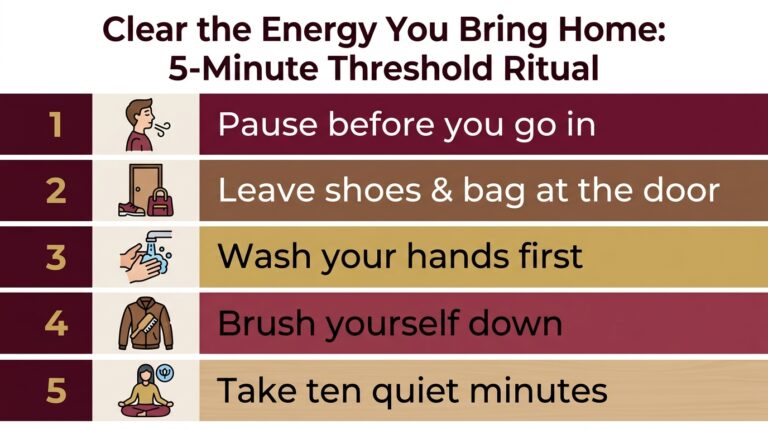
A Five-Minute Ritual to Clear the Energy You Bring Home
This is the simple routine I teach. It borrows from these traditions, and it fits into an ordinary weekday evening.
1. Pause before you go in. Sit in the car or stand on the step for one minute. Name the hardest part of your day, silently or out loud. This marks the end of the day on purpose, rather than letting it follow you inside.
2. Leave your shoes and bag at the door. Practitioners treat shoes as the things that touched the whole day. So they stay outside the living space.
3. Wash your hands first. Before you greet anyone or touch the kitchen, rinse your hands under running water. Many people pour water over each hand in turn, the way the funeral custom does. As you do, picture the day running off with the water.

4. Brush yourself down. Next, sweep your palms from your shoulders down your arms and flick your fingers toward the floor. Some practitioners add a pinch of salt to their hands first, echoing the Shinto custom.
5. Take ten quiet minutes. Finally, change your clothes and give yourself a little quiet before conversation. Tell the people you live with that this is a reset, not a mood. As Repetti’s research suggests, that short retreat may help you come back to them more fully.
Belief, Intention & The Power of Magic
Witchcraft, spells, and manifestation are deeply rooted in belief, intention, and spiritual practice. If these practices do not resonate with you, this may not be the path for you, and that’s perfectly okay. But if you believe in divine powers, trust your intentions, and feel drawn to the mysteries of the unseen, we invite you to continue exploring with Madame Celestine and discover the magic that speaks to your soul.
When the Energy You Bring Home Won’t Lift
Sometimes a threshold ritual isn’t enough. If the heaviness follows you for weeks, it’s worth asking what’s really going on. It could be ongoing stress, a situation you need to change, or simply exhaustion. My article on whether it’s anxiety or someone sending you bad energy can help you sort through it. And if low mood or worry stays with you, please talk to a doctor or counselor too.
Frequently Asked Questions
How do I know if I’m carrying someone else’s energy home?
Common signs include sudden irritability when you walk in, a strong need to be alone, or feeling drained after certain people or places. If the feeling fades after a short reset, it was likely something you picked up during the day.
What is the quickest way to clear the energy you bring home?
Wash your hands before you touch anything else, then take a few quiet minutes. Many practitioners also leave their shoes and bag at the door.
Do I need salt or herbs for a threshold ritual?
No. Water, a pause, and a clear intention are enough for most days. Salt or herbs can add to the ritual, but they are optional.
Should I do this every day?
Many people keep a short version as a daily habit. Others save the full ritual for heavy days, such as after a hospital visit, a funeral, or a hard conversation.
Can children do a threshold ritual too?
Yes, a simple version works well for kids. Washing hands and changing clothes after school can become a calm, familiar way to leave the day behind.
References
- Rena L. Repetti. Effects of Daily Workload on Subsequent Behavior During Marital Interaction: The Roles of Social Withdrawal and Spouse Support. Journal of Personality and Social Psychology, 1989 (hosted by UCLA Department of Psychology). https://www.psych.ucla.edu/wp-content/uploads/Repetti-JPSP-1989.pdf
- Liminal. Online Etymology Dictionary. https://www.etymonline.com/word/liminal
- Yehuda Shurpin. Why Do We Wash Hands After a Funeral or Cemetery Visit? Chabad.org. https://www.chabad.org/library/article_cdo/aid/4064052/jewish/Why-Do-We-Wash-Hands-After-a-Funeral-or-Cemetery-Visit.htm
- Harae. Wikipedia. https://en.wikipedia.org/wiki/Harae
Not sure where to start? You don’t have to do this alone.
Madame Celestine offers guided spellwork for beginners — real support for your first working, not just another guide to read.
Related reading: Smoke, Salt, or Water: Which Cleansing Method Fits Your Situation · She Moved Into a New Apartment — And Couldn’t Sleep Until She Did This

About Madame Celestine
Madame Celestine has practiced and taught spellwork, divination, and seasonal ritual for over two decades, helping newcomers build a grounded, confident practice from their very first spell.