

A knot spell that won’t hold is one of the most common worries I hear from newer witches. Sometimes the cord slips loose by morning. At other times the knots stay tied, but the spell feels flat, as if nothing is anchored. So in this guide, I’ll walk through the four places knot magic usually goes wrong: tension, cord, count and release. For each one, I’ll also show you what older traditions said, because the old rules explain the fixes better than any modern shortcut.
- Why a Knot Spell Slips: Tension and the Knot Itself
- Choosing the Wrong Cord for Witch Knots
- Three, Seven or Nine: Getting the Count Right in Knot Magic
- Four Checks Before You Tie a Knot Spell
- The Nine Knot Spell, Step by Step
- Release: The Knot Spell Mistake Almost Everyone Makes
- Old Fears About Witches’ Knots, and What to Keep
- Frequently Asked Questions
- References
Why a Knot Spell Slips: Tension and the Knot Itself
The first mistake is purely physical. Many people tie a quick “granny knot,” which is two half-knots twisted the same way. Unfortunately, that knot slips under strain. Instead, tie a square knot: right over left, then left over right. The ancient Greeks called a close cousin of this shape the Herakles knot. In fact, they wore it on jewelry, and they believed it had the power to cure wounds.[1] So the knot that holds best is also one of the oldest knots in magic.
Tension matters too. If you pull as hard as you can, you tie in strain rather than focus. On the other hand, a loose knot drifts apart. So aim for firm and steady, the way you would tie a gift you want to arrive intact.
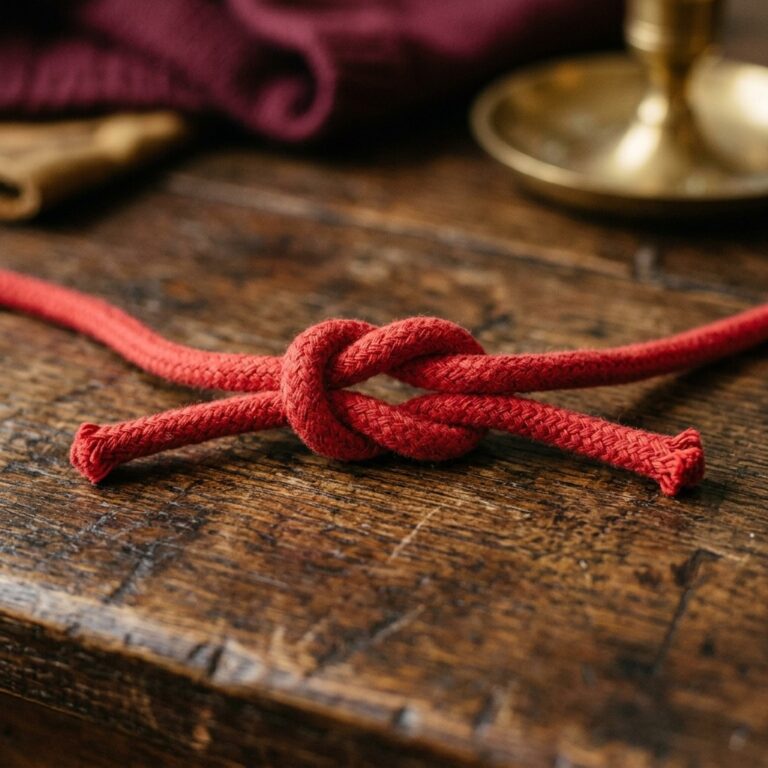
Your Knots Don’t Need to Look Perfect
However, don’t confuse firm with pretty. For example, the Met holds an Egyptian Isis-knot amulet that is blocky and unfinished. It was wrapped inside a mummy’s bandages, where it was meant to work regardless of how neat it looked.[2] In other words, a knot has to hold, not impress.
Choosing the Wrong Cord for Witch Knots
The second mistake is the cord itself. Satin ribbon and slick nylon look lovely, but they let knots creep open. Instead, choose a natural fiber such as cotton, wool or hemp, because its texture grips. Then cut a piece long enough to tie every knot with room to spare, since a cramped cord invites sloppy knots.
Color can carry meaning as well. For instance, the Egyptian Book of the Dead prescribed an Isis knot of red jasper at the throat of the dead, and red was the preferred color for that amulet.[2] So when I want a knot to guard or bind, I reach for red first.
A Note From a Humid City
Here in New Orleans, the air is heavy for much of the year, and that affects cord. Natural fibers swell as they take on moisture, and then they loosen slightly as they dry. As a result, a knot tied in damp air can feel slack a few days later. So store your cord somewhere dry, and give each knot a second, gentle snug before you set it aside.
Three, Seven or Nine: Getting the Count Right in Knot Magic
The third mistake is choosing a number at random. Traditional knot magic tied the count to what the knots would do. On the coasts of Devon and Cornwall, for example, sailors bought ropes from local witches with three knots in them. Then they untied one knot whenever they needed a certain wind.[3] In that case, each knot held one portion of the spell, ready to be let out.
So before you tie, decide what each knot is for. If you want a spell to build over several days, tie one knot per day. Similarly, if you want to release help in stages, give each stage its own knot. Three suits a simple, clear goal. Meanwhile, the modern nine knot spell uses nine because it builds to a strong finish, and it takes long enough to hold your focus.
When a Different Count Makes More Sense
Seven knots also work well, because seven days make a week. So you can tie one knot each evening and finish the spell on the seventh night. That rhythm suits habits, such as saving money or sleeping better, since the goal itself grows day by day. However, if you lose count or skip a night, don’t start over in a panic. Instead, pause, name where you are, and carry on. A knot spell rewards steady attention, not perfection.
Four Checks Before You Tie a Knot Spell
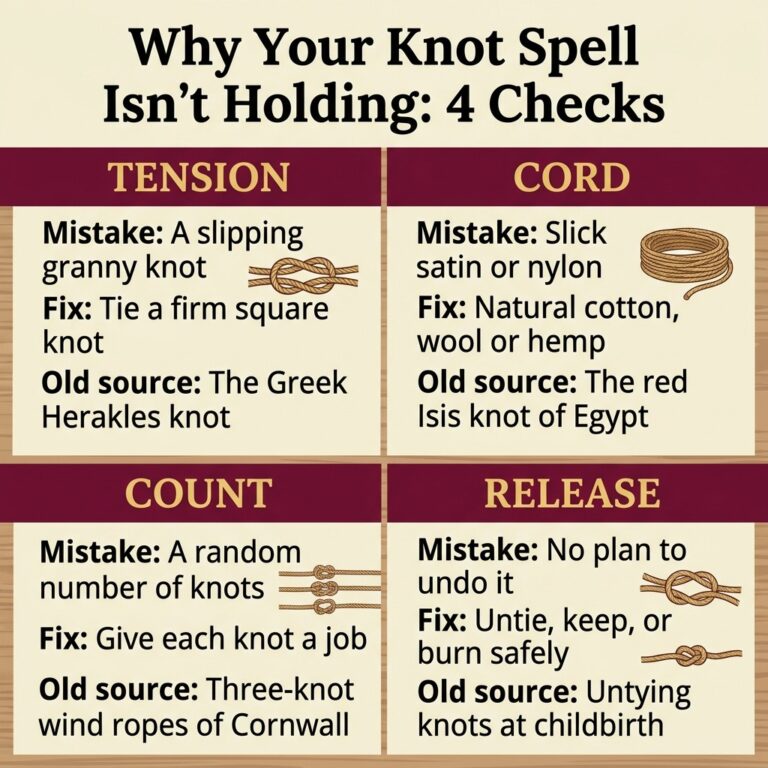
Put side by side, these old sources share one idea. Each treats a knot as something that keeps working until it is undone. This is my own reading of them rather than a rule any single tradition wrote down, but it explains nearly every failed knot spell I see:
- Tension: A slipping knot loses its hold, so tie a firm square knot, as the Greeks did with the Herakles knot.[1]
- Cord: A slick cord lets knots creep open, so choose a natural fiber, and pick red for guarding, as with the Isis knot.[2]
- Count: A random number gives the knots no job, so give each knot a purpose, as the three-knot wind ropes did.[3]
- Release: A knot with no plan to undo it has no ending, so decide how you will release it, as the old childbirth customs did.[4]
In short, most knot spells fail because of the last check rather than the first. People tie carefully, yet they never decide how the spell should end.
The Nine Knot Spell, Step by Step
The 9 knot spell is the one I teach most often, because it builds focus knot by knot. Here is the version I recommend:
- First, cut a natural cord about the length of your forearm, so you have room for nine knots.
- Then write one sentence that states your goal as if it is already true.
- Next, tie the first knot near one end while you say the sentence aloud.
- After that, tie the second knot at the other end, and then work toward the middle, alternating sides.
- Also, breathe on each knot once it is tied. Old love charms included blowing on knots after tying them.[4]
- Finally, tie the ninth knot in the center, say “it is done,” and put the cord somewhere safe.
Because you work from the ends inward, the last knot sits at the heart of the cord. That placement mirrors the spell itself, which gathers your intention into one point.
Belief, Intention & The Power of Magic
Witchcraft, spells, and manifestation are deeply rooted in belief, intention, and spiritual practice. If these practices do not resonate with you, this may not be the path for you, and that’s perfectly okay. But if you believe in divine powers, trust your intentions, and feel drawn to the mysteries of the unseen, we invite you to continue exploring with Madame Celestine and discover the magic that speaks to your soul.
Release: The Knot Spell Mistake Almost Everyone Makes
This is the mistake that matters most. Old folk custom treated knots as binding until someone undid them. For example, in Transylvania, a woman in labour had every knot on her clothing untied. Likewise, in Argyllshire, every lock in the house was opened at a birth.[4] Frazer also records a belief that a knot tied during a wedding could block the marriage until it was found and undone.[4]
A knot spell with no release plan is like a letter you never post. Before you tie, therefore, choose one of three endings. You can untie the knots one at a time, as the sailors did. Alternatively, you can keep the cord tied until the goal is met, and then untie it with thanks. Or, if you want to end something for good, you can burn the cord safely instead.
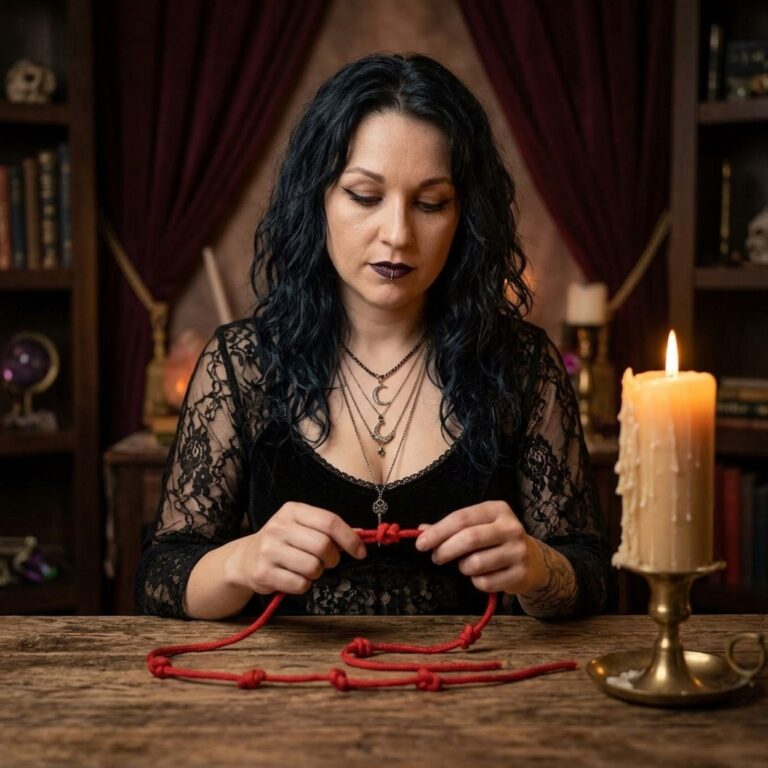
Also, don’t cut a knot spell in frustration. Cutting is abrupt, while untying is deliberate. So if you change your mind, sit down and untie each knot slowly. If you do choose to burn a cord, use a fireproof dish, burn it outdoors or near an open window, and stay with it until the flame is out.
Where to Keep a Knot Spell While It Works
Meanwhile, the cord needs a home while the spell is active. For a protective knot spell, many witches hang it near the front door. For a personal goal, a pocket, a purse or a drawer beside the bed keeps it close. Also, avoid leaving it where others will handle it, because a cord that gets tangled or tugged can loosen. Finally, when the goal is met, release it and let the cord go, since an old spell should not sit forgotten in a drawer.
Old Fears About Witches’ Knots, and What to Keep
Knot magic carries a lot of old fear. Pliny, for instance, warned that clasping your hands or crossing your legs near a pregnant woman could cast a harmful spell.[4] You don’t need to carry those fears into your practice. However, they show how seriously people took the power of a tie.
So keep the respect, but drop the dread. Tie with care, give each knot a job, and plan your release before you start. If you are new to cord work, begin with the gentle three-knot version in my guide to easy spells for beginners, and then move on to nine.
Frequently Asked Questions
Why did my knot spell come undone?
Usually the knot type or the cord is to blame. A granny knot and a slick cord both slip, so tie a firm square knot in cotton, wool or hemp instead.
What is a nine knot spell?
It is a knot spell where you tie nine knots in one cord, working from the ends toward the center while repeating your intention. The last knot sits in the middle to gather the spell together.
Should I cut or untie a knot spell?
Untie it whenever you can, because untying is deliberate while cutting is abrupt. If you want to end something for good, you can also burn the cord safely.
Is knot magic the same as a knot magic massage?
No. Knot magic is spellwork with tied cord, while a knot massage works on muscle tension. The two share a word but not a practice.
What cord is best for knot magick?
Natural fibers such as cotton, wool or hemp grip well and hold a knot. Red is a traditional choice for guarding, but any color can suit your goal.
References
- Gold ornament with Herakles knot. The Metropolitan Museum of Art. https://www.metmuseum.org/art/collection/search/248816
- Tit (Isis knot) amulet. The Metropolitan Museum of Art. https://www.metmuseum.org/art/collection/search/570311
- 219 – Knotted rope. Museum of Witchcraft and Magic. https://museumofwitchcraftandmagic.co.uk/object/knotted-rope/
- The Golden Bough, Chapter 21, Section 11: Knots and Rings Tabooed. James George Frazer. Internet Sacred Text Archive. https://sacred-texts.com/pag/frazer/gb02111.htm
Not sure where to start? You don’t have to do this alone.
Madame Celestine offers guided spellwork for beginners — real support for your first working, not just another guide to read.
Related reading: Easy Spells for Beginner Witches: Where to Start Your Practice · Fertility Spells and Rituals: What Tradition Offers Hopeful Parents

About Madame Celestine
Madame Celestine has practiced and taught spellwork, divination, and seasonal ritual for over two decades, helping newcomers build a grounded, confident practice from their very first spell.