

Wolf deities show up in almost every mythology that ever shared land with wolves, and people usually come to them with one question: what does the wolf actually mean? Is it a loyal guardian, a wild threat or a teacher? The honest answer is all three. In this guide, I walk through the mythological wolves of Rome, Scandinavia, Ireland, Egypt, Japan and Greece. Then I come home to New Orleans and the rougarou. Along the way, you’ll see why the same animal can stand for loyalty, wildness and protection at once, and what that pattern can teach a modern practitioner.
- The Loyal Wolf: Wolf Deities Who Stay and Serve
- The Wild Wolf: Fenrir and the Chain Made of Impossible Things
- The Protective Wolf: Wolf Gods Who Guard the Road
- Wolves in Greek Mythology and the Werewolf God Question
- The Rougarou: New Orleans’ Own Wolf Story
- Wolf Deities Side by Side: The Pattern Under the Names
- Working With Wolf Deities in Your Own Practice
- Frequently Asked Questions
- References
The Loyal Wolf: Wolf Deities Who Stay and Serve
Start with loyalty, because it’s the side of the wolf most people forget. Rome’s founding story hangs on it. According to legend, the twins Romulus and Remus were left to die by the Tiber, and a she-wolf nursed them instead. So the city that later ruled much of the known world traced its survival to a wolf’s milk. That’s not a small image. It says the wild can care for us when people fail to.
Norse myth gives us the god’s wolf in the most literal sense. Odin keeps two wolves, Geri and Freki, at his side in Valhalla. They aren’t pets or monsters. Instead, they are companions who share his table and his watch. When you picture Odin, you picture him flanked by wolves and ravens, and that pairing is deliberate. The ravens bring him knowledge, while the wolves stay close.
What ties these stories together is the pack. A wolf is loyal to its own, and myth borrowed that trait directly. As a result, the loyal wolf in myth is never loyal to everyone. It is loyal to its people, its god or its city.
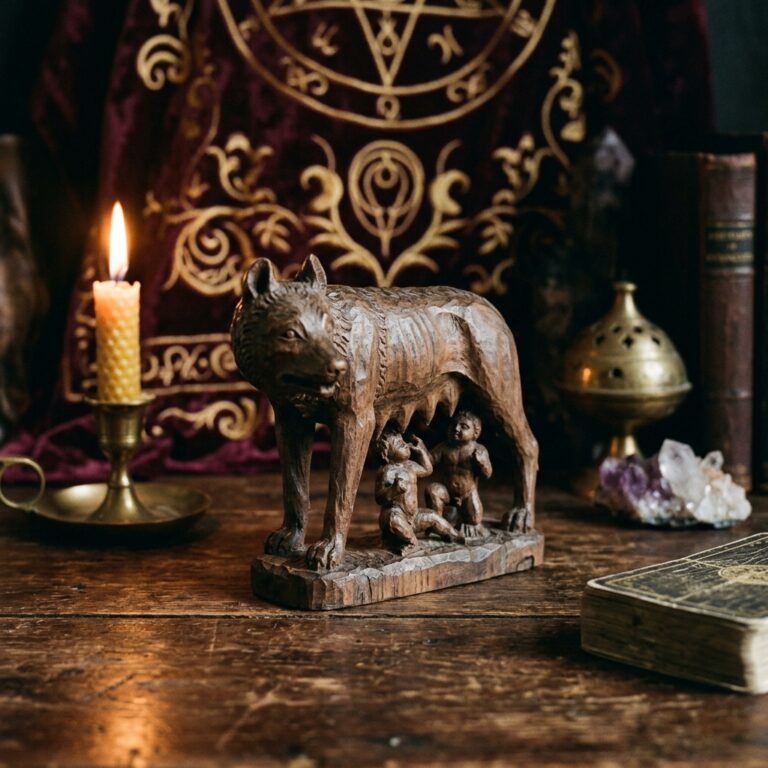
The Wild Wolf: Fenrir and the Chain Made of Impossible Things
Now turn the coin over, because not all wolf deities are gentle. Fenrir, the great wolf of Norse myth, was the son of the trickster Loki and the giantess Angerboda. The gods feared how fast he grew, so they tried to bind him. Ordinary chains snapped. Finally they used a magic fetter made from things that don’t exist, such as the sound of a cat’s footsteps, the beard of a woman and the breath of a fish.[1]
In the Norse telling, Fenrir only let them place it on him if one god put a hand in his mouth as a pledge. Tyr agreed. When the fetter held, Fenrir bit off Tyr’s hand.[1] The wolf then stays bound until Ragnarök, the end of the world, when he breaks loose and swallows Odin himself.[1]
I find Fenrir the most honest of all the wolf stories. Notice what the gods did wrong. They broke faith first, because the binding was a trick. So the wolf’s violence arrives as the price of a broken promise. That detail matters, and we’ll come back to it.
Ireland offers a darker, feminine version. The Morrígan, a goddess of war and fate, comes against the hero Cú Chulainn in several animal shapes, and one of them is a wolf. He strikes out one of its eyes.[2] For anyone searching for a goddess of wolf form in Celtic myth, she is the clearest example. Here the wolf is not a pet or a guardian. It is fate with teeth.
The Protective Wolf: Wolf Gods Who Guard the Road
The third face is protection, and among wolf deities it’s older than you might think. In Egypt, the god Wepwawet carried a name that means “Opener of the Ways.” He was believed to guide the dead along dangerous paths toward judgment.[3] Egyptologists usually describe him as a jackal. However, his main cult city, Asyut, was called Lykopolis by the Greeks, which means “Wolf-town.”[3] In other words, the Greeks looked at his canine image and saw a wolf.
Japan took wolf worship further than almost anyone. In the mountains of Saitama, Mitsumine Shrine was an ancient center of wolf worship. About 20 shrines in the surrounding Chichibu area drew people who wanted protection from fire and theft. Farmers also asked the wolf to guard their crops against deer and wild boar.[4] That’s a practical faith. For a farmer, a wolf that eats crop-raiding deer is a real ally.
Yet the Japanese wolf itself is gone. The last known one was killed by hunters in Nara Prefecture on January 23, 1905.[4] Even so, the shrines still honor it. So the wolf survives as a protector in faith long after it vanished from the forest. Of all the wolf deities here, it may be the most practical.

Wolves in Greek Mythology and the Werewolf God Question
People often ask me about a werewolf god. The closest story comes from wolves in Greek mythology. Lycaon, a legendary king of Arcadia, tried to trick Zeus into eating human flesh. As punishment, Zeus turned him into a wolf.[5] A festival called the Lycaea was later held for Zeus Lycaeus on Mount Lycaeus. It may have been built partly to explain Lycaon’s story.[5]
The Greek word for wolf is lykos. That root gives us Lycaon, the Lycaea and the modern word “lycanthropy,” which means turning from human into wolf. So when people look for werewolf gods, they usually find this: not a god who is a werewolf, but a god who makes one.
That difference is worth holding onto. In Greek myth, the wolf shape is a verdict. Lycaon broke the sacred law of hospitality by feeding a guest something monstrous. Then his outer form was made to match his inner one.
The Rougarou: New Orleans’ Own Wolf Story
Here in south Louisiana, the wolf story people actually know is the rougarou. The name comes from the French loup-garou, meaning werewolf. Over generations of spoken French, the sounds shifted until “loup-garou” became “rougarou.”[6]
Our rougarou is a shape-shifter that takes its beast form at night. According to the tradition, it passes its curse on by biting someone and drawing blood. Anyone who learns who the rougarou is must keep that secret for a year and a day, or in some tellings 101 days.[6]
Here’s the detail that surprises most visitors. Louisiana accounts rarely describe the rougarou as looking like a wolf. Instead, people compare it to a dog, an owl or something they can’t name, likely because wolves were scarce here.[6] For adults, the curse was often tied to failing one’s duties as a Catholic parishioner.[6] So even without the wolf’s body, the rougarou keeps the old job of the wolf deities. It enforces the rules of the community.

Wolf Deities Side by Side: The Pattern Under the Names
Put side by side, these traditions share something that a simple list of names hides. Here are the figures we’ve met, sorted by what the wolf does in each story.
| Figure | Tradition | What the wolf does |
|---|---|---|
| The she-wolf | Roman | Nurses the city’s founders |
| Geri and Freki | Norse | Stand beside Odin |
| Wepwawet | Egyptian | Guides the dead on the road |
| Mitsumine wolf | Japanese | Guards crops and homes |
| Fenrir | Norse | Breaks loose after a broken pledge |
| Lycaon | Greek | Is made a wolf for breaking guest law |
| Rougarou | Louisiana | Punishes broken church duties |
Read down the last column and a pattern appears. When the wolf serves, it guards a boundary, such as a city’s birth, a god’s hall, the road to the dead or a farmer’s field. When the wolf turns dangerous, a promise or a law has usually been broken first. Fenrir was tricked, Lycaon abused a guest, and the rougarou’s curse follows neglected duty.
So my reading is this. Loyalty and wildness aren’t opposite meanings of the wolf. They are two sides of one role. The wolf keeps the pact. It protects those who keep faith, and it comes for those who break it. That’s my own analysis of these stories, not an established rule of mythology. Still, it explains why wolf deities can be both guardian and threat.
Working With Wolf Deities in Your Own Practice
If you feel drawn to wolf deities, begin with the stories rather than the aesthetics. Wolf deities reward study more than decoration. Each wolf figure comes from a real culture with its own rules. First, pick the face of the wolf that fits your intention. For loyalty and family, the Roman she-wolf or Odin’s companions fit well. For protection of a home or path, Wepwawet and the Japanese shrine wolves fit better.
Next, read the source myth slowly. Notice what the wolf protects and what sets it off. Then set a simple image of the wolf on your altar, along with a candle and a written note of the promise you’re making. Because the pattern above centers on keeping faith, the promise is the heart of the practice. Finally, revisit that note each full moon and ask honestly whether you’ve kept it.
A few common mistakes are worth avoiding. Don’t treat Fenrir as a simple symbol of freedom, because his story is also about betrayal. Likewise, don’t lift closed shrine practices from Japan or elsewhere as your own. Instead, honor them by learning where they came from. If you want to widen your study, my guide to goddesses of the forest and wild animals places the wolf alongside other wild guardians.
Belief, Intention & The Power of Magic
Witchcraft, spells, and manifestation are deeply rooted in belief, intention, and spiritual practice. If these practices do not resonate with you, this may not be the path for you, and that’s perfectly okay. But if you believe in divine powers, trust your intentions, and feel drawn to the mysteries of the unseen, we invite you to continue exploring with Madame Celestine and discover the magic that speaks to your soul.
Frequently Asked Questions
What are the most important wolf deities in mythology?
Key wolf deities and figures include Fenrir and Odin’s wolves Geri and Freki in Norse myth, Wepwawet in Egypt, the Roman she-wolf, and the wolves honored at Japan’s Mitsumine Shrine. Each one leans toward loyalty, wildness or protection.
Who is the goddess of wolves?
No single goddess of wolf lore rules every tradition. The Irish Morrígan takes wolf form in the Cú Chulainn stories, and Rome’s founding she-wolf is the best-known female wolf figure in myth.
Is there a werewolf god?
Not exactly. The closest story is Greek: Zeus turned King Lycaon into a wolf as punishment, which is why the wolf shape there reads as a verdict rather than a divine form.
What are some wolf names in mythology?
Well-known names of wolf gods and mythic wolves include Fenrir, Geri, Freki, Wepwawet and Lycaon. Norse myth also names Sköll and Hati, the wolves said to chase the sun and moon.
Are there wolves in Greek mythology?
Yes. The Greek word for wolf is lykos, and it appears in the myth of Lycaon and in the Lycaea festival for Zeus on Mount Lycaeus.
Is the Louisiana rougarou a wolf?
Its name comes from the French word for werewolf, but Louisiana accounts rarely describe it as wolf-like. People more often compare it to a dog, an owl or something they can’t name.
References
- Fenrir. Encyclopaedia Britannica. https://www.britannica.com/topic/Fenrir
- Mark Cartwright. The Mórrigan. World History Encyclopedia, February 9, 2021. https://www.worldhistory.org/The_Morrigan/
- Wepwawet: Opener of the Ways. Death Dogs: The Jackal Gods of Ancient Egypt, Kelsey Museum of Archaeology, University of Michigan. https://exhibitions.kelsey.lsa.umich.edu/jackal-gods-ancient-egypt/wepwawet.php
- Hayashi Michiko. Sacred Beasts: Hunting for Traces of the Vanished Japanese Wolf. Nippon.com, January 2017. https://www.nippon.com/en/images/i00066/
- Lycaon. Encyclopaedia Britannica. https://www.britannica.com/topic/Lycaon-Greek-mythology
- Nathan Rabalais. Rougarou. 64 Parishes (Louisiana Endowment for the Humanities), July 31, 2024. https://64parishes.org/entry/rougarou
Not sure where to start? You don’t have to do this alone.
Madame Celestine offers guided spellwork for beginners — real support for your first working, not just another guide to read.
Related reading: Bee Goddesses and Gods: The Sacred Bee in Mythology · Earth Goddesses and Gods: Deities of Soil and Harvest

About Madame Celestine
Madame Celestine has practiced and taught spellwork, divination, and seasonal ritual for over two decades, helping newcomers build a grounded, confident practice from their very first spell.