
Rosemary magical properties are older and stranger than most herb lists let on. People usually ask one simple question: why do so many traditions put rosemary at the door? The answer runs through gardens, weddings, funerals and Christmas Eve. In this guide, I trace those old protection and luck customs, show you the thread that ties them together, and then share how I bring them to a New Orleans doorstep today.
- Dew of the Sea: Where Rosemary Magical Properties Begin
- The Witch-Proof Garden: Rosemary as a Doorstep Guard
- Crowns for Exams: Rosemary Magical Properties and Memory
- From Bridal Sprig to Graveside: Rosemary at Weddings and Funerals
- Christmas Luck and the Rose of Mary
- Four Thresholds, One Herb: The Common Thread
- Magical Uses for Rosemary at Your Doorstep Today
- Rosemary Witchcraft Properties: Common Mistakes
- Frequently Asked Questions
- References
Dew of the Sea: Where Rosemary Magical Properties Begin
Start with the name, because it tells a story. “Rosemary” comes from the Latin ros marinus, meaning “dew of the sea.” The plant earned it because it can survive on little more than the moisture in sea air.[1] So from the very beginning, rosemary was the herb that thrives where other plants give up.
Its ritual history is long, too. Britannica notes that traces of rosemary have been found in Egyptian tombs dating to about 3000 BCE. In ancient Greece and Rome, people linked it with memory and purification and often burned it as incense.[1] Later, during the Middle Ages, Europeans burned rosemary in homes and hospitals to purify the air.[1]
The herb also traveled with power. In the 9th century, Charlemagne ordered it grown in his imperial gardens. The Romans had already brought rosemary to Britain, and records show it was cultivated there by 1342.[1] As a result, the rosemary magical properties people trusted in England grew from a plant with a very long Mediterranean memory.
Botanists have also rethought the plant itself. In 2017, rosemary moved into the sage genus and became Salvia rosmarinus.[1] That’s a fitting detail for a witch to know. Sage and rosemary, two of our oldest cleansing herbs, turn out to be close family.
The Witch-Proof Garden: Rosemary as a Doorstep Guard
Now to the door. Across Britain and Europe, people believed a rosemary bush in the garden protected the household from witches who attacked at night.[2] Notice the timing in that belief. The danger came in the dark, while the family slept, so the guard had to be alive and growing outside.
The same logic moved indoors. In the Middle Ages, rosemary was used to protect against evil spirits. People also tucked it beneath the pillow to ward off bad dreams.[3] In other words, rosemary watched the two moments when people felt most exposed: crossing into the house and crossing into sleep.
That’s why I think of the doorstep as rosemary’s natural home. A threshold is where the outside world meets your private one. Because rosemary was trusted at exactly that line, the magic properties of rosemary are really about boundaries. It marks the place where what’s yours begins.

Crowns for Exams: Rosemary Magical Properties and Memory
Before rosemary guarded doors, it guarded minds. In Greece and Rome, students wore crowns of rosemary during their exams to help their memory.[4] That’s worth pausing on. The herb’s first job was not to keep something out. Its job was to keep something in.
This matters for the rest of the story, because memory is the root of every later custom. When mourners laid rosemary on the dead, they were promising to remember. When a family grew it by the house, they were keeping their home intact. So if you want to understand rosemary magical properties, begin with memory and the rest follows.
From Bridal Sprig to Graveside: Rosemary at Weddings and Funerals
Here’s the part that surprises people. The same herb served at both weddings and funerals. In literature and folklore, rosemary stands for remembrance and fidelity.[1] So it suited a promise to stay faithful, and it also suited a promise not to forget.
Funerals come first historically. Ancient Greek and Roman mourners often carried rosemary sprigs in funeral processions and laid them on the body.[4] The custom lasted for centuries. Traditionally, families still scatter sprigs on the graves of loved ones to show they won’t be forgotten.[3]
Shakespeare shows how close the two occasions sat. In Romeo and Juliet, Juliet’s family is preparing her wedding when she’s found seemingly dead. The Friar tells them to “stick your rosemary on this fair corse.” Then Capulet mourns, “Our bridal flowers serve for a buried corse.”[5] His audience didn’t need that explained. They knew the wedding rosemary could turn into funeral rosemary in a single morning.
Ophelia makes the meaning plain in Hamlet, too: “There’s rosemary, that’s for remembrance.” For a practitioner reading rosemary magical properties, that line is the key. Rosemary doesn’t mark joy or grief as such. Instead, it marks what we promise to hold onto.
Christmas Luck and the Rose of Mary
The luck customs grow from Christian legend. According to one story, rosemary was among the herbs lining the manger where Jesus was born. Another legend says the Virgin Mary draped her blue cloak over a white-flowered rosemary bush, and the blossoms turned blue.[4] That’s why people also called it the “Rose of Mary.”
These stories led to a medieval belief that smelling rosemary on Christmas Eve brought a year of good luck, health and happiness.[4] Rosemary also decked the floors of churches and homes at Christmas.[4] So when you walked on it, you released the scent, and with it, the luck.
That’s a useful detail for anyone asking about rosemary magic properties for luck. The old custom wasn’t about hoarding rosemary in a jar. It was about breathing it in at a turning point, as one year ended and the next began. So luck belongs among rosemary magical properties just as surely as protection does.
Four Thresholds, One Herb: The Common Thread
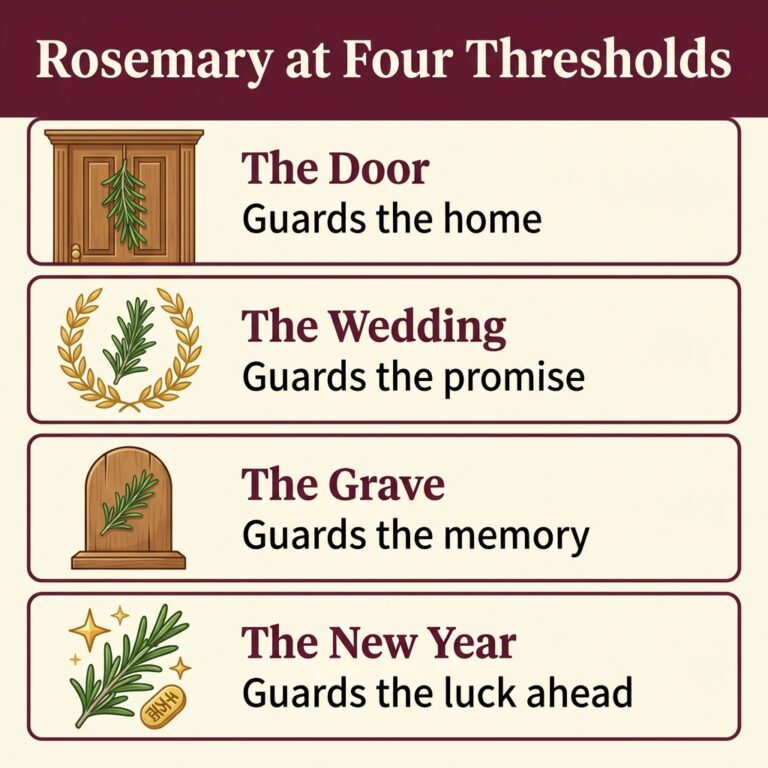
Put side by side, these customs share something that a list of rosemary magical uses usually misses. Every one of them happens at a crossing point.
| Threshold | Old custom | What it guards |
|---|---|---|
| The door | A rosemary bush against night witches | The home |
| The wedding | Rosemary as an emblem of fidelity | The promise |
| The grave | Sprigs laid on the body or grave | The memory |
| The new year | Smelling rosemary on Christmas Eve | The luck ahead |
Read down the last column and a pattern appears. At each crossing, rosemary protects something that could slip away, whether that’s safety, faithfulness, a loved one’s memory or a fresh start. Rosemary is evergreen and keeps its scent when dried, so it’s easy to see why people trusted it with things that shouldn’t fade.
My reading, then, is this. Protection and luck aren’t two separate rosemary magical properties. They are one property seen from two sides. Protection keeps what you have, and luck carries it safely into what comes next. That’s my own analysis of these customs, not an established rule. Still, it gives you a simple test: use rosemary when you’re crossing a line and want to keep something whole on the other side.
Magical Uses for Rosemary at Your Doorstep Today
You don’t need a cottage garden to use these customs. Here in New Orleans, the heat and humidity are hard on rosemary planted in heavy ground. So a pot with fast-draining soil by the front door works better, and it keeps the old living guard where the lore wants it.
First, set your pot on the outside of the threshold, not inside. This is the simplest way to put rosemary magical properties to work. The old belief placed rosemary between the house and whatever came at night. Next, when you water it, run your hand through the branches and breathe in the scent. That borrows the Christmas Eve custom, where the luck came through smelling the herb.
Then, for a doorway blessing, tie three fresh sprigs with a red or white thread and hang them above the inside of the door. Replace them when they turn brittle, because the old customs favored living, fragrant rosemary. Finally, at a turning point in your year, such as a move, a new job or a wedding, carry a sprig with you and name what you want to keep safe as you cross.

Belief, Intention & The Power of Magic
Witchcraft, spells, and manifestation are deeply rooted in belief, intention, and spiritual practice. If these practices do not resonate with you, this may not be the path for you, and that’s perfectly okay. But if you believe in divine powers, trust your intentions, and feel drawn to the mysteries of the unseen, we invite you to continue exploring with Madame Celestine and discover the magic that speaks to your soul.
Rosemary Witchcraft Properties: Common Mistakes
The most common mistake is using stale rosemary and expecting the old rosemary magical properties to carry through. A dusty kitchen jar has lost most of its scent, and scent is what the old customs relied on. Instead, use fresh sprigs or rosemary you dried recently.
Another mistake is treating rosemary as a shield you set once and forget. The old guard was a living bush that people passed every day. So tend your pot, refresh your sprigs, and let the care itself be part of the practice.
A third mistake is burning it carelessly. Rosemary was burned for purification for centuries, but dried branches catch fast. Always use a fireproof dish, open a window, and never leave it smoldering. If you want to pair rosemary with other guardians, my guide to herbs for protection covers plants that work well beside it.
Frequently Asked Questions
What are the main rosemary magical properties?
In folklore, rosemary is linked with protection, remembrance, fidelity, purification and luck. Most of its customs gather around thresholds, such as doors, weddings, funerals and the turn of the year.
What are the magical uses of rosemary for luck?
A medieval belief held that smelling rosemary on Christmas Eve brought a year of good luck, health and happiness. Today, many practitioners breathe in fresh rosemary at the start of a new chapter for the same reason.
Why do people put rosemary by the front door?
Old European lore held that a rosemary bush protected the household from witches at night. A pot by the door keeps that living guard at the threshold.
Can I use dried kitchen rosemary for magic?
You can, but fresh or recently dried rosemary is better. The old customs relied on its scent, and stale rosemary has little left.
What do the magic properties of rosemary mean at weddings and funerals?
At both, rosemary stands for remembrance and fidelity. At a wedding it honors a promise to stay faithful, and at a funeral it honors a promise not to forget.
References
- Rosemary. Encyclopaedia Britannica. https://www.britannica.com/plant/rosemary
- Thomas Waters. Six Ways That People of the Past Used Magic to Protect Their Homes, From Witch Bottles to Mystical Symbols. Smithsonian Magazine, September 15, 2026. https://www.smithsonianmag.com/history/six-ways-that-people-of-the-past-used-magic-to-protect-their-homes-from-witch-bottles-to-mystical-symbols-180989493/
- Margaret Murphy. Rosemary, a favorite herb. University of Wisconsin–Madison Division of Extension, Chippewa County, June 23, 2025. https://chippewa.extension.wisc.edu/2025/06/23/rosemary-a-favorite-herb/
- Nina Foster. Rosemary: The Herb of Ritual and Remembrance. JSTOR Daily, December 20, 2024. https://daily.jstor.org/rosemary-the-herb-of-ritual-and-remembrance/
- Romeo and Juliet, Act 4, Scene 5. Folger Shakespeare Library. https://www.folger.edu/explore/shakespeares-works/romeo-and-juliet/read/4/5/
Not sure where to start? You don’t have to do this alone.
Madame Celestine offers guided spellwork for beginners — real support for your first working, not just another guide to read.
Related reading: Passed Over Twice? A Tarot Spread for Reading a Career Setback · Cinnamon in New Orleans Money Magic: How I Use It (and Why)

About Madame Celestine
Madame Celestine has practiced and taught spellwork, divination, and seasonal ritual for over two decades, helping newcomers build a grounded, confident practice from their very first spell.