

A career tarot spread can help when you’ve been passed over for a job or promotion, maybe more than once. You did the work and waited for the call, and then someone else got the offer. It stings, and it can leave you asking questions a job board can’t answer. Why did this happen? Did I miss something? What now? In this guide, you’ll learn where tarot came from and why one old image, Fortune’s wheel, fits this moment so well. You’ll also get a five-card spread built for a career setback, with the reasoning behind each position.
- Passed Over Twice? What a Career Tarot Spread Can Offer
- From Card Game to Counsel: Where Tarot Came From
- The Wheel of Fortune and the Official Who Fell
- The Career Tarot Spread: Five Cards for a Setback
- How to Lay and Read Your Career Tarot Spread
- Cards That Often Speak to a Career Setback
- Common Mistakes With a Career Tarot Spread
- Frequently Asked Questions
- References
Passed Over Twice? What a Career Tarot Spread Can Offer
First, it helps to be clear about what tarot does in a reading like this. A career tarot spread is not a hiring forecast. Instead, most modern readers use tarot as a mirror. The cards offer images, and those images prompt you to look at your situation from new angles.
That approach suits a setback well. After a rejection, the mind tends to loop on one story, such as “I wasn’t good enough.” A spread breaks that loop, because each card position asks a different question. One position looks at what you brought. Another looks at what was missing. Yet another asks what is changing now.
So the aim is not to learn whether the next offer will come. Rather, the aim is to leave the reading with a clearer view of your strengths, one honest gap and one next step. Many readers find that clarity is what they needed most after being passed over.
From Card Game to Counsel: Where Tarot Came From
Tarot did not begin as a fortune-telling tool. Card makers in Italy invented the first decks in the 1430s as playing cards. They took the usual four-suited pack and added a fifth suit of 21 illustrated cards called trionfi, or “triumphs,” plus an odd card called il matto, “the fool”[1].
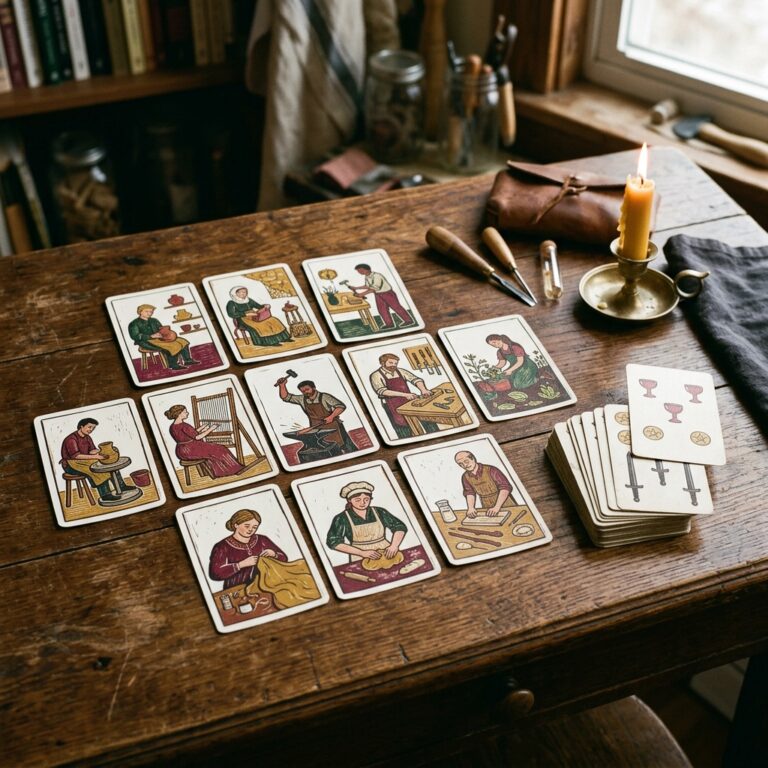
The mystical story came much later. In 1781, the French scholar Antoine Court de Gébelin claimed tarot held ancient Egyptian wisdom drawn from the Book of Thoth. Historians have since rejected most of his claims. Even so, his idea shaped how later occultists came to read the cards[2].
The deck most readers use today arrived in 1909. The artist Pamela Colman Smith illustrated all 78 of its cards. Crucially, she turned the minor cards into full scenes rather than simple symbols, and she received only a small fee for the work[3]. That choice matters for career readings. Because of her scenes, cards like the Eight of Pentacles show a worker at a bench. As a result, the deck draws in the everyday world of jobs, effort and reward.
The Wheel of Fortune and the Official Who Fell
One major card speaks directly to being passed over: the Wheel of Fortune. It draws on one of the oldest images in European thought, the idea that luck turns like a wheel.
That image owes a great deal to a sixth-century Roman named Boethius. He rose to become one of the most senior officials at court. Then he fell out with rivals, lost his position and ended up in prison. While awaiting execution, he wrote The Consolation of Philosophy[4]. In it, a woman who stands for Philosophy argues that no disaster, not even a fall like his, can destroy true happiness[4].
The book went on to shape medieval thought, and it became one of the most translated works in Western history after the Bible[5]. Its lesson still fits a career setback. Status and titles come and go as the wheel turns. However, your skills and character stay with you. So when the Wheel appears in a career reading, many readers take it as a reminder that one “no” is a position on the wheel, not a final verdict.
The Career Tarot Spread: Five Cards for a Setback
This spread uses five cards, and each position asks one clear question. Lay them in a simple row from left to right, so the reading moves from past to future.
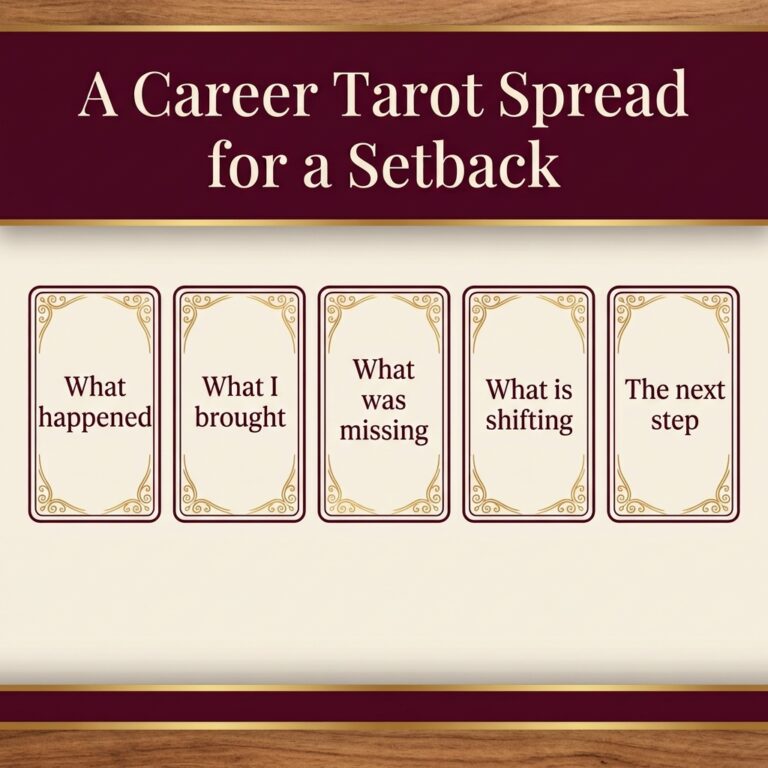
1. What happened. This card describes the situation as it truly stands. It comes first, so you name the event plainly before you judge it.
2. What I brought. This card shows the strengths you offered, even if they went unseen. After a rejection, people often forget these, so the spread puts them early.
3. What was missing. This card points to one gap. It might be a skill, visibility, timing or fit. The word “one” matters, because a single gap is something you can work on.
4. What is shifting. This card looks at what is already changing, inside you or around you. It echoes the turning wheel, so it keeps the reading from feeling stuck.
5. The next step. The final card suggests one practical action. Then the reading ends with something you can do, rather than only something to feel.
How to Lay and Read Your Career Tarot Spread
A calm setup makes the reading clearer. Each step below has a simple purpose.
First, write your question on paper. Keep it open, such as “What can I learn from being passed over?” A yes-or-no question, like “Will I get the next job?”, gives the cards little room to show you anything new.
Second, shuffle while you hold that question in mind. Many readers shuffle until the deck feels ready, because the pause itself helps them settle. Then lay the five cards in a row.
Third, look at the images before you check any meanings. Notice what the figures are doing and how the cards feel together. This step matters, since Smith drew her scenes to be read as pictures.
Next, note one sentence for each position in a journal. Finally, choose one action from card five and give yourself a date for it. Many readers also lay the same spread again a month later. That way, they can compare the two readings and see what has actually moved.
Belief, Intention & The Power of Magic
Witchcraft, spells, and manifestation are deeply rooted in belief, intention, and spiritual practice. If these practices do not resonate with you, this may not be the path for you, and that’s perfectly okay. But if you believe in divine powers, trust your intentions, and feel drawn to the mysteries of the unseen, we invite you to continue exploring with Madame Celestine and discover the magic that speaks to your soul.
Cards That Often Speak to a Career Setback
Any card can appear, of course. Still, certain cards speak very directly to work and rejection, so they are worth knowing.
The Five of Pentacles shows two figures out in the cold, passing a lit window. It often reflects the feeling of being left outside. The Six of Wands, by contrast, shows a rider crowned with a wreath. It speaks of recognition, whether you received it or are seeking it.

The Eight of Pentacles shows a craftsman at work on a row of coins. It usually points to practice and skill building. Meanwhile, the Page of Pentacles suggests study or a new course. Finally, the Four of Pentacles shows someone gripping their coins tightly. In a career reading, it can hint at holding on too hard to one role or one plan.
The suit of Pentacles appears often here for a reason. Older Italian decks called this suit Coins, and it still covers money, work and the material world. So a reading heavy with Pentacles usually keeps the focus on practical matters.
Common Mistakes With a Career Tarot Spread
The most common mistake is asking the cards to predict a hiring decision. That turns the reading into a guessing game. Instead, keep the question on what you can learn and do.
Another mistake is reading the spread every day. Repeating it that often usually feeds worry rather than insight. Once a month is plenty for a question this size. Between readings, let the journal notes do the work.
A third mistake is using the cards only to find someone to blame. The spread works best when it looks at your own part honestly and kindly. Lastly, don’t let the reading replace real feedback. If you can, ask the employer what would have changed the decision. For a ritual approach to the same moment, see this guide to a promotion ritual for when the answer is “not yet”.
Frequently Asked Questions
Can a career tarot spread tell me if I'll get the next job?
Most readers don't use it that way. A career tarot spread works best as a tool for reflection, helping you see your strengths, one gap and a next step.
How often should I do a career tarot spread?
Once after the setback and again about a month later works well. Reading it daily tends to feed worry instead of insight.
Which deck is best for career readings?
Many readers prefer decks based on Pamela Colman Smith's 1909 designs, because every card shows a full scene, including everyday work.
What does the Wheel of Fortune mean in a career reading?
It usually points to change and timing. Many readers take it as a sign that a setback is one turn of the wheel, not a final result.
Why do Pentacles show up so often in career readings?
The Pentacles suit, once called Coins, covers money, work and material life. So it naturally appears when a question is about jobs.
References
- Tarot. Encyclopaedia Britannica. https://www.britannica.com/topic/tarot
- Le Monde Primitif Tarot. The World of Playing Cards. https://www.wopc.co.uk/tarot/monde-primitif-tarot
- Pamela Colman Smith Was the Artist and Occultist Who Designed the Iconic Tarot Deck. Why Has No One Ever Heard Her Name? Katie White. Artnet News. August 26, 2022. https://news.artnet.com/art-world/pamela-colman-smith-rider-waite-tarot-2163627
- Anicius Manlius Severinus Boethius. Stanford Encyclopedia of Philosophy. https://plato.stanford.edu/entries/boethius/
- Consolation of Philosophy. Encyclopaedia Britannica. https://www.britannica.com/topic/Consolation-of-Philosophy
Not sure where to start? You don’t have to do this alone.
Madame Celestine offers guided spellwork for beginners — real support for your first working, not just another guide to read.
Related reading: Cinnamon in New Orleans Money Magic: How I Use It (and Why) · Flower Moon Luck: Old May Customs for Good Fortune

About Wren Ashby
Wren Ashby is the pen name our editorial team uses for articles on sigils, Tarot and modern traditional witchcraft. Articles under this byline are researched from published sources and reviewed by Madame Celestine before publishing.