
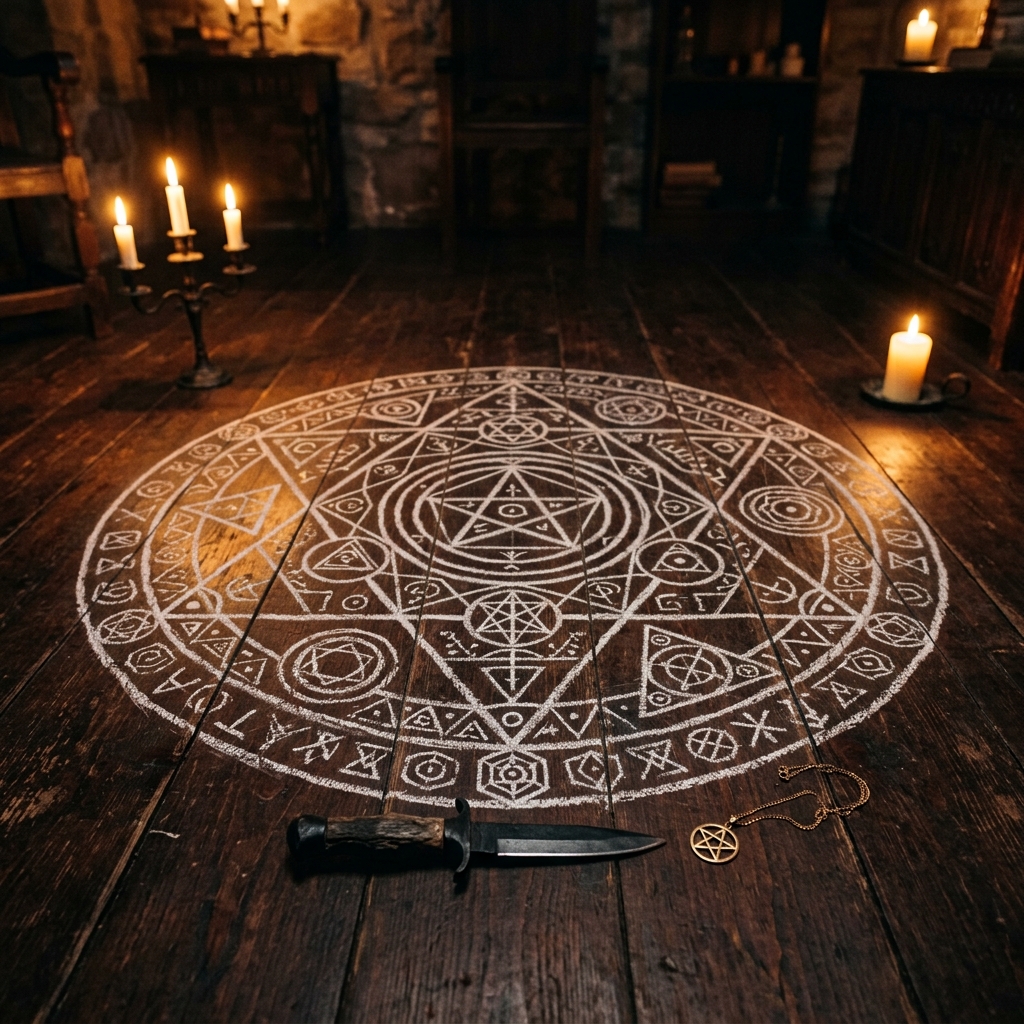
Grimoire protection is the part of old ritual magic most people skip past. Readers tend to jump straight to the spirits and their seals. Yet the old magical handbooks spend page after page on something else first: keeping the magician safe. If you are curious about Satanic or infernal protection workings, that is the best place to start. In this guide, you’ll learn how the grimoires armed the operator, meaning the person performing the ritual. You’ll see the circle, the names, the knife and the pentagram, and you’ll learn why each one mattered.
- One Devil Too Many: Why Grimoire Protection Mattered
- A Fortified Castle of Chalk: The Magic Circle
- Solomon’s Nine-Foot Circle in the Goetia
- Grimoire Protection You Could Wear: Pentacles and the Pentagram
- Fear No Foe: Protective Sigils in Working Manuals
- How Grimoire Protection Was Set Up, Step by Step
- Grimoire Protection in Modern Infernal Practice
- Frequently Asked Questions
- References
One Devil Too Many: Why Grimoire Protection Mattered
Early modern people took conjuring seriously, and a famous theater story shows how seriously. According to one old account, actors were once staging Christopher Marlowe’s Doctor Faustus in Exeter. During the conjuring scene, they suddenly counted “one devil too many” on stage. The players fled, spent the night reading and praying, and left town the next morning[1].
The tale is almost certainly legend. Still, it captures a real fear. If calling a spirit could work, then a spirit could also turn on the caller. So the grimoires, the handbooks of ritual magic, treated defense as the first step, not an extra. In fact, the same Faustus scene drew on conjuring circles and chanted invocations that audiences would have recognized[1].
That order is worth remembering. In these books, a magician did not simply call a spirit and hope for the best. Instead, he built a layered defense first, and only then began to speak.
A Fortified Castle of Chalk: The Magic Circle
The most famous defense is the magic circle. The Key of Solomon, one of the best known grimoires, gives detailed steps for making one. First, the magician takes a cord nine feet long and uses it to trace the main circle. Then, he marks it out with a sword or with a knife that has a black hilt[3].
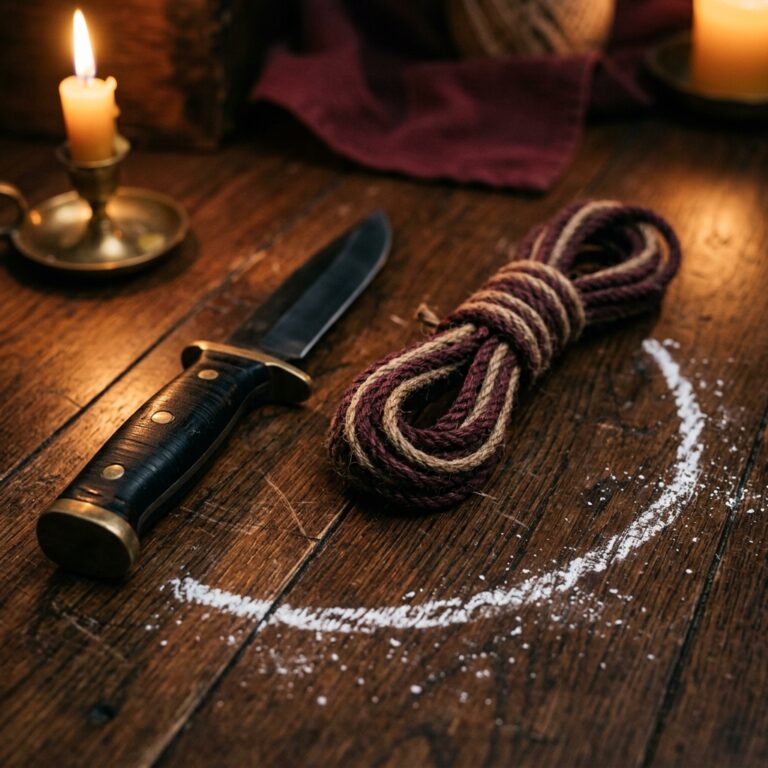
Next, he adds more rings and fills the outer band with pentagrams that hold the names of the Creator[3]. The names do the real work here. They place the magician under a higher authority than any spirit he calls.
The text then makes a bold promise. Whoever enters the circle, it says, will be as safe as “within a fortified Castle,” and nothing will be able to harm him. However, safety comes with a rule. Once inside, the magician must close the openings he left in the circle[3]. In other words, the circle only protects while it stays whole.
This is why grimoire protection is so exact about measurement and tools. A circle drawn by eye, or with an ordinary kitchen knife, was not thought to carry the same authority. The measured cord and the consecrated blade showed that the magician had followed the method, not improvised it.
Solomon’s Nine-Foot Circle in the Goetia
The Goetia, the first book of the Lesser Key of Solomon, is the grimoire most linked with infernal spirits today. It lists 72 spirits by name and rank. So it is no surprise that it also takes protection seriously.
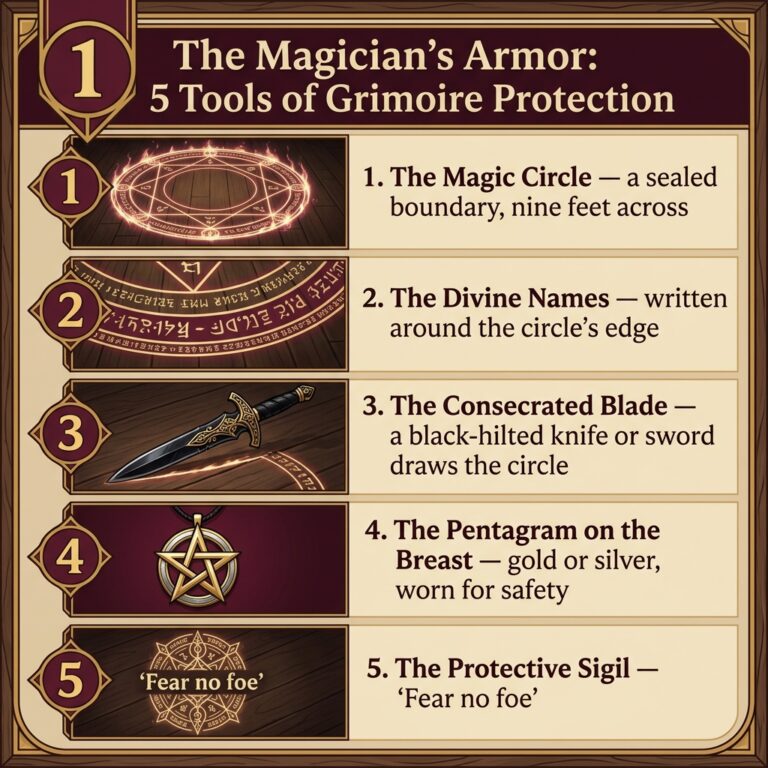
Its magical circle is nine feet across. Divine names run around it, starting with Ehyeh and ending with Levanah, the Hebrew name for the Moon. The text says King Solomon used this circle to keep himself safe from the “malice” of evil spirits[4].
Those names are not random. They follow the Sephiroth, the divine emanations of Jewish mystical thought[4]. As a result, the circle works like a map of heaven drawn around the magician’s feet. The spirit is kept outside, while the operator stands wrapped in sacred order.
The Goetia also pairs the circle with a triangle outside it, where the spirit is meant to appear. This circle-and-triangle layout also appears in our guide to Satanic home protection rituals, which looks at how these boundaries carry over into protecting a household.
Grimoire Protection You Could Wear: Pentacles and the Pentagram
A circle stays on the floor. So the grimoires also gave the magician protection he could carry. The word “pentacle” itself shows this. It entered English in the 1590s for a figure used in magical ceremonies and seen as a defense against demons[2].
Its background is revealing, too. A related Old French word, pentacol, meant an amulet worn around the neck. It came from parts meaning “hang,” “to” and “neck”[2]. So long before it meant a star in a circle, the idea behind the pentacle was something you hung on your body for safety.
The Goetia follows that pattern closely. Its Pentagram of Solomon is to be made of gold or silver and worn on the breast. According to the text, it serves two purposes. It preserves the magician from danger, and it also helps him command the spirits[5]. Practitioners often call a disk worn like this a lamen, a symbol worn over the heart during ritual. Notice that it both shields and commands. In these books, safety and authority are the same thing seen from two sides.
Fear No Foe: Protective Sigils in Working Manuals
Printed grimoires were only part of the story. Many practitioners copied their own handwritten manuals, and these often held smaller protective charms. A sixteenth-century manuscript at the Folger Shakespeare Library is a good example. Among its many sigils, which are symbols drawn to hold a specific power, is one for defense. Its bearer, the text says, shall “feare no fo, but feare GOD”[6].
That short line sums up the grimoire approach well. Protection did not come from the magician’s own strength. Instead, it came from placing himself under a higher power, so that lesser spirits could not touch him.
These handwritten manuals also show how personal protection could be. Each owner copied the charms he trusted, and he often added his own notes. As a result, no two working books were quite the same. However, almost all of them kept some form of defense close to the front.
How Grimoire Protection Was Set Up, Step by Step
Putting these sources together, a clear order appears. Each step had a reason, and skipping one was thought to leave a gap.
First, the operator prepared and consecrated his tools, meaning he blessed and set them apart for ritual use. The knife and sword had to be ready before any circle could be drawn. Second, he traced the circle with the measured cord and the black-hilted knife. That fixed its size and made it exact.
Third, he wrote the divine names and pentagrams around the edge. This step turned a chalk line into a sacred boundary. Fourth, he put on his pentagram or lamen, so that protection stayed with his body as well as the floor.
Finally, he stepped inside and closed the circle behind him. Only then did any conjuring begin. In most traditions, he also stayed inside until the spirit had been formally dismissed. This final rule mattered most, because a broken circle was thought to undo everything before it.

Belief, Intention & The Power of Magic
Witchcraft, spells, and manifestation are deeply rooted in belief, intention, and spiritual practice. If these practices do not resonate with you, this may not be the path for you, and that’s perfectly okay. But if you believe in divine powers, trust your intentions, and feel drawn to the mysteries of the unseen, we invite you to continue exploring with Madame Celestine and discover the magic that speaks to your soul.
Grimoire Protection in Modern Infernal Practice
Today, practitioners who work with infernal spirits handle these old defenses in different ways. Some keep the full circle, names and all, because they see spirits as powerful beings that deserve caution. Others treat spirits as allies. For them, the circle becomes less a wall and more a boundary that marks sacred space and sharpens focus.
Either way, the grimoires offer a useful lesson for anyone choosing a protection working. Ask how the practitioner protects the space and themselves before the main work begins. Ask what tradition their tools come from, and why they use them. A thoughtful answer suggests someone who understands the history. By contrast, a practitioner who skips the question entirely may simply not know it.
It also helps to know what grimoire protection was never meant to do. It did not promise that nothing would go wrong in the magician’s wider life. Instead, it guarded one specific act, the ritual itself, for as long as it lasted.
Most of all, remember the order the old books kept. Protection came first, then everything else. That simple rule has lasted for centuries, and it still shapes careful ritual work today.
Frequently Asked Questions
What is grimoire protection?
It is the set of defenses the old magical handbooks gave the magician before any conjuring, including the magic circle, divine names, consecrated tools and a pentagram worn on the breast.
Why did grimoire protection come before conjuring?
The grimoires assumed that a spirit strong enough to answer could also harm the caller. So the operator built his defenses first and only then began the ritual.
How big was the magic circle in the grimoires?
Both the Key of Solomon and the Goetia use nine feet as the key measurement, with divine names written around the edge.
What is the difference between a pentacle and a pentagram?
A pentagram is the five-pointed star itself. A pentacle is a protective figure used in ritual, and the word traces back to an amulet worn around the neck.
Do modern infernal practitioners still use a magic circle?
Many do, though some treat it as a boundary for focus rather than a wall against hostile spirits. Practice varies with each person's tradition and beliefs.
References
- Christopher Marlowe’s “Doctor Faustus” at 400. Ed Simon. The Paris Review. December 15, 2016. https://www.theparisreview.org/blog/2016/12/15/one-devil-too-many/
- Pentacle – Etymology, Origin & Meaning. Online Etymology Dictionary. https://www.etymonline.com/word/pentacle
- The Key of Solomon: Book II, Chapter IX. Of the Formation of the Circle. Internet Sacred Text Archive. https://sacred-texts.com/grim/kos/kos45.htm
- The Lesser Key of Solomon: Goetia: The Magical Circle. Internet Sacred Text Archive. https://sacred-texts.com/grim/lks/lks08.htm
- The Lesser Key of Solomon: Goetia: The Pentagram of Solomon. Internet Sacred Text Archive. https://sacred-texts.com/grim/lks/lks11.htm
- Grimoires and games. Shakespeare & Beyond, Folger Shakespeare Library. https://www.folger.edu/blogs/shakespeare-and-beyond/grimoires-and-games/
Not sure where to start? You don’t have to do this alone.
Madame Celestine offers guided spellwork for beginners — real support for your first working, not just another guide to read.
Related reading: Before You Commission a Satanic Banishing Ritual, Read This Guide · What Does ‘Warding’ Mean in Occult Practice? A Beginner’s Explanation

About Edmund Hale
Edmund Hale is the pen name our editorial team uses for articles on grimoires, Qabalah, ceremonial magic and British folklore. Articles under this byline are researched from published sources and reviewed by Madame Celestine before publishing.