
Satanic home protection raises one big question for most people. How do you know what you are actually asking for? The word “satanic” covers several very different traditions. So a ritual that sounds right on a website may rest on beliefs you do not share. In this guide, you will learn where house protection magic comes from and how modern Satanists understand it. You will also get seven clear questions to ask any practitioner before you book.
- Home Protection Magic Began at the Doorway and the Chimney
- Which Satanism? Why the Tradition Shapes Home Protection
- The Circle and the Triangle: Borrowed Boundaries from the Goetia
- Questions About Tradition and Method to Ask First
- Questions About Cost, Timing and Honest Limits
- Frequently Asked Questions
- References
Home Protection Magic Began at the Doorway and the Chimney
Long before modern Satanism, people in Britain guarded their homes with small hidden acts. Historic England calls these carvings “apotropaic marks,” from a Greek word meaning to turn away evil. Builders and owners scratched them near doorways, windows and fireplaces, mostly between the 1500s and the early 1800s[1]. The most common design was the hexafoil, a six-petal “daisy wheel” drawn with a compass.
The chimney got special attention, too. People believed a witch could slip into a house through the chimney stack. As a result, they buried “witch bottles” under hearths and near fireplaces. These jars held pins, nails, hair, nail clippings and often urine, and researchers have recovered more than 100 from British buildings[2]. The idea was to lure a traveling witch into the bottle and trap the witch on the sharp points.

People hid shoes as well. England’s Northampton Museum keeps an index of about 2,000 concealed shoe finds, and nearly half belonged to children[3]. Most turned up in chimneys, under floors, and around doors and windows. In other words, people treated every opening as a weak spot. That same logic shapes most satanic home protection work today. If you are weighing house-focused work against protection for yourself, our guide to home protection vs. personal protection explains the difference.
Which Satanism? Why the Tradition Shapes Home Protection
This is the part most people skip, and it matters most. Anton LaVey founded the Church of Satan in San Francisco on April 30, 1966. His church does not worship Satan as a real being. Instead, Satan stands as a symbol of self-assertion and rebellion against unjust authority[4]. LaVey’s rituals, set out in The Satanic Bible in 1969, work as psychodramas. That means staged ceremonies meant to build the participant’s own confidence and will[4].
Other practitioners are theistic. They treat Satan, Lucifer or other infernal figures as real spiritual presences they call on for help. Even the name Lucifer shows how layered this is. The Latin word means “light-bearing,” and it first named the planet Venus as the morning star[5]. Some Luciferians still stress that light-bringing meaning over the image of the devil.
So a satanic home protection ritual can mean two very different things. For one practitioner, it is a focused act of will that helps you feel in charge of your space. For another, it is a request made to a spirit. Neither is more “real” as a service. However, you should know which one you are paying for.
The Circle and the Triangle: Borrowed Boundaries from the Goetia
Many infernal rituals borrow their shape from the Goetia, the first book of The Lesser Key of Solomon. In that grimoire, the magician stands inside a circle nine feet across, ringed with divine names. The text says the circle exists so the magician can keep safe from the spirits’ malice[6]. Then the magician draws a triangle two feet outside the circle and calls the spirit to appear there[6].
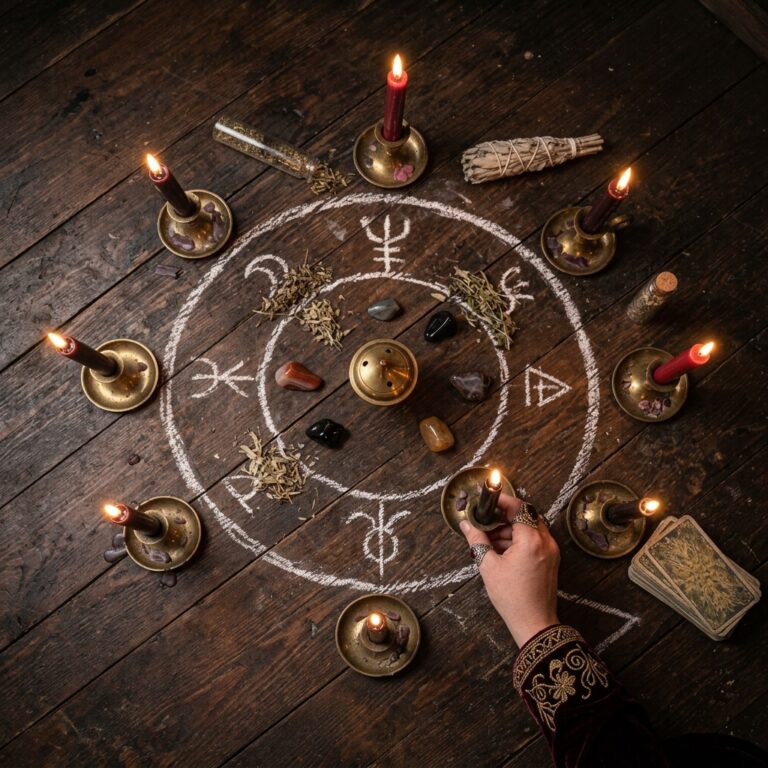
That layout is a lesson in boundaries. The person doing the work stays in a marked, protected space. Meanwhile, anything summoned stays at a fixed distance. Modern satanic home protection often scales this idea up to a house. The walls become the circle, and the thresholds become the guarded edge. So when a practitioner describes their method, listen for how they set and keep that boundary.
Questions About Tradition and Method to Ask First
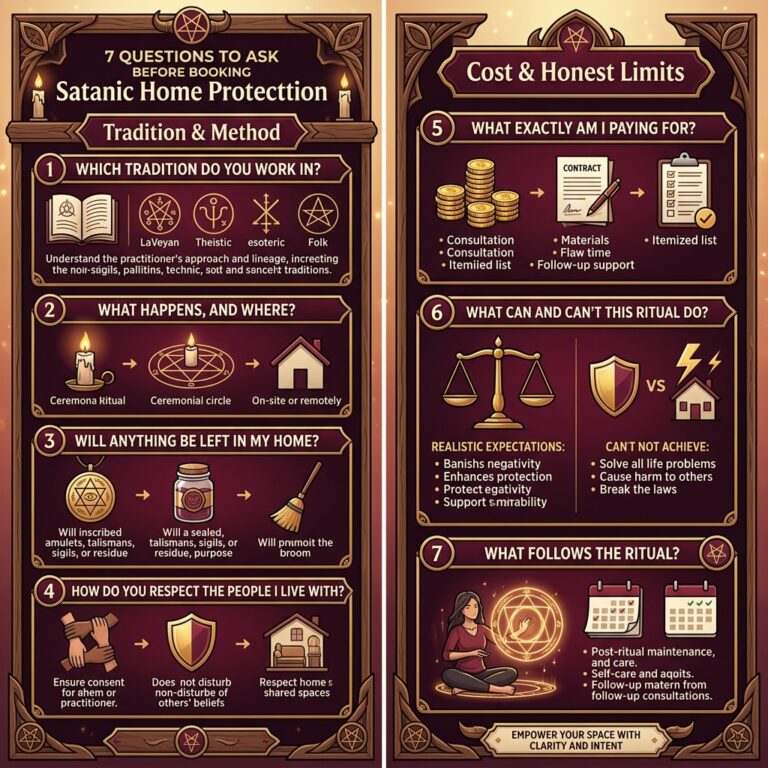
Start with the questions that tell you what the work actually is. A good practitioner will answer them plainly and without pressure.
- Which tradition do you work in? Ask whether they see Satan as a symbol or as a real presence. Their answer tells you whether the ritual is about your own will or about calling on a spirit.
- What happens, and where? Some rituals happen remotely. Others involve a visit or items you place yourself. You should know each step before you agree.
- Will anything be left in my home? Old practice hid bottles and marks for a reason. Today, a sigil, jar or carving may affect a landlord, a roommate or children.
- How do you respect the people I live with? Home protection touches everyone in the house. Also ask how they handle a partner or family member who does not share your beliefs.
Questions About Cost, Timing and Honest Limits
Next, move to the practical side. These questions protect your budget and your expectations.
- What exactly am I paying for? Ask for a clear price and a list of what it includes. A fixed fee you see up front is easier to judge than open-ended add-ons.
- What do you say this ritual can and cannot do? An honest practitioner talks about intention and belief. They do not promise that nothing bad will ever happen to your home.
- What follows the ritual? Ask whether they give you simple steps to keep up at home. For example, many traditions renew threshold work at the new moon or after someone moves out.
Finally, notice how the conversation feels. You should leave with more clarity, not more fear. If a satanic home protection offer relies on urgency, take time to think it over.
Belief, Intention & The Power of Magic
Witchcraft, spells, and manifestation are deeply rooted in belief, intention, and spiritual practice. If these practices do not resonate with you, this may not be the path for you, and that’s perfectly okay. But if you believe in divine powers, trust your intentions, and feel drawn to the mysteries of the unseen, we invite you to continue exploring with Madame Celestine and discover the magic that speaks to your soul.
Frequently Asked Questions
Is satanic home protection the same as a regular protection spell?
Not quite. Both aim to guard a space, but satanic home protection draws on infernal symbols and, in theistic practice, on calling infernal figures. The goal of a safer, calmer home is often the same.
Do you have to be a Satanist to ask for this kind of ritual?
No. However, you should understand the tradition behind the work and feel comfortable with it. If the symbols clash with your own beliefs, a different kind of protection work may suit you better.
Does a satanic protection ritual involve summoning a demon into my house?
Usually not. In the Goetic model, the magician holds any spirit outside the protected space. In the Church of Satan’s approach, the ritual calls no spirit at all.
Can I do simple home protection myself?
Yes. Many people start by cleaning and marking their doorways and windows with clear intention. These are the same openings that older folk traditions guarded.
How often should home protection be renewed?
Traditions differ. Many practitioners renew the work at the new moon, after a move, or when someone new joins or leaves the household.
References
- What Are Witches’ Marks? Historic England. https://historicengland.org.uk/whats-new/features/discovering-witches-marks/what-are-witches-marks/
- Daley, Jason. ‘Witch Bottle’ Filled With Teeth, Pins and Mysterious Liquid Discovered in English Chimney. Smithsonian Magazine, November 1, 2019. https://www.smithsonianmag.com/smart-news/witch-bottle-full-teeth-pins-and-possibly-urine-discovered-chimney-180973448/
- Morgan, Stuart. A belief in the power of concealed shoes. SATRA Bulletin, May 2018. https://www.satra.com/bulletin/article.php?id=2078
- Melton, J. Gordon. Church of Satan. Encyclopaedia Britannica. https://www.britannica.com/topic/Church-of-Satan
- Lucifer: Definition & Meaning. Merriam-Webster. https://www.merriam-webster.com/dictionary/Lucifer
- The Lesser Key of Solomon: Goetia, the Book of Evil Spirits (L. W. de Laurence edition, 1916). Project Gutenberg. https://www.gutenberg.org/files/72679/72679-h/72679-h.htm
Not sure where to start? You don’t have to do this alone.
Madame Celestine offers guided spellwork for beginners — real support for your first working, not just another guide to read.

About Madame Celestine
Madame Celestine has practiced and taught spellwork, divination, and seasonal ritual for over two decades, helping newcomers build a grounded, confident practice from their very first spell.