
Almost every culture has an earth goddess, or sometimes an earth god, but they are not all doing the same job. Some are the ground itself. Others make the grain grow, and a few even watch over right and wrong. So who is the god of the earth, and which earth goddess names should you know? In this guide, you’ll meet earth deities from Greece, Egypt, West Africa and the Andes. You’ll see how their roles differ, and you’ll learn a simple way to honor the earth in your own practice.
- Why Every Culture Needed an Earth Goddess
- Earth Goddess Names and Earth God Names From Around the World
- Ground, Grain or Justice? Comparing the Earth Deities
- Earth Among the Elements: Is There a Goddess of the Elements?
- A Simple Way to Honor an Earth Goddess
- Honoring Earth Deities With Respect
- Frequently Asked Questions
- References
Why Every Culture Needed an Earth Goddess
Before farming, people depended on what the land offered. After farming began, they depended on it even more. Soil decided whether a family ate or went hungry. So it is no surprise that the land itself became a sacred figure, usually a mother, sometimes a father, and often a judge.
Earth mythology also answers a very old question: where do we come from, and where do we go? The ground grows our food, and it also receives our dead. As a result, many earth deities hold both roles at once, as givers of life and keepers of what returns to the soil.
Scholars use a Greek word for this side of earth religion: chthonic, meaning “of the earth” or “under the earth.” Chthonic deities belong to soil, caves and the underworld, rather than the bright sky. In practice, that means an earth goddess might receive offerings poured onto the ground, not burned toward the heavens.
Understanding this double role helps you choose which deity of earth to honor. It also explains why earth goddesses are rarely simple or purely gentle figures.
Earth Goddess Names and Earth God Names From Around the World
Gaia (Greece)
Gaia, also spelled Gaea, is the Greek personification of the Earth as a goddess. She was the mother and wife of Uranus, the sky, and mother of the Titans.[1] Britannica notes she may have been a mother goddess worshipped in Greece before the cult of Zeus arrived. Later writers called her the giver of dreams and the nourisher of plants and young children.[1]
Geb (Egypt)
Egypt flips the usual pattern. Here the earth is male. Geb was the god of the earth, the physical support of the world. Art often shows him lying on the ground, with the sky goddess Nut arched above him.[2] Pharaohs even called their royal seat “the throne of Geb.”[2] So if you are asking who is the god of the earth, Geb is one of the clearest answers.
Demeter and Ceres (Greece and Rome)
Demeter was the Greek goddess of agriculture. When Hades carried off her daughter Persephone, her grief turned her away from the harvest and caused a famine.[3] Her Roman counterpart, Ceres, left a mark on everyday English. The word “cereal” comes from Latin Cerealis, originally meaning “of Ceres.”[4] Her worship at Eleusis, near Athens, also grew into the Eleusinian Mysteries, secret rites that drew initiates for centuries. So every bowl of breakfast cereal quietly carries a goddess’s name.
Ala (Igbo, West Africa)
Among the Igbo of Nigeria, Ala (also called Ani) is the earth goddess. The Igbo regard her as the mother of all crops. She is also the enforcer of moral law, so serious crimes count as offenses against the earth itself.[5] She is also the divine patron of Mbari, a sacred Igbo art tradition.[5]
Pachamama (Andes)
In the Andes, Pachamama is Mother Earth. For one Andean family who shared their practice with the Smithsonian Folklife Festival, the first day of August is the time to make a “payment,” or offering, to her. As the family explains, she provides for them and protects them. So whenever they drink, they share some with her.[6]
Other Earth Deities to Know
Other deities of earth include Prithvi, the earth goddess of Vedic India, and Jord, the Norse giantess of the earth who was the mother of Thor. Tellus, or Terra Mater, was Rome’s own personified earth.
Some gods of the land were even more local. Rome had Terminus, a god who lived in boundary stones and protected property lines. Many villages across the ancient world also honored the spirit of their own hill, spring or field. These gods of stone and ground remind us that the earth was not only one great mother. It was also every particular place people called home.
Ground, Grain or Justice? Comparing the Earth Deities
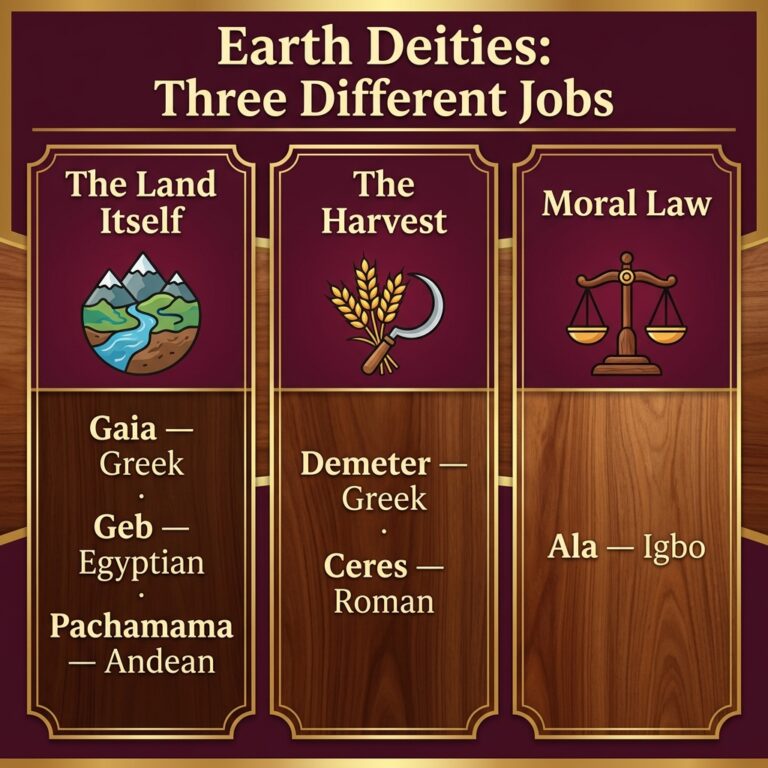
Put side by side, these earth deities do three different jobs. Some are the land itself. Others make it grow. A few also guard what is right.
| Deity | Culture | Main role |
|---|---|---|
| Gaia | Greek | The land itself |
| Geb | Egyptian | The land itself (male) |
| Pachamama | Andean | The land itself |
| Demeter / Ceres | Greek / Roman | The harvest |
| Ala | Igbo | Crops and moral law |
Two patterns stand out. First, the earth is not always a mother. Egypt’s Geb shows that some cultures pictured the ground as male and the sky as female. Second, several earth deities are also judges. Ala enforces moral law, and Pachamama expects respect in return for her care.
Here is the practical insight. Choose your earth deity by what you need. If you need grounding, home and a sense of belonging to the land, turn to a deity of the land itself, like Gaia or Pachamama. When you want abundance, gratitude and the rhythm of the seasons, a harvest deity like Demeter fits better. And for fairness, honesty and keeping promises, an earth figure like Ala, who guards moral law, speaks most directly to that need.
Earth Among the Elements: Is There a Goddess of the Elements?
Many people search for a single goddess of the elements. However, ancient religions rarely had one deity ruling earth, air, fire and water together. Instead, each element or force tended to have its own gods.
The four-element idea comes from ancient Greek philosophy, and modern witchcraft adopted it for ritual. So in today’s practice, an earth goddess usually stands for the element of earth: stability, the body, money, home and the physical world. Some practitioners call on four separate elemental deities, one for each direction. If that interests you, this guide to elemental spirits and the four directions explains how the elements are used in ritual.
A Simple Way to Honor an Earth Goddess
This short practice draws on a common thread in many earth traditions: sharing food and drink with the ground that feeds you. It does not copy any one culture’s sacred rite. Instead, it borrows the shared idea of giving back.
First, go outside to a patch of soil, such as a garden bed, a potted plant or a park tree. Bring a small cup of water or juice and a pinch of grain, such as oats or rice.
Next, place both hands on the ground for a moment. Notice the temperature and texture of the soil. Then name the earth deity you are honoring, or simply say “Mother Earth” or “the land.”

After that, pour a little of the drink onto the soil and scatter the grain. Say thank you for something specific the earth has given you, such as a meal, a home or a good harvest. Finally, sit quietly for a minute before you go. Many people repeat this at the start of each season, so it becomes a steady habit of gratitude.
If you live in an apartment, a single potted herb works just as well as a garden. Water it slowly, speak your thanks, and let that small act stand for the wider land. Over time, some people also keep a jar of soil from a meaningful place, such as a family home or a favorite forest, on their altar as a physical link to the earth.
Belief, Intention & The Power of Magic
Witchcraft, spells, and manifestation are deeply rooted in belief, intention, and spiritual practice. If these practices do not resonate with you, this may not be the path for you, and that’s perfectly okay. But if you believe in divine powers, trust your intentions, and feel drawn to the mysteries of the unseen, we invite you to continue exploring with Madame Celestine and discover the magic that speaks to your soul.
Honoring Earth Deities With Respect
Some earth goddesses belong to living traditions. Pachamama is still honored by Andean communities, and Ala remains important to many Igbo people. So it is respectful to learn about these deities from the people who practice their traditions, rather than borrowing their sacred rites wholesale.
A good rule is to honor the shared idea, not to copy the specific ceremony. Gratitude, care for the soil and giving something back are common to nearly all earth traditions. Those are open to anyone. Specific rites, such as Andean offering bundles, belong to the communities that keep them.
Finally, remember that honoring an earth goddess can be very practical. Composting, planting, picking up litter and eating seasonally are all ways of giving back to the ground. Many modern practitioners see these everyday acts as part of their devotion.
Frequently Asked Questions
Who is the god of the earth?
It depends on the culture. In ancient Egypt, the earth god was Geb, while in Greece the earth was the goddess Gaia. Many other cultures also pictured the earth as a mother goddess.
What are some earth goddess names?
Well-known earth goddess names include Gaia from Greece, Pachamama from the Andes, Ala from the Igbo of Nigeria, Prithvi from India and Jord from Norse myth. Demeter and Ceres are goddesses of the harvest.
Is there a goddess of the elements?
Ancient religions rarely had one goddess ruling all four elements. In modern witchcraft, practitioners often honor a separate deity or spirit for each element, including an earth goddess for the element of earth.
Is the earth always a female deity?
No. Egypt’s Geb was a male earth god, with the sky pictured as the goddess Nut above him. Most cultures, however, did picture the earth as female.
How can I honor an earth goddess?
A simple way is to pour a little water and scatter some grain onto soil while giving thanks. Caring for the land through gardening, composting and reducing waste is also a meaningful offering.
References
- Gaea. Encyclopaedia Britannica. https://www.britannica.com/topic/Gaea
- Geb. Encyclopaedia Britannica. https://www.britannica.com/topic/Geb
- Demeter. Encyclopaedia Britannica. https://www.britannica.com/topic/Demeter
- Cereal. Online Etymology Dictionary. https://www.etymonline.com/word/cereal
- Deities of the Igbo Religion. Encyclopedia.com. https://www.encyclopedia.com/history/news-wires-white-papers-and-books/deities-igbo-religion
- An Offering to the Pachamama. Rufino Turpo, translated by Roger Valencia, June 8, 2015. Smithsonian Folklife Festival. https://festival.si.edu/blog/2015/an-offering-to-pachamama/
Not sure where to start? You don’t have to do this alone.
Madame Celestine offers guided spellwork for beginners — real support for your first working, not just another guide to read.
Related reading: Hekate: Goddess of Witchcraft, Altars, Crystals and Incense · Mercury in Magic: The Messenger God, Herbs and Energy

About Wren Ashby
Wren Ashby is the pen name our editorial team uses for articles on sigils, Tarot and modern traditional witchcraft. Articles under this byline are researched from published sources and reviewed by Madame Celestine before publishing.