
Hecate witchcraft draws more modern practitioners than almost any other Greek tradition, yet her history is far older and stranger than the “queen of witches” image suggests. Who was she before she became the goddess of witchcraft? What belongs on a Hecate altar, and which crystals and incense actually connect to her story? In this guide, you’ll trace how Hecate changed over more than a thousand years. You’ll also learn how to build an altar for Hecate, which offerings suit her, and how to hold a simple new moon ritual with a prayer.
- Who Is Hecate? The Goddess Behind Hecate Witchcraft
- Torches, Keys and Three Faces: Hecate’s Symbols
- From Blessing-Giver to Witch Queen: How Hecate Changed
- Hecate in Modern Witchcraft
- How to Set Up a Hecate Altar
- Hecate Crystals and Stones
- Hecate Incense and Offerings
- A Simple New Moon Hecate Ritual and Prayer
- Hekate Signs: How Practitioners Read Her Presence
- Frequently Asked Questions
- References
Who Is Hecate? The Goddess Behind Hecate Witchcraft
Britannica calls Hecate the chief goddess of magic and spells. It also notes that she probably came to Greece from the Carians of southwest Asia Minor, in what is now Turkey.[1] So the goddess at the heart of Hecate witchcraft may have started as a foreign goddess who was welcomed early into Greek religion.
Her early reputation was surprisingly generous. In the poet Hesiod, writing around 700 BCE, she holds power over heaven, earth and sea. As a result, she gives wealth and all the blessings of daily life.[1] That is a long way from the spooky witchcraft figure of later stories about Hecate.
You will see her name spelled two ways. “Hekate” follows the Greek spelling, while “Hecate” follows the Latin. Both refer to the same goddess, and practitioners use them interchangeably.
Torches, Keys and Three Faces: Hecate’s Symbols
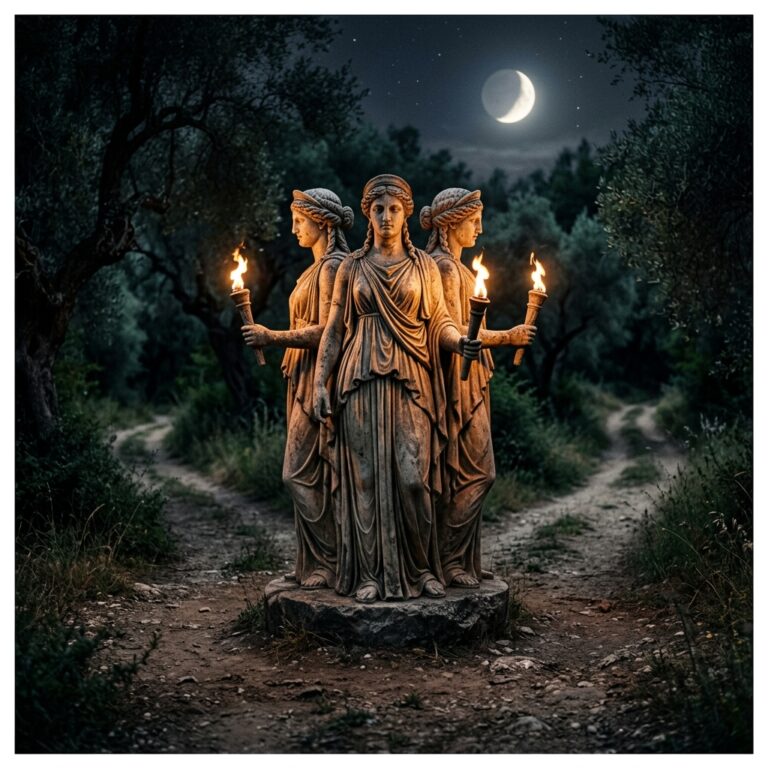
Greek pottery usually shows Hecate as a young woman holding a torch or a key.[2] The torch lights the way through darkness. The key opens doors, including the gates between worlds, which is why keys still appear in Hecate witchcraft today.
Her most famous image, though, has three bodies. Sculptors showed her with three bodies and three heads, or with one body and three heads, often crowned with moonbeams.[2] The Metropolitan Museum of Art holds one such figure from the 1st or 2nd century CE. Its description says she ruled over pathways and crossroads, especially at night, and was a goddess of the moon and of night-time sorcery.[3] Like Hermes, she could also travel between the underworld and the earth.[3]
The three faces make sense at a crossroads. Where three roads meet, a goddess with three faces can watch every direction at once. Dogs belong to her too, as the fierce hounds that roam the night in her company.[2]
From Blessing-Giver to Witch Queen: How Hecate Changed
Put in order, the sources show Hecate gaining new roles over time rather than keeping one fixed identity.
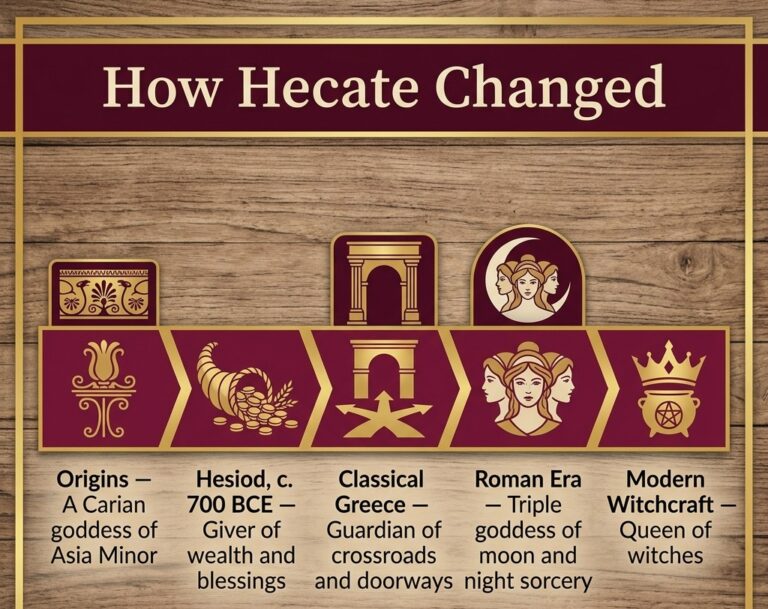
| Stage | How Hecate appears |
|---|---|
| Origins | Likely a Carian goddess from Asia Minor |
| Hesiod, c. 700 BCE | Giver of wealth and daily blessings |
| Classical Greece | Guardian of crossroads, gates and doorways |
| Roman era | Triple goddess of the moon and night sorcery |
| Modern witchcraft | Queen of witches and dark moon goddess |
In classical Greece, her protective role was very practical. People placed images of Hecate at city gates and at the doors of private homes, because she was believed to keep evil spirits away.[2] Each month, on the night of the new moon, they also left food at crossroads and thresholds. This was known as the supper of Hecate.[2]
Here is the insight for modern practice. Hecate as the queen of witchcraft is real, but she is a later layer. For most of her ancient history, she was a protector of thresholds who handed out blessings. So a Hecate altar near your front door, set with a key and a flame and tended at the new moon, sits closer to ancient practice than a shelf of dark crystals. You can still add those crystals. However, the doorway, the key and the new moon are her oldest anchors.
Hecate in Modern Witchcraft
The newest layer of her story is the one most people meet first. In modern witchcraft, Hecate is often called the queen of witches and linked with the dark or waning moon. Many practitioners also connect her with the idea of a triple moon goddess of maiden, mother and crone. That triple-goddess framework is a 20th-century idea rather than an ancient one, even though her three-bodied statues are genuinely old.
Why did Hecate witchcraft grow so popular? Part of the answer lies in the older layers. She stood at crossroads, guarded doorways and travelled between the living world and the underworld. Those are exactly the places where people turn to magic: moments of choice, change and uncertainty. So even when modern witches add new ideas, they are building on roles she held long before.
For your own practice, it helps to know which layer you are drawing on. You might honor the ancient protector at your door, the Roman goddess of night sorcery, or the modern queen of witches. All three are valid, but knowing the difference keeps your practice honest and grounded.
How to Set Up a Hecate Altar
First, choose your spot. A shelf or small table near the front door fits her role as guardian of thresholds. If that is not possible, any quiet corner works, especially one you pass at night.
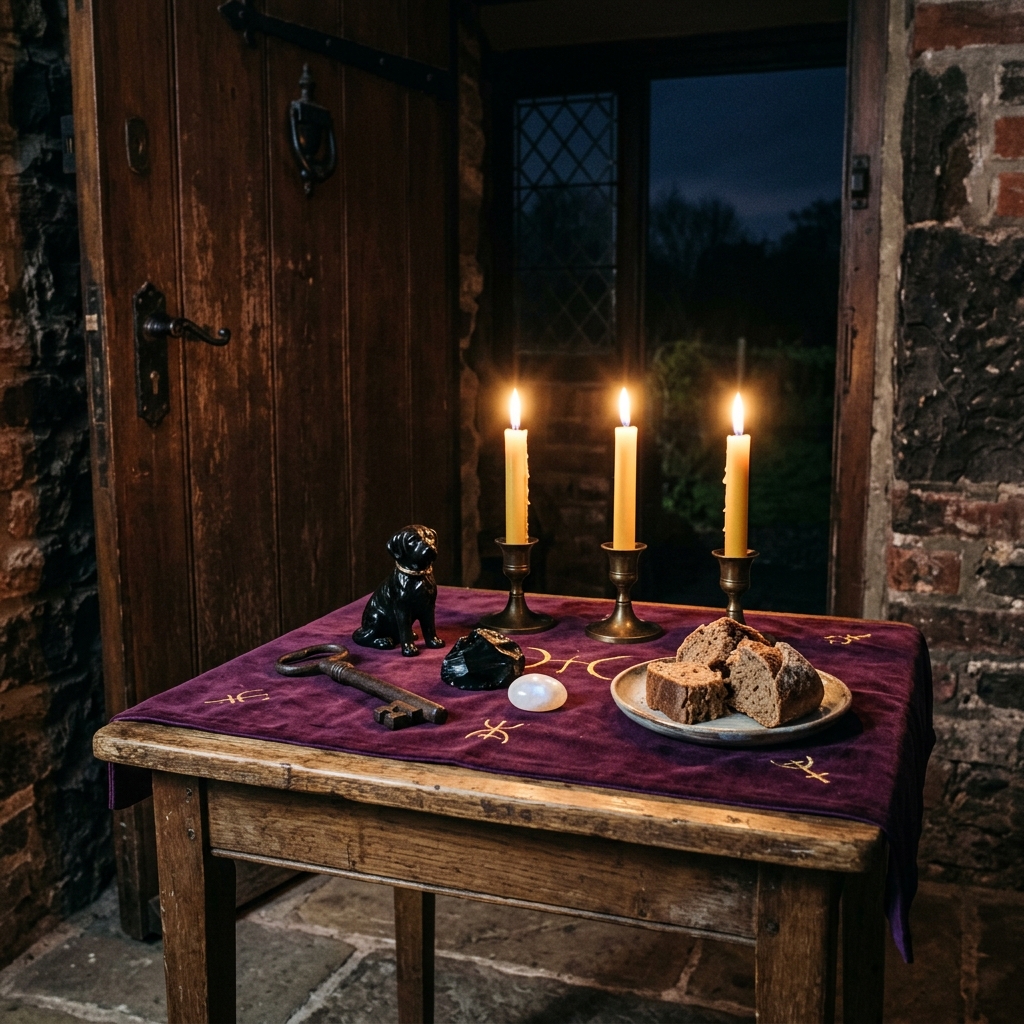
Next, lay a dark cloth, such as black, deep purple or midnight blue. Then add a key, since she was often shown carrying one. An old skeleton key works beautifully. Add a candle or lantern for her torch. Many people use three candles in a row to honor her three faces.
After that, add personal items. A small dog figurine nods to her hounds. A picture of a crossroads, or a stone from where three paths meet, links the altar to her oldest domain. Keep the space simple and tidy, and refresh it at each new moon.
Hecate Crystals and Stones
Crystals associated with Hecate come from modern witchcraft practice, not ancient sources. Still, they follow her themes of night, protection and the moon.
Black obsidian and onyx are popular Hecate stones, because their dark surfaces suggest night and shielding. Moonstone reflects her lunar side. Labradorite, with its flashes of color in dark stone, is often chosen for magic and hidden knowledge. Smoky quartz is another common choice for grounding during night work.
Choose one or two that speak to you. Then place them near the key or candle, where they can share the altar’s focus.
Hecate Incense and Offerings
For Hecate incense, practitioners often use myrrh, which has a dark, resinous scent suited to night rituals. Others burn mugwort, lavender or a simple frankincense blend. Choose one scent and use it each time, so it becomes a signal that you are turning to her.
Offerings can echo the ancient supper of Hecate. Historians record small cakes of eggs, cheese and bread among the foods left at crossroads.[2] Today, a slice of bread, an egg or a little cheese on a small plate works well. Many people also add garlic or honey. If you leave food outdoors, choose a spot where it won’t harm animals or become litter, or simply offer it at your altar and dispose of it respectfully the next day.
A Simple New Moon Hecate Ritual and Prayer
This Hecate ritual brings modern witchcraft together with the ancient timing of her monthly supper. It takes about twenty minutes.
First, on the night of the new moon, tidy your home. Many practitioners sweep from the back of the house toward the front door, clearing out the old month. Then set a small plate of bread or cheese on your altar.
Next, light your candle and incense. Hold the key in your hand. Speak aloud what you want to close behind you from the past month, and what door you hope to open next.
Then say this prayer, or your own version of it:
Hecate, torchbearer, keeper of the keys,
lady of the crossroads and the three-faced moon,
guard my door and light my way.
Take what I leave behind tonight,
and show me the road ahead.
With thanks, I honor you.
Finally, let the candle burn a while if it is safe, then put it out. The next day, remove the offering. Over the coming month, notice what doors seem to open.
Belief, Intention & The Power of Magic
Witchcraft, spells, and manifestation are deeply rooted in belief, intention, and spiritual practice. If these practices do not resonate with you, this may not be the path for you, and that’s perfectly okay. But if you believe in divine powers, trust your intentions, and feel drawn to the mysteries of the unseen, we invite you to continue exploring with Madame Celestine and discover the magic that speaks to your soul.
Hekate Signs: How Practitioners Read Her Presence
Many people who feel drawn to Hekate witchcraft describe small, repeated signs. Common examples include dogs appearing at odd moments, finding keys, dreams of crossroads or doors, and a sudden pull toward the new moon. These signs come from modern practitioner experience, not ancient texts. Still, they follow her classic symbols closely.
A good rule is to look for patterns rather than single events. One stray dog is just a dog. However, dogs, keys and crossroads showing up together during a time of big decisions may feel meaningful. If you sense her, many practitioners suggest a simple response: light a candle, say her name and ask what she wants you to notice.
Beyond witchcraft, Hecate also appears alongside other powerful night figures. If you want to explore them, this guide to goddesses of darkness offers more names to learn.
Frequently Asked Questions
Is Hecate the goddess of witchcraft?
Yes, she is widely known today as the goddess of witchcraft, magic and the crossroads. In her earliest Greek sources, however, she was also a generous goddess who gave wealth and blessings.
What is the difference between Hecate and Hekate?
They are the same goddess. Hekate follows the original Greek spelling, and Hecate follows the Latin spelling.
What crystals are associated with Hecate?
Popular choices include black obsidian, onyx, moonstone, labradorite and smoky quartz. These are modern correspondences that reflect her links to night, protection and the moon.
What incense is good for Hecate?
Myrrh is a common choice for Hecate incense, along with mugwort, lavender and frankincense. Using the same scent each time helps build a steady connection.
What should I put on a Hecate altar?
Good Hecate altar ideas include a key, a candle or lantern, a dark cloth and a small offering of bread, egg or cheese. Many people place the altar near their front door, since she guarded thresholds.
References
- Hecate. Encyclopaedia Britannica. https://www.britannica.com/topic/Hecate
- Hecate. Mark Cartwright, June 22, 2017. World History Encyclopedia. https://www.worldhistory.org/Hecate/
- Marble hekataion (statuette of triple-bodied Hekate) and the three Graces. The Metropolitan Museum of Art. https://www.metmuseum.org/art/collection/search/255881
Not sure where to start? You don’t have to do this alone.
Madame Celestine offers guided spellwork for beginners — real support for your first working, not just another guide to read.
Related reading: Mercury in Magic: The Messenger God, Herbs and Energy · Thurisaz Rune Meaning: Thor’s Rune of Force and Protection

About Wren Ashby
Wren Ashby is the pen name our editorial team uses for articles on sigils, Tarot and modern traditional witchcraft. Articles under this byline are researched from published sources and reviewed by Madame Celestine before publishing.