
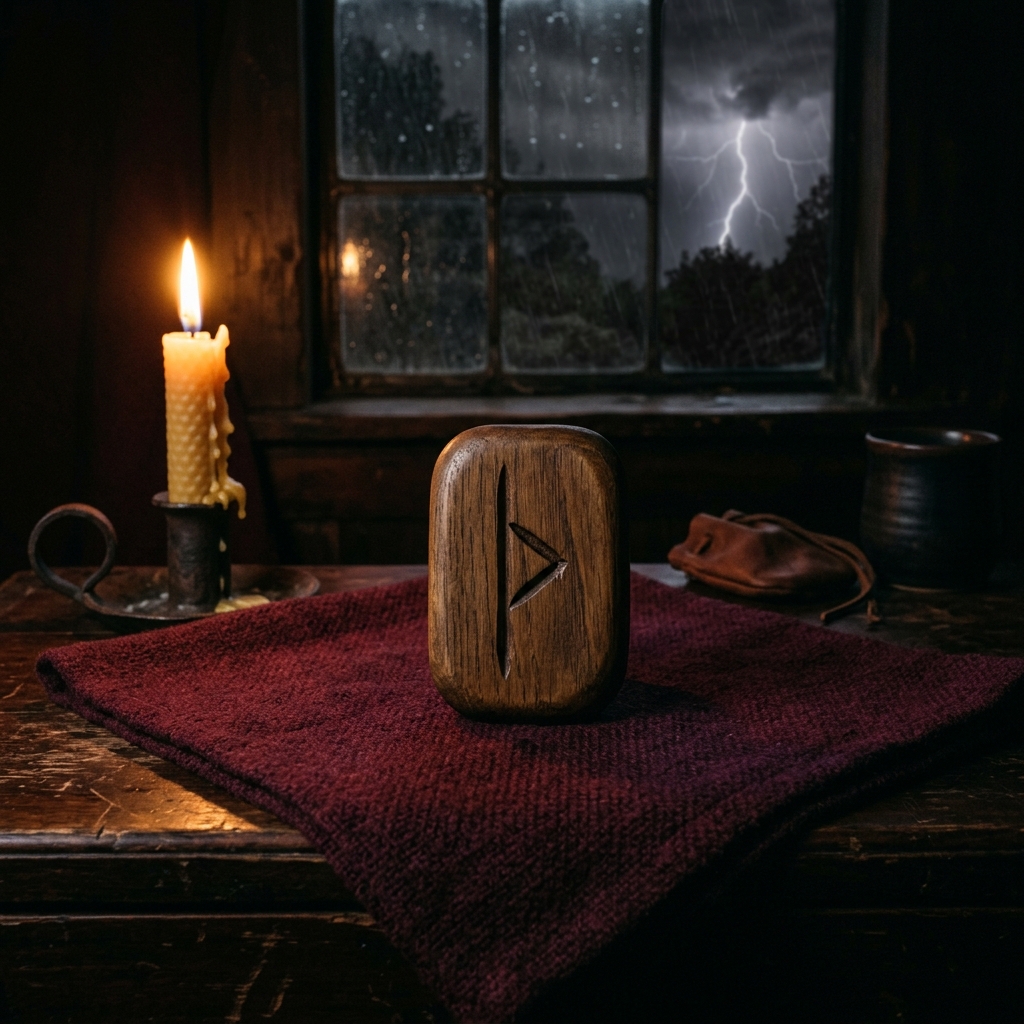
The thurisaz rune meaning puzzles many people when they first draw it. It looks like a thorn and is often called Thor’s rune. It also seems to stand for both danger and protection at once. So which is it? In this guide, you’ll learn what the old sources actually say about Thurisaz and where the link to Thor comes from. You’ll also see how this rune hides inside an ordinary English phrase. Finally, you’ll learn how modern readers work with it, upright and reversed.
- Thurisaz Rune Meaning at a Glance: The Third Rune
- Giant or Thorn? Where the Thurisaz Meaning Comes From
- Why Thurisaz Is Called Thor’s Rune
- The Thurisaz Rune Hiding in “Ye Olde”
- Thurisaz Rune Meaning in Modern Readings: Force, Defense and Crossings
- When the Thorn Turns Inward: Thurisaz Rune Meaning Reversed
- How to Work With Thurisaz for Protection and Boundaries
- Reading the Thurisaz Rune Meaning in Context
- Common Mistakes With the Thurisaz Rune Meaning
- Frequently Asked Questions
- References
Thurisaz Rune Meaning at a Glance: The Third Rune
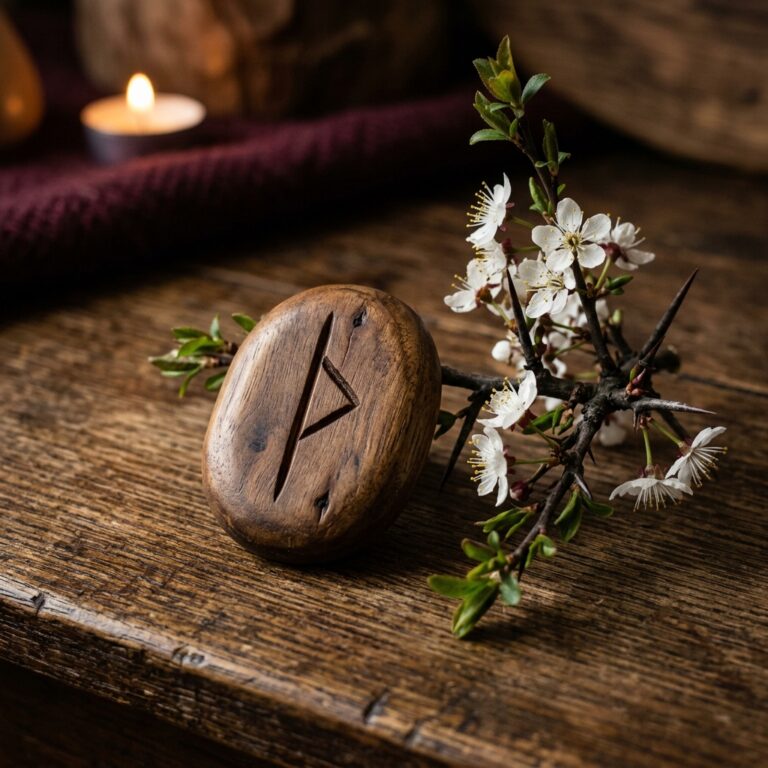
Thurisaz looks like a vertical stroke with a sharp triangle jutting from its side: ᚦ. Many people say it resembles a thorn on a stem, or a hammer seen from the side. It stands for the th sound, as in thing or thunder.
It is the third rune of the Elder Futhark, the oldest runic alphabet. That alphabet takes its name from its first six letters, and Thurisaz supplies the th in futhark.[1] It sits in the first group of eight runes, right after the runes linked to wealth and strength.
That order matters to many readers. First comes wealth, then strength, and then Thurisaz. So the rune is often read as what happens when raw strength meets resistance. It is force that must be faced, used, or guarded against.
Three places further along sits Kenaz, the torch rune. If you’re learning the first row in order, this guide to the Kenaz rune shows how the torch balances the thorn.
Giant or Thorn? Where the Thurisaz Meaning Comes From
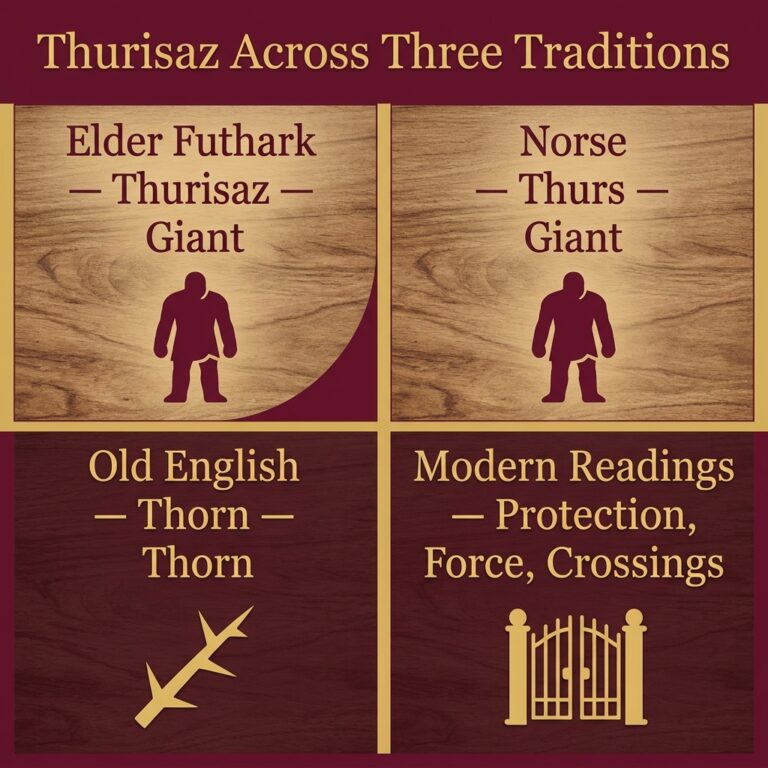
Like every Elder Futhark rune, Thurisaz is a modern name. Scholars rebuilt it from later sources, and those sources tell two different stories. In Scandinavia, the rune was called þurs, which means giant. In England, however, it was called þorn, which simply means thorn.[2] The reconstructed older name, þurisaz, is usually taken to mean giant as well.[2]
The giants of Norse myth were not just large people. They stood for the wild forces of nature, such as frost, storms, and chaos. So the Scandinavian reading of the rune points to power that is old, strong, and hard to control.
The English reading is more down to earth. The Old English Rune Poem says the thorn is painfully sharp for any warrior who grabs it. It adds that thorns are harsh on anyone who lies down among them.[3] For travelers who slept outdoors, that was very practical advice. Even so, a thorn also protects the plant that grows it. That double edge sits at the heart of the rune.
Why Thurisaz Is Called Thor’s Rune
The old rune poems do not name Thor in the Thurisaz verse. Instead, the link is a modern reading built on the myths. Thor was the god of thunder and a great warrior. He was a fierce enemy of the harmful giants, yet kind toward humankind.[4] Since the rune’s Norse name means giant, many readers pair it with the god who fought them.
His hammer, Mjöllnir, strengthens the connection. According to the myths, it returned to his hand like a boomerang after each throw.[4] Some readers see the rune’s shape as that hammer. As a result, Thurisaz is often read as force used on purpose, to protect rather than to destroy.
There is one tempting link that doesn’t hold up, though. Thursday really is named after Thor, as Thor’s day.[4] The word thurs, meaning giant, only sounds similar.[2] In other words, the giant and the god share a rune, but not a name.
The Thurisaz Rune Hiding in “Ye Olde”
Here is a surprise most rune guides miss. The English rune þorn lived on as a letter, called thorn, long after runes fell out of use. It kept its th sound and was written by hand for centuries.
Over time, the handwritten thorn came to look very like the letter y. That is why old signs say “Ye Olde” when they really mean “the old.” People always pronounced it “the,” but printers used the look-alike letter.[5] So every “Ye Olde Tea Shoppe” sign carries a faint echo of this rune.
This matters for readers, too. It reminds us that runes were first a working alphabet, used for names, owners, and memorials. The magical and divinatory meanings grew around letters that people also used every day. Knowing that keeps the thurisaz rune meaning grounded in real history.
Thurisaz Rune Meaning in Modern Readings: Force, Defense and Crossings
Modern readers draw on both old names, the giant and the thorn. When Thurisaz appears upright, it is usually read through these themes:
- Protection: a thorny hedge that keeps harm out, or a firm boundary.
- Raw force: sudden energy, conflict, or a strong push to act.
- A crossing point: a gate or threshold, where you must decide before going on.
- A challenge: an obstacle that tests you, and often makes you stronger.
Context decides which theme fits. For example, in a question about a difficult person, Thurisaz may suggest setting a clear boundary. In a question about a new project, however, it may point to a burst of drive, but also to a need for caution. The thurisaz rune meaning is rarely soft, yet it is rarely hopeless either.
When the Thorn Turns Inward: Thurisaz Rune Meaning Reversed
Not everyone reads reversals. Still, Thurisaz is not symmetrical, so it can land reversed, and many readers give that position its own sense. A reversed Thurisaz, sometimes called merkstave, is often read as the thorn pointing back at you.
In practice, that can mean acting rashly, lashing out, or being left without defenses. It may also suggest a conflict you are feeding rather than solving. Read this way, the reversed rune is a warning to slow down. It is not a curse, and it does not mean something bad is certain.
How to Work With Thurisaz for Protection and Boundaries
Many practitioners use Thurisaz as a symbol of a boundary. The simple practice below focuses on that idea, and each step has a clear reason.
- Name what needs guarding. Write down the boundary you want, such as your time, your home, or your peace of mind. A clear aim keeps the practice focused.
- Draw the rune. Draw ᚦ on a small card with a firm, single stroke. Drawing it yourself helps you learn its shape and its sharp edge.
- Picture the thorn hedge. Hold the card and imagine a hedge of thorns around what you named. Picture it as calm and steady, not angry.
- Place it at a threshold. Put the card near a door, on your desk, or in a journal. Thresholds suit this rune, because it is often read as a gate.
- Review it later. After a week, note what changed. Then keep the card, or retire it with thanks.
This practice treats the thurisaz rune meaning as protection with intention behind it. The thorn guards, but it does not go looking for a fight.
Belief, Intention & The Power of Magic
Witchcraft, spells, and manifestation are deeply rooted in belief, intention, and spiritual practice. If these practices do not resonate with you, this may not be the path for you, and that’s perfectly okay. But if you believe in divine powers, trust your intentions, and feel drawn to the mysteries of the unseen, we invite you to continue exploring with Madame Celestine and discover the magic that speaks to your soul.
Reading the Thurisaz Rune Meaning in Context
In a three-rune spread, the position of Thurisaz shapes its message. In the past position, it often points to a conflict you have already come through. When it lands in the present, it suggests a challenge that needs a clear response now. In the future position, it is usually read as a gate ahead, so prepare before you walk through.
Neighboring runes shift the tone, too. Beside Algiz, a rune many readers link to shelter, the protective side of Thurisaz grows stronger. Next to Raidho, the rune of the journey, it may warn of an obstacle on the road. With Hagalaz, the rune of hail, the reading often points to a sudden, stormy disruption.
These pairings are modern reading habits, not rules from the old poems. Still, they show why a single keyword is never enough. Look at what the thorn is guarding, and what it is guarding against.
Common Mistakes With the Thurisaz Rune Meaning
First, many beginners treat Thurisaz as purely evil. It can signal conflict, but it also protects. Second, some guides present the Thor link as ancient fact. As we’ve seen, it is a modern reading built on the giant name and the myths.
Third, people often read the rune alone. Its message changes a great deal depending on the runes around it and the question asked. Finally, some people use it lightly in tattoos or jewelry without knowing its thorny side. That choice is personal, of course. Even so, it helps to know that this rune carries both a shield and a sting.
Frequently Asked Questions
What is the thurisaz rune meaning?
Thurisaz is most often read as force, protection, and a challenge to face. Its Norse name means giant, while its Old English name means thorn, so it carries both power and defense.
What is the thurisaz rune meaning reversed?
Readers who use reversals often see reversed Thurisaz as the thorn turned inward. It can point to rash action, a conflict you are feeding, or feeling unprotected.
Is Thurisaz a protection rune?
Yes, many practitioners use Thurisaz as a protection rune. Like a thorn hedge, it is read as a sharp boundary that keeps harm out.
Why is Thurisaz called Thor’s rune?
The link is a modern reading rather than something the rune poems state. Because the rune’s Norse name means giant, readers connect it with Thor, the god who fought the giants.
How do you pronounce Thurisaz?
It is usually said as THOO-ree-sahz, with the stress on the first syllable. The name is a modern reconstruction, so small variations are common.
References
- Runes and Runic Inscriptions. Vikings in the East Midlands, University of Nottingham. https://emidsvikings.ac.uk/resources/runes-and-runic-inscriptions/
- Emma Groeneveld. Runes. World History Encyclopedia, June 19, 2018. https://www.worldhistory.org/runes/
- The Anglo-Saxon Rune Poem. Þa Engliscan Gesiþas (The English Companions). https://www.tha-engliscan-gesithas.org.uk/written-and-spoken-old-english/old-english-alphabet-2/the-anglo-saxon-rune-poem/
- Thor: Germanic Deity. Encyclopaedia Britannica. https://www.britannica.com/topic/Thor-Germanic-deity
- Letter Thorn. Scottish Handwriting, ScotlandsPeople. https://www.scotlandspeople.gov.uk/scottish-handwriting/coaching/letter-finder/letter-thorn
Not sure where to start? You don’t have to do this alone.
Madame Celestine offers guided spellwork for beginners — real support for your first working, not just another guide to read.
Related reading: Spider Deities: Anansi, Arachne and the Weavers of Fate · Kenaz Rune Meaning: The Torch of Knowledge and Creativity

About Edmund Hale
Edmund Hale is the pen name our editorial team uses for articles on grimoires, Qabalah, ceremonial magic and British folklore. Articles under this byline are researched from published sources and reviewed by Madame Celestine before publishing.