
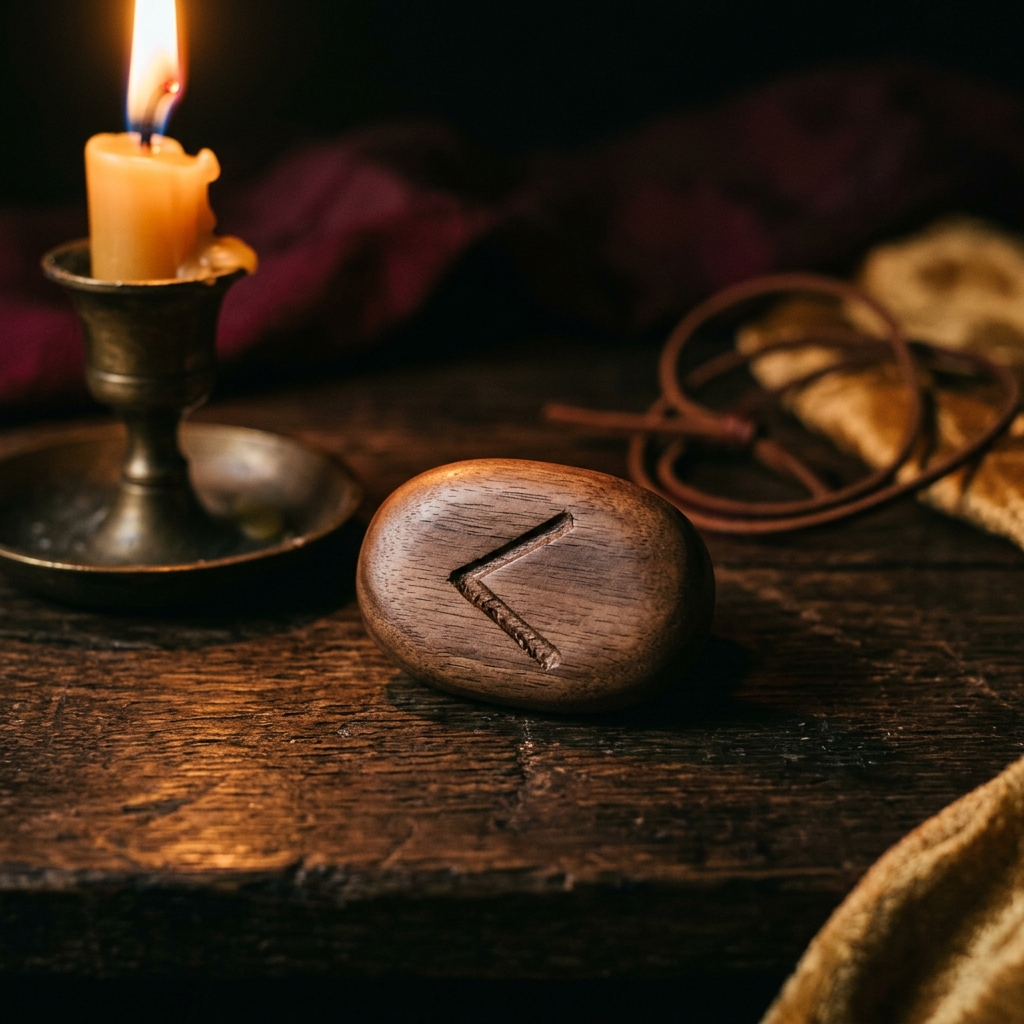
The kenaz rune meaning most people learn today is simple: a torch, a light in the dark, a spark of knowledge. Yet if you dig into the old sources, the story turns out to be richer and stranger than that. In this guide, you’ll learn where Kenaz sits in the runic alphabet. You’ll also learn why the old poems disagree about what it means. Finally, you’ll see how modern readers interpret it, and how to work with it in a simple reading.
- Kenaz Rune Meaning at a Glance: The K in Futhark
- Torch or Sore? Why the Meaning of Kenaz Splits in Two
- The Anglo-Saxon Rune Poem Behind the Kenaz Meaning
- Kenaz Rune Meaning in Modern Readings: Knowledge, Craft and Creativity
- When the Torch Goes Out: Kenaz Rune Meaning Reversed
- How to Work With the Kenaz Rune in a Simple Reading
- Reading the Kenaz Rune Meaning in Context
- Common Mistakes With the Kenaz Rune Meaning
- Frequently Asked Questions
- References
Kenaz Rune Meaning at a Glance: The K in Futhark
Kenaz looks like a small arrowhead pointing left, much like a less-than sign: ᚲ. It stands for the sound k. In fact, it is the sixth letter of the oldest runic alphabet. It even gives that alphabet part of its name. The word futhark comes from the first six runes in order: f, u, th, a, r and k.[1] So every time you say futhark, you end on Kenaz.
This older alphabet, called the Elder Futhark, had 24 runes.[1] Scholars divide them into three rows of eight, and each row is called an ætt (plural ættir), meaning a family or group.[2] Kenaz belongs to the first ætt, alongside runes for cattle, strength, and the journey.
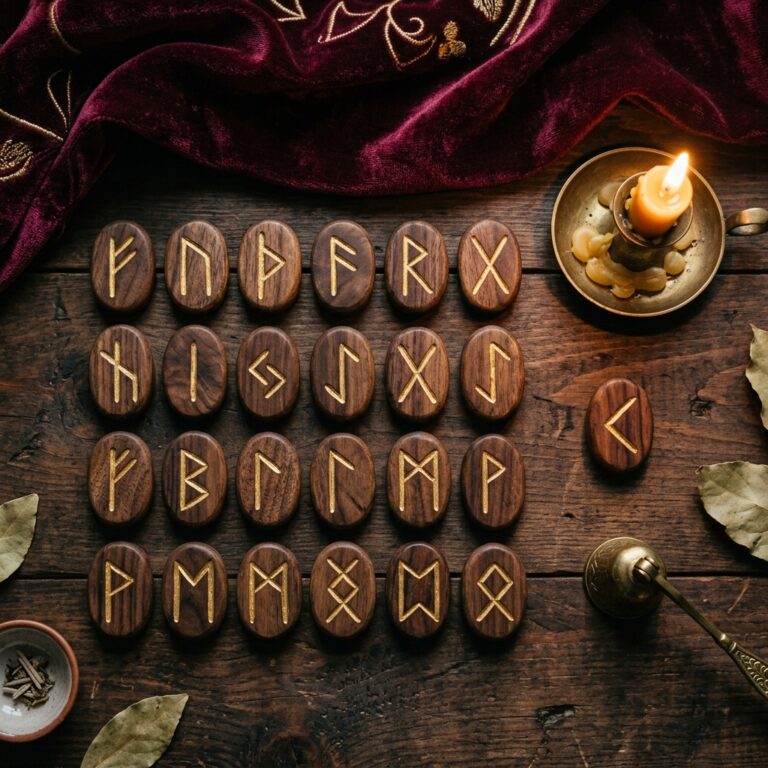
Why does its position matter? Because in rune reading, context is part of the meaning. The first ætt is often read as the runes of everyday life and early growth. Kenaz, as a result, is usually treated as the point where raw experience turns into skill and understanding.
Torch or Sore? Why the Meaning of Kenaz Splits in Two
Here is the surprise most rune guides skip. Nobody knows for certain what the Elder Futhark runes were called. Their names were never written down in that early period, so modern scholars rebuilt them from later English and Scandinavian sources.[2] “Kenaz” is one of those careful reconstructions.
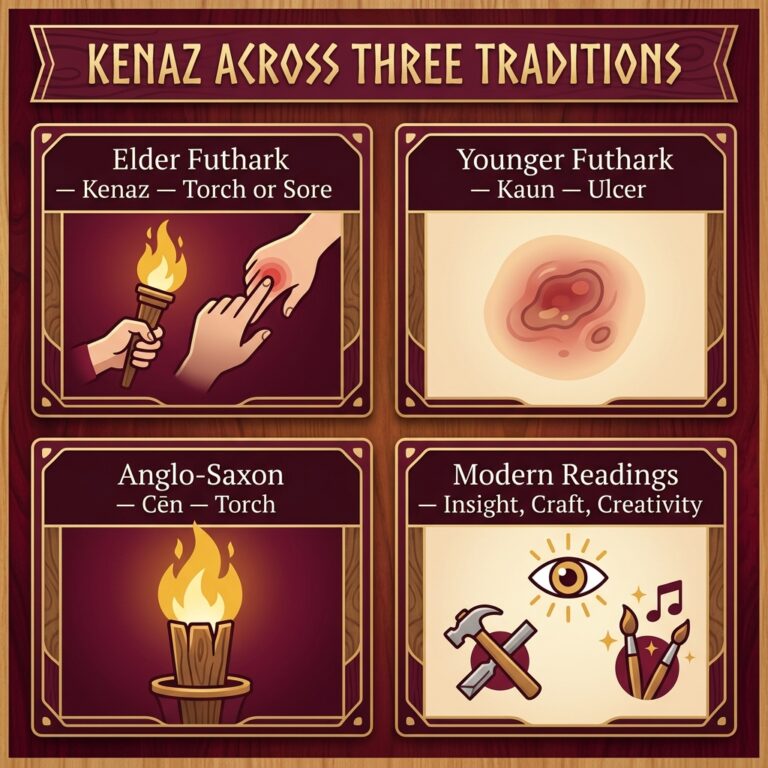
Those later sources don’t agree. In England, the rune became cēn, which means torch. In Scandinavia, however, it became kaun, which means an ulcer or a boil.[2] For that reason, some scholars think the original sense was closer to a sore or blister. Torch remains a possible alternative.[2]
The two traditions also drifted apart in form. In Scandinavia, the 24 runes were cut down to just 16 around the start of the Viking Age. Meanwhile, the Anglo-Saxons added new runes, and their version grew to 31 characters.[1] So Kenaz lived on in two quite different alphabets, and it picked up a different meaning in each.
Many modern readers find a link between the two. A torch is fire you hold and control. A fever or an inflamed wound, by contrast, is heat burning inside you. Both are fire, and both reveal something. This double edge gives Kenaz more depth than a simple “light bulb” rune. Keep both sides in mind, and the kenaz rune meaning becomes far more useful in a reading.
The Anglo-Saxon Rune Poem Behind the Kenaz Meaning
The torch image comes mainly from the Old English Rune Poem. Each short verse describes one rune. The verse for cēn describes the torch as “radiant and bright.” It adds that the torch usually burns where nobles rest indoors.[3]
Picture what that meant at the time. A torch in a dark hall was warmth, safety, and company. It lit the place where people gathered, told stories, and passed on knowledge. That is where the modern link between Kenaz and learning comes from. Much of today’s kenaz rune meaning grows directly out of this one short verse.
The poem’s own history has a twist, too. It is thought to date from the ninth century, yet we know it only from an early eighteenth-century printed copy. The single manuscript sheet it came from was lost in the fire at Ashburnham House in 1731.[3] That same fire badly damaged the Cotton library, and even scorched the edges of the Beowulf manuscript.[4] In other words, the verse praising the torch survives only because someone copied it before the flames came.
Kenaz Rune Meaning in Modern Readings: Knowledge, Craft and Creativity
Modern rune readers mostly build on the torch. When Kenaz appears upright in a reading, it is usually read as one of these themes:
- Insight: a light shining on something that was hidden, or a problem finally making sense.
- Learning: study, teaching, and the steady growth of knowledge.
- Craft and creativity: the controlled fire of the forge, where raw material becomes something useful or beautiful.
- Warmth and passion: the glow of the hearth, which some readers link to attraction and close bonds.
The craft theme deserves a closer look. Fire that is controlled builds things, while fire that is not destroys them. So Kenaz is often read as skill guided by intention, not raw inspiration alone. If a reading asks about a creative project, Kenaz tends to point to focused, practiced effort.
The warmth theme also explains why Kenaz turns up in love work. If you’re curious about that side, this guide to runes for love shows where Kenaz fits among other love runes.
When the Torch Goes Out: Kenaz Rune Meaning Reversed
Not every reader uses reversals. However, Kenaz is not symmetrical, so it can land upside down, and many readers give that position its own meaning. A reversed Kenaz, sometimes called merkstave, is often read as a torch that has gone dark.
In practice, that usually means a creative block, confusion, or a loss of motivation. Some readers also bring back the older Scandinavian sense here. The ulcer becomes a problem that has been ignored and is now “festering,” so the rune suggests facing it rather than covering it. Read this way, reversed Kenaz is a prompt to act, not a bad omen.
How to Work With the Kenaz Rune in a Simple Reading
You don’t need an elaborate ritual to work with Kenaz. The steps below keep things simple, and each one has a clear purpose.
- Set up a quiet space. Light a single candle, because a real flame echoes the torch in the rune poem.
- Hold or draw the rune. Use a rune stone, or simply draw ᚲ on paper. Drawing it yourself helps fix the shape in memory.
- Ask a focused question. Kenaz suits questions about learning, a creative project, or something you can’t yet see clearly.
- Sit with the image. Spend a few minutes imagining the torch lighting a dark hall. Then notice what in your question feels hidden.
- Write down what comes up. Record your thoughts before you look up any meanings, so your own reading comes first.
Over time, these notes build your own sense of the kenaz rune meaning. That personal record often proves more useful than any list of keywords.
Belief, Intention & The Power of Magic
Witchcraft, spells, and manifestation are deeply rooted in belief, intention, and spiritual practice. If these practices do not resonate with you, this may not be the path for you, and that’s perfectly okay. But if you believe in divine powers, trust your intentions, and feel drawn to the mysteries of the unseen, we invite you to continue exploring with Madame Celestine and discover the magic that speaks to your soul.
Reading the Kenaz Rune Meaning in Context
A rune rarely speaks alone. In a three-rune spread, for example, the position of Kenaz changes its message. In the past position, it often points to a lesson already learned or a skill you built earlier. When it lands in the present, it suggests a moment of clarity, so now is a good time to study, plan, or create. In the future position, it is usually read as understanding that is on its way.
Neighboring runes matter, too. Next to Fehu, the rune of wealth, Kenaz is often read as skill that can earn a living. Beside Isa, the rune of ice, the torch meets frozen ground, so progress may feel slow before it thaws. Next to Wunjo, the rune of joy, the kenaz rune meaning leans toward creative work that brings real satisfaction.
These pairings are modern reading habits, not rules found in the old poems. Even so, they show why context matters. Instead of memorizing one keyword, try to see how the torch lights up whatever sits beside it.
Common Mistakes With the Kenaz Rune Meaning
First, many beginners mix up rune systems. The 13 witch’s runes are a separate, modern set, so Kenaz does not appear there. Second, some guides present the torch meaning as ancient fact. As we’ve seen, it is one of two old readings, and the names themselves are reconstructed.
Third, people sometimes confuse shapes. The English cēn rune looks different from the Elder Futhark ᚲ, so check which alphabet your rune set uses. Finally, avoid reading Kenaz alone. Its meaning shifts with the runes around it, just as a torch looks different in a crowded hall than in an empty one.
Frequently Asked Questions
What is the kenaz rune meaning?
Kenaz is most often read as a torch, standing for insight, knowledge, creativity, and skilled craft. In Scandinavian tradition, however, the same rune was called kaun and meant an ulcer or sore.
What is the kenaz rune meaning reversed?
Readers who use reversals often see reversed Kenaz as a torch gone dark. It can point to a creative block, confusion, or a problem that needs attention before it grows.
What is the meaning of Kenaz in love?
In love readings, Kenaz is often linked to warmth, attraction, and the glow of the hearth. Some readers also see it as a sign of new understanding between two people.
Is Kenaz a fire rune?
Yes, most readers treat Kenaz as a fire rune. Both of its old meanings involve heat, either the controlled flame of a torch or the inner burn of a wound.
How do you pronounce Kenaz?
It is usually said as KEN-ahz, with the stress on the first syllable. The name is a modern reconstruction, so you will hear small variations.
References
- Runes and Runic Inscriptions. Vikings in the East Midlands, University of Nottingham. https://emidsvikings.ac.uk/resources/runes-and-runic-inscriptions/
- Emma Groeneveld. Runes. World History Encyclopedia, June 19, 2018. https://www.worldhistory.org/runes/
- The Anglo-Saxon Rune Poem. Þa Engliscan Gesiþas (The English Companions). https://www.tha-engliscan-gesithas.org.uk/written-and-spoken-old-english/old-english-alphabet-2/the-anglo-saxon-rune-poem/
- Fire, Fire! The Tragic Burning of the Cotton Library. British Library Medieval Manuscripts Blog, October 23, 2016. https://blogs.bl.uk/digitisedmanuscripts/2016/10/fire-fire-the-tragic-burning-of-the-cotton-library.html
Not sure where to start? You don’t have to do this alone.
Madame Celestine offers guided spellwork for beginners — real support for your first working, not just another guide to read.
Related reading: Woodpecker Spiritual Meaning: Messages and Symbolism · White Smoke Spiritual Meaning: Signs in Smoke and Dreams

About Edmund Hale
Edmund Hale is the pen name our editorial team uses for articles on grimoires, Qabalah, ceremonial magic and British folklore. Articles under this byline are researched from published sources and reviewed by Madame Celestine before publishing.