

Many people feel a quiet pull to remember the family who came before them, yet they are not sure where to begin. An ancestral altar is one of the oldest and simplest answers to that pull. In this guide, you’ll learn where the practice comes from and what to place on an altar for ancestors. You’ll also learn how to set up an ancestral altar step by step, and how to keep it alive through the year.
- What an Ancestral Altar Is, and Why So Many Cultures Built One
- From Ofrendas to Egungun: Ancestor Altars Around the World
- Choosing the Right Spot for Your Altar for Ancestors
- What Goes on an Ancestral Altar: The Essential Pieces
- How to Set Up and Open Your Ancestral Altar
- Rituals to Honor Ancestors Through the Year
- Ancestor Altar Ideas and Common Mistakes
- Frequently Asked Questions
- References
What an Ancestral Altar Is, and Why So Many Cultures Built One
An ancestral altar is a small, dedicated space where you remember and speak to your family dead. It can be a whole table or a single shelf. What makes it an altar is not its size but its purpose. It is a place set apart for relationship, and an ancestral altar keeps that relationship visible every day.
This idea is very old and very widespread. Britannica notes that shrines honoring ancestors were kept in Greek and Roman homes in antiquity.[1] It also explains that, in many African religions, ancestors act as mediators who give the living access to spiritual guidance.[1] That is why the ancestral altar is often the first altar a person builds, even before one for any deity.
In ancient China, families set up inscribed wooden tablets. These recorded the names, family lines and achievements of important ancestors.[2] Offerings of food, drink and incense followed on key dates, such as New Year’s Day.[2] So the core pieces we still use today, a name, a place and an offering, were in place thousands of years ago.
Even the word carries history. “Altar” comes from the Latin altare, and it is probably related to a Latin verb meaning “to burn up.”[3] Interestingly, English speakers once spelled it “alter” in Middle English.[3] So if you have searched for an “ancestor alter,” you were closer to history than you thought.
From Ofrendas to Egungun: Ancestor Altars Around the World

Ancestor altars look different from one culture to the next. Still, they share a sense of welcome. In Mexico, families prepare home shrines for the Indigenous festivity dedicated to the dead. UNESCO describes how this takes place from the end of October into early November.[4] Families cook the favorite dishes of the dead and set them around the home shrine with flowers and paper cut-outs.[4] They also lay petals, candles and offerings along the path from the cemetery to the house, so the returning souls can find their way.[4]
Among the Yoruba of West Africa, the ancestors are called egun, and they are honored in more than one way. At public festivals, the Egungun masqueraders appear in flowing cloth or palm-leaf costumes, often with carved headpieces.[5] At home, however, the relationship is quieter. There, an ancestral altar often begins with water, a candle and the spoken names of the dead.
Ifá and Orisha communities across the diaspora share a well-known Lucumí saying. It is ikú lobí ochá, “the dead gave birth to the orisha.” In other words, the ancestors come first. For that reason, many practitioners greet their egun before any other spiritual work. Similarly, Cuban Espiritismo uses a bóveda, a white-covered table holding several glasses of water for the spirits of the dead.
Choosing the Right Spot for Your Altar for Ancestors
Place matters because the altar needs to be visited, not just built. Choose a spot you pass every day, such as a living room shelf or a quiet corner of a hallway. If you only see your ancestral altar once a week, the relationship can fade.
Many traditions avoid the bedroom. That is because the bedroom is a private space for rest and intimacy, and the dead are guests rather than housemates in it. Likewise, many people avoid placing the altar in a bathroom or directly on the floor. Instead, a table or shelf at waist height or lower is common. In some Afro-diasporic houses, the egun shrine sits low, closer to the earth where the dead are buried.
Finally, think about safety and privacy. You will be lighting candles, so keep curtains and papers well away. If you share your home, a small closed cabinet can hold the ancestors altar and still give it dignity.
What Goes on an Ancestral Altar: The Essential Pieces
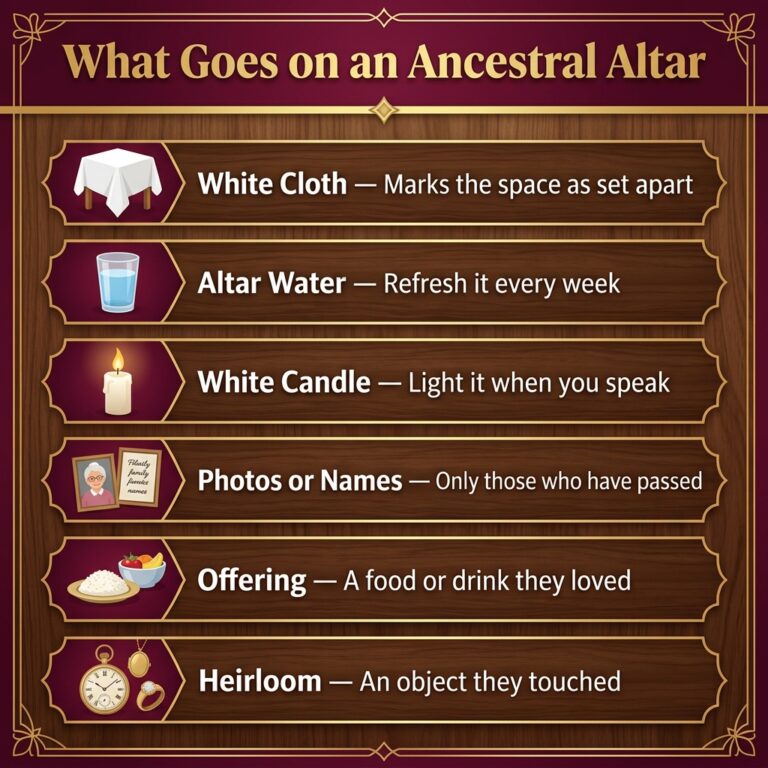
You do not need to buy anything special. In fact, the best pieces are usually things your family already touched. Below are the core elements and why each one is there.
A Clean White Cloth
White is used in many African and diaspora traditions for the dead, because it stands for coolness, peace and clarity. The cloth marks the space as set apart. It also makes it easy to notice dust, spills or neglect.
Altar Water
A clear glass of fresh water is often the heart of the ancestral altar. Practitioners describe water as a path or doorway for spirits, and as something that cools and calms. You change the altar water regularly, at least once a week. Then pour the old water outside onto the earth rather than down the sink, as a sign of respect.
A Candle
A plain white candle is enough. People light it when they sit to speak, so the flame becomes a signal that the conversation has started.
Photos and Names
Use photographs of relatives who have died, or write their names on a card if you have no pictures. Many practitioners advise keeping photos of living people off the altar. The altar belongs to the dead, so mixing the two is often seen as confusing the space.
Offerings and Heirlooms
Add something your ancestors enjoyed, such as coffee, a small plate of food or a favorite sweet. An heirloom, like a ring, a tool or a recipe card, also helps. It links the altar to real people rather than an abstract idea.
How to Set Up and Open Your Ancestral Altar
Once you have your pieces, setting up the ancestral altar can take less than an hour. The goal is to move slowly and with attention.
First, clean the space. Wipe the surface with water and a little salt, or with Florida water, a citrus-scented cologne used for spiritual cleansing. This clears away the ordinary use of the shelf.
Next, lay the white cloth and place the glass of water at the center. Then add the photos or name cards, the candle and any heirlooms around it.
After that, light the candle and knock gently on the table or floor three times. In many diaspora houses, this is how you let the dead know you are present. Then say the names you know aloud, from the most recent to the oldest. Finish with a general line such as “and all my ancestors whose names I don’t know.”
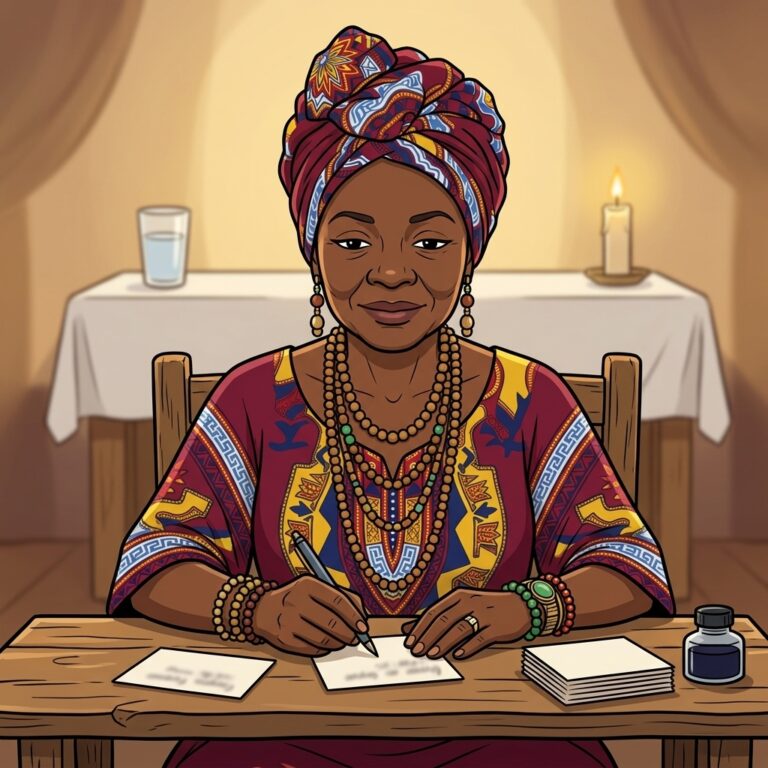
Now offer the food or drink. Speak simply, as you would to an elder. You might thank them, share news or ask for guidance. When you finish, let the candle burn a little longer if it is safe, then put it out. Finally, remove perishable food within a day so nothing spoils on the altar.
Belief, Intention & The Power of Magic
Witchcraft, spells, and manifestation are deeply rooted in belief, intention, and spiritual practice. If these practices do not resonate with you, this may not be the path for you, and that’s perfectly okay. But if you believe in divine powers, trust your intentions, and feel drawn to the mysteries of the unseen, we invite you to continue exploring with Madame Celestine and discover the magic that speaks to your soul.
Rituals to Honor Ancestors Through the Year
An ancestral altar is a relationship, so it needs regular care. The simplest rhythm is weekly. Change the water, dust the photos and light the candle for a few minutes. Many people choose one fixed day, so the care becomes a habit.
Beyond that, mark the dates that matter to your family. Birthdays and death anniversaries are natural times to cook a favorite dish and set a small plate on the altar. Then there are the great seasonal feasts. Día de Muertos, Samhain and the Chinese festivals for the dead all fall at times when the living traditionally turn toward their ancestors.
This is also where ancestral magic comes in. For most practitioners, ancestral magic simply means asking the dead for help with real life, such as protection, a hard decision or healing a family pattern. For a deeper look at one such practice, see this guide to what an ancestral guidance ritual involves. The request should always come after the relationship, not in place of it.
Ancestor Altar Ideas and Common Mistakes
If space is tight, a single floating shelf with a glass of water and one photo is a complete ancestral altar. Some people use a small wooden box that opens like a shrine. Others keep a travel altar in a tin, with a tea light, a name card and a tiny cup for water.
For more ancestor altar ideas, look to your own family history. You could add soil from a family homeland, a hymn book, a sewing thimble or a tool from someone’s trade. Such objects carry memory more strongly than anything store-bought.
Now the common mistakes. The first is setting it up and then forgetting it. Stale water and dust send the opposite message to the one you intend. The second is feeling you must include everyone. If a relative caused harm, you are not obliged to place them on your altar. Instead, you can honor the “well and wise” ancestors only, a phrase many modern practitioners use. The third mistake is expecting instant results. Most people describe the bond growing slowly, through dreams, small signs and a steady sense of support. Over time, the ancestral altar becomes less of a project and more of a daily habit.
Frequently Asked Questions
What is altar water used for on an ancestral altar?
Altar water is a glass of fresh water offered to the ancestors. Practitioners see it as a cooling, calming offering and a pathway for spirits, so it is refreshed at least once a week.
Can I put someone I never met on my ancestors altar?
Yes. Many people honor great-grandparents or distant relatives they never knew, often by writing their names on a card. You can also include a general line for all the ancestors whose names are lost.
Is it spelled “ancestor alter” or “ancestor altar”?
The correct modern spelling is “altar,” which means a place for offerings. “Alter” means to change, although Middle English writers did once spell altar that way.
What is ancestral magic?
Ancestral magic is spiritual work done with the support of your family dead, such as asking for protection or guidance. Most traditions build the relationship through regular offerings before making requests.
What are some simple rituals to honor ancestors?
Simple rituals include changing their water weekly, lighting a candle while saying their names, and cooking a favorite dish on their birthdays or death anniversaries. Telling their stories aloud to younger family members is also a meaningful way to honor them.
References
- Ancestor worship. Encyclopaedia Britannica. https://www.britannica.com/topic/ancestor-worship
- Ancestor Worship in Ancient China. Mark Cartwright, October 17, 2017. World History Encyclopedia. https://www.worldhistory.org/article/1132/ancestor-worship-in-ancient-china/
- Altar. Merriam-Webster Dictionary. https://www.merriam-webster.com/dictionary/altar
- Indigenous festivity dedicated to the dead. UNESCO Intangible Cultural Heritage. https://ich.unesco.org/en/RL/indigenous-festivity-dedicated-to-the-dead-00054
- Egungun. Encyclopaedia Britannica. https://www.britannica.com/topic/Egungun
Not sure where to start? You don’t have to do this alone.
Madame Celestine offers guided spellwork for beginners — real support for your first working, not just another guide to read.
Related reading: Saturnalia for Modern Pagans: Role Reversal, Gifts and Candles · Building a Ritual Around Eggs in Magickal Practice: Spells, Correspondences, and Mythology: A Practical Guide
About Thakathi
Thakathi is the pen name our editorial team uses for articles on Ifá, Orisha traditions and ancestor reverence across the African diaspora. Articles under this byline are researched from published sources and reviewed by Madame Celestine before publishing.