
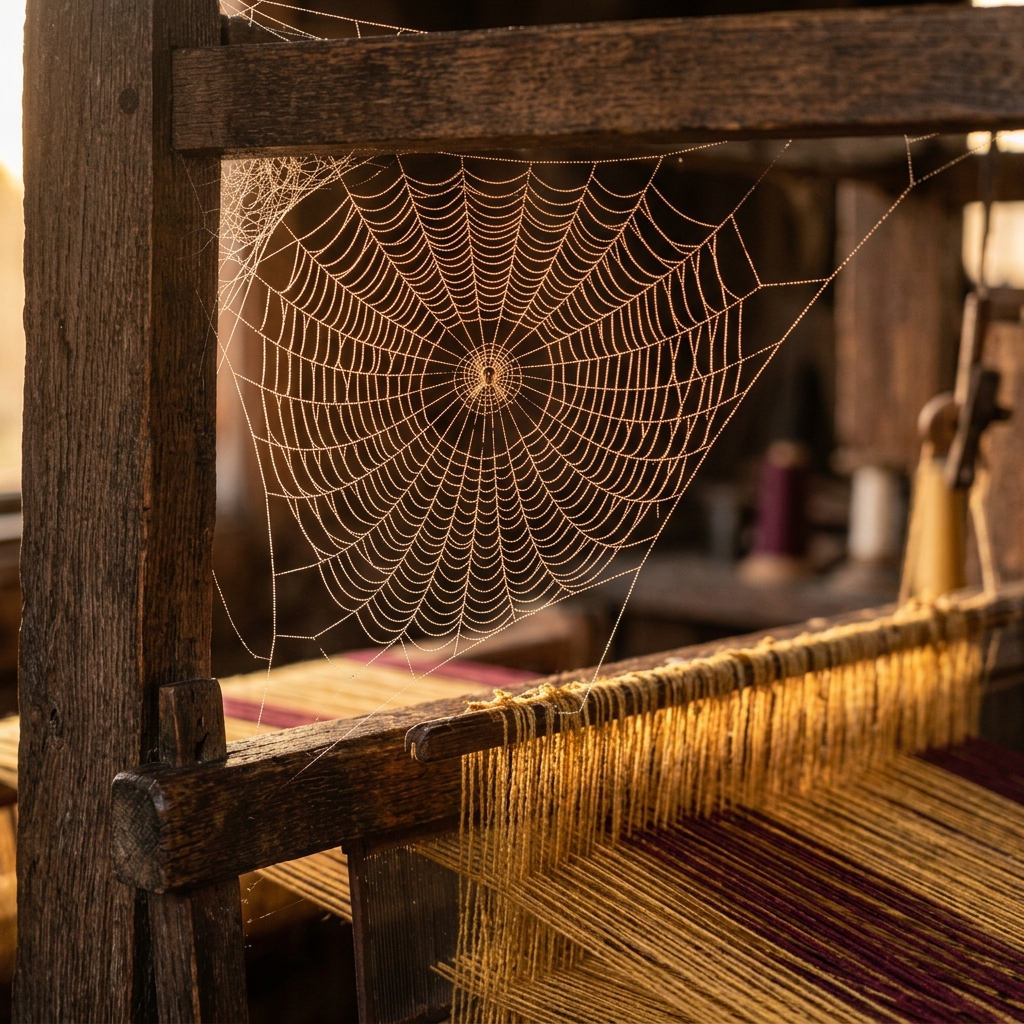
Is there a spider god, and why do so many cultures link spiders with wisdom, weaving and fate? The short answer is yes, there are several. From the Akan storyteller Anansi to the Greek weaver Arachne and the Diné Spider Woman, spiders in mythology keep turning up at the same crossroads of skill, patience and destiny. In this guide, you’ll meet the best-known spider deities, learn where their stories come from, and see why the thread of a web became a symbol for the thread of a life.
- Why the Spider God Is Always a Weaver
- Anansi: The Akan Spider God Who Owned the Stories
- From Ghana to Jamaica: How the Spider God Crossed the Ocean
- Arachne: The Weaver Who Became the First Spider
- Spider Woman and the First Loom of the Diné
- The Weavers of Fate: Threads, Webs and Destiny
- A Simple Spider God Reflection Practice
- Common Misreadings of Spider Gods
- Frequently Asked Questions
- References
Why the Spider God Is Always a Weaver
Before looking at single figures, it helps to ask why spiders earned sacred status at all. The answer sits in plain sight. A spider makes something intricate out of its own body, and it does so again and again after every storm. So people who spun, wove and told stories saw a mirror of their own work in it.
That is why the spider god in most traditions is not a god of fear. Instead, he or she is a maker. The web becomes a picture of the world, with every strand connected to every other. Touch one thread, and the whole web trembles. For that reason, many cultures used the spider to explain how small choices ripple outward.
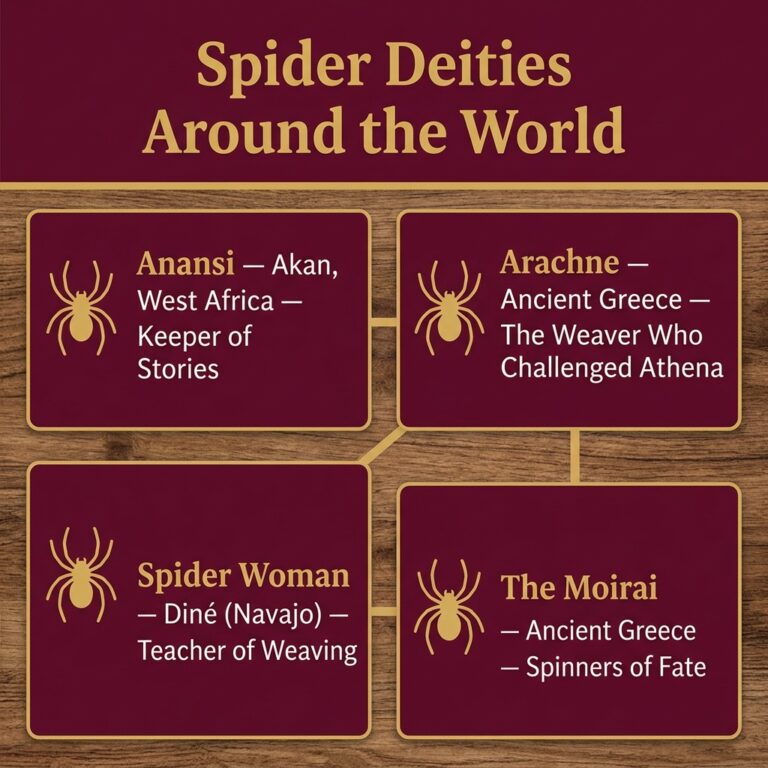
If you have ever asked what deity is associated with spiders, the honest answer depends on where your family comes from. West Africa, Greece, the American Southwest and the ancient world of fate goddesses each give a different face to the same idea.
Anansi: The Akan Spider God Who Owned the Stories
The most famous spider deity in the world is probably Anansi, also written Ananse. Britannica describes him as an Akan character, from the peoples of present-day Ghana, known for his insight, intelligence and wisdom.[1] His tales are so central that they have their own name, Anansesem, or “Anansi stories.”[1]
In one well-loved tale, all the stories in the world belong to the sky god Nyame. Anansi asks to buy them. Nyame sets a price that seems impossible: capture a python, a leopard, a swarm of hornets and a spirit. Through clever tricks rather than strength, the small spider delivers every one. As a result, the stories become his, and he shares them with everyone.
This is why Anansi is more than a trickster. He is also a culture hero, a figure who brings a gift to humanity. His power is wit, and his gift is narrative itself. So when people call Anansi a spider god, they often mean the patron of storytelling, cleverness and survival against bigger forces.
From Ghana to Jamaica: How the Spider God Crossed the Ocean

Anansi did not stay in West Africa. Enslaved Akan people carried his stories across the Atlantic, and they took root wherever people needed hope. Britannica notes that he is known by many names, including Anancy, Aunt Nancy, Hapanzi and Nanzi, and that the stories spread widely through the Caribbean and the Americas.[1]
The change in name tells its own story. In Jamaica he became Anancy. Meanwhile, in the southern United States, the name drifted into “Aunt Nancy,” and the spider sometimes turned into a woman. Yet the heart of the tales stayed the same. A small, clever figure outwits the powerful, and that message mattered deeply to people living under slavery.
For many in the African diaspora today, Anansi stories are a form of inheritance. Telling them keeps a thread running back to the old country. In this sense, the spider god still weaves, but what he weaves is memory.
Arachne: The Weaver Who Became the First Spider
Greek myth gives us a very different spider. Arachne was a mortal woman, not a goddess. According to Britannica, she was the daughter of a purple dyer from Colophon in Lydia, and her weaving was so skilled that she challenged Athena herself.[2]
The contest is full of meaning. Athena wove the gods in all their majesty. Arachne, however, wove the gods’ love affairs and deceptions.[2] Her work was flawless, but it also mocked the divine. In despair after the goddess’s anger, Arachne hanged herself. Athena then loosened the rope into a cobweb and turned Arachne into a spider.[2]
Her name lives on in science. The zoological class that holds spiders, Arachnida, is named after her.[2] So every time someone says “arachnid,” they repeat a myth about pride, talent and the risk of speaking truth to power. The main source for her story is Ovid’s poem, the Metamorphoses.[2]
Spider Woman and the First Loom of the Diné
In the American Southwest, the spider is a teacher. For the Diné (Navajo) people, Spider Woman, called Na’ashjé’ii Asdzáá, brought the gift of weaving.[3] In a Bard Graduate Center exhibition, Diné weavers explain that she traveled to the sacred mountains to gather what she needed. She collected wood for her husband, Spider Man, to build a loom, and plants for dyes.[3]
The first loom was not made of ordinary things. In the creation story, its crosspoles were made of sky and earth cords, and its warp sticks of sunrays.[3] Through her patterns, prayers and songs, Spider Woman gave weaving to the Diné so they could bring hózhó, a Diné idea of harmony and balance, into daily life.[3]
This framing matters. Here the spider deity is not a trickster or a warning. Instead, she is a grandmother figure whose craft carries prayer. Weaving becomes a sacred act, and every rug holds a thread of that first teaching.
The Weavers of Fate: Threads, Webs and Destiny
Even where no literal spider god appears, the weaver of fate often does. The Greeks pictured destiny as a thread. Britannica explains that Clotho spun the thread of each life, Lachesis handed it out, and Atropos cut it, which marked the moment of death.[4] The Romans had their own versions, who were first linked to childbirth.[4]
In Norse lore, the Norns are also said to shape fate at the roots of the world tree. Although these figures are not spiders, they share the spider’s tools. So the web and the thread became a shared language across cultures. Life is something spun, woven and eventually finished.
Everyday folklore kept this respect alive too. An old English rhyme advises, “If you wish to live and thrive, let a spider run alive.” Small money spiders landing on your clothes were once read as a sign that money was on its way. So even without a named spider god, many households treated spiders as small, lucky guests rather than pests.
This is where mythological spiders and fate goddesses meet. The spider shows what the Fates do on a cosmic scale. It builds with patience, repairs what breaks and works within limits it cannot change.
A Simple Spider God Reflection Practice
You don’t need a special altar to learn from these stories. Instead, try this short practice, drawn from the themes the myths share. It takes about twenty minutes.
First, find a real web outdoors, or picture one clearly. Notice the spokes that hold it steady and the spiral that fills it in. The spokes are your commitments. The spiral is your daily effort.
Next, choose the spider god whose story speaks to you right now. Anansi suits a moment when you feel outmatched and need cleverness. Arachne suits a moment when your talent may be outrunning your caution. Spider Woman suits a moment when you want your work to carry meaning.
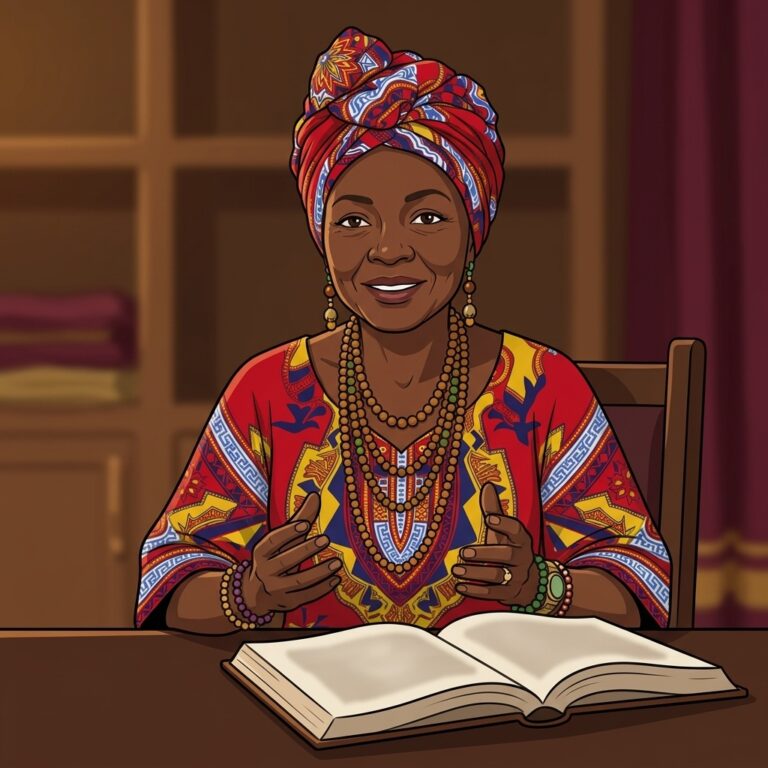
Then write one short paragraph as if that figure were speaking to you. What would they advise? Finally, retell one of their stories aloud to someone else, or simply to yourself. In many traditions, telling a story is itself a way of honoring the one who first told it.
Why does this work as a practice? Because each of these myths was first passed on by voice, not by book. When you retell one, you step into the same chain of tellers. In addition, you notice details you missed when reading silently, and those details often carry the lesson you needed.
Belief, Intention & The Power of Magic
Witchcraft, spells, and manifestation are deeply rooted in belief, intention, and spiritual practice. If these practices do not resonate with you, this may not be the path for you, and that’s perfectly okay. But if you believe in divine powers, trust your intentions, and feel drawn to the mysteries of the unseen, we invite you to continue exploring with Madame Celestine and discover the magic that speaks to your soul.
Common Misreadings of Spider Gods
One common mistake is treating every spider god as dark or dangerous. Horror films have trained us to fear spiders, but most myths do the opposite. They present spiders as makers, teachers and keepers of knowledge.
Another mistake is blending all spider deities into one figure. Anansi is a clever culture hero from the Akan world. Arachne is a punished mortal in Greek myth. Spider Woman is a sacred teacher in Diné tradition. Each belongs to a living or historical culture, so it is respectful to learn them in their own context. If you are drawn to nature deities more broadly, this overview of goddesses of the forest, wild animals and nature offers more figures to explore.
Finally, many people assume these stories are only for children. In fact, Anansi tales were long used to teach adults about power and survival. Likewise, the Diné weaving story carries serious ideas about harmony and prayer.
Frequently Asked Questions
What deity is associated with spiders?
The best-known is Anansi, the Akan spider of West Africa who became famous across the Caribbean. Other spider figures include Arachne in Greek myth and Spider Woman in Diné (Navajo) tradition.
Is Anansi a spider god or a trickster?
He is both. Anansi is a trickster who uses wit instead of strength, and he is also a culture hero who brings stories to the world.
Why are spiders in mythology linked to fate?
Many cultures pictured life as a thread that is spun, measured and cut. Because spiders spin threads and weave webs, they became a natural symbol for destiny and connection.
Who is the weaver spider god in Native American tradition?
In Diné (Navajo) tradition, Spider Woman taught the people to weave. Her husband, Spider Man, built the first loom from sacred materials.
Was Arachne a spider goddess?
No. Arachne was a mortal weaver who challenged the goddess Athena and was turned into a spider. Her name later gave spiders their scientific class name, Arachnida.
References
- Ananse. Molefi Kete Asante. Encyclopaedia Britannica. https://www.britannica.com/topic/Ananse
- Arachne. Encyclopaedia Britannica. https://www.britannica.com/topic/Arachne
- Spider Woman and the Role of Diné Women. Shaped by the Loom, Bard Graduate Center. https://exhibitions.bgc.bard.edu/shapedbytheloom/theme/homeland-creation-cosmology/spider-woman-and-the-role-of-dine-women/
- Fate. Gitanjali Roy. Encyclopaedia Britannica. https://www.britannica.com/topic/Fate-Greek-and-Roman-mythology
Not sure where to start? You don’t have to do this alone.
Madame Celestine offers guided spellwork for beginners — real support for your first working, not just another guide to read.
Related reading: Kenaz Rune Meaning: The Torch of Knowledge and Creativity · Woodpecker Spiritual Meaning: Messages and Symbolism

About Thakathi
Thakathi is the pen name our editorial team uses for articles on Ifá, Orisha traditions and ancestor reverence across the African diaspora. Articles under this byline are researched from published sources and reviewed by Madame Celestine before publishing.