
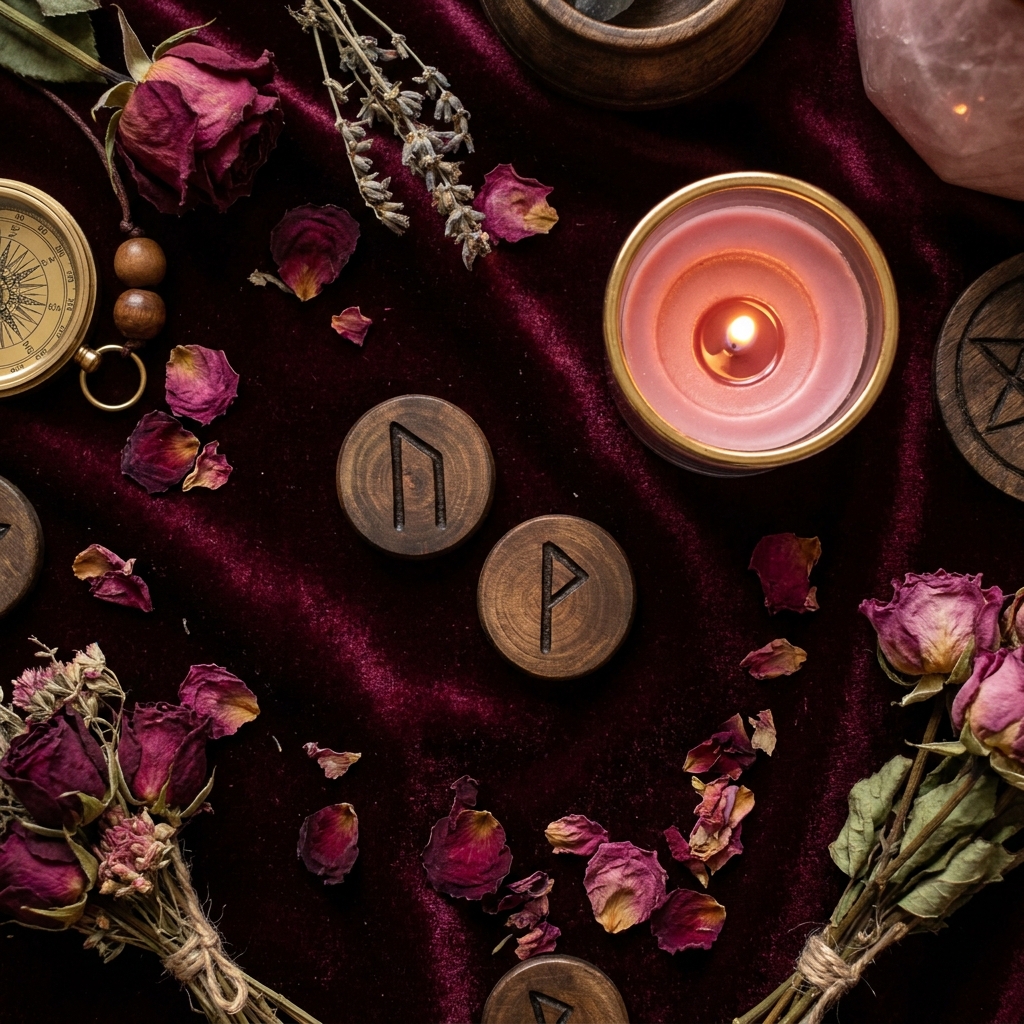
Love runes show up everywhere in modern witchcraft, from carved candles to bind runes inked on wrists. But which runes actually belong to love, and what did the people who first wrote them have in mind? This guide covers the six runes most often used for love and what the old Rune Poem says about each one. It also shows how medieval lovers really wrote with runes. Then it explains how to use love runes yourself, and which runes suit a breakup that you want to end kindly.
- Love Runes Begin With a Word That Meant “Secret”
- Real Medieval Love Runes Were Whole Sentences
- Six Love Runes and What the Old Rune Poem Really Says
- How to Use Love Runes: Three Simple Methods
- When to Work With Love Runes: Friday and the Growing Moon
- Breakup Runes: Choosing Runes to End Things Kindly
- Common Mistakes With Love Runes
- Frequently Asked Questions
- References
Love Runes Begin With a Word That Meant “Secret”
The word rune itself carries a hint of intimacy. In Old English, run meant a secret, a mystery or a whispered conversation. The related Old Norse word could mean a hidden message, a charm or a single runic letter.[1] So before runes were letters, the word described the kind of thing people only say quietly.
Runes are also older than most people expect. The University of Copenhagen dates the oldest runic row, the 24-character elder futhark, to roughly 150 to 650 AD. During the Viking Age, from about 725 to 1075 AD, people in Scandinavia wrote with a shorter row of 16 characters, called the younger futhark.[2] The rune names most love guides use today, such as Gebo and Wunjo, belong to the older 24-rune row.
Modern witches also use other symbol sets that share the name. For example, the witch’s runes and their 13 symbols are a modern divination set, separate from the Norse and Germanic alphabets covered here.
Real Medieval Love Runes Were Whole Sentences
When medieval Scandinavians used runes for love, they didn’t draw a single magic symbol. Instead, they wrote out plain words, the way you might write a note today.
In 1973, archaeologists at Lödöse, one of Sweden’s earliest towns, found an 11th-century paring knife, probably a weaving tool. Its handle carries a runic message that reads roughly “think of me, I think of you, love me, I love you.” Museum staff still don’t know whether it was a betrothal gift, a wedding gift or a plea from someone whose love wasn’t returned.[3]
Similar messages turned up on wooden sticks from Bryggen, the medieval harbor in Bergen, Norway. One asks Gunnhild to kiss the writer. Another simply says “my love, kiss me.”[3] One Bryggen stick is worded almost exactly like the Lödöse knife, which suggests these phrases traveled across the Nordic world.
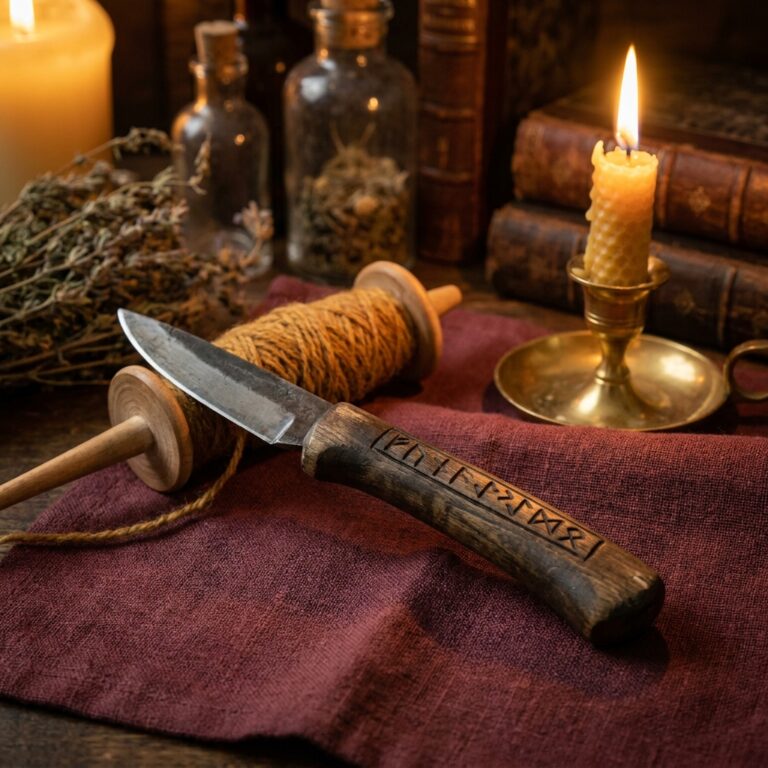
In other words, the most historically grounded love rune is a sentence. You name the person, say what you feel, and carve it. That idea shapes the first method further down.
Six Love Runes and What the Old Rune Poem Really Says
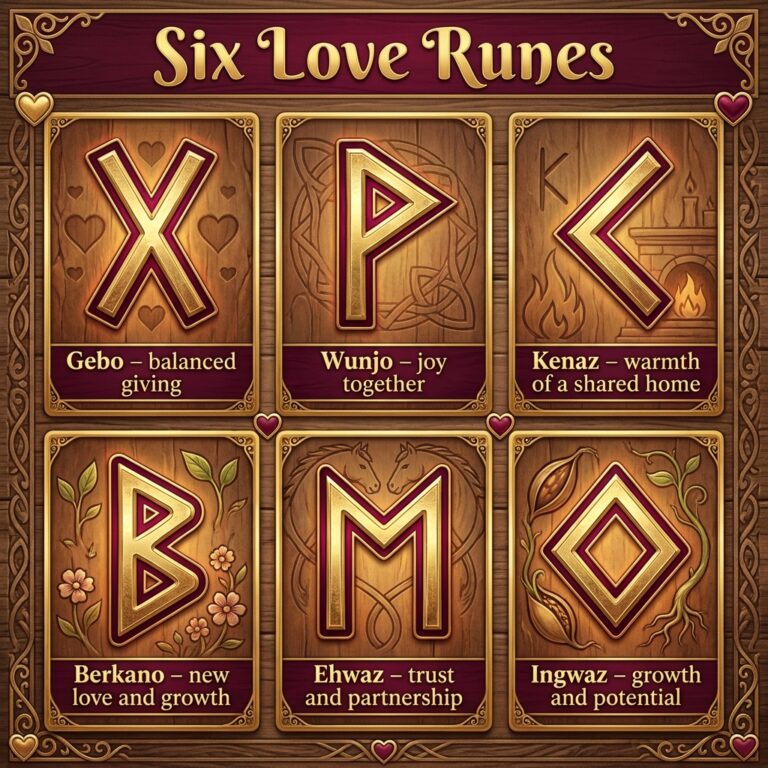
The Old English Rune Poem gives a short verse for each rune in the Anglo-Saxon row. As a result, it is one of the few early sources that attach a meaning to the runes witches use for love. Below, each rune’s common modern love meaning sits beside a plain summary of its verse, based on the Rutgers University translation.[4]
| Rune | Modern love meaning | What the Old English verse says |
|---|---|---|
| Gebo (ᚷ) | Partnership, giving and receiving | Generosity brings honor, and those with nothing deserve mercy |
| Wunjo (ᚹ) | Joy and harmony together | Joy belongs to those who know little suffering |
| Kenaz (ᚲ) | Passion and attraction | A torch whose flame lights the place where people shelter |
| Berkano (ᛒ) | New love and nurture | A birch that sprouts without seed and spreads its leaves |
| Ehwaz (ᛖ) | Trust and loyal partnership | A good horse is a comfort to its rider |
| Ingwaz (ᛜ) | Fertility and love that is still growing | Ing appeared among the East-Danes, then left with his wagon following |
Where the old verses and modern meanings meet
Put side by side, the verses and the modern meanings line up well for some runes and drift for others. My reading is this. Ehwaz and Berkano match their love meanings closely, because a horse and rider who trust each other and a tree that renews itself are easy pictures of partnership and new love. Kenaz is warmer and quieter in the poem than its modern “passion” label suggests, since its torch lights a shared shelter, so it suits a home more than a fling. Gebo’s verse is about generosity, not romance, which makes it a rune of fair giving in a relationship.
Ingwaz is the surprise. Its verse describes a figure who arrives and then leaves. So if you want a love rune to help someone stay, the poem gives Ingwaz little support. Use Ehwaz or Gebo for that wish instead, and keep Ingwaz for growth and new potential.
How to Use Love Runes: Three Simple Methods
Each method below starts small, because love runes work best with one clear intention. Choose the method that fits what you want, then follow the steps.
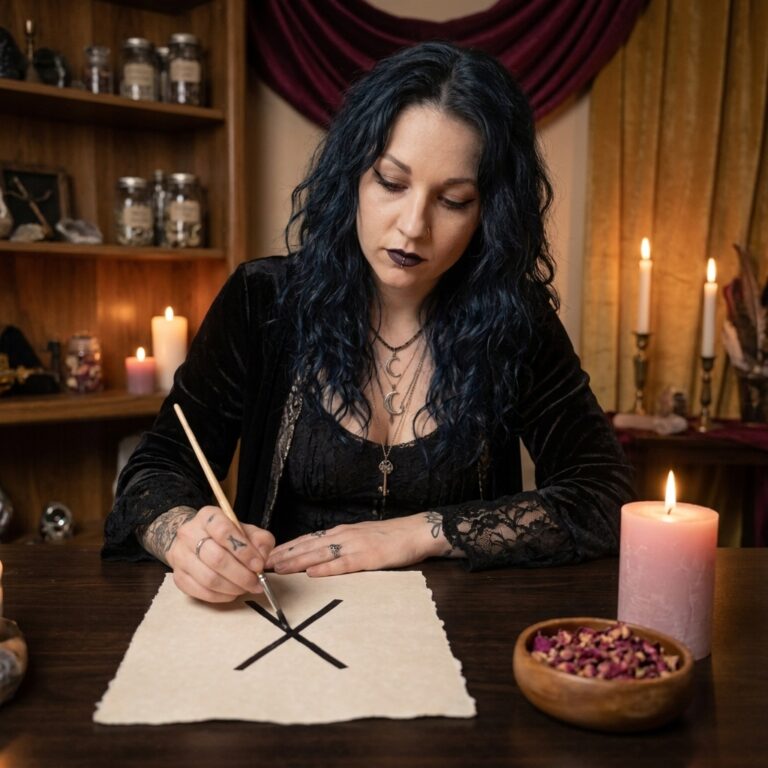
- Write your feeling in runes, the medieval way. Spell out a short sentence, such as “I love you” or your own names joined together, in runic letters. Then carve it into wood, write it on paper or scratch it into a candle. This follows the Lödöse and Bryggen messages, where the love was in the words themselves.
- Make a simple love bind rune. A bind rune joins two or three runes into one symbol that shares lines. For example, Gebo and Wunjo combine neatly, because Wunjo’s upright stroke can sit inside Gebo’s cross. Keep it to two or three runes, so the shape stays readable and the intention stays focused.
- Carve a rune into a candle. Use a pin to carve one rune, such as Berkano for a new start, into a pink or red candle. Then light it while you hold your intention in mind, and let it burn safely while you stay nearby.
For any of these methods, keep the work about your own feelings and choices. Carving someone’s name to bind them to you goes against both the medieval examples, which simply asked, and most modern ethics. If what you need right now is your own steadiness, a daily self-love ritual is a gentler place to begin.
Belief, Intention & The Power of Magic
Witchcraft, spells, and manifestation are deeply rooted in belief, intention, and spiritual practice. If these practices do not resonate with you, this may not be the path for you, and that’s perfectly okay. But if you believe in divine powers, trust your intentions, and feel drawn to the mysteries of the unseen, we invite you to continue exploring with Madame Celestine and discover the magic that speaks to your soul.
When to Work With Love Runes: Friday and the Growing Moon
Many witches choose Friday for love work, and the reason sits inside the word. In Old English, Friday was frigedæg, the day of Frigg, the wife of Odin. Etymologists describe her as a goddess of married love. The name was a Germanic translation of the Latin dies Veneris, the day of Venus.[5] So the Friday habit links two love traditions, one Norse and one Roman.
The moon adds a second layer. Practitioners usually work love runes for attraction or growth while the moon is waxing, because the light grows each night. Work focused on release, by contrast, usually falls during the waning half, when the moon shrinks. That split also helps with the next section.
Breakup Runes: Choosing Runes to End Things Kindly
Not every rune question is about holding on. Sometimes the kindest thing is a clean, gentle ending, and runes can mark that too. However, a breakup rune should work on your side of the ending, such as your courage, calm and recovery. It should never try to push another person away or break up someone else’s relationship.
Using the Rune Poem as a guide again, four runes fit a kind ending well:[4]
- Isa (ᛁ), ice: the verse describes ice as bitterly cold and glittering like gems. For a breakup, it suits a cooling-off period, when contact pauses and feelings settle.
- Raidho (ᚱ), riding: the verse says riding seems easy indoors but proves hard over a long road. In other words, moving on is real work, and this rune honors that.
- Gebo (ᚷ), gift: used for an ending, its verse about generosity becomes a wish to part fairly and give each other grace.
- Berkano (ᛒ), birch: the birch that sprouts without seed fits life after the breakup, when something new grows on its own.
A simple way to use them is to write Isa and Berkano on a slip of paper during the waning moon. Then fold it away from you and keep it until the ending feels settled. If the hurt runs deeper, a full release ritual for heartache gives the process more structure.
Common Mistakes With Love Runes
A few habits weaken love rune work, so they’re worth avoiding from the start.
First, don’t read a “reversed” Gebo. The rune is an X, so it looks the same upside down, and it has no reversed meaning. Second, don’t crowd a bind rune. Five or six runes merged together become a tangle, and the intention blurs along with the shape.
Third, check what a rune means before you use it for its shape. Thurisaz, for instance, is a thorn rune, and practitioners often use its spiky shape for defense. Before adding it to love work, read up on what the Thurisaz rune means, because a protective thorn sends a very different signal from Gebo or Wunjo. Finally, don’t treat runes as a way to control someone. The oldest love runes we have simply asked to be loved back.
Frequently Asked Questions
What is the best rune for love?
Gebo is the most common choice, because it stands for balanced giving between two people. For a new relationship, many witches pair it with Berkano or Wunjo.
What is a love bind rune?
A love bind rune joins two or three love runes into one symbol that shares lines. Gebo combined with Wunjo is a popular simple example.
Can love runes bring back an ex?
Practitioners use runes to clarify their own intention and open a door, not to override another person’s choice. Many prefer Gebo for reconciliation work, because it centers fair exchange.
Which rune is used for a breakup?
Isa is a common choice for a cooling-off period, often paired with Berkano for healing afterward. Keep the focus on your own recovery rather than the other person.
Are love runes the same as the witch’s runes?
No. Love runes come from the Germanic runic alphabets, while the witch’s runes are a modern set of 13 divination symbols.
References
- Rune. Online Etymology Dictionary. https://www.etymonline.com/word/rune
- Runology. University of Copenhagen, Department of Nordic Studies and Linguistics. https://nors.ku.dk/english/research/runes/
- A Viking-Age Valentine’s Day Card: A Medieval Runic Love Message from Sweden (February 13, 2026). Medievalists.net. https://www.medievalists.net/2026/02/a-viking-age-valentines-day-card-a-medieval-runic-love-message-from-sweden/
- The Rune Poem. Old English Poetry Project, Rutgers University. https://oldenglishpoetry.camden.rutgers.edu/the-rune-poem/
- Friday. Online Etymology Dictionary. https://www.etymonline.com/word/Friday
Not sure where to start? You don’t have to do this alone.
Madame Celestine offers guided spellwork for beginners — real support for your first working, not just another guide to read.
Related reading: Reconciliation Spell: A Candle and Photo Ritual · Self-Love Spell: A Daily Ritual for Worth and Care

About Madame Celestine
Madame Celestine has practiced and taught spellwork, divination, and seasonal ritual for over two decades, helping newcomers build a grounded, confident practice from their very first spell.