
A letting go spell is for the moment when you know a relationship is over, but your heart hasn’t caught up yet. You may have already decided to move on. Still, the ache keeps returning at night, in songs and in small reminders. This guide looks at an old answer to that problem: giving the feeling to moving water. You’ll see how three traditions send things away on rivers and seas, and why that differs from cutting a cord. Then you’ll learn a gentle water ritual for heartache that you can do at home.
- Why Water? The Old Logic Behind a Letting Go Spell
- Paper Dolls on the River: Japan’s Nagashi-Bina
- Loy Krathong: Floating Away Anger by Moonlight
- Cut, Burn or Wash Away: Choosing the Right Release Spell
- Feel It First: Why a Heartbreak Spell Starts on Paper
- How to Do a Letting Go Spell With Water
- After the Spell: Detachment Takes More Than One Night
- Frequently Asked Questions
- References
Why Water? The Old Logic Behind a Letting Go Spell
Many release rituals choose water for a simple reason. Water moves, so whatever you give it doesn’t stay where you are.
Jewish tradition offers one of the clearest examples. On the first day of Rosh Hashanah, many Jews gather at flowing water for Tashlich. The name means “casting away.” There, people symbolically cast away the wrongdoings of the past year by throwing breadcrumbs into the water[1]. This practice draws on a line from the prophet Micah: “You will cast all their sins into the depths of the sea”[2].
The custom is about six centuries old. Most Jewish sources trace it to Rabbi Yaakov Moelin, who died in 1427 in Worms, Germany[2]. Even the bread has a debate attached. Many rabbis consider throwing bread into water on Rosh Hashanah forbidden under Jewish law[2].
Tashlich is about wrongdoing, not heartbreak. Still, its shape is useful for anyone looking for a release spell. You name what you’re carrying, give it a physical form, and let the current take it.
Paper Dolls on the River: Japan’s Nagashi-Bina
Japan has its own version, and it adds a striking step. In nagashi-bina ceremonies, people make dolls of paper or straw and send them down a river on small boats. The dolls carry away the maker’s impurities with them[3].

The roots go back more than a thousand years. In the Heian period, a ritual specialist called an onmyōji performed a purification rite. A doll was rubbed against a person’s body to soak up impurities, and then it was set adrift on a river[3]. Today, the custom is tied to the Doll Festival in March. In Tottori City, the Nagashibina Doll Museum still follows the old lunar calendar for it[3].
That rubbing step matters for heartache, because the doll first touches the person and only then leaves. For a spell to remove heartache, this is a useful model, because grief lives in the body as much as in the mind.
Loy Krathong: Floating Away Anger by Moonlight
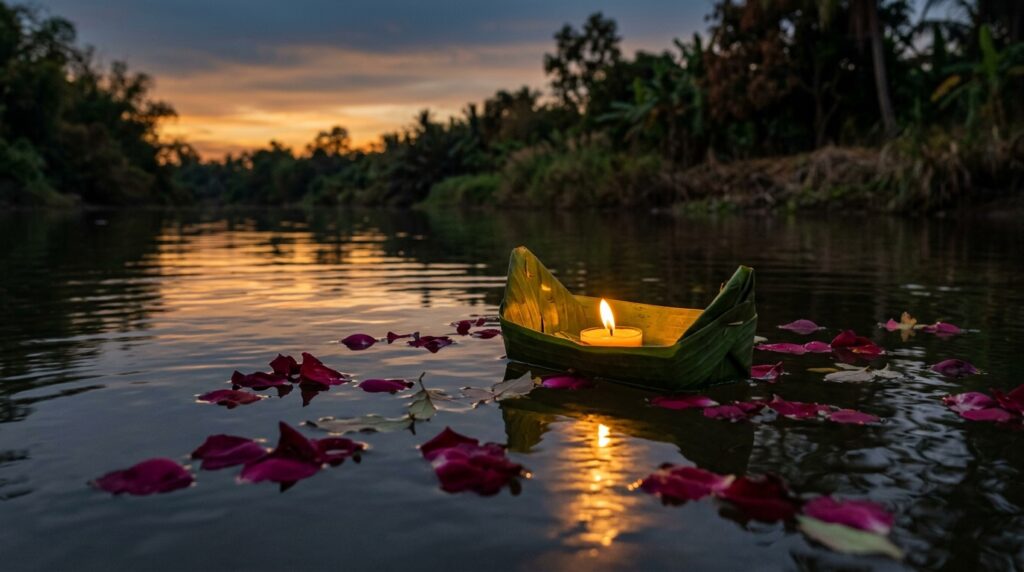
In Thailand, the full moon of the twelfth lunar month brings Loy Krathong, usually in November[4]. People float a krathong, a small raft of folded banana leaves with a candle and three incense sticks[4]. As it drifts away, the act stands for letting go of hatred, anger and defilements[4].
Some people go further. They add their own nail clippings to the krathong as a sign of letting go of past wrongs and negative thoughts[4]. Like the Japanese doll, this puts a real piece of the person into the water.
Loy Krathong also carries a modern lesson. Some krathongs are now made of bread so they break down naturally. Meanwhile, foam versions face growing bans because they pollute waterways[4]. So if you borrow from this tradition for a letting go spell, choose materials the river can absorb.
Cut, Burn or Wash Away: Choosing the Right Release Spell
Put these water rituals beside the better-known cord cutting, and a useful difference appears. Each method suits a different kind of pain. Here is how this guide reads them.
| Method | What it does | Best for |
|---|---|---|
| Cut | Severs a tie | A pull toward one person |
| Burn | Ends and transforms | A chapter you want closed |
| Wash away | Carries off slowly | Grief that needs to move |
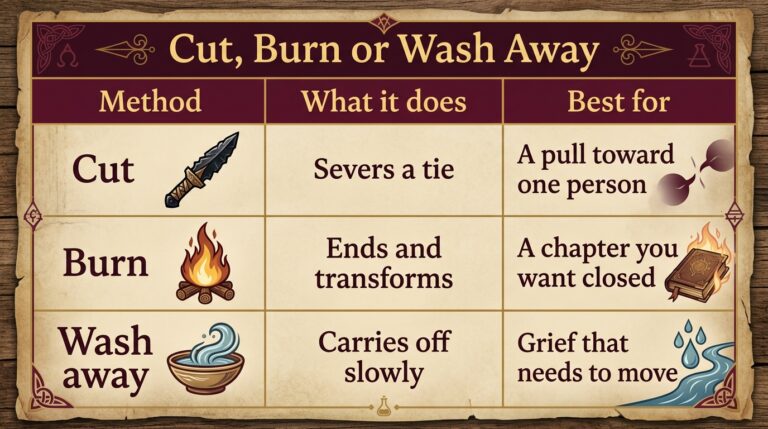
Look closely at the three water traditions, and they share a pattern. Each one puts something physical into the water: bread, a doll that touched the body, or nail clippings. None of them destroys the object. Instead, they let the current carry it somewhere else. Each also happens on a set date, such as the new year, the Doll Festival or a full moon.
In this guide’s reading, that points to a clear use. Cutting suits a tie to another person, and the cut and clear ritual for spiritual ties covers that in full. Water suits something you can’t cut, because it lives inside you. Heartache is that kind of thing. So a water-based letting go spell makes sense when the person is already gone, but the feeling isn’t.
If you’re still unsure whether you want to let go at all, it helps to answer that first. The guide on choosing reconciliation or release walks through that question.
Feel It First: Why a Heartbreak Spell Starts on Paper
Before anything goes into the water, a letting go spell works best when you’ve named what you’re releasing. That is where writing comes in, and here psychology has something to add.
In a well-known 1986 study, James Pennebaker and Sandra Beall asked students to write about their deepest thoughts and feelings on an upsetting experience. Participants wrote for 15 to 20 minutes over several sessions[5]. Later research linked this kind of writing to better mood and fewer doctor visits[5]. However, the same review notes that writing can bring a short-term rise in sadness, and it should never replace medical or psychological care[5].
That caveat matters for ritual work too. A feel your own heartbreak spell isn’t meant to skip the pain. It asks you to meet it on the page first, and only then release it. So expect the writing step to sting a little. That sting is part of the process, not a sign that it went wrong.
How to Do a Letting Go Spell With Water
This releasing spell borrows its shape from the traditions above. This letting go spell works at a river, a stream or the sea. It also works at home with a bowl of water.
- First, choose your time. The traditions above all used a set date, so pick one that means something to you, such as a full moon or the end of the month.
- Next, write it out. Spend 15 to 20 minutes writing what you feel about the loss. Don’t edit and don’t reread it yet.
- Then make a carrier. Copy one short line from your writing onto a leaf, a flower petal or dissolvable paper. Keep it small and natural, so the water can break it down.
- After that, hold it close. Press the carrier to your chest for a moment, echoing the Japanese doll that touched the body. Say aloud what you are releasing.
- Finally, let it go. Place it on moving water and watch it drift away. At home, let it soften in the bowl, then pour the water onto soil outside.
You can keep or burn the longer piece of writing. Rereading it a few weeks later can show you how far you’ve come.

Belief, Intention & The Power of Magic
Witchcraft, spells, and manifestation are deeply rooted in belief, intention, and spiritual practice. If these practices do not resonate with you, this may not be the path for you, and that’s perfectly okay. But if you believe in divine powers, trust your intentions, and feel drawn to the mysteries of the unseen, we invite you to continue exploring with Madame Celestine and discover the magic that speaks to your soul.
After the Spell: Detachment Takes More Than One Night
A detachment spell marks a decision. It doesn’t finish the work in a single evening. Notice that every tradition in this guide repeats each year. Tashlich returns every Rosh Hashanah, and Loy Krathong returns every November. So if the ache comes back, that doesn’t mean the ritual failed. You can simply repeat the letting go spell at your next chosen date.
In the days after, small changes help the intention hold. For example, put away photos you keep reaching for, or mute a profile you check too often. These are practical steps, but they match the ritual’s meaning: you’ve let something float away, so stop pulling it back to shore.
You can also pair spells to detach from someone with a cleansing of your space. The guide to smoke, salt or water cleansing explains which method suits which situation.
Finally, be gentle with yourself. If heartache turns into weeks of sleeplessness or hopelessness, talk to someone you trust or a counselor. A ritual can support healing, but it works best alongside real support.
Frequently Asked Questions
What is a letting go spell?
A letting go spell is a ritual for releasing a feeling, a relationship or a chapter that still weighs on you. This version uses moving water to carry a small token of that feeling away.
Is there a spell to remove heartache?
Release rituals are often used for heartache, and water rituals suit it well because grief needs to move rather than be cut. No ritual can promise to erase pain, but it can mark a clear decision to let it go.
What is the difference between a detachment spell and cord cutting?
Cord cutting is meant to sever a tie to another person. A water-based detachment spell focuses on the feeling inside you, letting it drift away instead of cutting it.
Can I do a release spell without a river?
Yes. Place your natural carrier in a bowl of water, let it soften, and then pour the water onto soil outside.
How often can I repeat a letting go spell?
You can repeat it whenever the feeling returns strongly. A regular date, such as each full moon, keeps the practice steady until the release feels complete.
References
- Tashlich. Reform Judaism. https://reformjudaism.org/glossary/tashlich
- Tashlikh. Wikipedia. https://en.wikipedia.org/wiki/Tashlikh
- Hinamatsuri. Wikipedia. https://en.wikipedia.org/wiki/Hinamatsuri
- Loy Krathong. Wikipedia. https://en.wikipedia.org/wiki/Loy_Krathong
- Karen A. Baikie and Kay Wilhelm. Emotional and physical health benefits of expressive writing. Advances in Psychiatric Treatment, Cambridge University Press, 2005. https://www.cambridge.org/core/journals/advances-in-psychiatric-treatment/article/emotional-and-physical-health-benefits-of-expressive-writing/ED2976A61F5DE56B46F07A1CE9EA9F9F
Not sure where to start? You don’t have to do this alone.
Madame Celestine offers guided spellwork for beginners — real support for your first working, not just another guide to read.
Related reading: Protection Talisman: How to Enchant Jewelry as an Amulet · Honey Jar Spell Mistakes: When to Add, Shake and Retire the Jar

About Wren Ashby
Wren Ashby is the pen name our editorial team uses for articles on sigils, Tarot and modern traditional witchcraft. Articles under this byline are researched from published sources and reviewed by Madame Celestine before publishing.