

A protection talisman can be as small as a pendant, yet people have trusted these pieces of jewelry for thousands of years. So what turns an ordinary necklace or ring into a protective charm? This guide looks at the object itself. You’ll learn the difference between an amulet and a talisman, which protective symbols different cultures wear, and why their shapes, colors and inscriptions matter. Then you’ll see how to choose and prepare your own piece, step by step.
- Protection Talisman or Amulet: What’s the Difference?
- The Eye That Watches Back: Nazar and the Wedjat
- The Open Hand: Hamsa Jewelry as a Protection Talisman
- Written Power: Taoist Fulu and the Talisman No One Reads
- Wiccan Amulets: The Pentacle as a Protection Talisman
- Choosing a Protective Talisman: Shape, Color, Material and Words
- How to Make an Amulet for Protection From Jewelry
- When a Protection Talisman Cracks: Care and Common Mistakes
- Frequently Asked Questions
- References
Protection Talisman or Amulet: What’s the Difference?
The two words are often swapped, but they don’t mean quite the same thing. Britannica defines an amulet as an object, natural or made by hand, that people believe can protect them or bring good fortune[1]. A talisman is sometimes defined more narrowly, as an engraved amulet[1].
That small difference is useful. A plain stone or a bare silver ring is an amulet. Once a symbol, a name or a line of writing is added to it, it becomes a talisman. In other words, a protection talisman carries a message on its surface.
The list of possible materials is long. Amulets have been made from precious stones, metals, plants, bones and animal teeth, and also from religious medals and small figurines[1]. Even modern objects count. Britannica lists crosses, birthstones and rabbit’s feet as present-day examples[1]. So the jewelry box on your dresser may already hold a few witchcraft amulets without you thinking of them that way.
The Eye That Watches Back: Nazar and the Wedjat
An eye is one of the most common shapes for a protection talisman. The logic behind them is easy to follow. If harm arrives through a jealous look, an eye charm meets that look and turns it away.
The best-known example today is the nazar. It is a handmade glass bead with rings of dark blue, white and light blue around a dark center[2]. The name comes from the Arabic word for “sight”[2]. In Turkish belief, blue works as a shield and soaks up negativity[2]. The same charm appears as the máti in Greece and in Persian and Afghan folklore too[2].
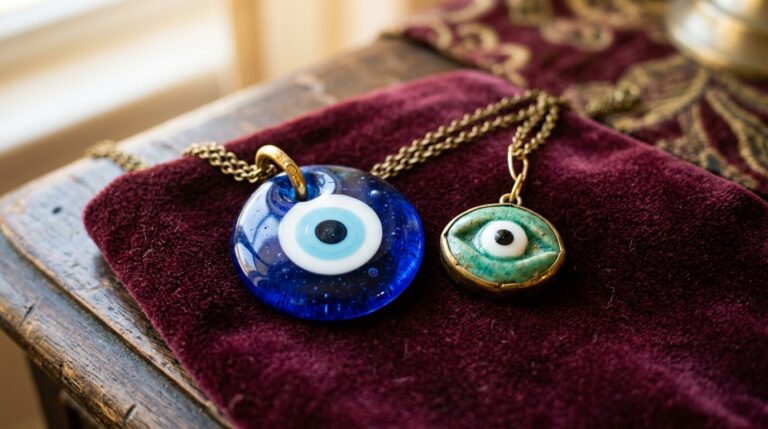
Ancient Egypt had its own eye, much older. The wedjat shows the healed eye of the god Horus, and its name means “the one that is sound (again)”[3]. Egyptians believed it passed the power of healing on to its wearer and protected them in general[3]. Notably, the colors overlap with the nazar. Egyptian amulets were often made of faience in green and blue, because those colors stood for life and renewal[3].
The Open Hand: Hamsa Jewelry as a Protection Talisman
The hamsa is a palm-shaped amulet popular across North Africa and the Middle East, worn as jewelry and hung on walls[4]. Its name comes from the Arabic word for “five,” after the five fingers[4]. Muslim, Jewish and Christian communities all use it, each with its own meaning. For example, it is called the Hand of Miriam in Jewish settings[4].
Like the nazar, the hamsa is meant to guard against the evil eye. What makes it unusual is that its direction changes its job. With the fingers pointing up, it is said to ward off evil. With the fingers pointing down, it is meant to give blessings instead[4]. So if you choose a hamsa pendant as a protection talisman, check which way it hangs.
Material mattered here as well. Older hamsas were most often carved from jet or made of silver[4]. Both are durable, so the charm could be worn every day for years.
Written Power: Taoist Fulu and the Talisman No One Reads
In China, the classic protective talisman is written rather than carved. Taoist fulu are magic symbols and incantations painted on talismans by Taoist practitioners[5]. They act as instructions to deities and spirits, as symbols for driving out harmful influences, and as part of healing work[5].
The strokes resemble Chinese characters, but they are stretched, stacked and mixed with signs that are not characters at all[5]. Scholars note that the talisman’s authority comes partly from the fact that ordinary people can’t read it[5]. In fact, by the Eastern Jin dynasty (317–420), users no longer needed to understand the writing for the talisman to count[5].
The method of writing fulu was also guarded. It usually passed in secret from a Taoist priest to their students as a special craft[5]. As a result, the value of a fulu as a protection talisman rested partly on who had written it.
Wiccan Amulets: The Pentacle as a Protection Talisman
For many modern witches, the pentacle is the most familiar protection talisman. Yet its history is older than Wicca. In the old grimoires, or books of ritual magic, a pentacle was a talisman used when calling spirits. It could be made of many materials and carried magical designs[6]. It wasn’t always a five-pointed star, either.
One grimoire tells the user to wear the pentacle around the neck, promising that no enchantment could then harm them[6]. You can read more about these protective tools in the old grimoires in a separate article.
Modern Wiccan amulets kept the shape but changed its meaning. Today, many Wiccans define the pentacle as a pentagram inside a circle, and it stands for the element of earth[6]. So a Wiccan talisman worn as a pendant links two traditions at once: the grimoire’s protective charm and the grounding symbolism of earth.
Choosing a Protective Talisman: Shape, Color, Material and Words
Put these traditions side by side, and a pattern stands out. The Metropolitan Museum of Art explains that an Egyptian amulet drew its power from four things: its shape, its material, its color and its inscription[3]. That framework was written about Egypt. However, in this guide’s reading, it fits the other traditions just as well.
| What it carries | Examples | Choose it if you want |
|---|---|---|
| Shape | Eye, open hand | A shield against envy |
| Color | Blue glass, green faience | Protection you can see |
| Material | Silver, jet | A charm for daily wear |
| Words | Fulu, pentacle | A specific, personal purpose |
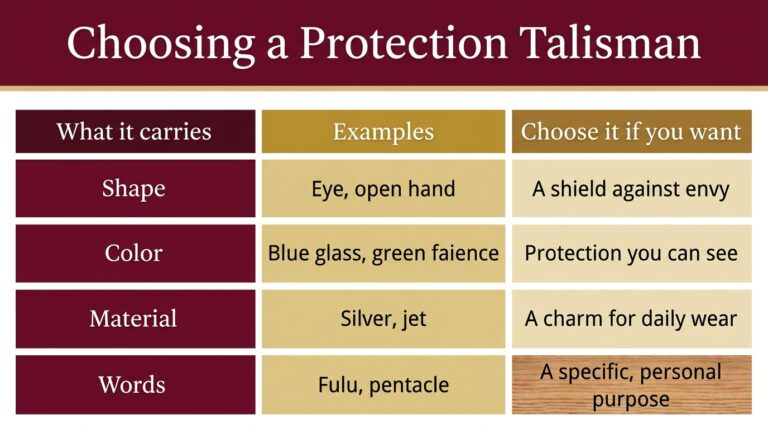
The nazar works mainly through shape and color. The hamsa works through shape and, for some wearers, its silver. Fulu and pentacles, by contrast, work through words and symbols. In each case, the maker leaned on one or two of the four, not all of them.
That gives you a practical rule. Before you buy or make a protection talisman, decide which of the four will carry its power. If envy or unwanted attention is the worry, an eye or a hand shape fits. If you want something tied to one specific intention, an inscription fits better, because writing turns an amulet into a talisman.
How to Make an Amulet for Protection From Jewelry
You don’t need a craftsman’s skills to create an amulet. Instead, you need a clear purpose and a piece you’ll actually wear. Enchanting jewelry follows the same few steps whatever symbol you pick, so here is a simple way to turn jewelry into a protection talisman.
- First, choose the piece. Use the four parts above. Pick a shape, color, material or symbol that matches what you want protection from.
- Next, cleanse it. Pass the piece through incense smoke or rinse it in water, so it starts fresh.
- Then add the words. This is the step that makes it a talisman. You can have a symbol engraved on the back, or fold a short written intention into a locket.
- After that, charge it. This is how you put intention into an amulet. The guide on how to charge and activate amulets covers moon, candle, breath and earth methods in detail.
- Finally, wear it close. Amulets were made to stay on the body, so keep the piece on you where you can feel it.

Belief, Intention & The Power of Magic
Witchcraft, spells, and manifestation are deeply rooted in belief, intention, and spiritual practice. If these practices do not resonate with you, this may not be the path for you, and that’s perfectly okay. But if you believe in divine powers, trust your intentions, and feel drawn to the mysteries of the unseen, we invite you to continue exploring with Madame Celestine and discover the magic that speaks to your soul.
When a Protection Talisman Cracks: Care and Common Mistakes
Folk tradition has a clear answer for a broken charm. In nazar belief, a bead that cracks has taken in a strong evil eye and broken while protecting its owner[2]. So the owner simply replaces it with a new one.
One common mistake is choosing a piece for looks alone. A pretty pendant is fine, but if its shape and symbols mean nothing to you, it has little to focus your intention on. Another mistake is forgetting the direction of a symbol. A hamsa hung fingers down, for example, is traditionally a blessing, not a guard.
A third mistake is never revisiting the piece. Jewelry worn every day picks up the wear of daily life. Cleansing and recharging it from time to time keeps the intention fresh. If the evil eye is your main concern, the evil eye signs quiz can help you think through what you’re guarding against.
Frequently Asked Questions
What is the difference between a protection talisman and an amulet?
An amulet is any object believed to protect or bring good fortune. A talisman is often defined as an engraved amulet, so a protection talisman carries a symbol or writing on it.
How do you make an amulet for protection?
Choose a piece whose shape, color, material or symbol matches your purpose, then cleanse it. Add an engraving or written intention, charge it, and wear it close to your body.
How do you put intention into an amulet?
Hold the piece, state your intention clearly, and then charge it with a method such as moonlight, candlelight or breath. Repeating the intention from time to time keeps it focused.
What are the most common protective amulets?
Eye charms such as the nazar, the open-hand hamsa, the Egyptian wedjat and the Wiccan pentacle are among the best known. Each guards against harm in its own traditional way.
Can any piece of jewelry become a jewelry spell?
Yes, almost any piece you wear often can be used for a jewelry spell. The best choices are pieces with a meaningful shape or symbol, because they give your intention something to hold on to.
References
- Amulet. Encyclopaedia Britannica. https://www.britannica.com/topic/amulet
- Nazar (amulet). Wikipedia. https://en.wikipedia.org/wiki/Nazar_(amulet)
- Isabel Stünkel. Ancient Egyptian Amulets. The Metropolitan Museum of Art, February 2019. https://www.metmuseum.org/essays/egyptian-amulets
- Hamsa. Wikipedia. https://en.wikipedia.org/wiki/Hamsa
- Fulu. Wikipedia. https://en.wikipedia.org/wiki/Fulu
- Pentacle. Wikipedia. https://en.wikipedia.org/wiki/Pentacle
Not sure where to start? You don’t have to do this alone.
Madame Celestine offers guided spellwork for beginners — real support for your first working, not just another guide to read.
Related reading: Honey Jar Spell Mistakes: When to Add, Shake and Retire the Jar · Lammas and Lughnasadh: How to Celebrate the First Harvest

About Wong Fat Kin
Wong Fat Kin is the pen name our editorial team uses for articles on Taoist ritual, talismans (符), house cleansing, Feng Shui and divination. Articles under this byline are researched from published sources and reviewed by Madame Celestine before publishing.