
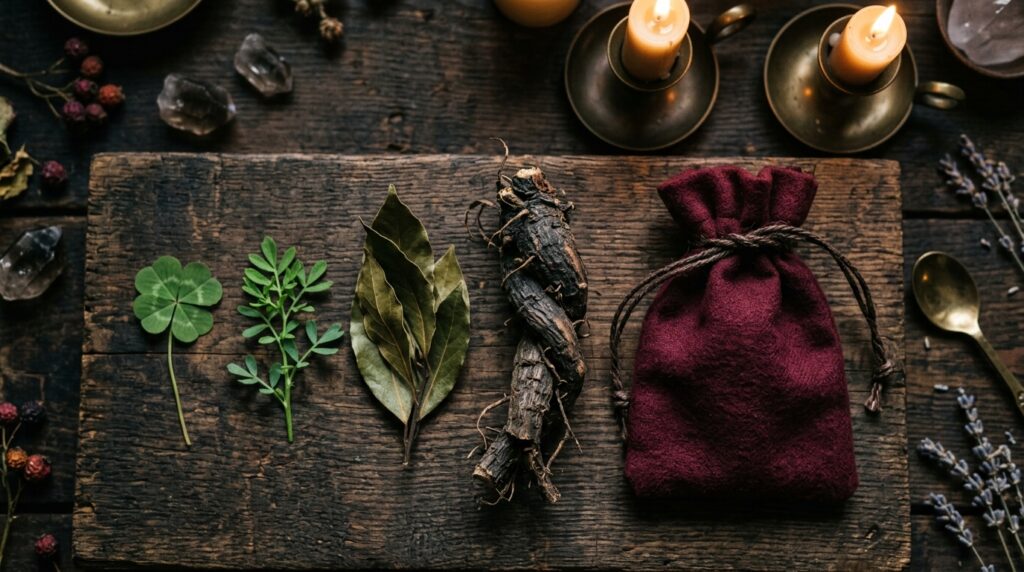
Herbs for luck turn up in almost every old family tradition, yet each country used them in its own way. So which plants did people actually trust with their fortune, and what did they do with them? In this guide, you’ll meet the clover of Ireland, the rue and bay laurel of Italy, and the roots of Southern Hoodoo. You’ll also learn how each one was carried, worn or burned, and why. Then we’ll put the traditions side by side, because the pattern they share is more useful than any single plant.
- Ireland’s Shamrock and the Four-Leaf Clover
- Rue and the Cimaruta: Italy’s Silver Sprig of Luck
- Bay Laurel: The Roman Herb for Success
- Hoodoo Roots and the Mojo Bag: Good Luck Herbs You Feed
- Herbs for Luck Side by Side: The Common Thread
- How to Carry or Burn Good Luck Herbs at Home
- Common Mistakes With Lucky Herbs
- Frequently Asked Questions
- References
Ireland’s Shamrock and the Four-Leaf Clover
The most famous lucky plant in the world has an unclear identity. Nobody agrees which plant the true Irish shamrock is. Britannica notes there is no scientific agreement on the species, and lists white clover, suckling clover, wood sorrel and black medic as candidates[1]. So the national emblem of Ireland is, in a sense, a family of look-alikes.
The three-leaf shamrock’s best-known story is religious. According to legend, Saint Patrick used its three leaflets on one stalk to explain the Christian Trinity[1]. That is why people still pin it to their lapels on March 17.
The luck belongs to its rare cousin. Sometimes a clover plant makes a leaf with four leaflets instead of three, and that mistake is the lucky four-leaf clover[1]. In practice, that means you can’t buy this kind of luck by the bag. You find it, usually by chance.
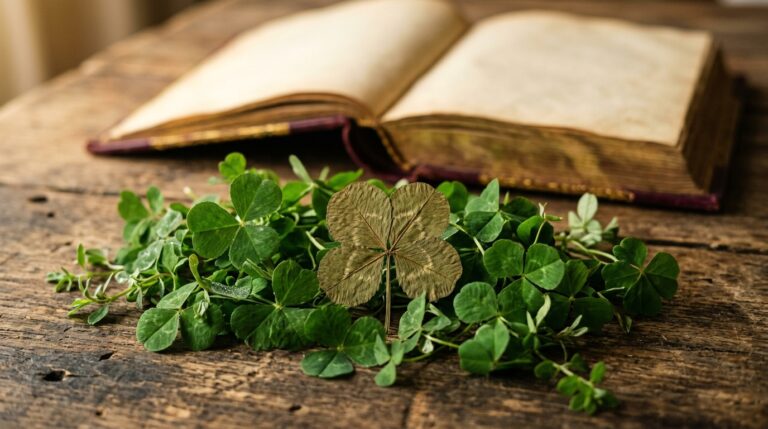
So if you ever find one, press it in a book or slip it into a wallet to keep the luck close. Among Irish herbs for luck, the clover teaches that good luck is something you notice first and then protect.
Rue and the Cimaruta: Italy’s Silver Sprig of Luck
In southern Italy, luck was often about defense. Here the big threat was the evil eye, the belief that envy from another person can spoil your fortune. So Italy’s best-known herbs for luck were guards, and the most famous charm protects fortune instead of chasing it.
That charm is the cimaruta. The name is a Neapolitan form of cima di ruta, which means “sprig of rue”[2]. It is a small silver amulet shaped like a branch of rue, with tiny charms hanging from its tips. Those charms can include a crescent moon, a hand holding a wand or sword, a fish, a snake, an owl and a vervain blossom[2]. Families traditionally wore it around the neck or hung it above a baby’s bed to ward off the evil eye[2].
Why rue? The sources don’t settle that question, but one likely reason is the plant itself. Rue is bitter and sharp-smelling, so it makes sense as a guard. Either way, the cimaruta turned the herb into metal. As a result, nobody needed a fresh sprig, because the shape of the plant did the work.
Rosemary is another of the old herbs for luck, with a long history in protection customs too. You can read more about the old rosemary doorstep customs in a separate guide.
Bay Laurel: The Roman Herb for Success
If rue protected luck, bay laurel announced it. Among the old herbs for luck, bay is the one most closely tied to winning, and it is one of the oldest herbs for success on record.
At the Pythian Games, held in honor of Apollo, winners received wreaths of bay laurel as a sign of the god’s favor[3]. Later, Rome made the laurel a symbol of victory. The Romans also believed laurel trees were safe from lightning. For that reason, Emperor Tiberius reportedly wore a laurel wreath during storms[3].
Bay is also the clearest example of a luck herb that was burned. Pliny the Elder wrote about how laurel crackles in a fire. Romans read that crackle as a sign that the plant held a kind of heavenly fire, which gave it protective power[3]. So when modern practitioners write a wish on a dry bay leaf and burn it, they are echoing a very old idea. To the Romans, the sound the leaf made in the fire was part of what it meant.
Hoodoo Roots and the Mojo Bag: Good Luck Herbs You Feed
Hoodoo, the African American folk tradition of the American South, treats herbs for luck as something closer to living partners. Much of that work happens through the mojo bag. This is a small flannel bag holding roots, herbs, coins or other tokens, carried as “a prayer in a bag”[4]. Related charms called gris-gris are tied especially to Louisiana Voodoo and Hoodoo[4].
Two details set the mojo bag apart. First, it stays hidden. Men often kept it in a pants pocket, while women might clip it inside a bra[4]. Second, it gets fed. The owner dresses the bag with liquids such as alcohol, perfume or water to keep it working[4].
The best-known luck root in Hoodoo is High John the Conqueror. Botanically, it is the root of Ipomoea jalapa, a relative of the morning glory[5]. It is considered lucky for gambling, and practitioners place it in mojo bags for victory, good luck and protection[5]. The root also carries a folk hero’s name. John the Conqueror was a trickster figure in African American stories, and he stood for resistance and courage[5].
Ginseng has a place here too. Because its root can look like a human figure, Hoodoo practitioners link it with vitality, and it is believed to bring good luck[6]. Practitioner Stephanie Rose Bird told the Smithsonian that “herbs and roots are alive and need tending”[6]. That belief also explains why a mojo bag gets fed. Spices joined these roots in the South as well, as the guide to cinnamon in New Orleans money magic shows.
Herbs for Luck Side by Side: The Common Thread
Side by side, the three traditions share a clear pattern.
| Tradition | Lucky herb | How it was kept |
|---|---|---|
| Ireland | Four-leaf clover | Found by chance, then saved |
| Italy | Rue (cimaruta) | Worn on the body as silver |
| Ancient Rome | Bay laurel | Worn as a wreath, or burned |
| Hoodoo | High John root, ginseng | Hidden in a mojo bag and fed |

Here is how I read that table. None of these traditions treats herbs for luck as a one-time fix. Instead, the herb stays close to the person, either on the body or near it. People save a clover once they find it. The cimaruta is worn every day. The mojo bag rides in a pocket and gets fed. Even burned bay was about something lasting, because the crackle was read as protection.
Also notice that luck and protection blur together in every case. The Italians guarded fortune from envy. The Romans trusted laurel against lightning. Hoodoo bags held luck and protection in the same flannel. So if you want to borrow from these traditions, choose one herb, keep it near you and keep tending it. That steady relationship matters more, in these traditions, than the rarity of the plant. For more on why plants carry this weight at all, see why herbs matter in spell work.
How to Carry or Burn Good Luck Herbs at Home
If you’d like to try this, start small. Here is a simple way to work with herbs for luck, drawn from the habits above.
- First, pick one herb for one intention. Bay suits success and new ventures, because of its link to victory. Clover suits general good fortune. Choose the herb whose story matches what you want, so the meaning stays clear.
- Next, decide how to keep it. To carry it, put a dried leaf or small root in a little cloth pouch. Flannel follows the mojo tradition, but any natural fabric works. Then keep the pouch in a pocket or bag you use every day.
- Or burn it instead. To burn bay, use one fully dry leaf. Write your wish on it, then light it over a fireproof dish near an open window. Listen for the crackle, since that sound was the part the Romans paid attention to.
- Finally, tend what you keep. A carried herb is not a set-and-forget object. So hold the pouch and restate your intention each week. You can also add a drop of oil, which echoes the Hoodoo habit of feeding a bag. When a herb crumbles or loses its scent, replace it.

Belief, Intention & The Power of Magic
Witchcraft, spells, and manifestation are deeply rooted in belief, intention, and spiritual practice. If these practices do not resonate with you, this may not be the path for you, and that’s perfectly okay. But if you believe in divine powers, trust your intentions, and feel drawn to the mysteries of the unseen, we invite you to continue exploring with Madame Celestine and discover the magic that speaks to your soul.
Common Mistakes With Lucky Herbs
The most common mistake with herbs for luck is stuffing too much into one charm. A pouch with nine herbs for nine wishes has no clear purpose. Instead, the old traditions each centered on a single plant, such as one clover or one main root.
Another mistake is ignoring the protective side. Every tradition above paired luck with guarding it. So if you feel your good fortune keeps slipping away, a protective herb may fit better than an attracting one. For example, rue’s whole history is about keeping envy out.
A third mistake is forgetting the plant once it’s tucked away. Hoodoo practice feeds the bag, and the cimaruta was worn daily. So if your pouch has sat at the bottom of a drawer for a year, it has lost the relationship these traditions valued. Likewise, if you work with basil for money, the guide to a basil money-drawing spell shows one way to work with that herb.
Finally, don’t confuse folklore with a promise. These herbs and their magical uses describe what people believed and hoped. They are a way to focus intention.
Frequently Asked Questions
What are the most common herbs for luck?
In the traditions covered here, the best-known lucky herbs are the four-leaf clover, rue, bay laurel, High John the Conqueror root and ginseng. Each comes from a different culture and was used in its own way.
How do you carry herbs for good fortune?
Put a dried leaf or small root in a little cloth pouch and keep it in a pocket or bag you use daily. In Hoodoo, this kind of pouch is called a mojo bag, and it is fed with a drop of oil or perfume to keep it active.
Which lucky herb is best for success?
Bay laurel is the classic herb for success. The ancient Greeks and Romans crowned victors with laurel, so it has a long link to winning and achievement.
Are there herbs for new beginnings?
The old traditions in this article don’t set aside one herb only for new beginnings. Bay is a natural fit for a fresh start, because its whole history is about victory and good outcomes.
Can you burn herbs for abundance in witchcraft?
Yes, many practitioners burn herbs for abundance, and bay is a popular choice because of its old link to fire. Write your wish on one dry leaf and burn it over a fireproof dish near an open window.
References
- Shamrock. Encyclopaedia Britannica. https://www.britannica.com/plant/shamrock
- Cimaruta. Wikipedia. https://en.wikipedia.org/wiki/Cimaruta
- Laurus nobilis. Wikipedia. https://en.wikipedia.org/wiki/Laurus_nobilis
- Mojo (African-American culture). Wikipedia. https://en.wikipedia.org/wiki/Mojo_(African-American_culture)
- High John the Conqueror. Wikipedia. https://en.wikipedia.org/wiki/High_John_the_Conqueror
- Asia Smith. Ginseng, Hoodoo, and the Magic of Upholding African American Earth-Based Traditions. Smithsonian Center for Folklife and Cultural Heritage, February 23, 2021. https://festival.si.edu/blog/ginseng-hoodoo-african-american-traditions
Not sure where to start? You don’t have to do this alone.
Madame Celestine offers guided spellwork for beginners — real support for your first working, not just another guide to read.
Related reading: Basil in Witchcraft: A Money-Drawing Spell With Basil Leaves · Summer Deities: 12 Gods and Goddesses of Sun and Abundance

About Madame Celestine
Madame Celestine has practiced and taught spellwork, divination, and seasonal ritual for over two decades, helping newcomers build a grounded, confident practice from their very first spell.