

Why does a common kitchen herb show up in so many money spells? Basil in witchcraft has a longer and stranger history than most practitioners realize. Long before anyone tucked a leaf into a wallet, basil was a royal perfume plant, a love signal on Italian windowsills and a sacred plant in Hindu homes. In this guide you’ll learn where those beliefs come from and why modern practitioners tie basil to money. You’ll also find a simple money-drawing spell called Fresh Funds, with the reason behind each step.
- Basil in Witchcraft Starts With a King’s Name
- Scorpions, Curses and Windowsills: Basil’s Odd Folk History
- Basil Magical Properties: Why Money Joined the List
- Five Traditions, One Herb: What Basil in Witchcraft Really Borrows
- The Fresh Funds Spell: A Money-Drawing Ritual With Basil Leaves
- Wilted Leaves and Other Basil Spell Mistakes
- Beyond Money: Other Basil Uses in Witchcraft
- Frequently Asked Questions
- References
Basil in Witchcraft Starts With a King’s Name
“Basil” comes from the Greek basilikon, meaning “royal plant,” from basileus, the word for king.[1] The usual explanation is practical. The plant was probably named this way because people believed it went into royal perfumes.[1]
That royal link still shapes how practitioners read the herb today. A plant fit for a king’s perfume suggests abundance and status. So when modern witches look for an herb that “attracts” wealth, a plant with a kingly name is an easy fit.
Botany adds a second layer. Sweet basil (Ocimum basilicum) belongs to the mint family, and it is likely native to India.[2] This matters because the herb reached Europe carrying reputations from several cultures at once. As a result, basil in witchcraft today is a blend of Indian, Greek, Italian and Christian folk belief, often without anyone noticing the seams.
Scorpions, Curses and Windowsills: Basil’s Odd Folk History
Basil’s folk record is full of contradictions. For example, the ancient Greeks believed basil had to be sown while shouting abuse at it, or it would not thrive.[3] Gardeners cursed the seed bed, and the plant was expected to grow better for it.
Old herbals were also suspicious of it. One claim held that a sprig of basil left under a pot would turn into a scorpion.[3] Yet basil was also prescribed for scorpion stings. The 17th-century herbalist Nicholas Culpeper called it “an herb of Mars, and under the Scorpion.”[3] Mars, in old astrology, ruled heat, conflict and drive. That fiery rating helps explain why many modern correspondence lists still pair basil with Mars and the element of fire.
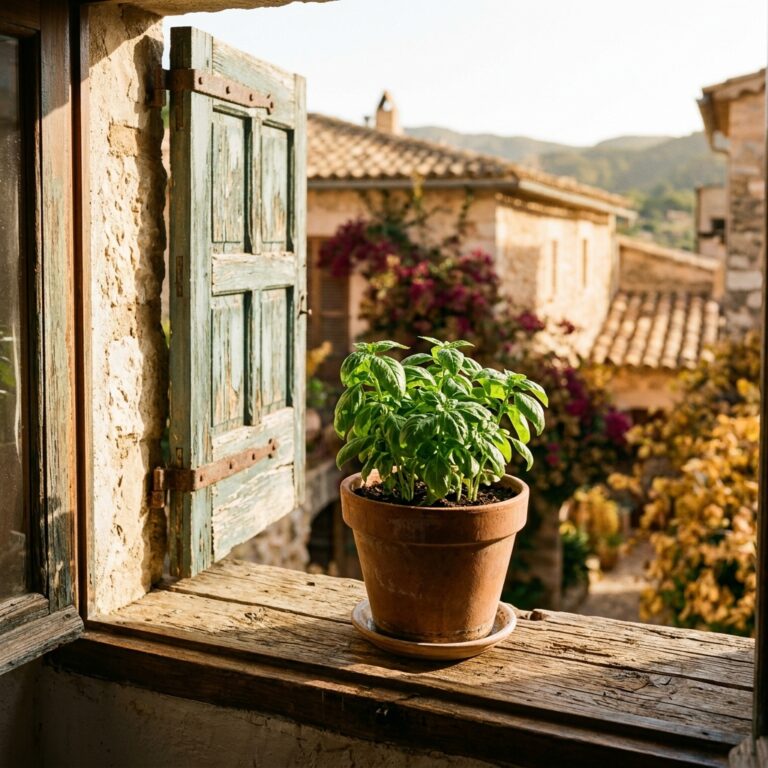
Italy gave basil a gentler role. In Renaissance custom, a pot of basil on a windowsill told passers-by that an eligible daughter lived inside.[3] Boccaccio’s Decameron (around 1353) turned the plant tragic. In one tale, a young woman named Lisabetta hides her murdered lover’s head in a pot of basil and waters it with her tears.[3] Centuries later, John Keats retold the same story in his poem “Isabella, or the Pot of Basil.” Because of stories like these, basil in witchcraft still carries a strong link to love and devotion.
Basil Magical Properties: Why Money Joined the List
So how did a love and scorpion herb become a money herb? The older sources above say very little about wealth. Instead, the money link seems to come from how the plant looks and behaves, plus its royal name.
First, consider the leaves. They are broad, green and soft, and practitioners often compare them to paper money. Sympathetic magic, the idea that like attracts like, makes that resemblance meaningful. Second, basil grows fast when it’s pinched back. Every cut encourages two new shoots, so the plant models the idea of money that multiplies when used well.
Scent is the third factor, and it is also the easiest to notice, since basil releases a strong smell the moment you bruise a leaf. Many practitioners believe that fragrance “wakes up” an herb’s intention, which is why rubbing leaves between the palms is a common step. To understand how scent, color and plant lore fit together in spellcraft, see this guide on why herbs matter in spell work.
Together, these basil magical properties explain its reputation. Practitioners use it to draw steady income, support a new business or invite prosperity into a home. These are the intentions practitioners hold for the herb, and no spell can guarantee an outcome.
Five Traditions, One Herb: What Basil in Witchcraft Really Borrows
Basil means something different in each culture that grows it. However, a pattern appears once you line those meanings up side by side.

In Hinduism, holy basil, or tulsi (Ocimum tenuiflorum), is sacred and often seen as a form of the goddess Lakshmi.[4] Lakshmi is the goddess of wealth and good fortune. During the festival of Tulsi Vivah, homes and temples hold a ceremonial wedding between the tulsi plant and the god Vishnu.[4] Tulsi is also believed to offer protection.[4]
In Greek Orthodox tradition, the tie runs through the Cross. According to a Greek legend, basil grew on the spot where Saint Helena found the True Cross.[5] On the Feast of the Holy Cross, September 14, worshippers still take sprigs of basil home. Families often root those sprigs in water and plant them in the garden.[5] Some older households even used the blessed basil to start a new sourdough starter.[5]
Where Basil Lives in Each Tradition
| Tradition | Where basil is kept | What it signals |
|---|---|---|
| Ancient Greek | Royal perfume, the garden bed | Kingship and status |
| Culpeper’s herbal | The medicine chest | Mars, heat and drive |
| Renaissance Italy | The windowsill | An open invitation |
| Hindu tulsi worship | The household shrine | Lakshmi, fortune and protection |
| Greek Orthodox | Carried from church into the home | Blessing brought across the threshold |
Put side by side, these traditions share one habit. Basil almost always sits at a boundary of the home. It stands in the window, lives in the household shrine or crosses the threshold from church to kitchen. In each case, the plant marks the point where something welcome comes in, whether that’s a suitor, a blessing or a goddess of fortune.
For money work, this suggests a simple rule when using basil in witchcraft. Place your basil where money actually enters your life. That could be your wallet, the cash drawer, your front door or your work desk. A basil charm hidden in a drawer you never open misses the pattern these traditions share.
The Fresh Funds Spell: A Money-Drawing Ritual With Basil Leaves
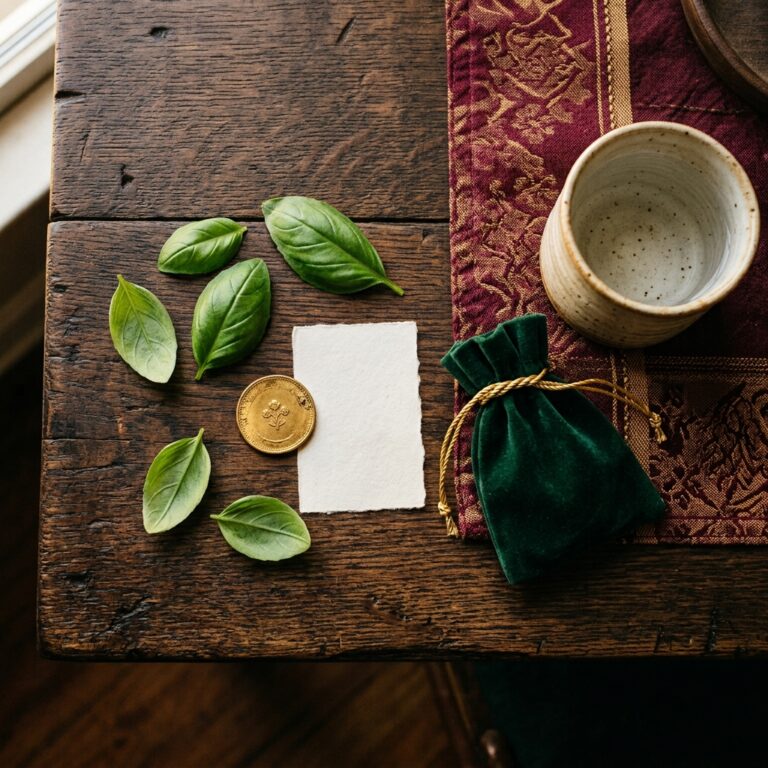
Like most money work with basil in witchcraft, this spell uses fresh leaves, because the goal is growth. It takes about 15 minutes, and everything can come from a grocery store. Here is what you’ll need:
- Five to seven fresh sweet basil leaves
- One coin or small bill you actually own
- A small slip of paper and a pen
- Green cloth pouch or folded green paper
- Clean water in a cup
Step by Step: Basil in Witchcraft for Money
1. Choose your timing. Many practitioners work money spells during the waxing moon, the phase when the moon appears to grow each night. Thursday is also popular, because planetary correspondences link it to Jupiter and expansion. If neither fits your schedule, a clear intention matters more than the calendar.
2. Name a specific goal. First, write one concrete money goal on the slip of paper, such as covering a bill or finding new clients. Vague wishes give the spell nothing to focus on, so be exact about what the money is for.
3. Wake the leaves. Rinse the basil and pat it dry. Then rub each leaf gently between your palms until you smell it. This step echoes the herb’s history as a perfume plant, and practitioners treat the scent as the moment the herb starts working.
4. Build the charm. Lay the coin on the paper and cover it with the leaves. Next, fold the paper toward you, since many practitioners fold toward the body when the goal is to draw something in. Place the bundle in the green pouch. If you’d like a candle as well, this green candle money ritual pairs well with it.
Placing and Refreshing Your Basil Charm
5. Put it where money enters. Then keep the pouch in your wallet, near your cash drawer or by your front door. Following the threshold pattern above, the location matters as much as the ingredients.
6. Make a basil wash. Next, drop any leftover leaves into the cup of water and let them steep for an hour. Then wipe the water across your doorstep or the counter where you take payments.
7. Refresh it every week. Fresh basil wilts within a few days. So replace the leaves weekly, and return the old ones to the soil. This mirrors the Greek custom of rooting blessed basil and planting it back in the garden.
Belief, Intention & The Power of Magic
Witchcraft, spells, and manifestation are deeply rooted in belief, intention, and spiritual practice. If these practices do not resonate with you, this may not be the path for you, and that’s perfectly okay. But if you believe in divine powers, trust your intentions, and feel drawn to the mysteries of the unseen, we invite you to continue exploring with Madame Celestine and discover the magic that speaks to your soul.
Wilted Leaves and Other Basil Spell Mistakes
Rot is the first problem to watch for when using basil in witchcraft. Fresh leaves sealed in a wallet will turn brown and can grow mold. A rotting charm sends the opposite message from “fresh funds,” so change the leaves before they spoil.
Swapping in dried basil from the spice rack also changes the spell. Dried basil still works in jars and powders, and many practitioners use it that way. However, this particular spell relies on scent and freshness, so fresh leaves suit it better.
People also mix up the two plants. Sweet basil is the kitchen herb. Tulsi, or holy basil, is a separate species with its own sacred role in Hinduism. If you work with tulsi, treat it with the respect its tradition gives it, instead of using it as a stand-in ingredient.
Finally, don’t expect the charm to replace real effort. Practitioners describe a money spell as a way to focus intention, so pair it with a practical step, like sending the invoice. Some add a second money herb for warmth, and cinnamon in money magic is the classic partner.
Beyond Money: Other Basil Uses in Witchcraft
Basil’s spiritual uses also reach well past prosperity, so much of basil in witchcraft has nothing to do with money. Because of its Italian history, many practitioners use it in love and attraction work. A pot of basil on the kitchen windowsill doubles as a quiet nod to that old courtship signal.
Protection is another major theme. Tulsi’s protective reputation in Hinduism and the Orthodox habit of carrying blessed basil home both feed this use.[4][5] For example, some practitioners hang a small bundle near the front door. Others add basil to floor washes to bless a new home. If you’re drawn to doorway magic, these rosemary protection customs follow a similar logic.
Basil also appears in home blessings and in work to ease household tension. Across all of these magical uses of basil, the thread stays the same. The herb welcomes good things in at the places where people and energy cross into the home.
Frequently Asked Questions
What is basil used for in witchcraft?
Basil is mainly used for money drawing, love and attraction, protection and home blessing. Practitioners often place it at doors, windows or wallets, where they want good things to enter.
Can I use dried basil for a money spell?
Yes, dried basil works well in jars, powders and sachets. For the Fresh Funds spell, fresh leaves are better because the ritual relies on their scent and freshness.
Is holy basil the same as sweet basil in witchcraft?
No. Sweet basil is the common kitchen herb, while holy basil, or tulsi, is a different species that is sacred in Hinduism. Many practitioners reserve tulsi for devotional work rather than general spellcraft.
How often should I refresh a basil money charm?
Replace fresh leaves about once a week, or sooner if they start to brown. Many practitioners return the old leaves to the soil instead of throwing them away.
Which planet is basil linked to?
Basil is most often linked to Mars and the element of fire. The herbalist Nicholas Culpeper gave it this rating in the 17th century, and many modern correspondence lists still follow it.
References
- Basil – Etymology, Origin & Meaning. Online Etymology Dictionary. https://www.etymonline.com/word/basil
- Basil. Encyclopaedia Britannica. https://www.britannica.com/plant/basil
- Julia Blakely. A Pot of Basil in Every Household. Biodiversity Heritage Library (Smithsonian Libraries), June 27, 2017. https://blog.biodiversitylibrary.org/2017/06/a-pot-of-basil-in-every-household
- Tulsi Vivah. Encyclopaedia Britannica. https://www.britannica.com/topic/Tulsi-Vivah
- Artemis Markaki. Why Greeks Bring Basil Home on the Feast of the Holy Cross. GreekReporter.com, September 14, 2026. https://greekreporter.com/2026/09/14/holy-cross-basil-greek-tradition/
Not sure where to start? You don’t have to do this alone.
Madame Celestine offers guided spellwork for beginners — real support for your first working, not just another guide to read.
Related reading: Summer Deities: 12 Gods and Goddesses of Sun and Abundance · Rosemary on the Doorstep: Old Protection and Luck Customs

About Wren Ashby
Wren Ashby is the pen name our editorial team uses for articles on sigils, Tarot and modern traditional witchcraft. Articles under this byline are researched from published sources and reviewed by Madame Celestine before publishing.