

Why did so many ancient cultures give the summer sun a face and a name? The answer says a lot about how people once lived. The summer deities of the old world carried the hopes of farmers, kings and families who depended on light and a good harvest. In this guide, you will meet 12 gods and goddesses of sun and abundance from Greece to Japan to the Andes. You will also see a surprising pattern that links many of them. Then you will find a simple way to honor them at home.
- Summer Symbolism: Why the Sun Needed a Name
- The Greek God of Summer: Helios, Apollo and Demeter
- Summer Gods of Egypt, India and the Andes
- When the Sun Is a Woman: The Summer Goddess
- The Chariot Pattern That Links Summer Deities
- Gods of Summer Abundance: Freyr, Lugh and Ceres
- Honoring Summer Deities: A Simple Solstice Offering
- Summer Deities Beyond the Solstice
- Frequently Asked Questions
- References
Summer Symbolism: Why the Sun Needed a Name
For most of history, summer was not a holiday season. Instead, it was the season that decided whether a community would eat through the winter. Long days ripened the grain, and warm weather fed the herds. So a strong summer meant food, trade and safety.
That is why summer symbolism is so often about two things at once. First, there is the sun itself, bright and powerful at its peak. Second, there is the abundance the sun makes possible, such as ripe fields, fruit and full storehouses. Many cultures gave these two jobs to different summer deities. One deity drove the sun, while another looked after the harvest.
Keep that split in mind as you read. It explains why the list below mixes shining sun figures with earthy grain goddesses. Together, these summer deities tell one story about light becoming food.
The Greek God of Summer: Helios, Apollo and Demeter
If you ask for the Greek god of summer, the first answer is usually Helios. He was the sun in person, not just a god who ruled it. According to Greek myth, he drove a chariot across the sky from east to west every day. Then, at night, he sailed back around the world’s northern ocean in a huge golden cup.[1] The island of Rhodes treated him as its chief god from at least the early 5th century BCE.[1]
Apollo is the second answer, and his story is more complicated. He began as a god of light in the sense of purity, music and healing. However, from the 5th century BCE onward, Greeks increasingly read him as a sun god as well.[1] That is why modern books often blur Helios and Apollo together, even though they started as separate figures.
Finding a Greek goddess of summer is harder, because no single goddess owned the season. Instead, many modern pagans turn to Demeter, the goddess of grain. In her best-known myth, her grief for her daughter Persephone makes the earth barren. When Persephone returns, the fields grow again. As a result, Demeter joins the summer deities as the face of the growing season and its harvest.
Summer Gods of Egypt, India and the Andes
Outside Greece, three summer deities stand out for how deeply they shaped daily life.
Ra (Egypt). Ra was the Egyptian sun god and one of the most important gods in the country’s long history. Egyptians pictured him sailing across the sky in a boat, because the Nile made boats the natural way to travel. At night, his boat passed through the underworld, and each sunrise was his return.
Surya (India). In Hinduism, Surya is both the sun and the sun god. He usually rides a chariot drawn by seven horses, or by a single horse with seven heads.[2] The 13th-century Sun Temple at Konark in Odisha takes this idea literally. Its builders designed the whole temple as a giant chariot on wheels, pulled by stone horses.[2]
Inti (Inca Empire). Inti was the Inca sun god, and Inca rulers claimed him as their ancestor. His great festival, Inti Raymi, fell near the June solstice, which is midwinter in the Southern Hemisphere. So his main feast asked the sun to return and strengthen, rather than celebrating its peak. Today, Cusco still stages a large Inti Raymi reenactment every June.
When the Sun Is a Woman: The Summer Goddess
Many readers assume the sun is always male in mythology. In fact, several cultures saw it as a woman. Their myths hold the clearest summer goddess figures.
Sól (Norse). In the Prose Edda, a 13th-century Icelandic book of myths, Sól drives the chariot of the sun. Her two horses are named Early-Wake and All-Strong. A wolf named Sköll chases her across the sky, and she runs because she fears him.[3] This myth explains the sun’s steady movement as a daily escape.
Saule (Baltic). In Latvian and Lithuanian folk tradition, Saule is the sun goddess. Folk songs often describe her crossing the sky and sinking into the sea each evening. She is closely tied to midsummer, when Latvians celebrate Jāņi and Lithuanians celebrate Rasos with bonfires, oak leaves and flower crowns.
Amaterasu (Japan). Amaterasu is the Shintō sun goddess, and Japan’s imperial family claims descent from her. In a famous myth, she hides in a cave in protest, and darkness falls over the world.[4] Her main shrine is the Grand Shrine of Ise. There, a sacred mirror represents her, and it is one of Japan’s three imperial treasures.[4] So for anyone searching for a goddess of summer, Amaterasu is among the most honored summer deities anywhere.

The Chariot Pattern That Links Summer Deities
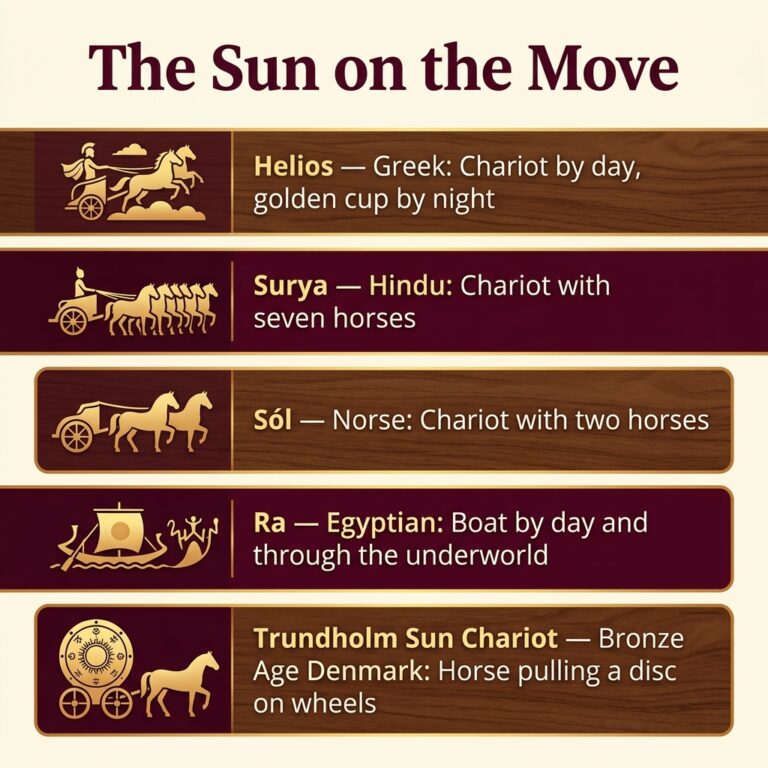
Put side by side, these myths share a striking habit. Again and again, the sun does not simply shine. Instead, it travels, and it almost always needs a vehicle.
The oldest physical proof of this idea comes from Denmark. In 1902, a farmer ploughing the Trundholm bog turned up a bronze model of a horse pulling a sun disc on wheels. Archaeologists date the Trundholm Sun Chariot to around 1400 BC. It shows the belief that a divine horse drew the sun on its endless journey.[5] That is more than two thousand years before the Prose Edda wrote down Sól’s horses.
Here is how the pattern looks across the traditions in this article:
| Deity | Culture | How the sun travels |
|---|---|---|
| Helios | Greek | Chariot by day, golden cup by night |
| Surya | Hindu | Chariot with seven horses |
| Sól | Norse | Chariot with two horses |
| Ra | Egyptian | Boat by day and through the underworld |
| Trundholm sun | Bronze Age Denmark | Horse pulling a disc on wheels |
Notice what changes and what stays the same. The vehicle matches the local way of travel. Egypt, a river culture, chose a boat, while horse-keeping peoples chose chariots. Yet the core idea holds steady: the sun is a traveler on a daily route, and someone has to keep it moving.
For a modern practitioner, this is the most useful insight here. Old summer deities were rarely honored as static lights. People honored them as beings doing work, day after day. So a summer ritual that gives thanks for that steady effort follows the old logic more closely than one that only asks for power.
Gods of Summer Abundance: Freyr, Lugh and Ceres
The sun is only half of summer. The other half is what the sun grows, and three summer deities cover that side well.
Freyr (Norse). Freyr ruled peace and fertility, along with rain and sunshine.[6] That mix makes him an ideal god of summer for farmers, since crops need both sun and rain. The boar was sacred to him and to his sister Freyja.[6]
Lugh (Irish). Lugh was a many-skilled hero god in Irish myth. His festival, Lughnasadh, falls around 1 August and marks the start of the grain harvest. Irish tradition says Lugh founded it to honor his foster mother, Tailtiu, who died after clearing land for farming.
Ceres (Roman). Ceres was the Roman goddess of grain and the Roman counterpart of Demeter. Her name lives on in an everyday word, because “cereal” comes from Ceres. So every breakfast bowl carries a small echo of an ancient summer goddess.
Honoring Summer Deities: A Simple Solstice Offering
You do not need a temple to honor summer deities. A small, thoughtful offering to summer deities follows the spirit of the old traditions. Here is a simple approach that works for most of the figures above.
1. Choose one deity and learn about them first. Read their myths and learn which culture honored them. This matters because each tradition had its own customs, and respect starts with knowledge.
2. Pick a time with meaning. The summer solstice suits sun figures such as Helios, Sól or Saule. Early August, near Lughnasadh, suits harvest figures such as Lugh, Freyr or Demeter.
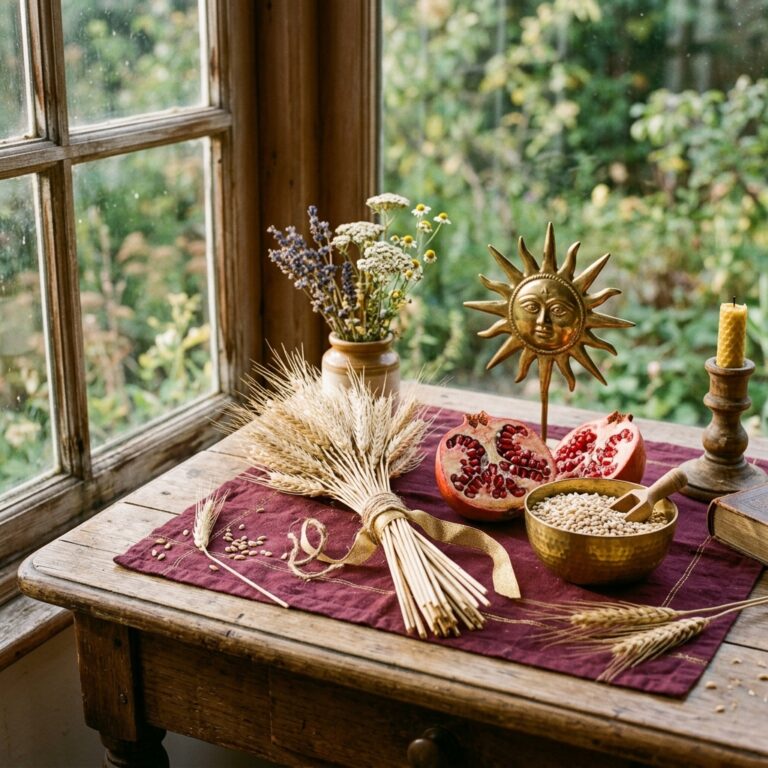
3. Set out a matching offering. Bread, grain, honey, fresh fruit or golden flowers fit harvest deities. Meanwhile, a lit candle or a bowl of water left in sunlight fits sun deities.
4. Speak your thanks. Following the chariot pattern above, thank the deity for their steady work. Then name what you hope to grow in the months ahead.
5. Return the offering respectfully. Afterwards, share food with others, compost it or leave it outdoors where it is safe to do so.
A few common mistakes are worth avoiding. First, try not to mix deities from different cultures in one ritual without learning how each was honored. Second, don’t treat living traditions, such as Shintō, as costume. Finally, if you live in the Southern Hemisphere, shift the timing to your own summer months.
Belief, Intention & The Power of Magic
Witchcraft, spells, and manifestation are deeply rooted in belief, intention, and spiritual practice. If these practices do not resonate with you, this may not be the path for you, and that’s perfectly okay. But if you believe in divine powers, trust your intentions, and feel drawn to the mysteries of the unseen, we invite you to continue exploring with Madame Celestine and discover the magic that speaks to your soul.
Summer Deities Beyond the Solstice
Summer deities are not only for June and July. Many practitioners keep a small sun image or a sheaf of grain on their altar all year. It works as a reminder that light and harvest return in their own time.
These figures also connect naturally to the land. For example, grain goddesses like Demeter and Ceres sit close to the earth goddesses and gods of soil and harvest, who carry the same story into autumn. Working with both can give your practice a full seasonal arc, from summer sun to stored grain.
Finally, remember that these deities came from real communities with real needs. They reflect people who watched the sky closely because their food depended on it. When you honor them, you also honor that long human effort to live with the seasons.
Frequently Asked Questions
Who is the Greek god of summer?
Helios, the sun who drove his chariot across the sky, is the most common answer. Apollo is also linked to the sun, because later Greeks increasingly treated him as a sun god.
Who is the goddess of summer?
No single goddess rules summer everywhere. Popular choices include Sól in Norse myth, Saule in Baltic tradition, Amaterasu in Japan and Demeter for the Greek harvest season.
Which summer deities are linked to abundance?
Demeter, Ceres, Freyr and Lugh are the clearest abundance figures. They are tied to grain, fertility and the start of the harvest rather than to the sun itself.
Can I honor summer deities from different cultures together?
Many modern pagans do, but it helps to learn each deity’s own customs first. Honoring one figure at a time is often the most respectful place to start.
When is the best time to honor summer gods?
The summer solstice suits sun figures, while early August suits harvest figures. In the Southern Hemisphere, shift both dates to your own summer.
References
- Helios | Myths, History, & Facts. Encyclopaedia Britannica. https://www.britannica.com/topic/Helios-Greek-god
- Surya | God, Meaning, & Hinduism. Encyclopaedia Britannica. https://www.britannica.com/topic/Surya
- The Prose Edda: Gylfaginning, translated by Arthur Gilchrist Brodeur. Internet Sacred Text Archive. https://sacred-texts.com/neu/pre/pre04.htm
- Amaterasu | Japanese Sun Goddess, Shintō Deity. Encyclopaedia Britannica. https://www.britannica.com/topic/Amaterasu
- The Sun Chariot. National Museum of Denmark. https://en.natmus.dk/historical-knowledge/denmark/prehistoric-period-until-1050-ad/the-bronze-age/the-sun-chariot/
- Freyr | God of Fertility, Harvest & Peace. Encyclopaedia Britannica. https://www.britannica.com/topic/Freyr
Not sure where to start? You don’t have to do this alone.
Madame Celestine offers guided spellwork for beginners — real support for your first working, not just another guide to read.
Related reading: Rosemary on the Doorstep: Old Protection and Luck Customs · Passed Over Twice? A Tarot Spread for Reading a Career Setback

About Wren Ashby
Wren Ashby is the pen name our editorial team uses for articles on sigils, Tarot and modern traditional witchcraft. Articles under this byline are researched from published sources and reviewed by Madame Celestine before publishing.